
Shrub traits of forest and shrubland reveal different
Shrub traits of forest and shrubland reveal different life strategies Jian Ni, Jiayu Cao, Quan Yuan College of Chemistry and Life Sciences Zhejiang Normal University, Jinhua, China Email: nijian@zjnu. edu. cn
Aims Shrub plants play important roles in both forest and shrubland ecosystems, but traits of shrub species have been less investigated. This study aims to explore the adaptation strategies of shrubs in different habitats by analyzing the differences of shrub functional traits in understory of forest communities and in two shrublands.
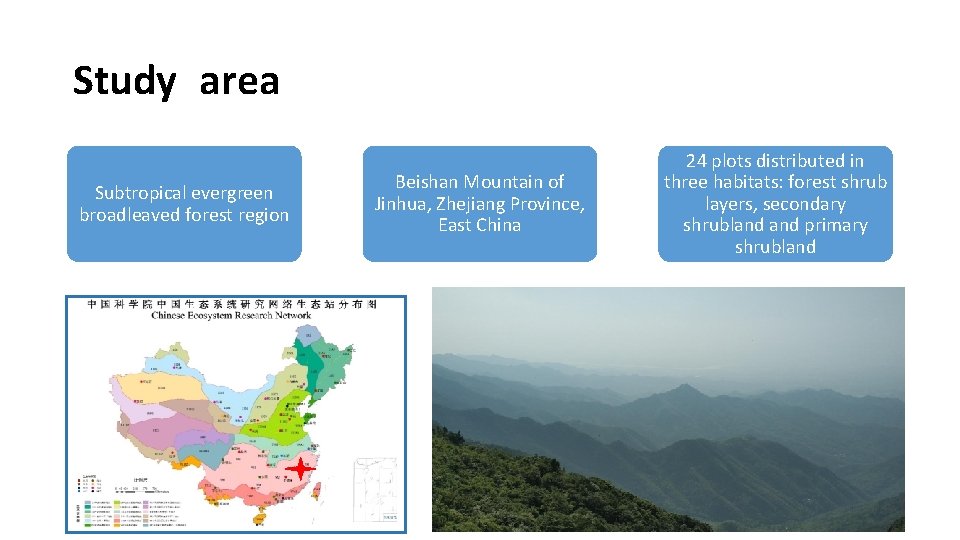
Study area Subtropical evergreen broadleaved forest region Beishan Mountain of Jinhua, Zhejiang Province, East China 24 plots distributed in three habitats: forest shrub layers, secondary shrubland primary shrubland

Study area Conifer forest Evergreen broadleaved forest Primary shrubland Evergreen and deciduous broadleaved mixed forest Deciduous broadleaved forest Secondary shrubland

Methods 9 functional traits of leaves and twigs 20 dominant shrub plants • Leaf area (LA) • Leaf thickness (LT) • Leaf tissue density (LTD) • Specific leaf area (SLA) • Leaf dry-matter content (LDMC) • Twig diameter (TD) • Twig bark thickness (TBT) • Twig tissue density (TTD) • Twig dry-matter content (TDMC)
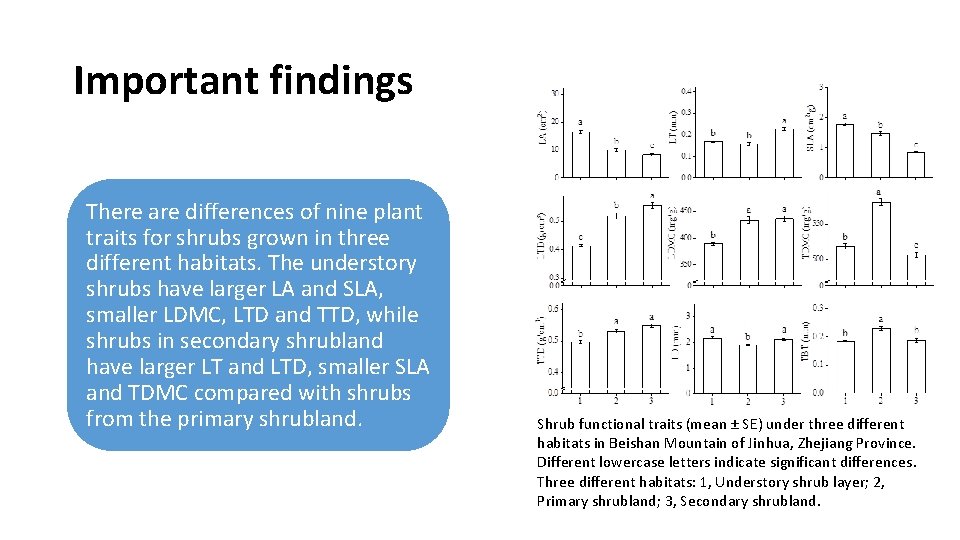
Important findings There are differences of nine plant traits for shrubs grown in three different habitats. The understory shrubs have larger LA and SLA, smaller LDMC, LTD and TTD, while shrubs in secondary shrubland have larger LT and LTD, smaller SLA and TDMC compared with shrubs from the primary shrubland. Shrub functional traits (mean ± SE) under three different habitats in Beishan Mountain of Jinhua, Zhejiang Province. Different lowercase letters indicate significant differences. Three different habitats: 1, Understory shrub layer; 2, Primary shrubland; 3, Secondary shrubland.
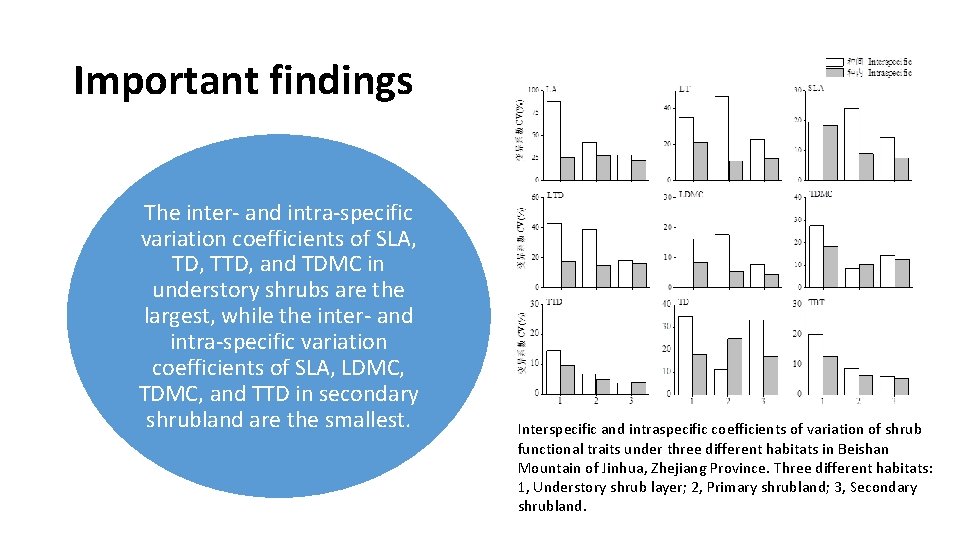
Important findings The inter- and intra-specific variation coefficients of SLA, TD, TTD, and TDMC in understory shrubs are the largest, while the inter- and intra-specific variation coefficients of SLA, LDMC, TDMC, and TTD in secondary shrubland are the smallest. Interspecific and intraspecific coefficients of variation of shrub functional traits under three different habitats in Beishan Mountain of Jinhua, Zhejiang Province. Three different habitats: 1, Understory shrub layer; 2, Primary shrubland; 3, Secondary shrubland.
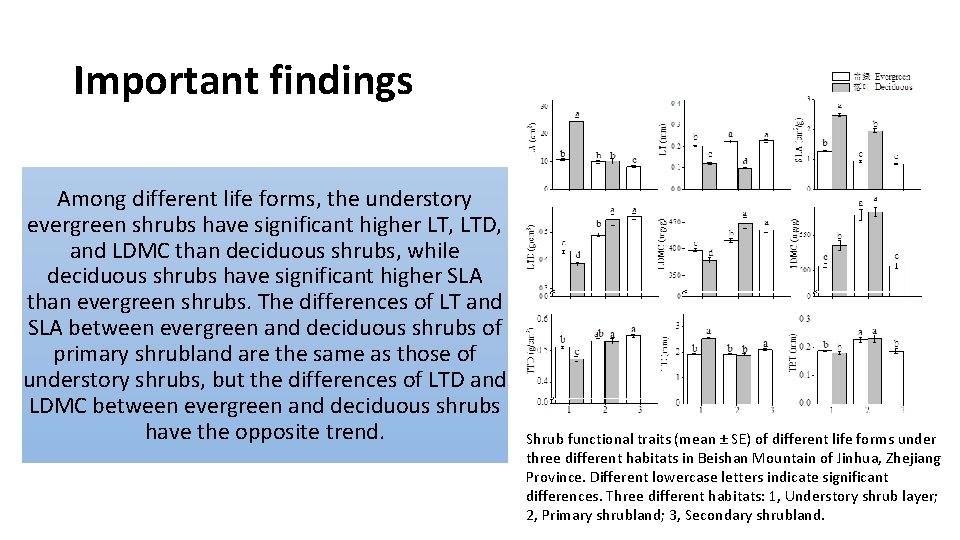
Important findings Among different life forms, the understory evergreen shrubs have significant higher LT, LTD, and LDMC than deciduous shrubs, while deciduous shrubs have significant higher SLA than evergreen shrubs. The differences of LT and SLA between evergreen and deciduous shrubs of primary shrubland are the same as those of understory shrubs, but the differences of LTD and LDMC between evergreen and deciduous shrubs have the opposite trend. Shrub functional traits (mean ± SE) of different life forms under three different habitats in Beishan Mountain of Jinhua, Zhejiang Province. Different lowercase letters indicate significant differences. Three different habitats: 1, Understory shrub layer; 2, Primary shrubland; 3, Secondary shrubland.
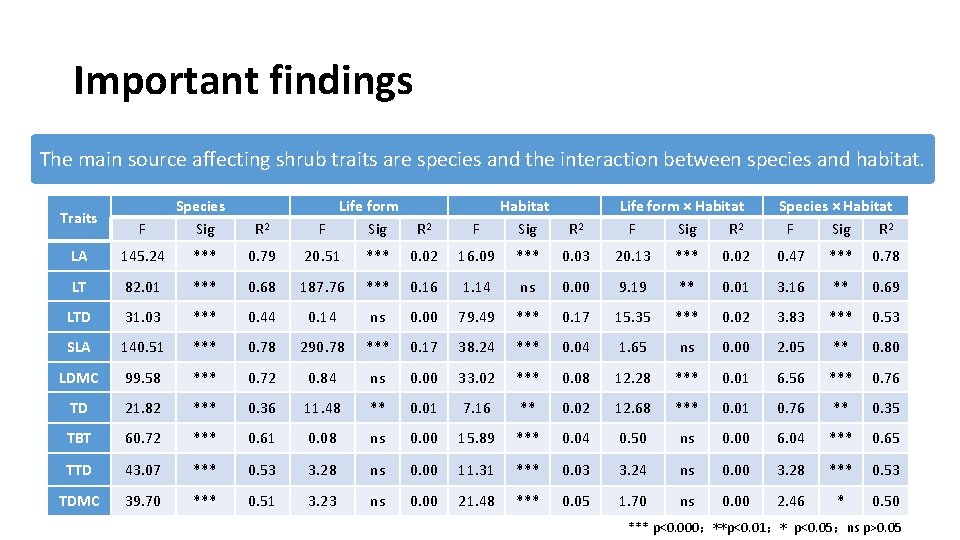
Important findings The main source affecting shrub traits are species and the interaction between species and habitat. Traits F Species Sig R 2 Life form F Sig R 2 F Habitat Sig R 2 Life form × Habitat F Sig R 2 Species × Habitat F Sig R 2 LA 145. 24 *** 0. 79 20. 51 *** 0. 02 16. 09 *** 0. 03 20. 13 *** 0. 02 0. 47 *** 0. 78 LT 82. 01 *** 0. 68 187. 76 *** 0. 16 1. 14 ns 0. 00 9. 19 ** 0. 01 3. 16 ** 0. 69 LTD 31. 03 *** 0. 44 0. 14 ns 0. 00 79. 49 *** 0. 17 15. 35 *** 0. 02 3. 83 *** 0. 53 SLA 140. 51 *** 0. 78 290. 78 *** 0. 17 38. 24 *** 0. 04 1. 65 ns 0. 00 2. 05 ** 0. 80 LDMC 99. 58 *** 0. 72 0. 84 ns 0. 00 33. 02 *** 0. 08 12. 28 *** 0. 01 6. 56 *** 0. 76 TD 21. 82 *** 0. 36 11. 48 ** 0. 01 7. 16 ** 0. 02 12. 68 *** 0. 01 0. 76 ** 0. 35 TBT 60. 72 *** 0. 61 0. 08 ns 0. 00 15. 89 *** 0. 04 0. 50 ns 0. 00 6. 04 *** 0. 65 TTD 43. 07 *** 0. 53 3. 28 ns 0. 00 11. 31 *** 0. 03 3. 24 ns 0. 00 3. 28 *** 0. 53 TDMC 39. 70 *** 0. 51 3. 23 ns 0. 00 21. 48 *** 0. 05 1. 70 ns 0. 00 2. 46 * 0. 50 *** p<0. 000;**p<0. 01;* p<0. 05;ns p>0. 05
Conclusions Compared to shrubs from shrublands, understory shrubs in forest communities form a series of trait combinations that are larger LA and SLA, smaller LTD, TTD and LDMC to grow faster to adapt to the understory environment with less light and stronger competition. This is a quick investment-return (resource acquisitive) strategy. Secondary shrubland primary shrubland have a series of shrub trait combinations that are larger LT, LTD LDMC and TTD, smaller LA, SLA to store more nutrients and grow slower. This is a slow investment-return (resource conservative) strategy. Different combinations of shrub functional traits and their various life strategies can provide guidance to the ecological restoration of degraded vegetation in the subtropical region of China.

Thank
- Slides: 11