
Showeet com Life cycle assessment for a sustainable
©Showeet. com Life cycle assessment for a sustainable agriculture Dr. Mª Dolores Gómez-López Dr. Silvia Martínez Ph. D. María Gabarrón Dr. Ángel Faz
INDEX 1. Introduction 2. What is Life cycle assessment? 3. Phases of the LCA 4. LCA methods Study case 1. Life cycle assessment of the wetland for slurry depuration Study case 2. Life cycle assessment of the use of pig slurry as fertilizer
1 INTRODUCTION Agriculture, like all human activity, involves an exploitation of the natural environment. The process of agrarian intensification of the last century has brought with it a series of environmental, and even social, impacts. Intensive agriculture, with the search for greater productivity, mainly in economic terms, has sometimes led to the limit of ecosystems.
1. INTRODUCTION One of the most important environmental challenges arising from the intensification of agriculture is the preservation of soil fertility, the main patrimony of the farmer. Agricultural sector contributes with almost 10% climate change of greenhouse gas emissions. Agriculture and the environment are not incompatible. Agriculture has been singled out by the EU as a key sector in halting the loss of biodiversity in 2020 (EC COM 2011). In the last decades, companies has made great efforts to improve its environmental behavior, including in the total cost of the product or service the costs associated, directly or indirectly, with the environmental impacts originated in the whole life cycle, the so-called eco-costs.
2 What is life cycle assessment? • Life Cycle Thinking is a way of thinking that includes the economic, environmental and social consequences of a product or process over its entire life cycle. • Life Cycle Thinking helps enterprises to understand improve their environmental performance and social performance, while maintaining or improving profits.
2. WHAT IS LIFE CYCLE ASSESSMENT? • Life Cycle Assessment (LCA) is a comprehensive life cycle approach that quantifies ecological and human health impacts of a product or system over its complete life cycle. • LCA uses credible scientific methods to model steady-state, global environmental and human health impacts. • LCA helps decision makers understand the scale of many environmental and human health impacts of competing products, services, policies or actions.
2. WHAT IS LIFE CYCLE ASSESSMENT? LCA is an environmental management tool to: • Apply a system-wide examination • Use a multi-media approach (air, water, solid waste) • Identify trade-offs among alternatives • Identify opportunities to improve systems • Support environmental decision making • Achieve sustainable development
2. WHAT IS LIFE CYCLE ASSESSMENT? There is a standardized tool for conducting a multi-media, cradle-to-grave assessment • ISO 14040 “Life Cycle Assessment – Principles and Framework” 1997 • ISO 14044 “Life Cycle Assessment – Requirements and Guidelines” 2006 * ISO – International Standards Organization
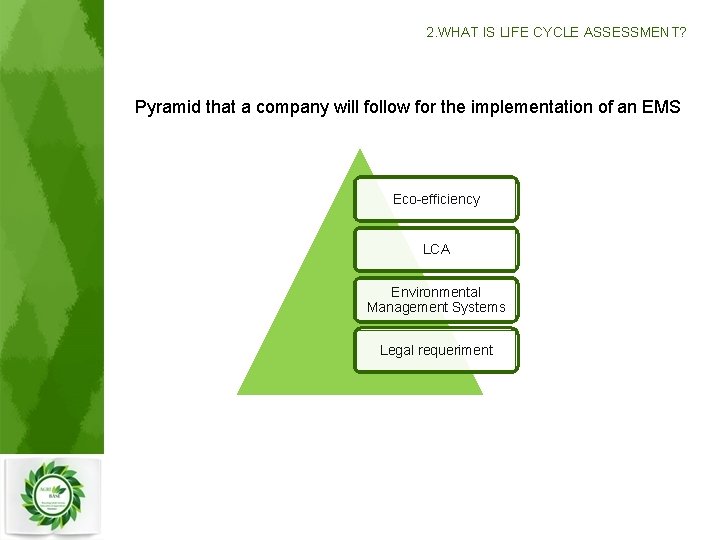
2. WHAT IS LIFE CYCLE ASSESSMENT? Pyramid that a company will follow for the implementation of an EMS Eco-efficiency LCA Environmental Management Systems Legal requeriment

3 PHASES OF THE LCA
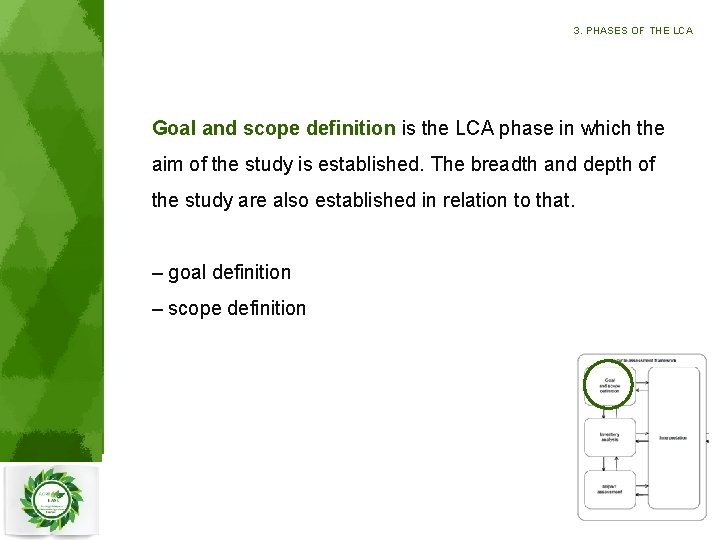
3. PHASES OF THE LCA Goal and scope definition is the LCA phase in which the aim of the study is established. The breadth and depth of the study are also established in relation to that. – goal definition – scope definition
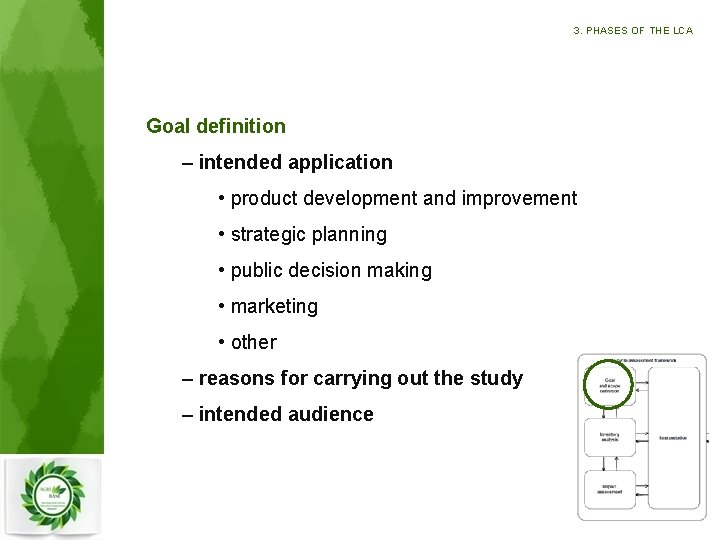
3. PHASES OF THE LCA Goal definition – intended application • product development and improvement • strategic planning • public decision making • marketing • other – reasons for carrying out the study – intended audience
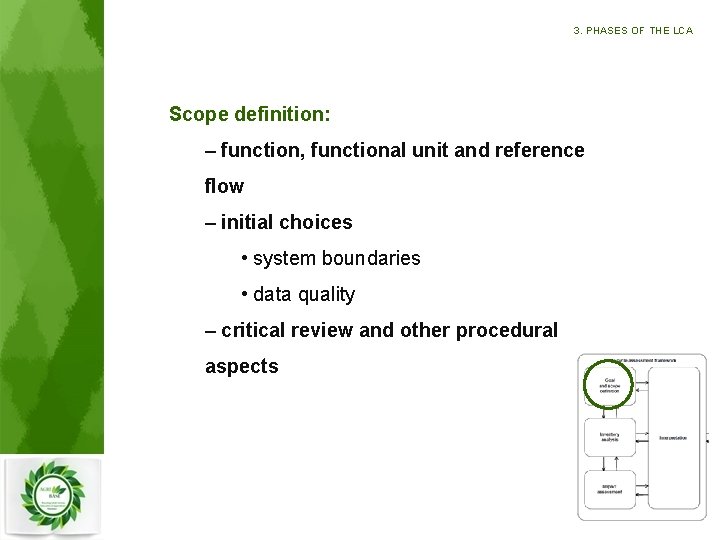
3. PHASES OF THE LCA Scope definition: – function, functional unit and reference flow – initial choices • system boundaries • data quality – critical review and other procedural aspects
3. PHASES OF THE LCA Functional unit – comparison on the basis of an equivalent function – example: 1000 liters of milk packed in glass bottles or packed in carton, instead of 1 glass bottle versus 1 carton
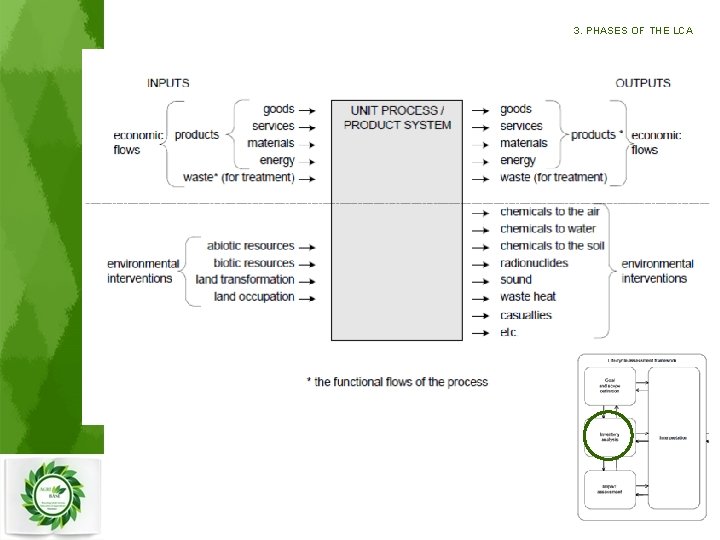
3. PHASES OF THE LCA Inventory data availability • ISO: Inventory Analysis is the LCA phase involving the compilation and quantification of inputs and outputs, for a given product system throughout its life cycle. • Steps: – preparing for data collection – data collection (both described in ISO 14041) – calculation procedures – allocation and recycling (both described in ISO 14042)
3. PHASES OF THE LCA • Data come from many different sources, such as: − Proprietary company data − Consultants, labs, universities − Public, e. g. , Toxics Release Inventory (EPA) • Databases use different units or different reference flows; report on different time periods • Often more than one source is needed to calculate the necessary inventory data • Data for new products must be estimated
3. PHASES OF THE LCA
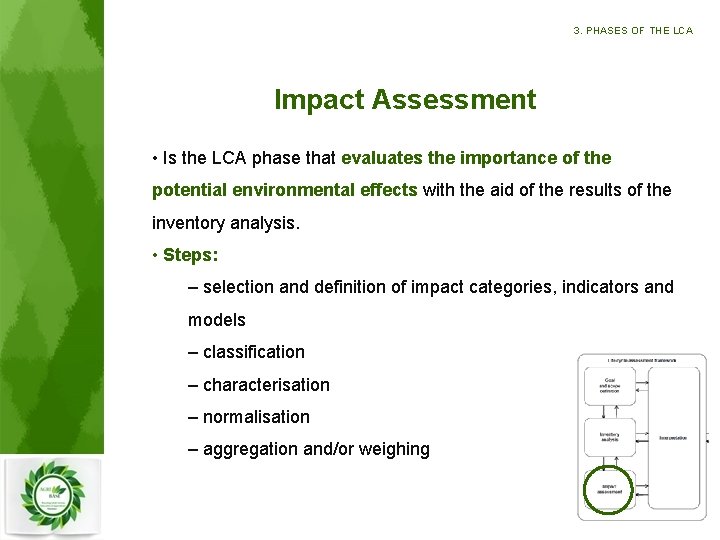
3. PHASES OF THE LCA Impact Assessment • Is the LCA phase that evaluates the importance of the potential environmental effects with the aid of the results of the inventory analysis. • Steps: – selection and definition of impact categories, indicators and models – classification – characterisation – normalisation – aggregation and/or weighing
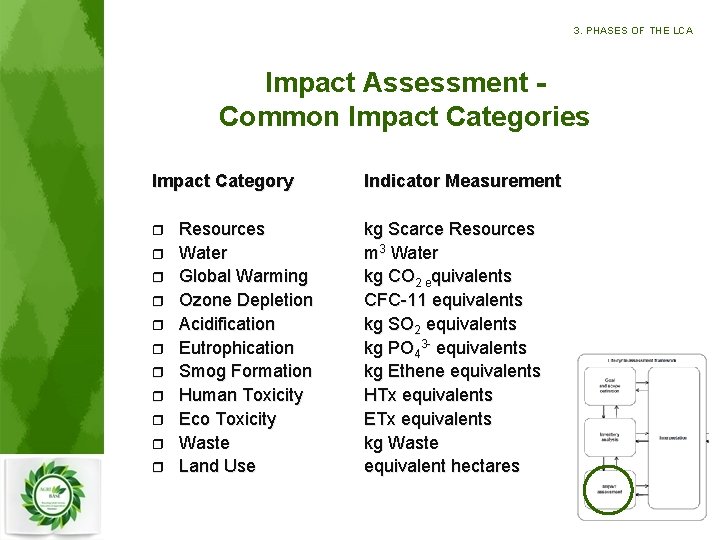
3. PHASES OF THE LCA Impact Assessment Common Impact Categories Impact Category r r r Resources Water Global Warming Ozone Depletion Acidification Eutrophication Smog Formation Human Toxicity Eco Toxicity Waste Land Use Indicator Measurement kg Scarce Resources m 3 Water kg CO 2 equivalents CFC-11 equivalents kg SO 2 equivalents kg PO 43 - equivalents kg Ethene equivalents HTx equivalents ETx equivalents kg Waste equivalent hectares
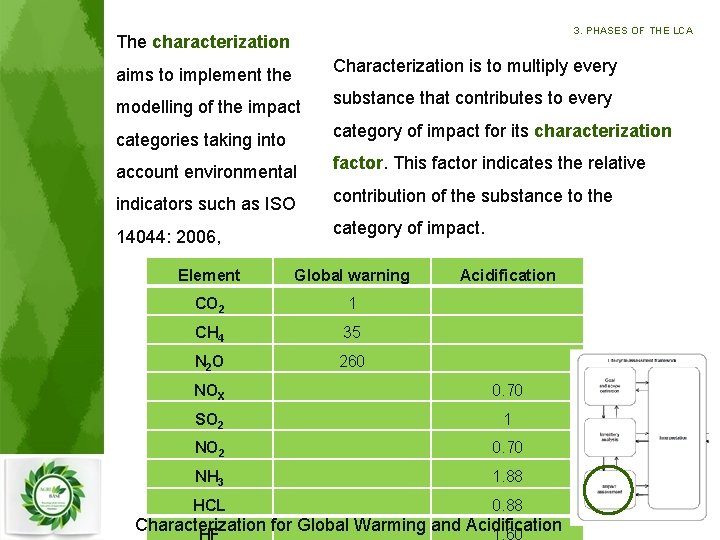
3. PHASES OF THE LCA The characterization aims to implement the Characterization is to multiply every modelling of the impact substance that contributes to every categories taking into category of impact for its characterization account environmental factor. This factor indicates the relative indicators such as ISO contribution of the substance to the 14044: 2006, category of impact. Element Global warning CO 2 1 CH 4 35 N 2 O 260 Acidification NOX 0. 70 SO 2 1 NO 2 0. 70 NH 3 1. 88 HCL 0. 88 Characterization for Global Warming and Acidification HF 1. 60
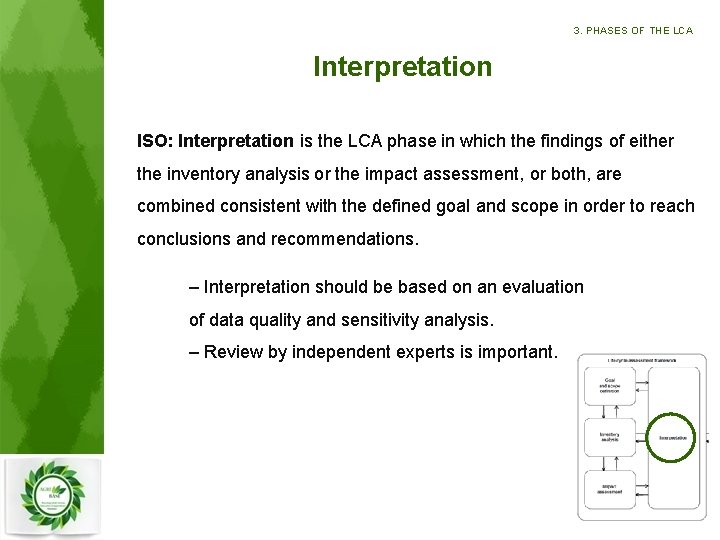
3. PHASES OF THE LCA Interpretation ISO: Interpretation is the LCA phase in which the findings of either the inventory analysis or the impact assessment, or both, are combined consistent with the defined goal and scope in order to reach conclusions and recommendations. – Interpretation should be based on an evaluation of data quality and sensitivity analysis. – Review by independent experts is important.
4 LCA Methods There are several methods and sowfware for conducting LCA that vary among countries, trends, categories of impact and characterization values within categories.
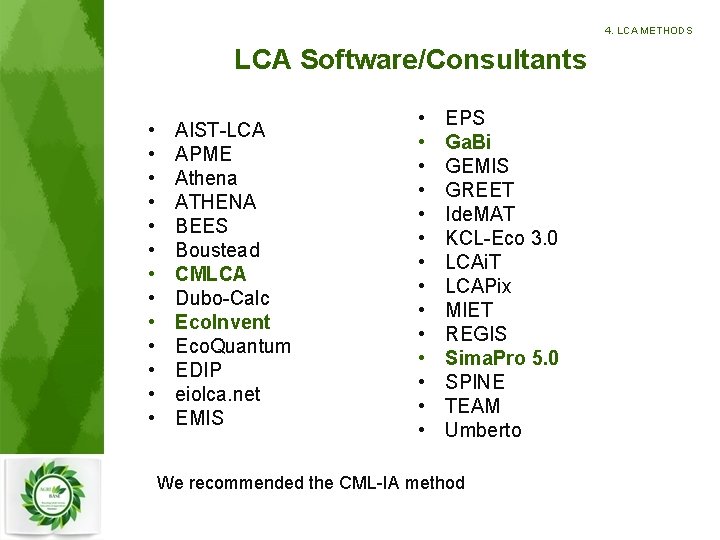
4. LCA METHODS LCA Software/Consultants • • • • AIST-LCA APME Athena ATHENA BEES Boustead CMLCA Dubo-Calc Eco. Invent Eco. Quantum EDIP eiolca. net EMIS • • • • EPS Ga. Bi GEMIS GREET Ide. MAT KCL-Eco 3. 0 LCAi. T LCAPix MIET REGIS Sima. Pro 5. 0 SPINE TEAM Umberto We recommended the CML-IA method
4. LCA METHODS The categories more used in agriculture are: Abiotic depletion. This impact category is concerned with the protection of human welfare, human health and ecosystem health. This impact category indicator is related to extraction of minerals and fossil fuels due to inputs in the system. The Abiotic Depletion Factor (ADF) is determined for each extraction of minerals and fossil fuels (kg antimony equivalents/kg extraction) based on concentration reserves and rate of de-accumulation. The geographic scope of this indicator is at global scale.
4. LCA METHODS Global warming. Climate change can result in adverse affections upon ecosystem health, human health and material welfare. Climate change is related to emissions of greenhouse gases to air. The characterization model as developed by the Intergovernmental Panel on Climate Change (IPCC) is selected for development of characterization factors. Factors are expressed as Global Warming Potential for time horizon 100 years (GWP 100), in kg carbon dioxide/kg emission. The geographic scope of this indicator is at global scale.
4. LCA METHODS Acidification. Acidifying substances cause a wide range of impacts on soil, groundwater, surface water, organisms, ecosystems and materials (buildings). Acidification Potential (AP) for emissions to air is calculated with the adapted RAINS 10 model, describing the fate and deposition of acidifying substances. AP is expressed as kg SO 2 equivalents/ kg emission. The time span is eternity and the geographical scale varies between local scale and continental scale.
4. LCA METHODS Eutrophication (also known as nitrification). It includes all impacts due to excessive levels of macro-nutrients in the environment caused by emissions of nutrients to air, water and soil. Nitrification potential (NP) is based on the stoichiometric procedure of Heijungs (1992), and expressed as kg PO 4 equivalents per kg emission. Fate and exposure is not included, time span is eternity, and the geographical scale varies between local and continental scale
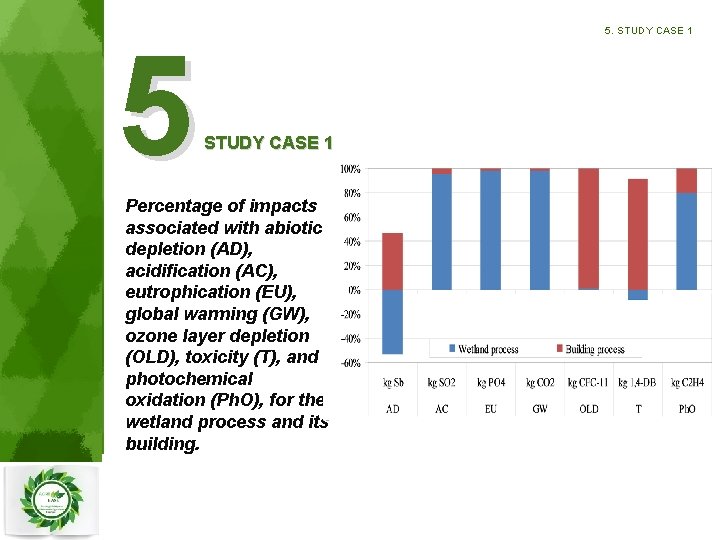
5 5. STUDY CASE 1 Percentage of impacts associated with abiotic depletion (AD), acidification (AC), eutrophication (EU), global warming (GW), ozone layer depletion (OLD), toxicity (T), and photochemical oxidation (Ph. O), for the wetland process and its building.
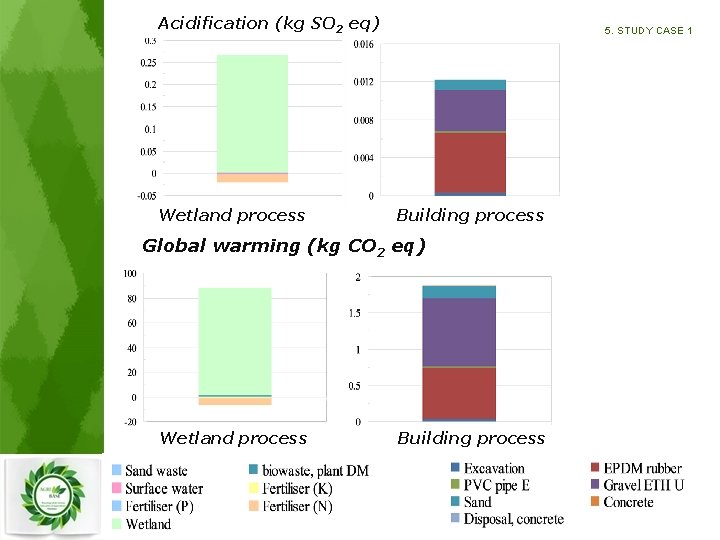
Acidification (kg SO 2 eq) Wetland process 5. STUDY CASE 1 Building process Global warming (kg CO 2 eq) Wetland process Building process
5. STUDY CASE 1 • The impacts associated to wetland process proved to be higher than those due to the construction, except for toxicity and abiotic depletion. • The quantitatively biggest impacts were due to emission of gases in the process, reflected in the categories of acidification and global warming.
5. STUDY CASE 1 • The high environmental benefit obtained with the reincorporation of the purified slurry to the ground and the consequent saving of mineral fertilizer caused that degradation of the waterproof plastic and building materials to be offset in the overall balance, particularly reflected in the toxicity and abiotic depletion impact categories. • For the wetland construction, the biggest impact was for the toxicity impact category, and it was associated with the waste generated (EPDM rubber, gravel and sand) as well as transport for its manufacture and recycling.
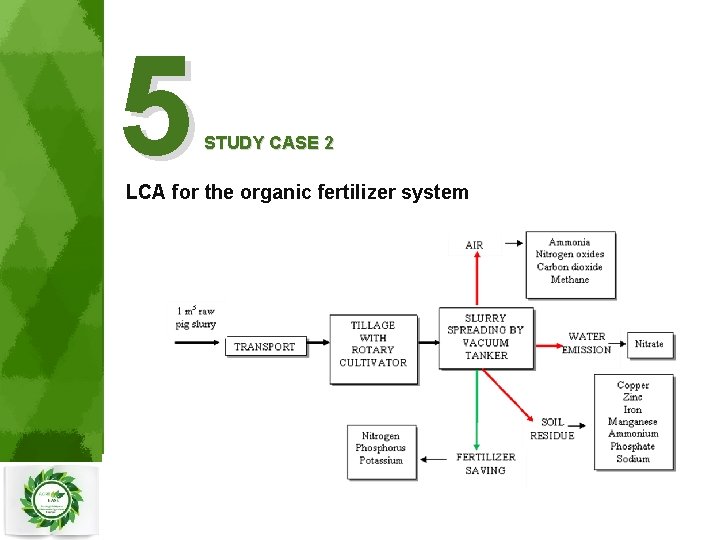
5 STUDY CASE 2 LCA for the organic fertilizer system
5. STUDY CASE 2 The use of pig slurry has been proposed as a field amendment due to its high mineral content, taking always into account the limits imposed by current legislation. The link established between breeder and farmer has been studied: breeder keeps the slurry pig into a reservoir, being later transferred to fields for its direct spreading. As it is well recognized, only a proportion of applied elements by fertilization are taken up by the crop, the remainder being dissipated in the atmosphere or leached into water. According to different authors, field absorption figures would be 60% for N, 100% for P and K, 90% for Ca and 25% for Mg.
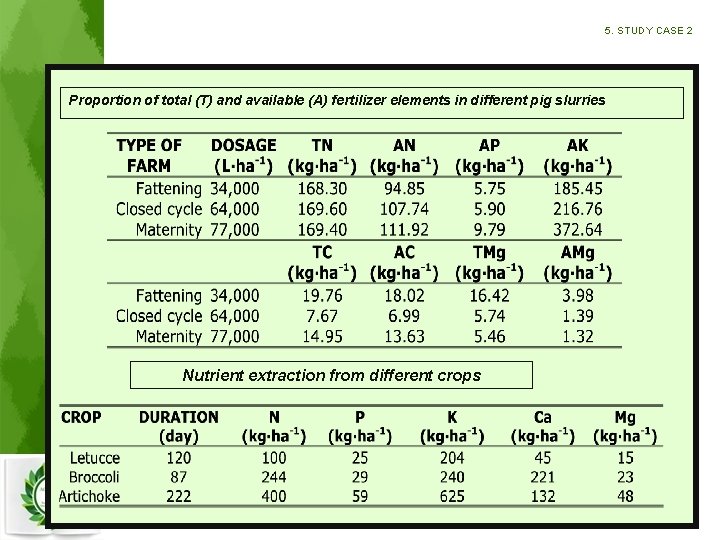
5. STUDY CASE 2 Proportion of total (T) and available (A) fertilizer elements in different pig slurries Nutrient extraction from different crops
5. STUDY CASE 2
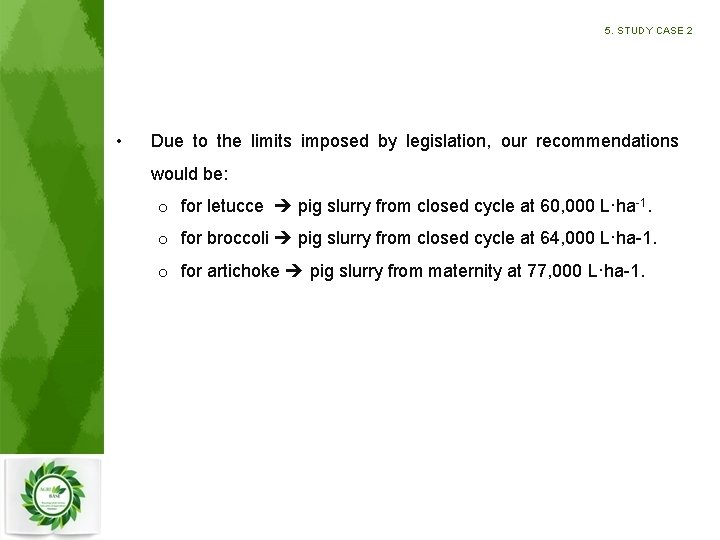
5. STUDY CASE 2 • Due to the limits imposed by legislation, our recommendations would be: o for letucce pig slurry from closed cycle at 60, 000 L·ha-1. o for broccoli pig slurry from closed cycle at 64, 000 L·ha-1. o for artichoke pig slurry from maternity at 77, 000 L·ha-1.
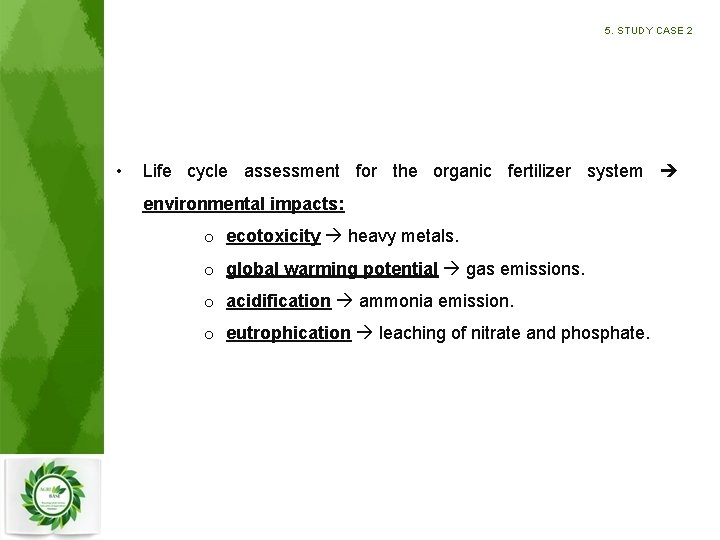
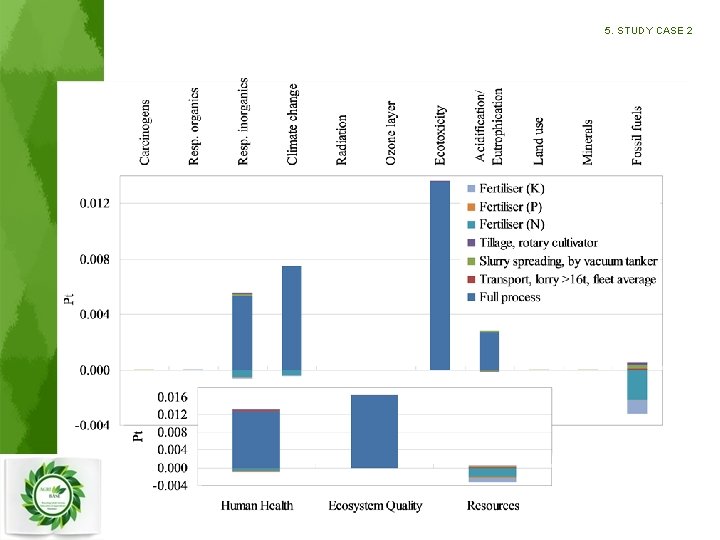
5. STUDY CASE 2 • Life cycle assessment for the organic fertilizer system environmental impacts: o ecotoxicity heavy metals. o global warming potential gas emissions. o acidification ammonia emission. o eutrophication leaching of nitrate and phosphate.
5. STUDY CASE 2 • Life cycle assessment for the organic fertilizer system positive effects: • decrease of inorganic fertilizer both environmental and economic save. • New approaches for pig slurry treatment in order to minimize leaching and emissions • use of wetlands and new field disposal systems for the minimization of atmospheric emissions.
Boosting Adult System Education In Agriculture – AGRI BASE Financed by: Partners:
- Slides: 39