
Show me what you know The play opens
- Slides: 43
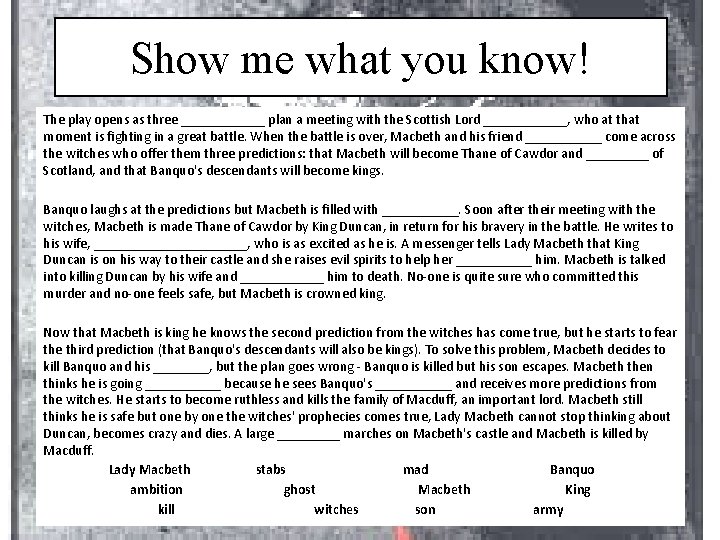
Show me what you know! The play opens as three ______ plan a meeting with the Scottish Lord ______, who at that moment is fighting in a great battle. When the battle is over, Macbeth and his friend ______ come across the witches who offer them three predictions: that Macbeth will become Thane of Cawdor and _____ of Scotland, and that Banquo's descendants will become kings. Banquo laughs at the predictions but Macbeth is filled with ______. Soon after their meeting with the witches, Macbeth is made Thane of Cawdor by King Duncan, in return for his bravery in the battle. He writes to his wife, ___________, who is as excited as he is. A messenger tells Lady Macbeth that King Duncan is on his way to their castle and she raises evil spirits to help her ______ him. Macbeth is talked into killing Duncan by his wife and ______ him to death. No-one is quite sure who committed this murder and no-one feels safe, but Macbeth is crowned king. Now that Macbeth is king he knows the second prediction from the witches has come true, but he starts to fear the third prediction (that Banquo's descendants will also be kings). To solve this problem, Macbeth decides to kill Banquo and his ____, but the plan goes wrong - Banquo is killed but his son escapes. Macbeth then thinks he is going ______ because he sees Banquo's ______ and receives more predictions from the witches. He starts to become ruthless and kills the family of Macduff, an important lord. Macbeth still thinks he is safe but one by one the witches' prophecies comes true, Lady Macbeth cannot stop thinking about Duncan, becomes crazy and dies. A large _____ marches on Macbeth's castle and Macbeth is killed by Macduff. Lady Macbeth stabs mad Banquo ambition ghost Macbeth King kill witches son army https: //www. youtube. com/watch? v=WZc. Fn. Z 2 ZMR 0
Exercise Book Your name English Teacher Set Stick in LP neatly. Leave a page – we will be sticking an overview of the year here.
Macbeth Year 11 Lesson 1
Eac
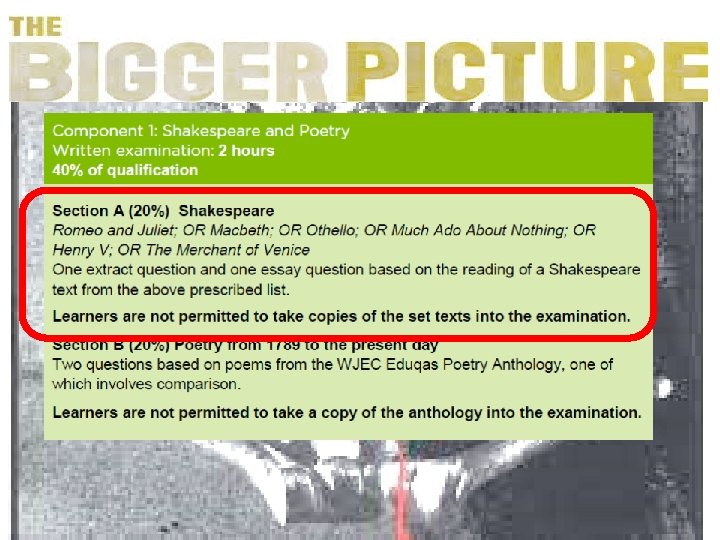
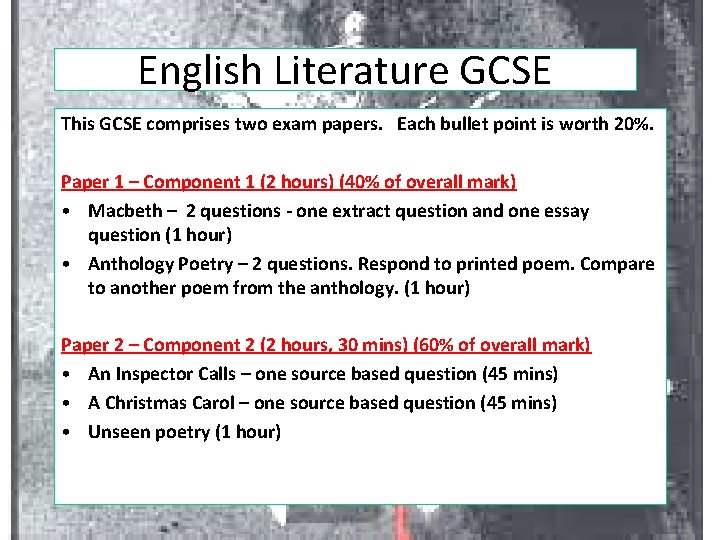
English Literature GCSE This GCSE comprises two exam papers. Each bullet point is worth 20%. Paper 1 – Component 1 (2 hours) (40% of overall mark) • Macbeth – 2 questions - one extract question and one essay question (1 hour) • Anthology Poetry – 2 questions. Respond to printed poem. Compare to another poem from the anthology. (1 hour) Paper 2 – Component 2 (2 hours, 30 mins) (60% of overall mark) • An Inspector Calls – one source based question (45 mins) • A Christmas Carol – one source based question (45 mins) • Unseen poetry (1 hour)
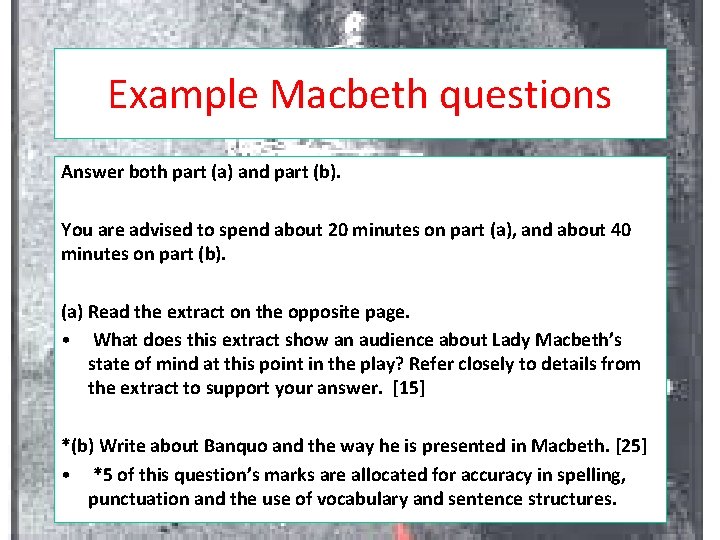
Example Macbeth questions Answer both part (a) and part (b). You are advised to spend about 20 minutes on part (a), and about 40 minutes on part (b). (a) Read the extract on the opposite page. • What does this extract show an audience about Lady Macbeth’s state of mind at this point in the play? Refer closely to details from the extract to support your answer. [15] *(b) Write about Banquo and the way he is presented in Macbeth. [25] • *5 of this question’s marks are allocated for accuracy in spelling, punctuation and the use of vocabulary and sentence structures.
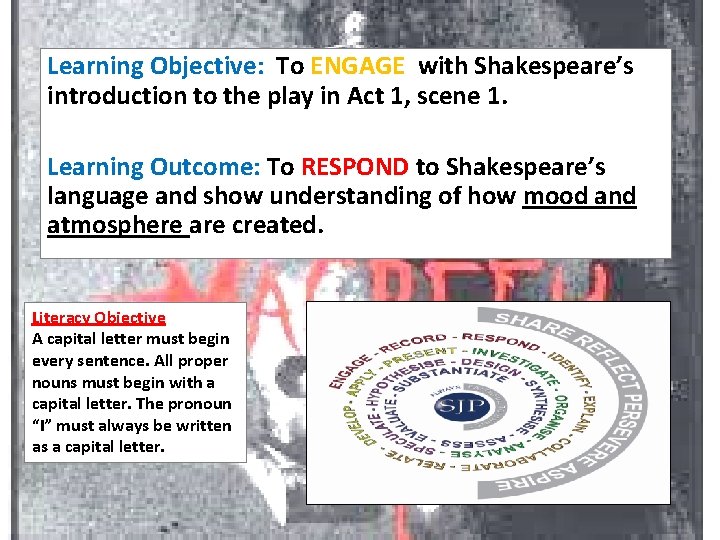
Learning Objective: To ENGAGE with Shakespeare’s introduction to the play in Act 1, scene 1. Learning Outcome: To RESPOND to Shakespeare’s language and show understanding of how mood and atmosphere are created. Literacy Objective A capital letter must begin every sentence. All proper nouns must begin with a capital letter. The pronoun “I” must always be written as a capital letter.
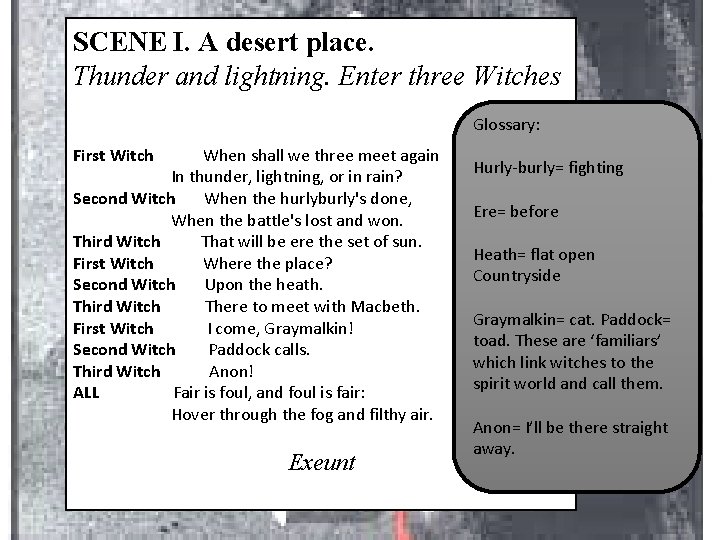
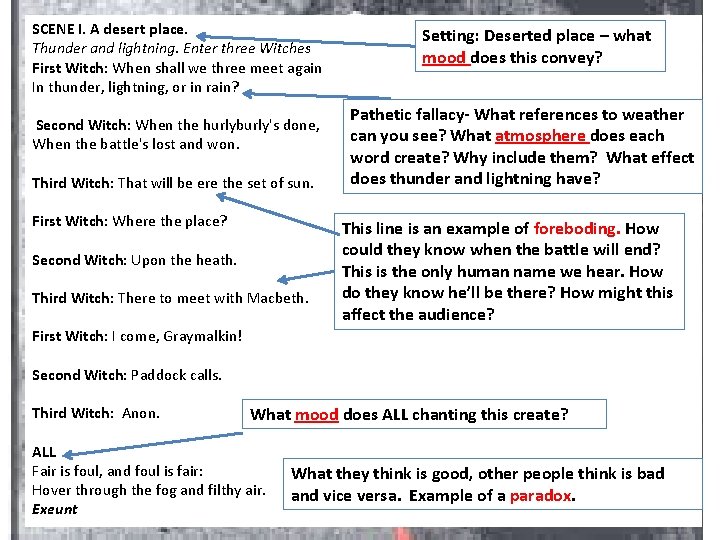
SCENE I. A desert place. Thunder and lightning. Enter three Witches Glossary: First Witch When shall we three meet again In thunder, lightning, or in rain? Second Witch When the hurlyburly's done, When the battle's lost and won. Third Witch That will be ere the set of sun. First Witch Where the place? Second Witch Upon the heath. Third Witch There to meet with Macbeth. First Witch I come, Graymalkin! Second Witch Paddock calls. Third Witch Anon! ALL Fair is foul, and foul is fair: Hover through the fog and filthy air. Exeunt Hurly-burly= fighting Ere= before Heath= flat open Countryside Graymalkin= cat. Paddock= toad. These are ‘familiars’ which link witches to the spirit world and call them. Anon= I’ll be there straight away.
SCENE I. A desert place. Thunder and lightning. Enter three Witches First Witch: When shall we three meet again In thunder, lightning, or in rain? Setting: Deserted place – what mood does this convey? Pathetic fallacy- What references to weather Second Witch: When the hurlyburly's done, can you see? What atmosphere does each When the battle's lost and won. word create? Why include them? What effect does thunder and lightning have? Third Witch: That will be ere the set of sun. First Witch: Where the place? This line is an example of foreboding. How could they know when the battle will end? Second Witch: Upon the heath. This is the only human name we hear. How do they know he’ll be there? How might this Third Witch: There to meet with Macbeth. affect the audience? First Witch: I come, Graymalkin! Second Witch: Paddock calls. Third Witch: Anon. What mood does ALL chanting this create? ALL Fair is foul, and foul is fair: What they think is good, other people think is bad Hover through the fog and filthy air. and vice versa. Example of a paradox. Exeunt
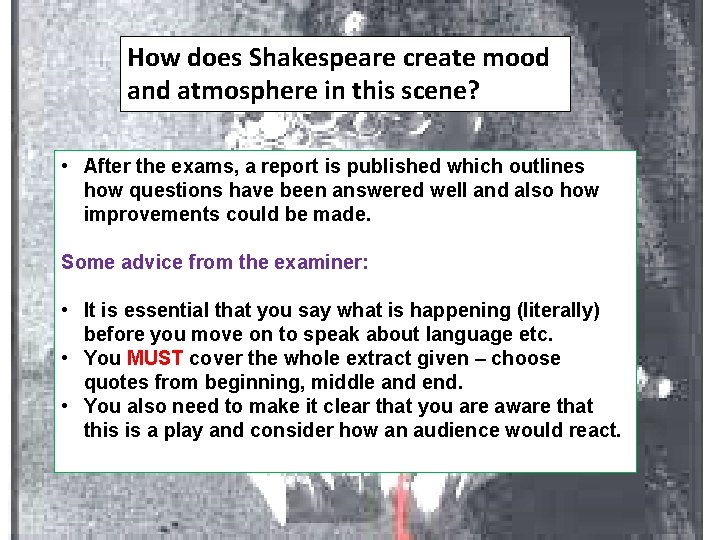
How does Shakespeare create mood and atmosphere in this scene? • After the exams, a report is published which outlines how questions have been answered well and also how improvements could be made. Some advice from the examiner: • It is essential that you say what is happening (literally) before you move on to speak about language etc. • You MUST cover the whole extract given – choose quotes from beginning, middle and end. • You also need to make it clear that you are aware that this is a play and consider how an audience would react.
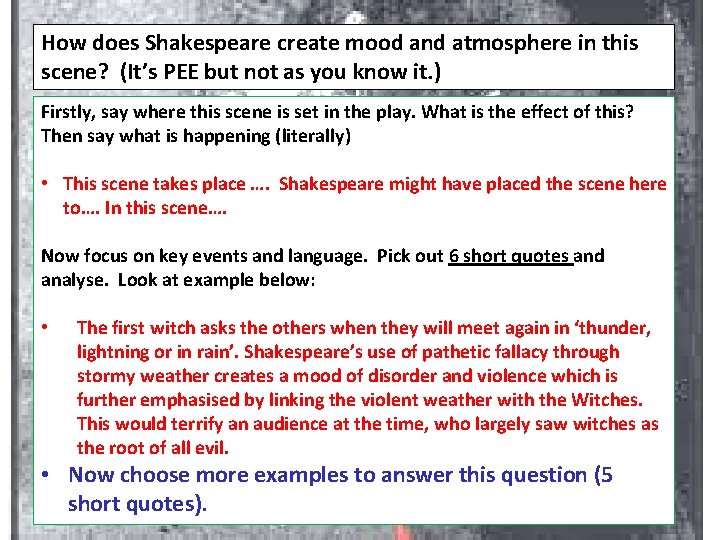
How does Shakespeare create mood and atmosphere in this scene? (It’s PEE but not as you know it. ) Firstly, say where this scene is set in the play. What is the effect of this? Then say what is happening (literally) • This scene takes place …. Shakespeare might have placed the scene here to…. In this scene…. Now focus on key events and language. Pick out 6 short quotes and analyse. Look at example below: • The first witch asks the others when they will meet again in ‘thunder, lightning or in rain’. Shakespeare’s use of pathetic fallacy through stormy weather creates a mood of disorder and violence which is further emphasised by linking the violent weather with the Witches. This would terrify an audience at the time, who largely saw witches as the root of all evil. • Now choose more examples to answer this question (5 short quotes).
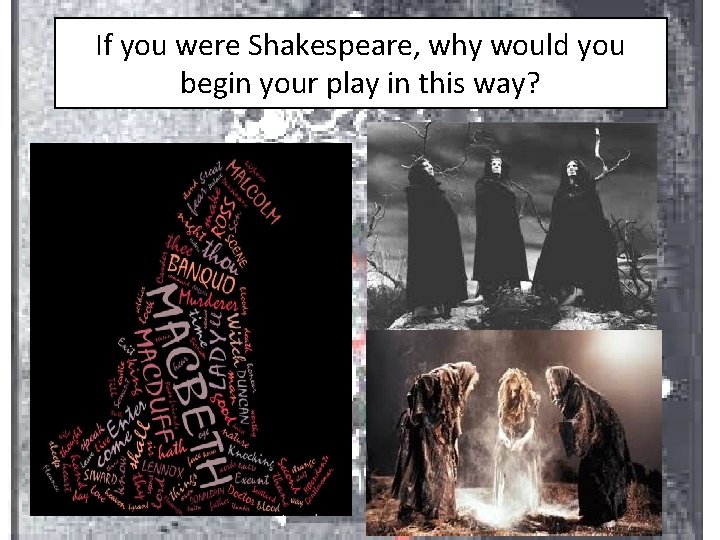
If you were Shakespeare, why would you begin your play in this way?
ENGLISH LITERATURE REVISION – 5 A DAY STARTER TASKS • You need to know WHOLE texts very well to succeed at English Literature GCSE. • At the beginning of lessons, you will complete a short task answering five questions. • You may not get all of them right at first but this will improve the more you do!
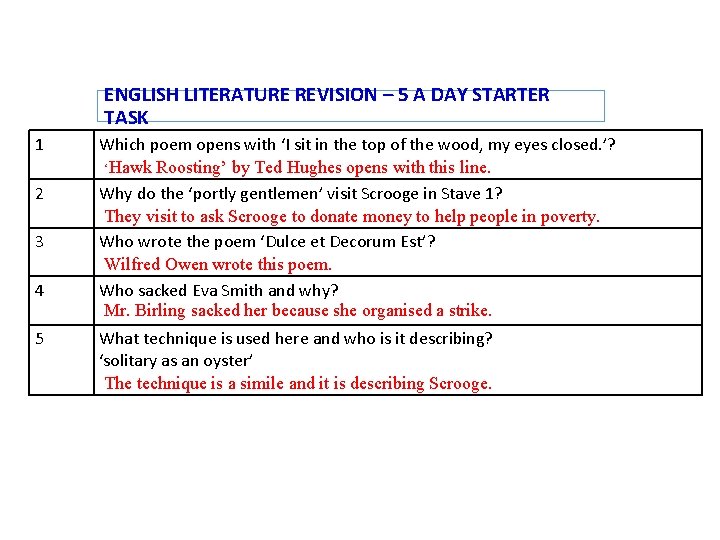
ENGLISH LITERATURE REVISION – 5 A DAY STARTER TASK 1 2 3 4 5 Which poem opens with ‘I sit in the top of the wood, my eyes closed. ’? ‘Hawk Roosting’ by Ted Hughes opens with this line. Why do the ‘portly gentlemen’ visit Scrooge in Stave 1? They visit to ask Scrooge to donate money to help people in poverty. Who wrote the poem ‘Dulce et Decorum Est’? Wilfred Owen wrote this poem. Who sacked Eva Smith and why? Mr. Birling sacked her because she organised a strike. What technique is used here and who is it describing? ‘solitary as an oyster’ The technique is a simile and it is describing Scrooge.
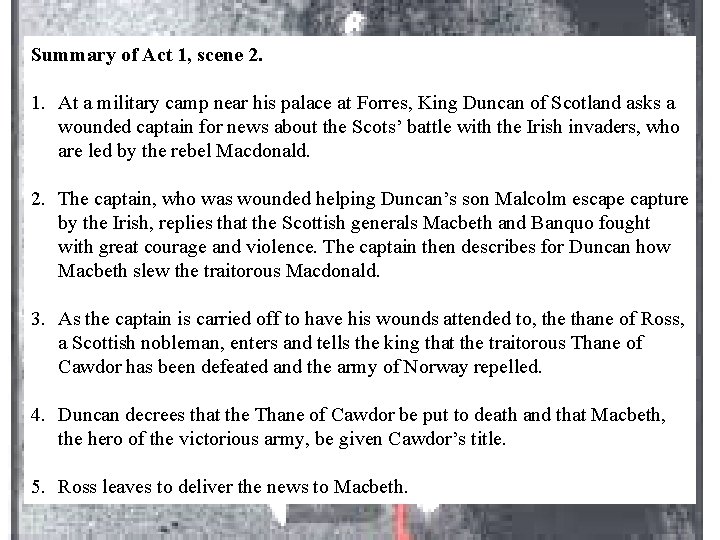
Summary of Act 1, scene 2. 1. At a military camp near his palace at Forres, King Duncan of Scotland asks a wounded captain for news about the Scots’ battle with the Irish invaders, who are led by the rebel Macdonald. 2. The captain, who was wounded helping Duncan’s son Malcolm escape capture by the Irish, replies that the Scottish generals Macbeth and Banquo fought with great courage and violence. The captain then describes for Duncan how Macbeth slew the traitorous Macdonald. 3. As the captain is carried off to have his wounds attended to, the thane of Ross, a Scottish nobleman, enters and tells the king that the traitorous Thane of Cawdor has been defeated and the army of Norway repelled. 4. Duncan decrees that the Thane of Cawdor be put to death and that Macbeth, the hero of the victorious army, be given Cawdor’s title. 5. Ross leaves to deliver the news to Macbeth.
Macbeth Year 11 LP 1/1 Lesson 2
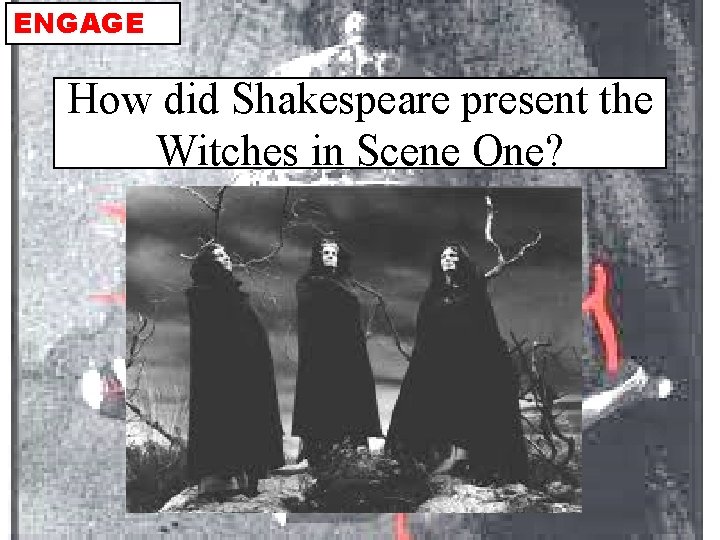
ENGAGE How did Shakespeare present the Witches in Scene One?
Learning Objective: • To INVESTIGATE the different reactions of Macbeth and Banquo to the witches. Learning Outcome: • To RESPOND to questions demonstrating secure understanding of Act 1, scene 3. Literacy Objective A capital letter must begin every sentence. All proper nouns must begin with a capital letter. The pronoun “I” must always be written as a capital letter.
Jacobean audiences. • When the play was first performed the audience The Jacobean was a very differently to us. would haveera reacted period of history which • coincides A Jacobean audience would have been afraid of with the rule of the witches. In the 16 th century people believed King James I (who watched athat lot ofwitches Shakespeare’s plays with the devil were real. and pacts first hand). • In fact, many innocent women were tortured and killed because people believed they were witches. • As we look at the scene in more detail we can see this fear and trepidation in the characters.
Now read Act One Scene 3 • AO 1 1. What are three prophecies made by the witches? 2. How does Macbeth react to the Witches? 3. How does Banquo react to the Witches? 4. Is Macbeth affected by their words to Banquo?
AO 2 FOCUS 1. Macbeth’s first words in the play remind us of the earlier words of the Witches. Why might Shakespeare be linking them here? 2. Banquo’s description of the Witches makes the scene sinister. Find evidence. 3. Macbeth uses imperatives when speaking to the Witches. What does this imply about his character? 4. How are their words slightly ambiguous? 5. Find evidence to show Banquo’s reaction to the Witches. 6. What does the term “horrible imaginings” reveal about Macbeth’s hidden side?
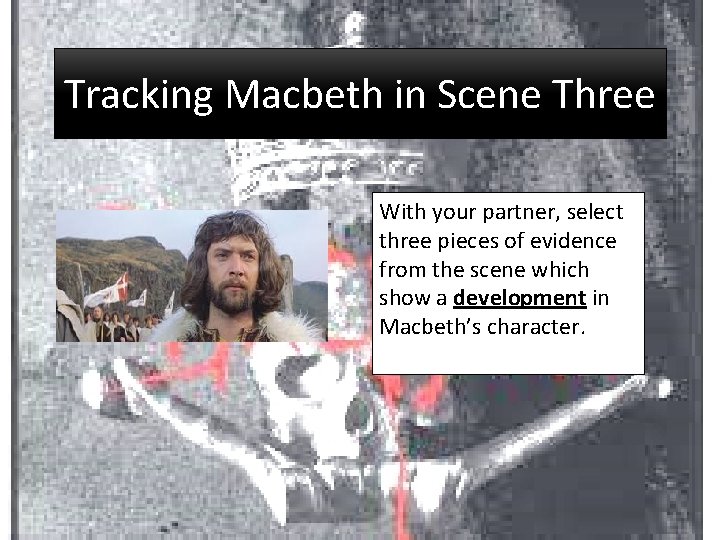
Tracking Macbeth in Scene Three With your partner, select three pieces of evidence from the scene which show a development in Macbeth’s character.
How does Shakespeare present Macbeth in Act One Scene Three? Write a short summary using evidence to show his character develops. Shakespeare initially presents Macbeth as ______ when he reacts to the witches by saying______. This implies ______. Remember: • Say literally what is happening; • Include relevant terminology (adjective, verb, simile, adverb…); • Comment on effect on audience.
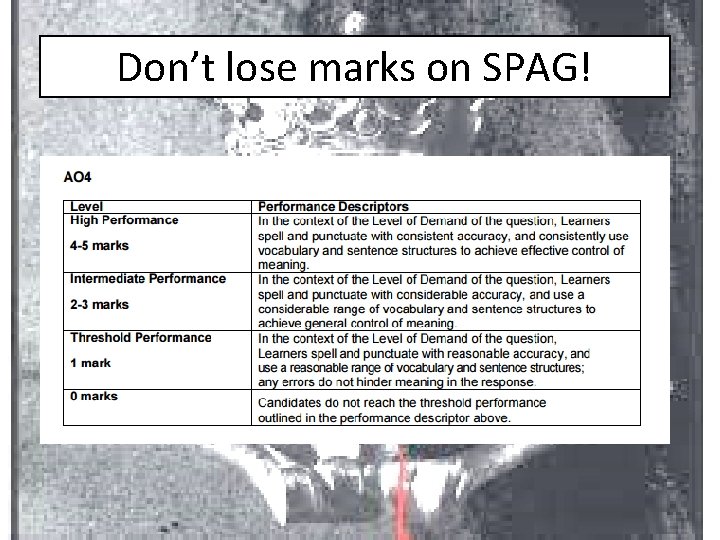
Don’t lose marks on SPAG!
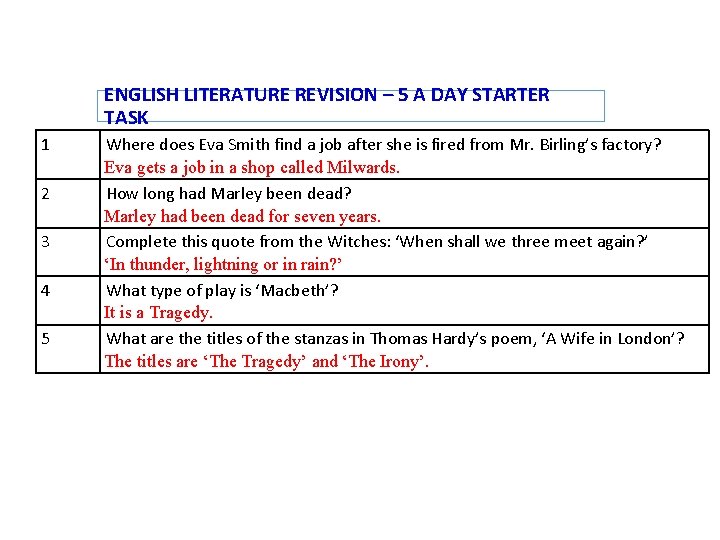
ENGLISH LITERATURE REVISION – 5 A DAY STARTER TASK 1 2 3 4 5 Where does Eva Smith find a job after she is fired from Mr. Birling’s factory? Eva gets a job in a shop called Milwards. How long had Marley been dead? Marley had been dead for seven years. Complete this quote from the Witches: ‘When shall we three meet again? ’ ‘In thunder, lightning or in rain? ’ What type of play is ‘Macbeth’? It is a Tragedy. What are the titles of the stanzas in Thomas Hardy’s poem, ‘A Wife in London’? The titles are ‘The Tragedy’ and ‘The Irony’.
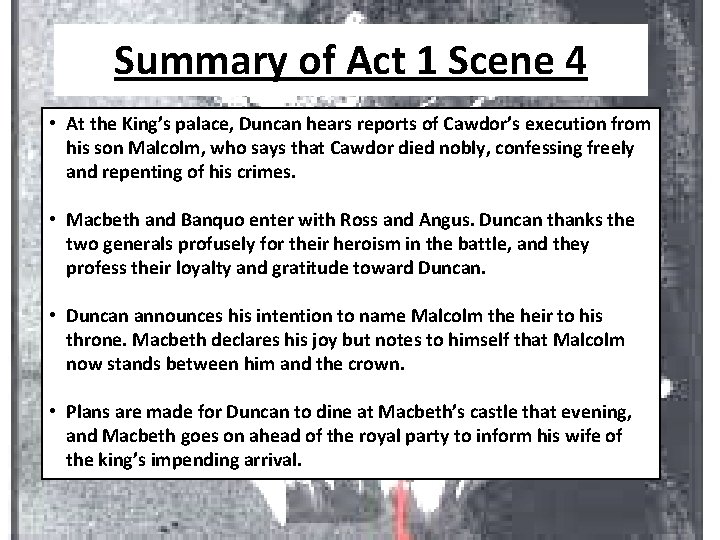
Summary of Act 1 Scene 4 • At the King’s palace, Duncan hears reports of Cawdor’s execution from his son Malcolm, who says that Cawdor died nobly, confessing freely and repenting of his crimes. • Macbeth and Banquo enter with Ross and Angus. Duncan thanks the two generals profusely for their heroism in the battle, and they profess their loyalty and gratitude toward Duncan. • Duncan announces his intention to name Malcolm the heir to his throne. Macbeth declares his joy but notes to himself that Malcolm now stands between him and the crown. • Plans are made for Duncan to dine at Macbeth’s castle that evening, and Macbeth goes on ahead of the royal party to inform his wife of the king’s impending arrival.
Macbeth Year 11 LP 1/1 Lesson 3
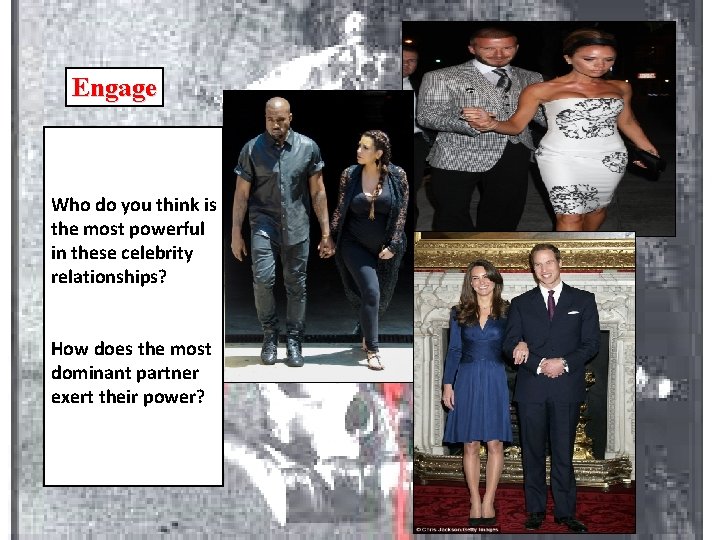
Engage Who do you think is the most powerful in these celebrity relationships? How does the most dominant partner exert their power?
Learning Objective: • To understand how to RESPOND effectively using short, embedded evidence to illustrate my points. Learning Outcome: • To EXPLAIN how Shakespeare introduces the character of Lady Macbeth using apt, short embedded quotes to illustrate my points. Literacy Objective A capital letter must begin every sentence. All proper nouns must begin with a capital letter. The pronoun “I” must always be written as a capital letter.
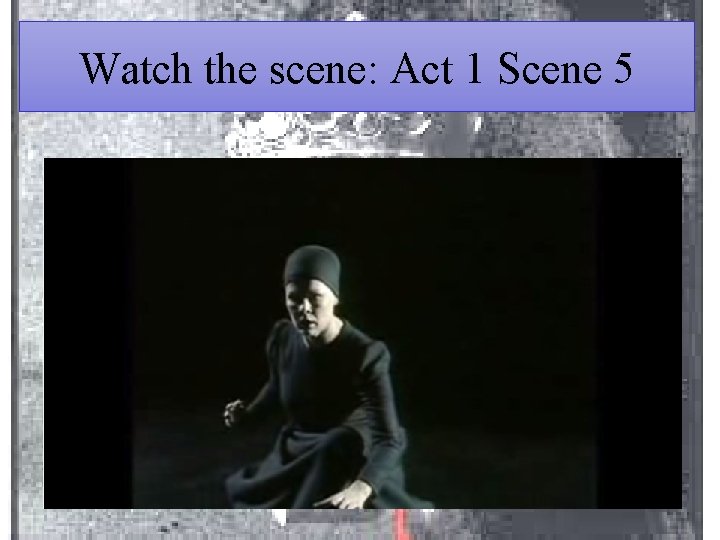
Watch the scene: Act 1 Scene 5
Now read Act One Scene Five AO 1 What does Macbeth tell his wife in his letter? What does she think about the news? What does she think about her husband’s character? What does she plan to do?
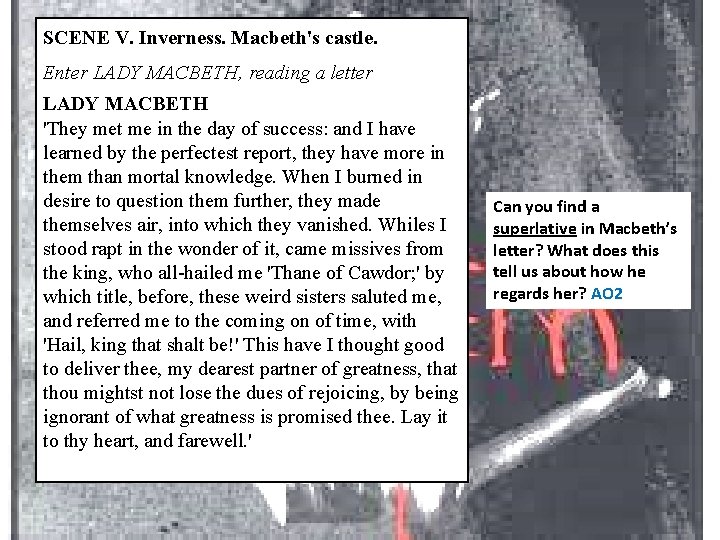
SCENE V. Inverness. Macbeth's castle. Enter LADY MACBETH, reading a letter LADY MACBETH 'They met me in the day of success: and I have learned by the perfectest report, they have more in them than mortal knowledge. When I burned in desire to question them further, they made themselves air, into which they vanished. Whiles I stood rapt in the wonder of it, came missives from the king, who all-hailed me 'Thane of Cawdor; ' by which title, before, these weird sisters saluted me, and referred me to the coming on of time, with 'Hail, king that shalt be!' This have I thought good to deliver thee, my dearest partner of greatness, that thou mightst not lose the dues of rejoicing, by being ignorant of what greatness is promised thee. Lay it to thy heart, and farewell. ' Can you find a superlative in Macbeth’s letter? What does this tell us about how he regards her? AO 2
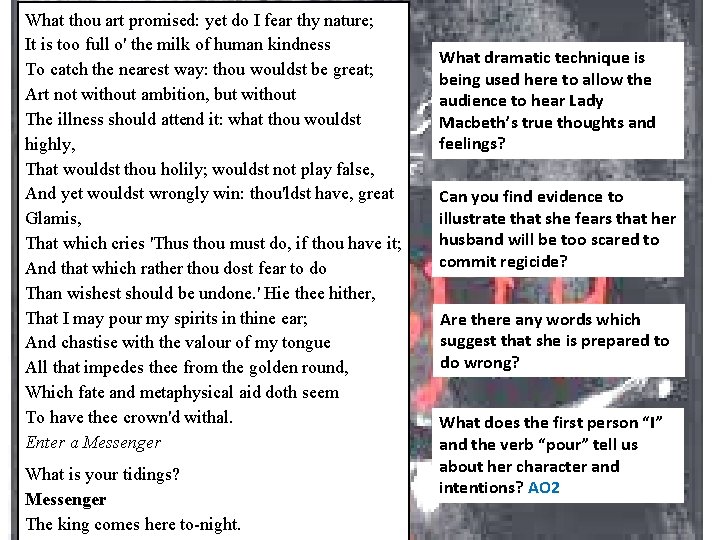
What thou art promised: yet do I fear thy nature; It is too full o' the milk of human kindness To catch the nearest way: thou wouldst be great; Art not without ambition, but without The illness should attend it: what thou wouldst highly, That wouldst thou holily; wouldst not play false, And yet wouldst wrongly win: thou'ldst have, great Glamis, That which cries 'Thus thou must do, if thou have it; And that which rather thou dost fear to do Than wishest should be undone. ' Hie thee hither, That I may pour my spirits in thine ear; And chastise with the valour of my tongue All that impedes thee from the golden round, Which fate and metaphysical aid doth seem To have thee crown'd withal. Enter a Messenger What is your tidings? Messenger The king comes here to-night. What dramatic technique is being used here to allow the audience to hear Lady Macbeth’s true thoughts and feelings? Can you find evidence to illustrate that she fears that her husband will be too scared to commit regicide? Are there any words which suggest that she is prepared to do wrong? What does the first person “I” and the verb “pour” tell us about her character and intentions? AO 2
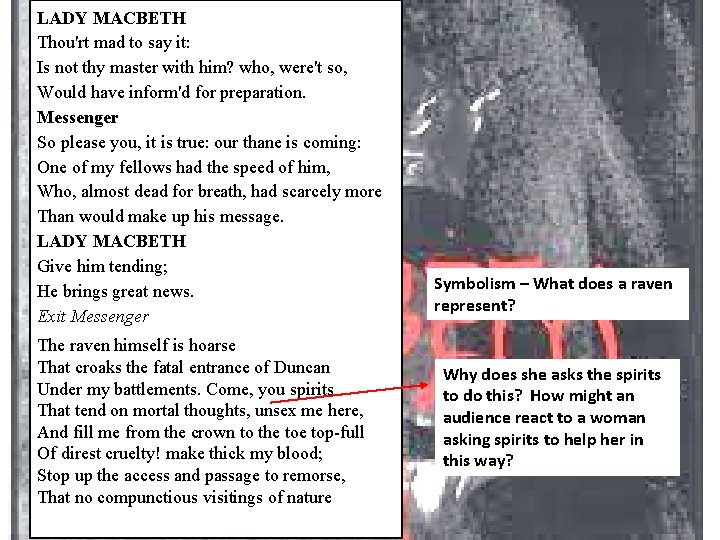
LADY MACBETH Thou'rt mad to say it: Is not thy master with him? who, were't so, Would have inform'd for preparation. Messenger So please you, it is true: our thane is coming: One of my fellows had the speed of him, Who, almost dead for breath, had scarcely more Than would make up his message. LADY MACBETH Give him tending; He brings great news. Exit Messenger The raven himself is hoarse That croaks the fatal entrance of Duncan Under my battlements. Come, you spirits That tend on mortal thoughts, unsex me here, And fill me from the crown to the top-full Of direst cruelty! make thick my blood; Stop up the access and passage to remorse, That no compunctious visitings of nature Symbolism – What does a raven represent? Why does she asks the spirits to do this? How might an audience react to a woman asking spirits to help her in this way?
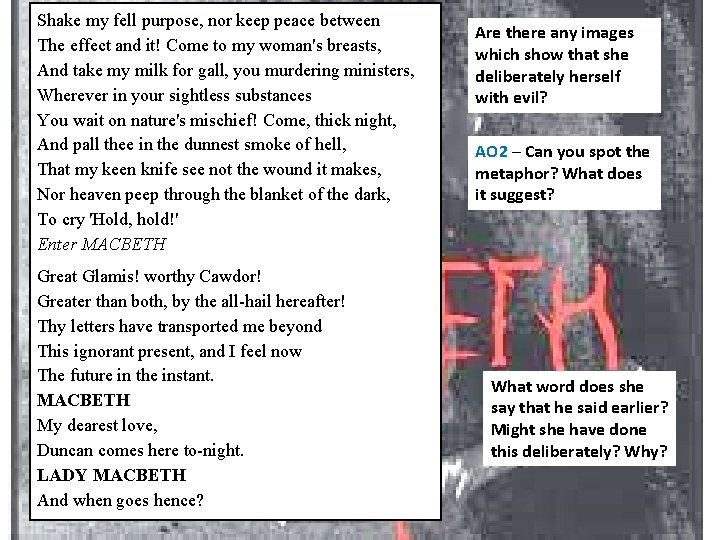
Shake my fell purpose, nor keep peace between The effect and it! Come to my woman's breasts, And take my milk for gall, you murdering ministers, Wherever in your sightless substances You wait on nature's mischief! Come, thick night, And pall thee in the dunnest smoke of hell, That my keen knife see not the wound it makes, Nor heaven peep through the blanket of the dark, To cry 'Hold, hold!' Enter MACBETH Great Glamis! worthy Cawdor! Greater than both, by the all-hail hereafter! Thy letters have transported me beyond This ignorant present, and I feel now The future in the instant. MACBETH My dearest love, Duncan comes here to-night. LADY MACBETH And when goes hence? Are there any images which show that she deliberately herself with evil? AO 2 – Can you spot the metaphor? What does it suggest? What word does she say that he said earlier? Might she have done this deliberately? Why?
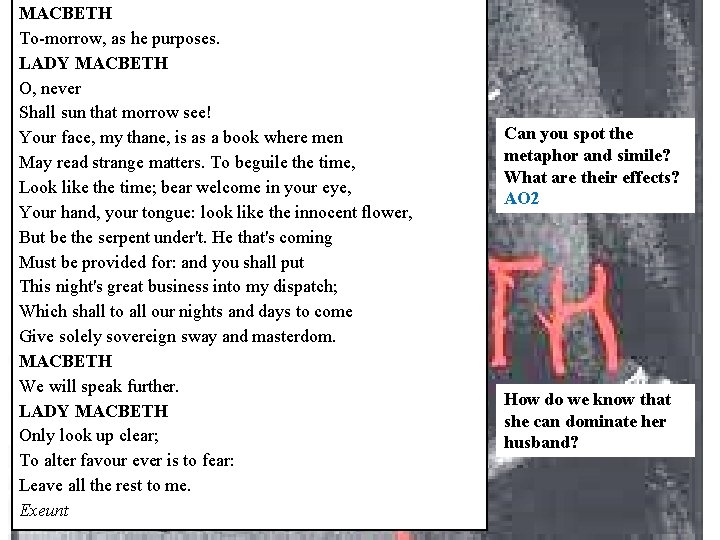
MACBETH To-morrow, as he purposes. LADY MACBETH O, never Shall sun that morrow see! Your face, my thane, is as a book where men May read strange matters. To beguile the time, Look like the time; bear welcome in your eye, Your hand, your tongue: look like the innocent flower, But be the serpent under't. He that's coming Must be provided for: and you shall put This night's great business into my dispatch; Which shall to all our nights and days to come Give solely sovereign sway and masterdom. MACBETH We will speak further. LADY MACBETH Only look up clear; To alter favour ever is to fear: Leave all the rest to me. Exeunt Can you spot the metaphor and simile? What are their effects? AO 2 How do we know that she can dominate her husband?
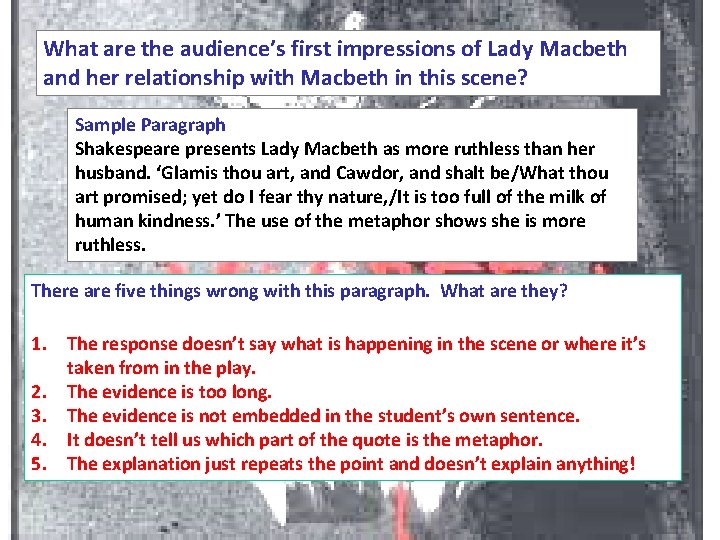
What are the audience’s first impressions of Lady Macbeth and her relationship with Macbeth in this scene? Sample Paragraph Shakespeare presents Lady Macbeth as more ruthless than her husband. ‘Glamis thou art, and Cawdor, and shalt be/What thou art promised; yet do I fear thy nature, /It is too full of the milk of human kindness. ’ The use of the metaphor shows she is more ruthless. There are five things wrong with this paragraph. What are they? 1. The response doesn’t say what is happening in the scene or where it’s taken from in the play. 2. The evidence is too long. 3. The evidence is not embedded in the student’s own sentence. 4. It doesn’t tell us which part of the quote is the metaphor. 5. The explanation just repeats the point and doesn’t explain anything!
What are the audience’s first impressions of Lady Macbeth and her relationship with Macbeth in this scene? In this scene, we are introduced to Lady Macbeth for the first time. She’s reading her husband’s letter which tells her about the Witches’ prophecies. Immediately, we discover how ruthless she is as she is worried that Macbeth won’t kill Duncan to become king. The metaphor ‘too full o’th’milk of human kindness’ to describe Macbeth reveals that she will stop at nothing to get what she wants but she fears that his conscience and ‘kindness’ might stop him. Shockingly for the audience her words imply that she wouldn’t hesitate, suggesting that she is evil. • • • Why is this better? TELLS US WHAT IS HAPPENING (LITERALLY); USES A SHORT QUOTE; EMBEDS THE QUOTE CORRECTLY; USES TERMINOLOGY CORRECTLY; EXPLAINS WHY SHE MIGHT BE ACTING THIS WAY/EFFECT ON AUDIENCE
What are the audience’s first impressions of Lady Macbeth and her relationship with Macbeth in this scene? Find evidence for each statement. • Lady Macbeth is linked to the witches. • Lady Macbeth is duplicitous (two-faced). • Lady Macbeth is dominant in her relationship with Macbeth. Now write your own response to the question above using these statements as your starting points. Model example In this scene, we are introduced to Lady Macbeth for the first time. She’s reading her husband’s letter which tells her about the Witches’ prophecies. Immediately, we discover how ruthless she is as she is worried that Macbeth won’t kill Duncan to become king. The metaphor ‘too full o’th’milk of human kindness’ to describe Macbeth reveals that she will stop at nothing to get what she wants but she fears that his conscience and ‘kindness’ could stop him. Shockingly for the audience her words imply that she wouldn’t hesitate, suggesting that she is evil.
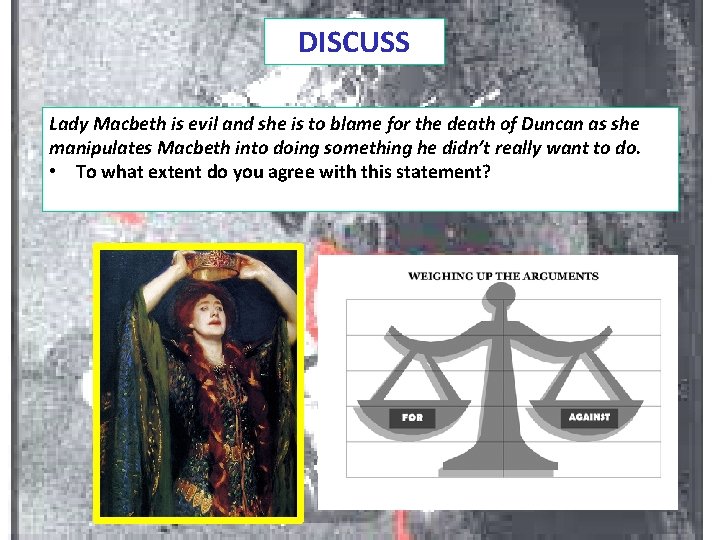
DISCUSS Lady Macbeth is evil and she is to blame for the death of Duncan as she manipulates Macbeth into doing something he didn’t really want to do. • To what extent do you agree with this statement?