
Show Me the Data The Power of Data



- Slides: 21
Show Me the Data! The Power of Data in Driving Education Change Presented by Susan Dawson President, E 3 Alliance www. e 3 alliance. org Twitter: #E 3 Alliance © 2014 E 3 Alliance
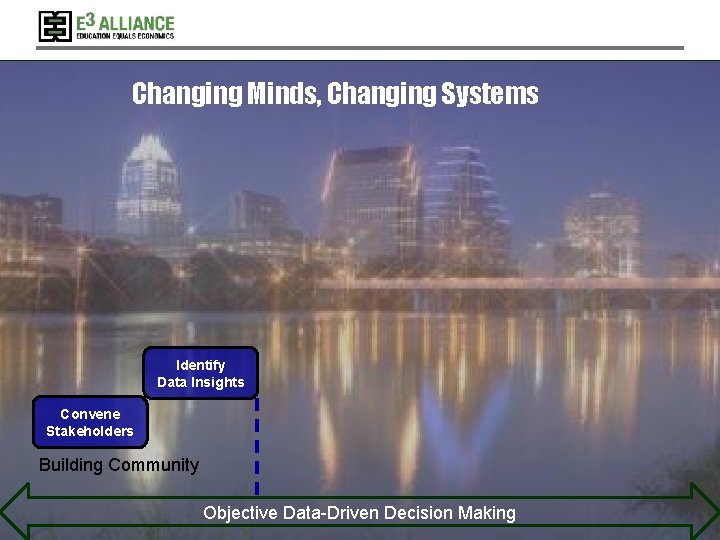
Changing Minds, Changing Systems Identify Data Insights Convene Stakeholders Building Community Objective Data-Driven Decision Making © 2014 E 3 Alliance
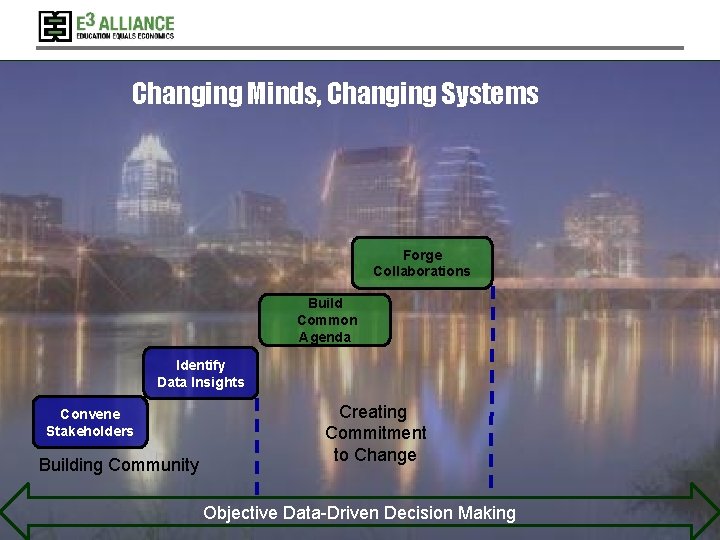
Changing Minds, Changing Systems Forge Collaborations Build Common Agenda Identify Data Insights Convene Stakeholders Building Community Creating Commitment to Change Objective Data-Driven Decision Making © 2014 E 3 Alliance
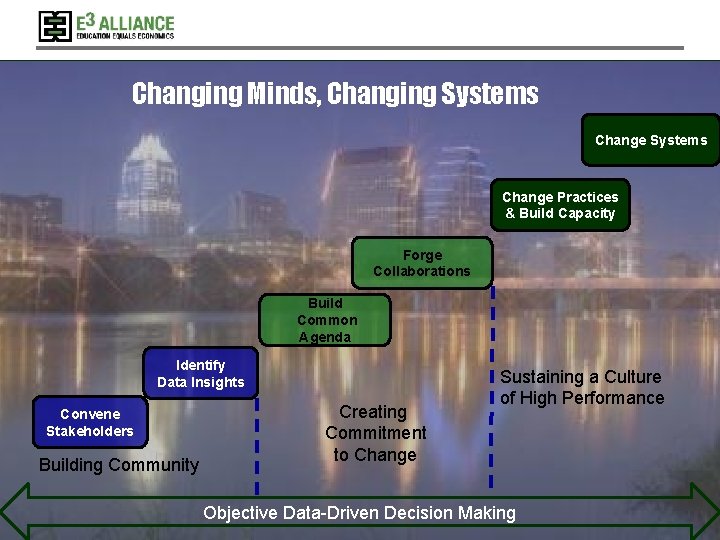
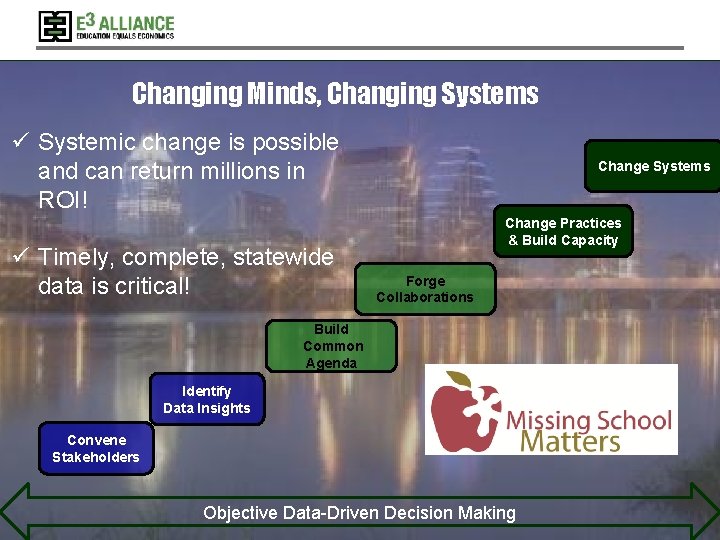
Changing Minds, Changing Systems Change Practices & Build Capacity Forge Collaborations Build Common Agenda Identify Data Insights Convene Stakeholders Building Community Creating Commitment to Change Sustaining a Culture of High Performance Objective Data-Driven Decision Making © 2014 E 3 Alliance
Central Texas Proof Points Span the Cradle to Career Continuum ü 500% Growth in STEM Pipeline ü 1 st standard for Kindergarten Readiness ü 1 st regional college persistence plan ü Replicable practices to improve outcomes for ELL’s © 2014 E 3 Alliance 5
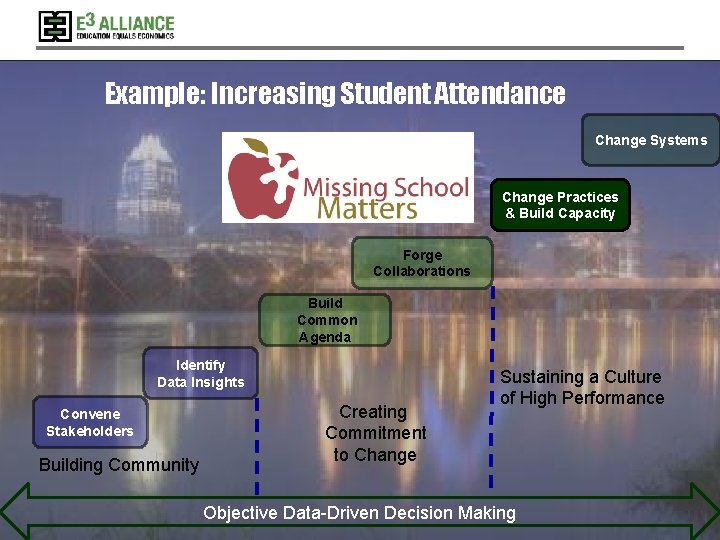
Example: Increasing Student Attendance Change Systems Change Practices & Build Capacity Forge Collaborations Build Common Agenda Identify Data Insights Convene Stakeholders Building Community Creating Commitment to Change Sustaining a Culture of High Performance Objective Data-Driven Decision Making © 2014 E 3 Alliance
Background • Superintendents said community can help increase attendance: 1. “Triple Bottom Line” benefit 2. Unlike teacher quality, communities can directly and positively impact • E 3 Alliance using powerful data to spearhead regional approach © 2014 E 3 Alliance
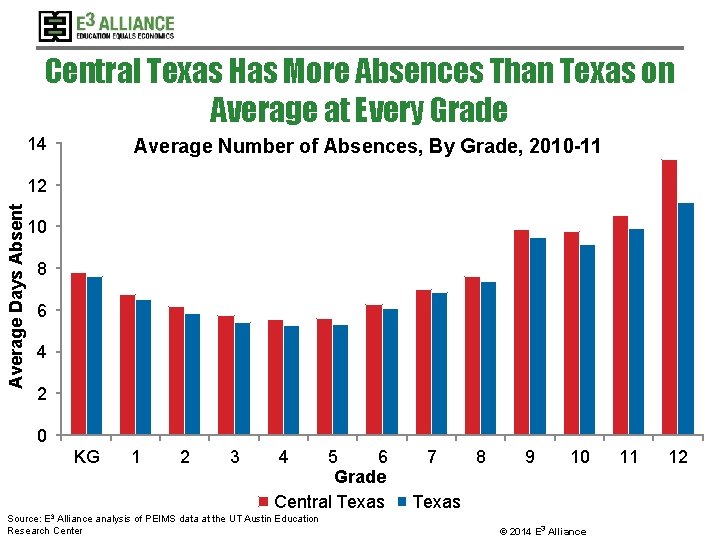
Central Texas Has More Absences Than Texas on Average at Every Grade 14 Average Number of Absences, By Grade, 2010 -11 Average Days Absent 12 10 8 6 4 2 0 KG 1 2 3 4 5 6 Grade Central Texas Source: E 3 Alliance analysis of PEIMS data at the UT Austin Education Research Center 7 8 9 10 Texas © 2014 E 3 Alliance 11 12
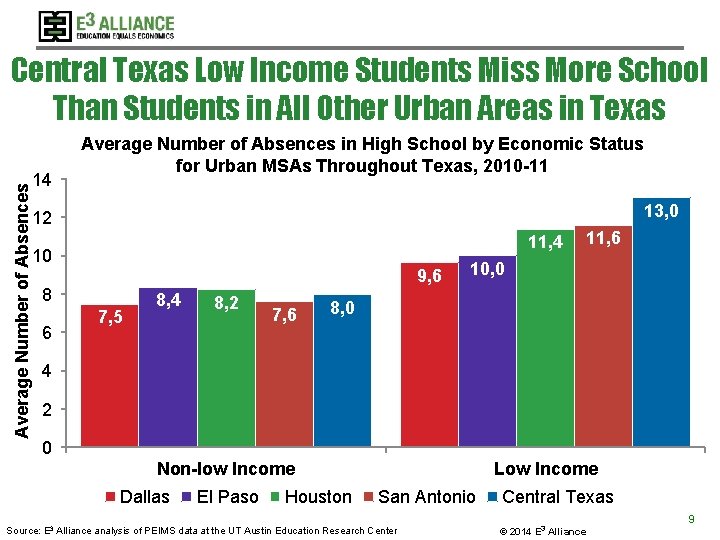
Average Number of Absences Central Texas Low Income Students Miss More School Than Students in All Other Urban Areas in Texas 14 Average Number of Absences in High School by Economic Status for Urban MSAs Throughout Texas, 2010 -11 13, 0 12 11, 4 10 9, 6 8 6 7, 5 8, 4 8, 2 7, 6 11, 6 10, 0 8, 0 4 2 0 Non-low Income Dallas El Paso Houston Low Income San Antonio Source: E 3 Alliance analysis of PEIMS data at the UT Austin Education Research Center Central Texas © 2014 E 3 Alliance 9
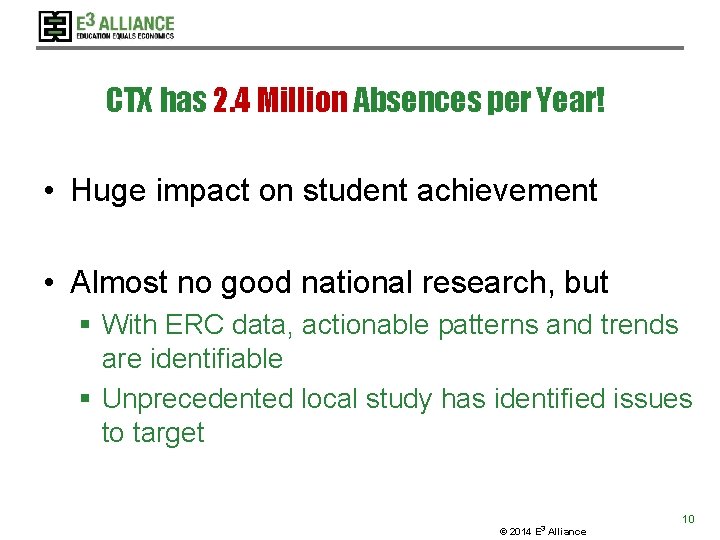
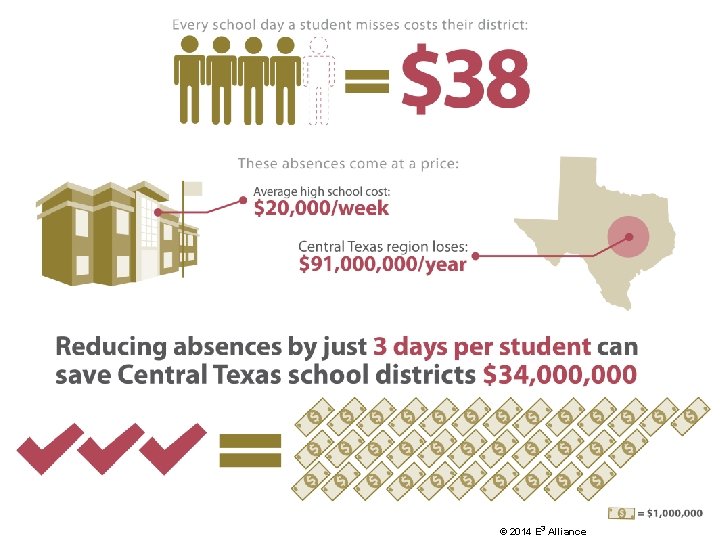
CTX has 2. 4 Million Absences per Year! • Huge impact on student achievement • Almost no good national research, but § With ERC data, actionable patterns and trends are identifiable § Unprecedented local study has identified issues to target © 2014 E 3 Alliance 10
© 2014 E 3 Alliance
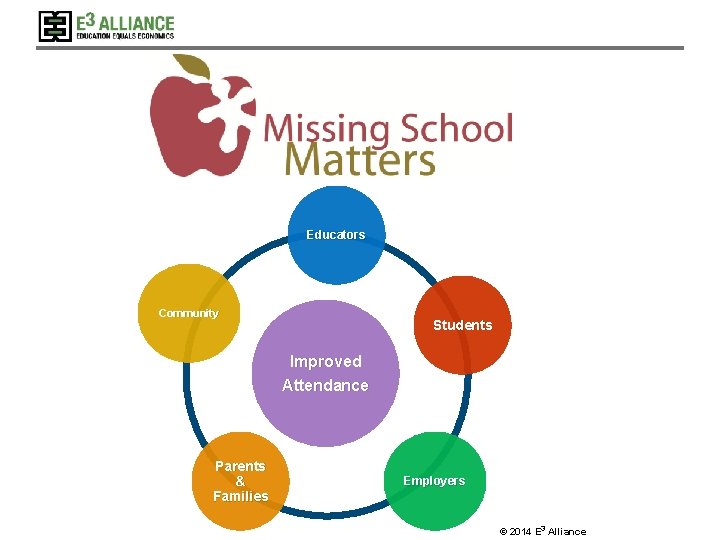
Educators Community Students Improved Attendance Parents & Families Employers © 2014 E 3 Alliance
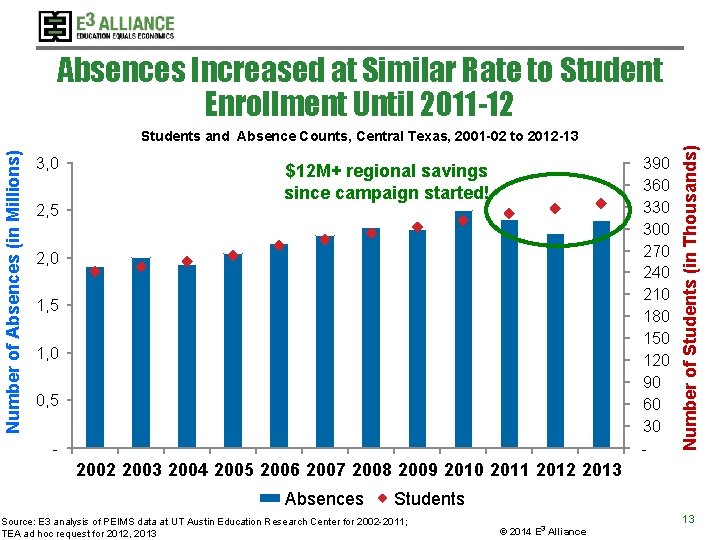
Absences Increased at Similar Rate to Student Enrollment Until 2011 -12 3, 0 2, 5 390 360 330 300 270 240 210 180 150 120 90 60 30 - $12 M+ regional savings since campaign started! 2, 0 1, 5 1, 0 0, 5 - Number of Students (in Thousands) Number of Absences (in Millions) Students and Absence Counts, Central Texas, 2001 -02 to 2012 -13 2002 2003 2004 2005 2006 2007 2008 2009 2010 2011 2012 2013 Absences Students Source: E 3 analysis of PEIMS data at UT Austin Education Research Center for 2002 -2011; TEA ad hoc request for 2012, 2013 © 2014 E 3 Alliance 13
Why are students absent and what can we do about it? © 2014 E 3 Alliance
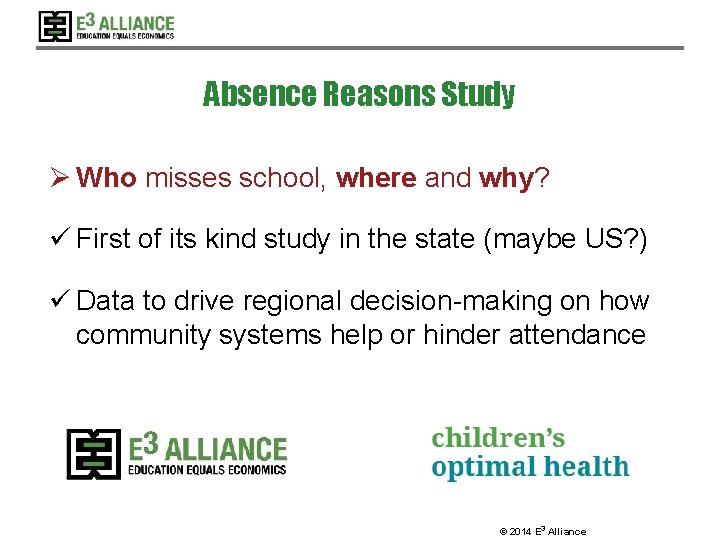
Absence Reasons Study Ø Who misses school, where and why? ü First of its kind study in the state (maybe US? ) ü Data to drive regional decision-making on how community systems help or hinder attendance © 2014 E 3 Alliance
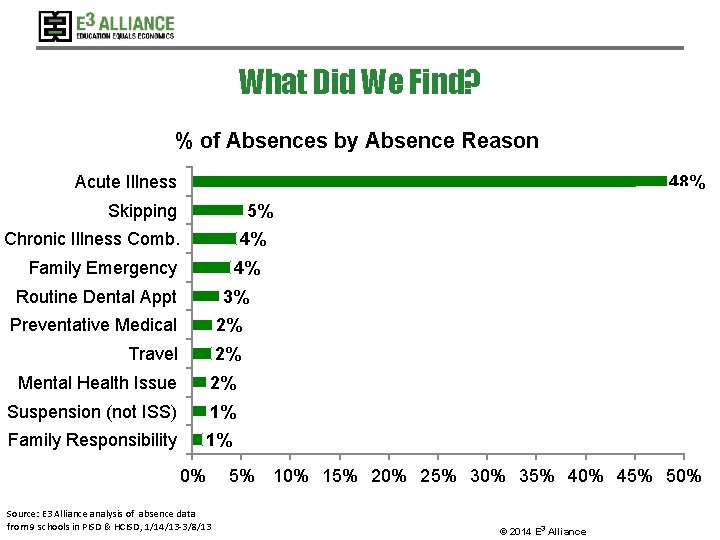
What Did We Find? % of Absences by Absence Reason Acute Illness 48% (8124) 5% (751) Skipping Chronic Illness Comb. 4% (707) Family Emergency 4% (654) Routine Dental Appt 3% (465) Preventative Medical 2% (352) Travel 2% (326) 2% (254) Mental Health Issue Suspension (not ISS) 1% (247) 1% (173) Family Responsibility 0% Source: E 3 Alliance analysis of absence data from 9 schools in PISD & HCISD, 1/14/13 -3/8/13 5% 10% 15% 20% 25% 30% 35% 40% 45% 50% © 2014 E 3 Alliance
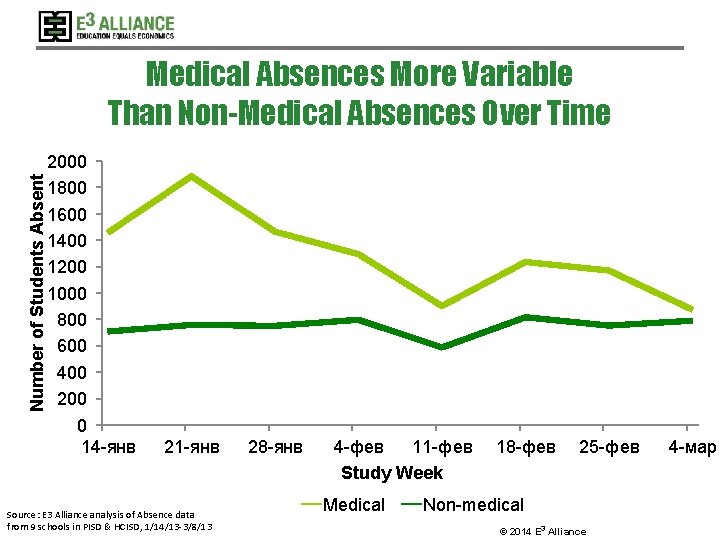
Number of Students Absent Medical Absences More Variable Than Non-Medical Absences Over Time 2000 1800 1600 1400 1200 1000 800 600 400 200 0 14 -янв 21 -янв Source: E 3 Alliance analysis of Absence data from 9 schools in PISD & HCISD, 1/14/13 -3/8/13 28 -янв 4 -фев 11 -фев Study Week Medical 18 -фев 25 -фев Non-medical © 2014 E 3 Alliance 4 -мар
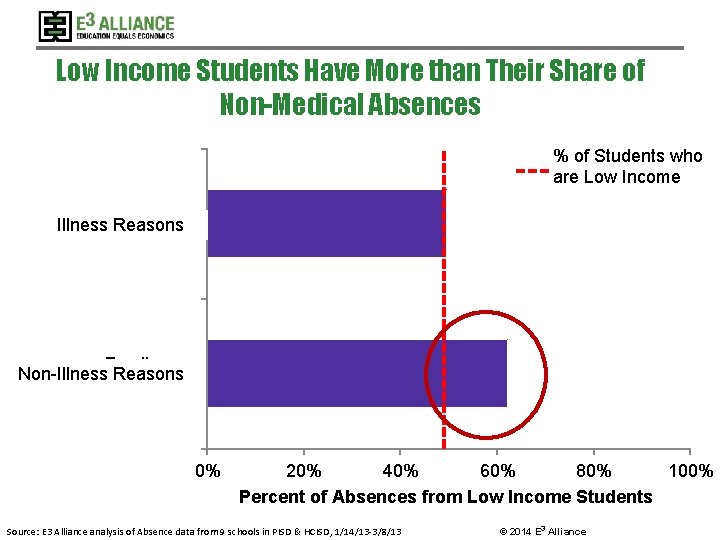
Low Income Students Have More than Their Share of Non-Medical Absences % of Students who are Low Income Illness Reasons Family, Non-Illness Reasons Transportation, or Legal Reason 0% 20% 40% 60% 80% 100% Percent of Absences from Low Income Students Source: E 3 Alliance analysis of Absence data from 9 schools in PISD & HCISD, 1/14/13 -3/8/13 © 2014 E 3 Alliance
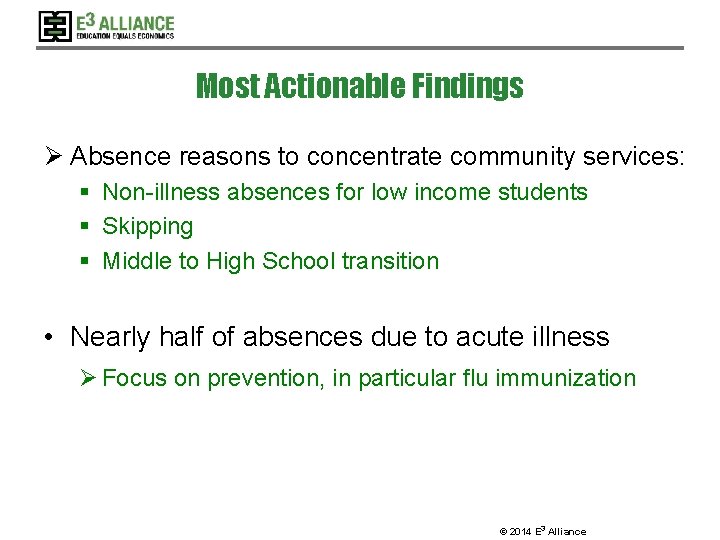
Most Actionable Findings Ø Absence reasons to concentrate community services: § Non-illness absences for low income students § Skipping § Middle to High School transition • Nearly half of absences due to acute illness Ø Focus on prevention, in particular flu immunization © 2014 E 3 Alliance
Barriers to Data-Driven Change? • ERC data not very timely • And in some cases incomplete • Original research costly but sometimes required © 2014 E 3 Alliance 20
Changing Minds, Changing Systems ü Systemic change is possible and can return millions in ROI! ü Timely, complete, statewide data is critical! Change Systems Change Practices & Build Capacity Forge Collaborations Build Common Agenda Identify Data Insights Convene Stakeholders Objective Data-Driven Decision Making © 2014 E 3 Alliance