
Shoulder Imaging Optimizing Bone CT General Bones S
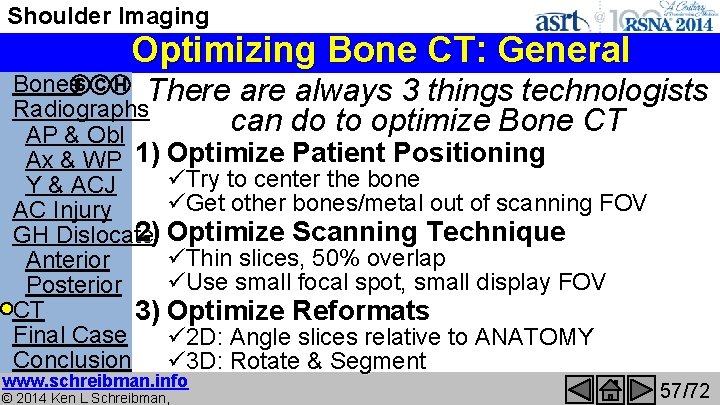
Shoulder Imaging Optimizing Bone CT: General Bones. S C H There always 3 things technologists Radiographs can do to optimize Bone CT AP & Obl Ax & WP 1) Optimize Patient Positioning üTry to center the bone Y & ACJ üGet other bones/metal out of scanning FOV AC Injury 2) Optimize Scanning Technique GH Dislocate üThin slices, 50% overlap Anterior üUse small focal spot, small display FOV Posterior CT 3) Optimize Reformats Final Case ü 2 D: Angle slices relative to ANATOMY Conclusion ü 3 D: Rotate & Segment www. schreibman. info © 2014 Ken L Schreibman, 57/72
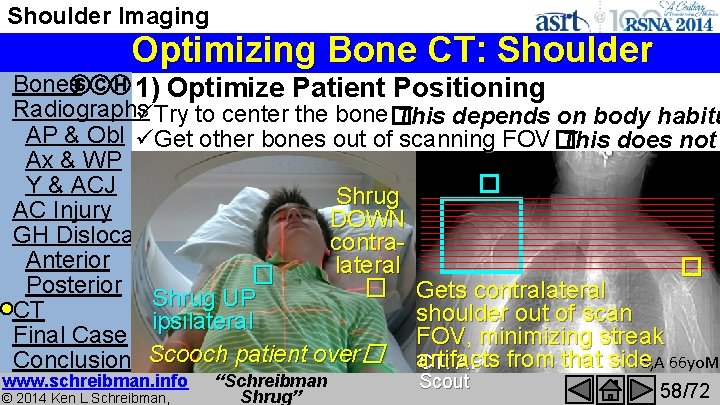
Shoulder Imaging Optimizing Bone CT: Shoulder Bones. S C H 1) Optimize Patient Positioning Radiographs üTry to center the bone� This depends on body habitu AP & Obl üGet other bones out of scanning FOV � This does not Ax & WP � Y & ACJ Shrug AC Injury DOWN GH Dislocate contra. Anterior lateral � � Posterior � Gets contralateral Shrug UP CT shoulder out of scan ipsilateral Final Case FOV, minimizing streak Conclusion Scooch patient over� artifacts S, A 66 yo. M CT: AP from that side www. schreibman. info © 2014 Ken L Schreibman, “Schreibman Shrug” Scout 58/72

Shoulder Imaging Optimizing Bone CT: Shoulder Bones. S C H 1) Optimize Patient Positioning Radiographs üTry to center the bone� This depends on body habitu AP & Obl üGet other bones out of scanning FOV � This does not Ax & WP üGET METAL OUT OF SCANNING FOV! Y & ACJ AC Injury � GH Dislocate Anterior � Posterior CT Gets metal ABER keeps metal Final Case contralateral shoulder out of scan CT: AP within the scan FOV Conclusion CT: AP www. schreibman. info Scout “Schreibman Scout C, B 83 yo. F FOV 59/72 © 2014 Ken L Schreibman, Shrug”
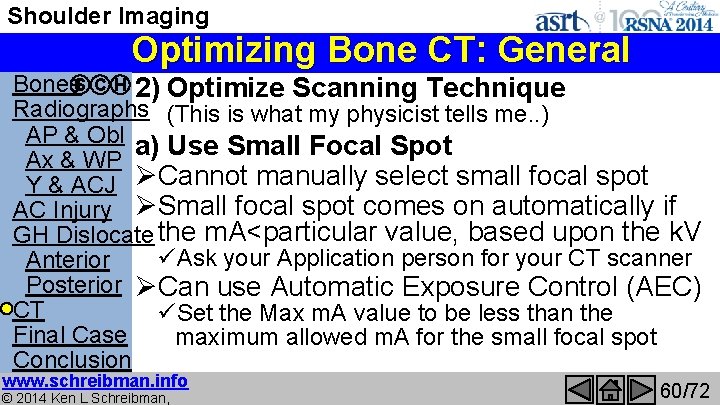
Shoulder Imaging Optimizing Bone CT: General Bones. S C H 2) Optimize Scanning Technique Radiographs (This is what my physicist tells me. . ) AP & Obl a) Use Small Focal Spot Ax & WP Y & ACJ ØCannot manually select small focal spot AC Injury ØSmall focal spot comes on automatically if GH Dislocate the m. A<particular value, based upon the k. V üAsk your Application person for your CT scanner Anterior Posterior ØCan use Automatic Exposure Control (AEC) CT üSet the Max m. A value to be less than the Final Case maximum allowed m. A for the small focal spot Conclusion www. schreibman. info © 2014 Ken L Schreibman, 60/72
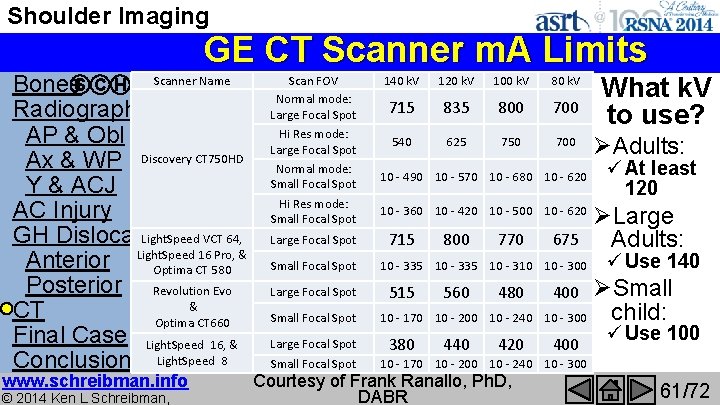
Shoulder Imaging GE CT Scanner m. A Limits Bones. S C H Scanner Name Radiographs AP & Obl Ax & WP Discovery CT 750 HD Y & ACJ AC Injury GH Dislocate Light. Speed VCT 64, 16 Pro, & Anterior Light. Speed Optima CT 580 Posterior Revolution Evo & CT Optima CT 660 Final Case Light. Speed 16, & Conclusion Light. Speed 8 www. schreibman. info © 2014 Ken L Schreibman, Scan FOV Normal mode: Large Focal Spot Hi Res mode: Large Focal Spot Normal mode: Small Focal Spot Hi Res mode: Small Focal Spot Large Focal Spot Small Focal Spot 140 k. V 120 k. V 100 k. V 80 k. V 715 835 800 700 540 625 750 700 10 - 490 10 - 570 10 - 680 10 - 620 10 - 360 10 - 420 10 - 500 10 - 620 715 800 770 675 10 - 335 10 - 310 10 - 300 515 560 480 10 - 170 10 - 200 10 - 240 380 440 420 What k. V to use? ØAdults: ü At least 120 ØLarge Adults: ü Use 140 ØSmall child: 10 - 300 400 ü Use 100 10 - 170 10 - 200 10 - 240 10 - 300 Courtesy of Frank Ranallo, Ph. D, DABR 61/72

Shoulder Imaging Optimizing Bone CT: General Bones. S C H 2) Optimize Scanning Technique Radiographs (This is what my physicist tells me. . ) AP & Obl b) Thin slices with 50% overlap Ax & WP Y & ACJ ØShoulder: Thin but not too thin (1 -1. 5 mm) ü<1 mm slices may be too noisy (We use 1. 25 mm) AC Injury Ø 50% overlap yields better reformats GH Dislocate üAdds information to the stack of axial images Anterior Posterior ØPitch close to 0. 5 CT üReduces helical artifacts Final Case üUses less m. A, hence use small focal spot Conclusion www. schreibman. info © 2014 Ken L Schreibman, 62/72
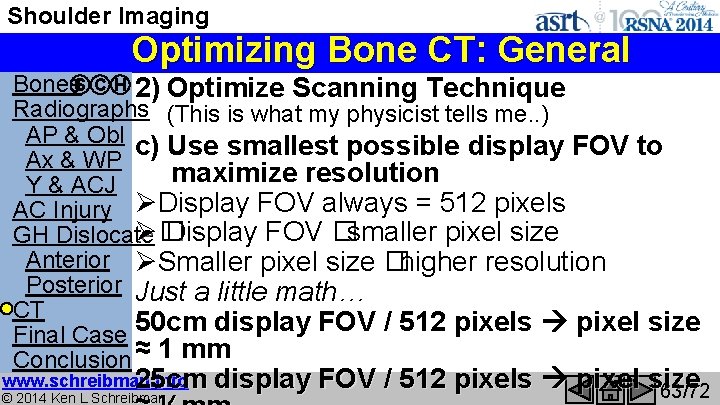
Shoulder Imaging Optimizing Bone CT: General Bones. S C H 2) Optimize Scanning Technique Radiographs (This is what my physicist tells me. . ) AP & Obl c) Use smallest possible display FOV to Ax & WP maximize resolution Y & ACJ AC Injury ØDisplay FOV always = 512 pixels Ø� Display FOV �smaller pixel size GH Dislocate Anterior ØSmaller pixel size � higher resolution Posterior Just a little math… CT Final Case 50 cm display FOV / 512 pixels pixel size Conclusion ≈ 1 mm www. schreibman. info 25 cm © 2014 Ken L Schreibman, display FOV / 512 pixels pixel size 63/72
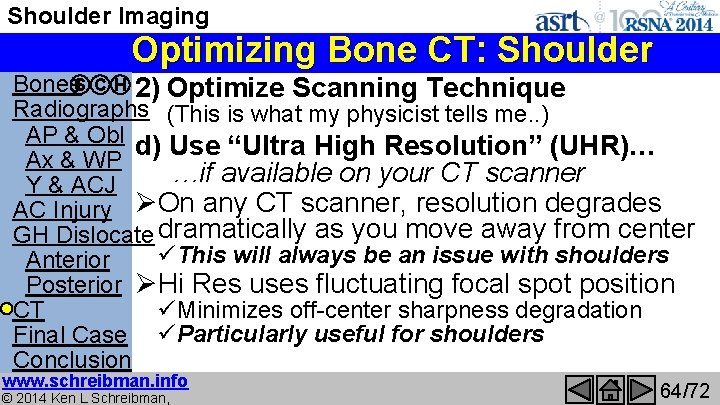
Shoulder Imaging Optimizing Bone CT: Shoulder Bones. S C H 2) Optimize Scanning Technique Radiographs (This is what my physicist tells me. . ) AP & Obl d) Use “Ultra High Resolution” (UHR)… Ax & WP …if available on your CT scanner Y & ACJ AC Injury ØOn any CT scanner, resolution degrades GH Dislocate dramatically as you move away from center üThis will always be an issue with shoulders Anterior Posterior ØHi Res uses fluctuating focal spot position üMinimizes off-center sharpness degradation CT Final Case üParticularly useful for shoulders Conclusion www. schreibman. info © 2014 Ken L Schreibman, 64/72
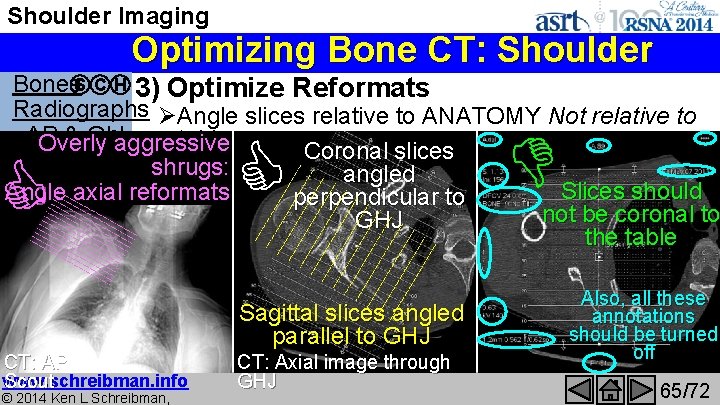
Shoulder Imaging Optimizing Bone CT: Shoulder Bones. S C H 3) Optimize Reformats Radiographs ØAngle slices relative to ANATOMY Not relative to AP & Oblaggressive table Overly Coronal slices Ax & WP shrugs: angled Y & ACJ Slices should Angle axial reformats perpendicular to AC Injury not be coronal to GHJ GH Dislocate the table Anterior Posterior Also, all these CT Sagittal slices angled annotations should be turned Final Case parallel to GHJ off Conclusion CT: AP CT: Axial image through www. schreibman. info Scout © 2014 Ken L Schreibman, GHJ 65/72
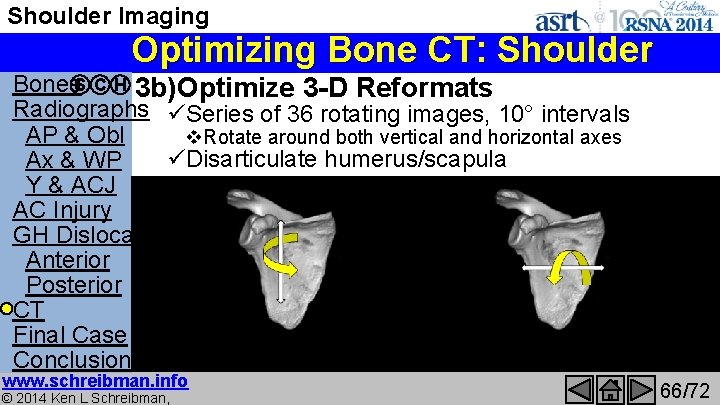
Shoulder Imaging Optimizing Bone CT: Shoulder Bones. S C H 3 b)Optimize 3 -D Reformats Radiographs üSeries of 36 rotating images, 10° intervals AP & Obl v. Rotate around both vertical and horizontal axes üDisarticulate humerus/scapula Ax & WP Y & ACJ AC Injury GH Dislocate Anterior Posterior CT Final Case Conclusion www. schreibman. info © 2014 Ken L Schreibman, 66/72
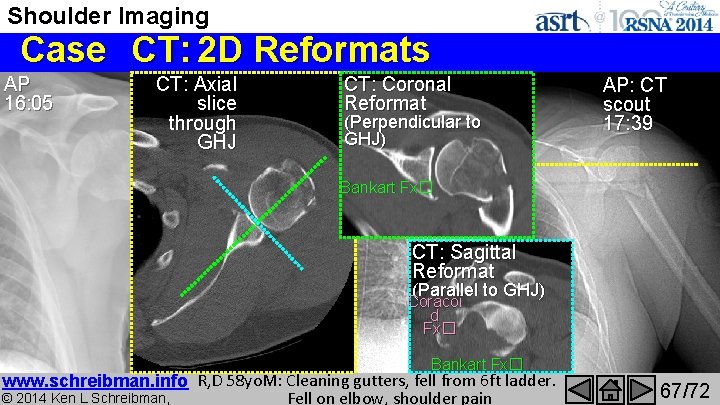
Shoulder Imaging Case CT: 2 D Reformats AP Bones. S C H CT: Axial 16: 05 slice Radiographs through AP & Obl GHJ Ax & WP Y & ACJ AC Injury GH Dislocate Anterior Posterior CT Final Case Conclusion CT: Coronal Reformat (Perpendicular to GHJ) AP: CT scout 17: 39 Bankart Fx� CT: Sagittal Reformat (Parallel to GHJ) Coracoi d Fx� Bankart Fx� www. schreibman. info R, D 58 yo. M: Cleaning gutters, fell from 6 ft ladder. © 2014 Ken L Schreibman, Fell on elbow, shoulder pain 67/72
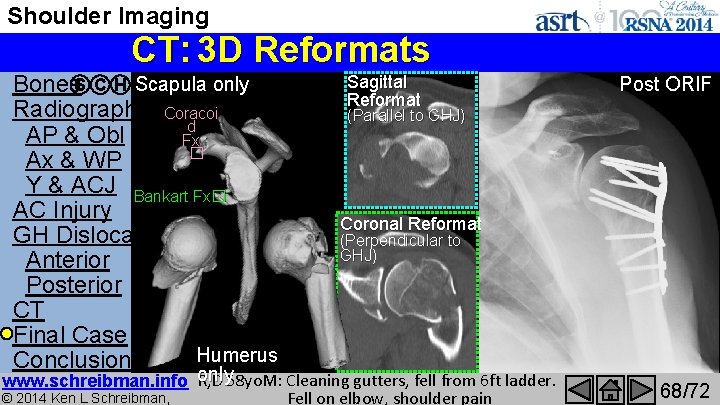
Shoulder Imaging CT: 3 D Reformats Sagittal 36 Images: Ribs Reoriented Removed & Clavicle only to Vertical Horizontal better Removed Rotation show Rotation GH Bones. S C H Scapula Reformat Axis. Coracoi Joint Radiographs (Parallel to GHJ) d AP & Obl Fx � Ax & WP Y & ACJ Bankart Fx� AC Injury Coronal Reformat GH Dislocate (Perpendicular to GHJ) Anterior Posterior CT Final Case Humerus Conclusion only 58 yo. M: Cleaning gutters, fell from 6 ft ladder. www. schreibman. info R, D © 2014 Ken L Schreibman, Fell on elbow, shoulder pain Post ORIF 68/72
- Slides: 12