
Shoulder Dystocia Delivery that requires additional obstetric maneuvers
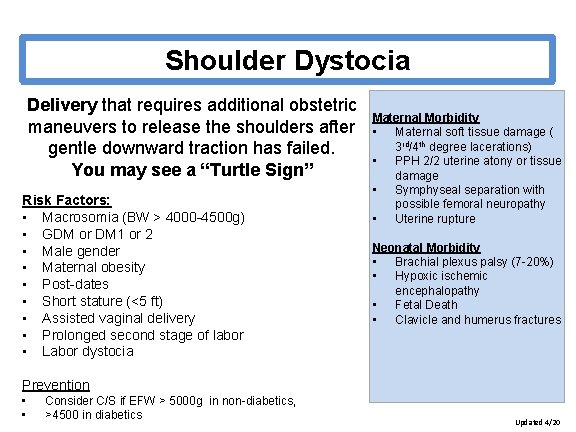
Shoulder Dystocia Delivery that requires additional obstetric maneuvers to release the shoulders after gentle downward traction has failed. You may see a “Turtle Sign” Risk Factors: • Macrosomia (BW > 4000 -4500 g) • GDM or DM 1 or 2 • Male gender • Maternal obesity • Post-dates • Short stature (<5 ft) • Assisted vaginal delivery • Prolonged second stage of labor • Labor dystocia Maternal Morbidity • Maternal soft tissue damage ( 3 rd/4 th degree lacerations) • PPH 2/2 uterine atony or tissue damage • Symphyseal separation with possible femoral neuropathy • Uterine rupture Neonatal Morbidity • Brachial plexus palsy (7 -20%) • Hypoxic ischemic encephalopathy • Fetal Death • Clavicle and humerus fractures Prevention • • Consider C/S if EFW > 5000 g in non-diabetics, >4500 in diabetics Updated 4/20
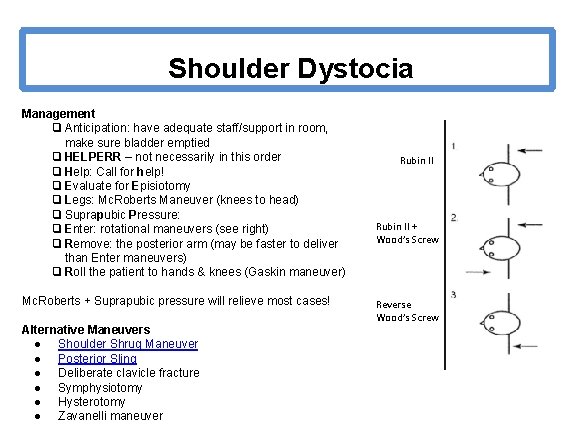
Shoulder Dystocia Management ❑ Anticipation: have adequate staff/support in room, make sure bladder emptied ❑ HELPERR – not necessarily in this order ❑ Help: Call for help! ❑ Evaluate for Episiotomy ❑ Legs: Mc. Roberts Maneuver (knees to head) ❑ Suprapubic Pressure: ❑ Enter: rotational maneuvers (see right) ❑ Remove: the posterior arm (may be faster to deliver than Enter maneuvers) ❑ Roll the patient to hands & knees (Gaskin maneuver) Mc. Roberts + Suprapubic pressure will relieve most cases! Alternative Maneuvers ● Shoulder Shrug Maneuver ● Posterior Sling ● Deliberate clavicle fracture ● Symphysiotomy ● Hysterotomy ● Zavanelli maneuver Rubin II + Wood’s Screw Reverse Wood’s Screw
- Slides: 2