
Should RFC 2861 on TCP Congestion Window Validation
- Slides: 5
Should RFC 2861 on TCP Congestion Window Validation move towards Proposed Standard? RFC 2861 authors: Mark Handley, Jitendra Padhye, and Sally Floyd TCPM July 2007
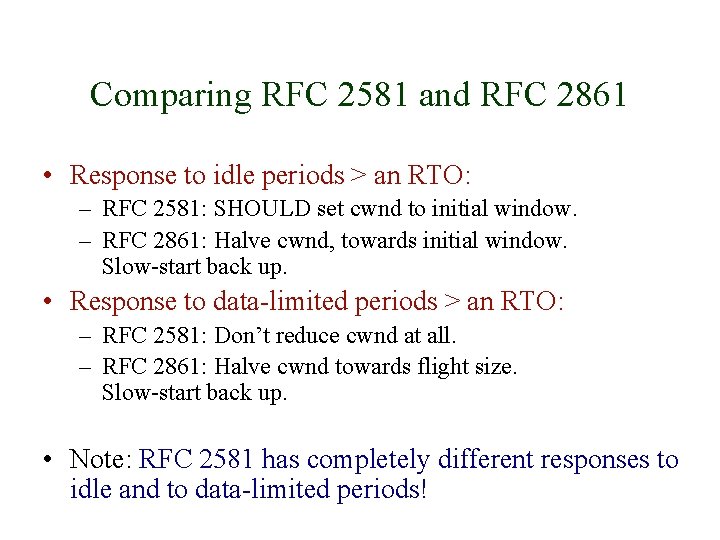
Comparing RFC 2581 and RFC 2861 • Response to idle periods > an RTO: – RFC 2581: SHOULD set cwnd to initial window. – RFC 2861: Halve cwnd, towards initial window. Slow-start back up. • Response to data-limited periods > an RTO: – RFC 2581: Don’t reduce cwnd at all. – RFC 2861: Halve cwnd towards flight size. Slow-start back up. • Note: RFC 2581 has completely different responses to idle and to data-limited periods!
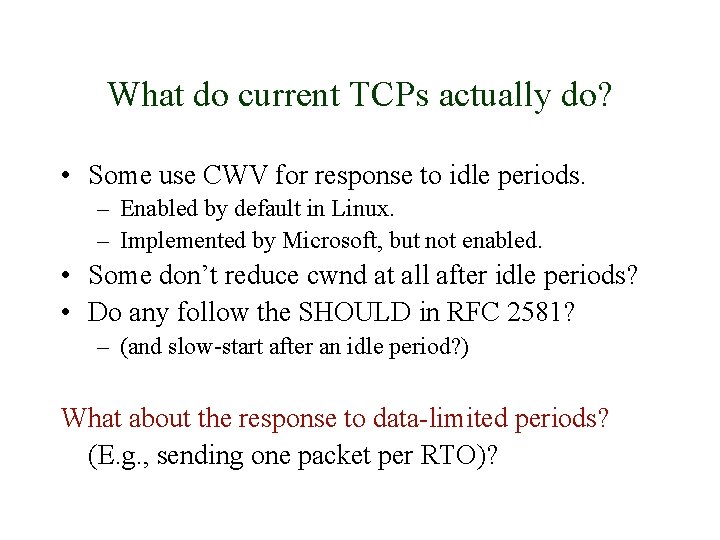
What do current TCPs actually do? • Some use CWV for response to idle periods. – Enabled by default in Linux. – Implemented by Microsoft, but not enabled. • Some don’t reduce cwnd at all after idle periods? • Do any follow the SHOULD in RFC 2581? – (and slow-start after an idle period? ) What about the response to data-limited periods? (E. g. , sending one packet per RTO)?
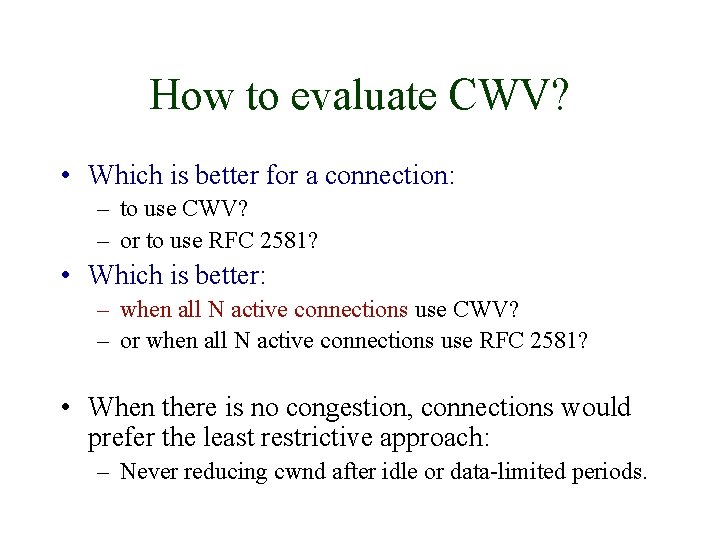
How to evaluate CWV? • Which is better for a connection: – to use CWV? – or to use RFC 2581? • Which is better: – when all N active connections use CWV? – or when all N active connections use RFC 2581? • When there is no congestion, connections would prefer the least restrictive approach: – Never reducing cwnd after idle or data-limited periods.
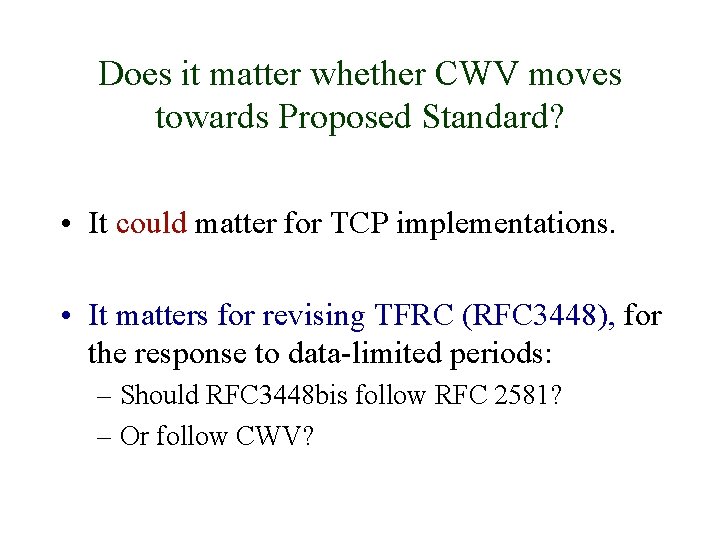
Does it matter whether CWV moves towards Proposed Standard? • It could matter for TCP implementations. • It matters for revising TFRC (RFC 3448), for the response to data-limited periods: – Should RFC 3448 bis follow RFC 2581? – Or follow CWV?