
Shots Angles and Lighting Film Analysis Part One
- Slides: 21
Shots, Angles and Lighting Film Analysis Part One
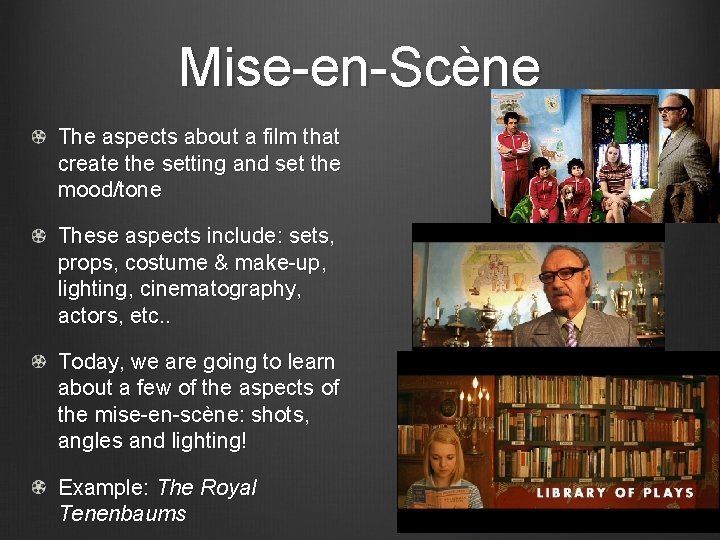
Mise-en-Scène The aspects about a film that create the setting and set the mood/tone These aspects include: sets, props, costume & make-up, lighting, cinematography, actors, etc. . Today, we are going to learn about a few of the aspects of the mise-en-scène: shots, angles and lighting! Example: The Royal Tenenbaums
Commonly Used Frames Extreme Long Shot Full Shot Medium Shot Close-Up Extreme Close-up Deep Focus/Wide-Angle Shot
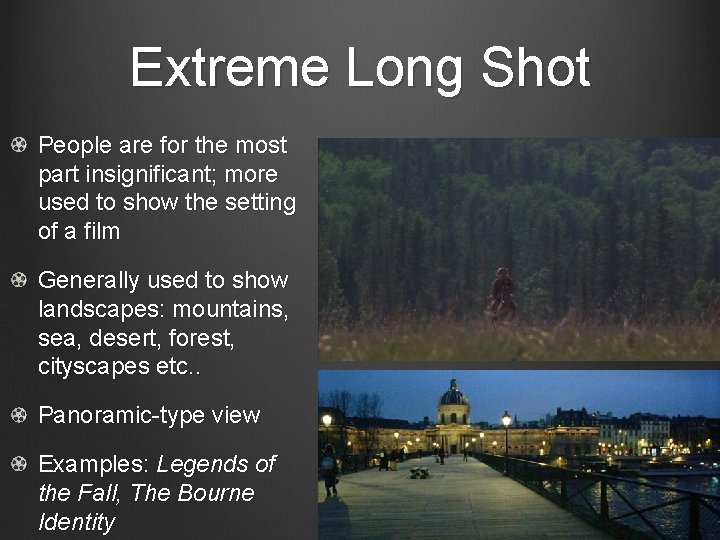
Extreme Long Shot People are for the most part insignificant; more used to show the setting of a film Generally used to show landscapes: mountains, sea, desert, forest, cityscapes etc. . Panoramic-type view Examples: Legends of the Fall, The Bourne Identity
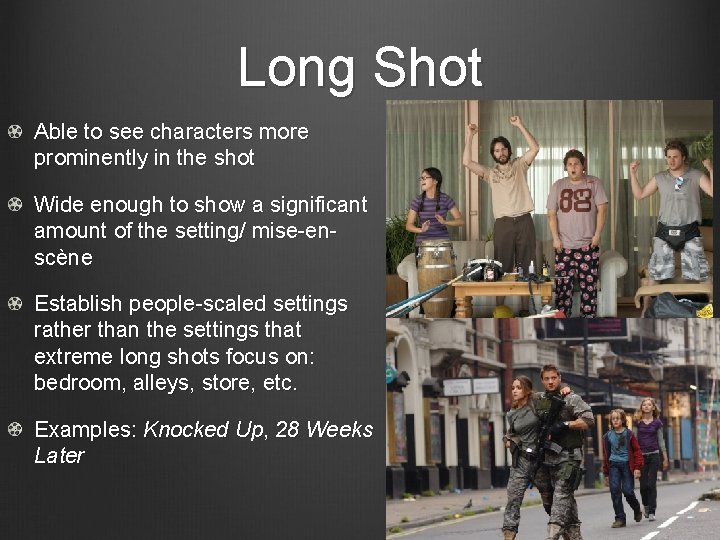
Long Shot Able to see characters more prominently in the shot Wide enough to show a significant amount of the setting/ mise-enscène Establish people-scaled settings rather than the settings that extreme long shots focus on: bedroom, alleys, store, etc. Examples: Knocked Up, 28 Weeks Later
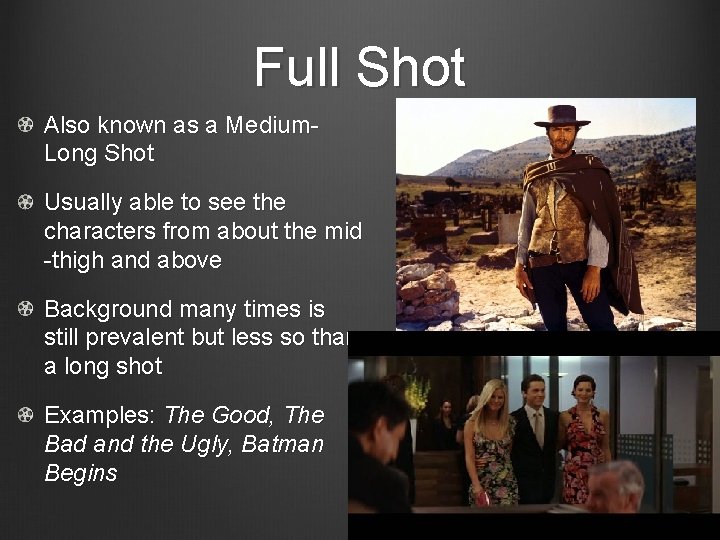
Full Shot Also known as a Medium. Long Shot Usually able to see the characters from about the mid -thigh and above Background many times is still prevalent but less so than a long shot Examples: The Good, The Bad and the Ugly, Batman Begins
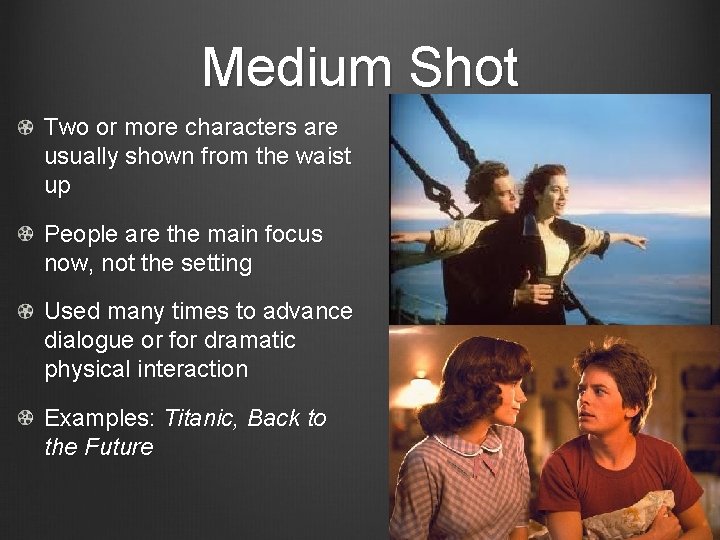
Medium Shot Two or more characters are usually shown from the waist up People are the main focus now, not the setting Used many times to advance dialogue or for dramatic physical interaction Examples: Titanic, Back to the Future
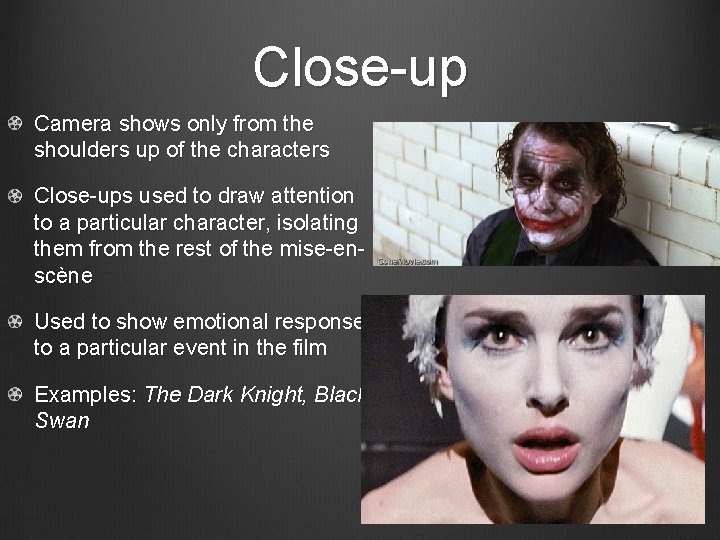
Close-up Camera shows only from the shoulders up of the characters Close-ups used to draw attention to a particular character, isolating them from the rest of the mise-enscène Used to show emotional response to a particular event in the film Examples: The Dark Knight, Black Swan
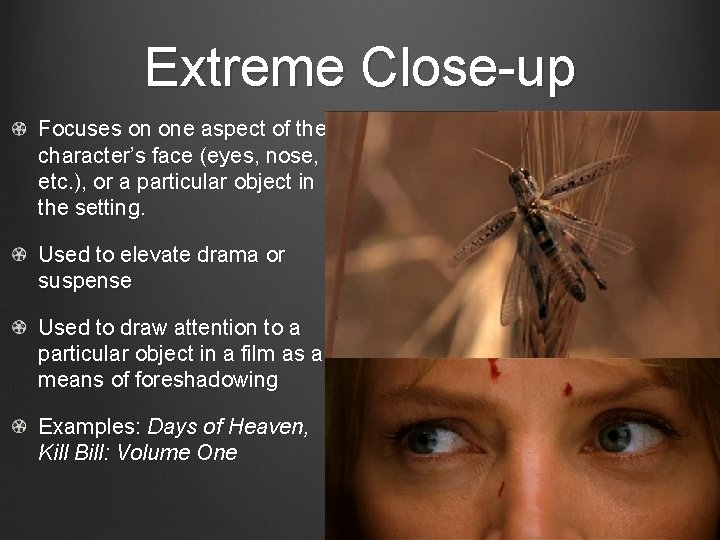
Extreme Close-up Focuses on one aspect of the character’s face (eyes, nose, etc. ), or a particular object in the setting. Used to elevate drama or suspense Used to draw attention to a particular object in a film as a means of foreshadowing Examples: Days of Heaven, Kill Bill: Volume One
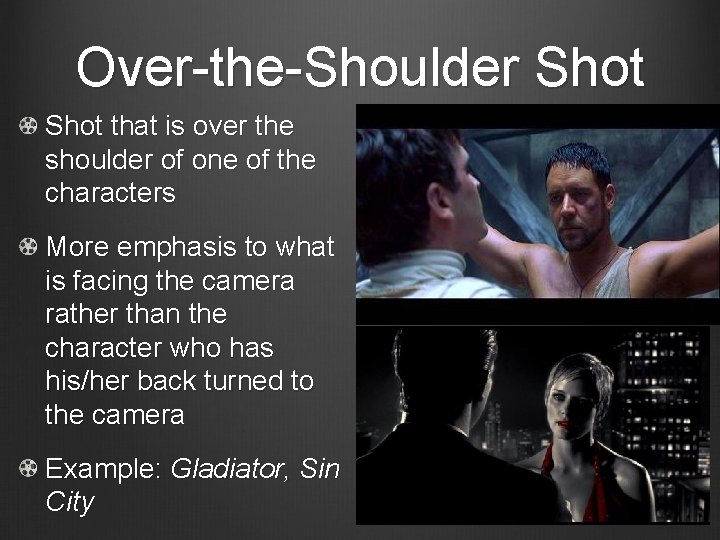
Over-the-Shoulder Shot that is over the shoulder of one of the characters More emphasis to what is facing the camera rather than the character who has his/her back turned to the camera Example: Gladiator, Sin City
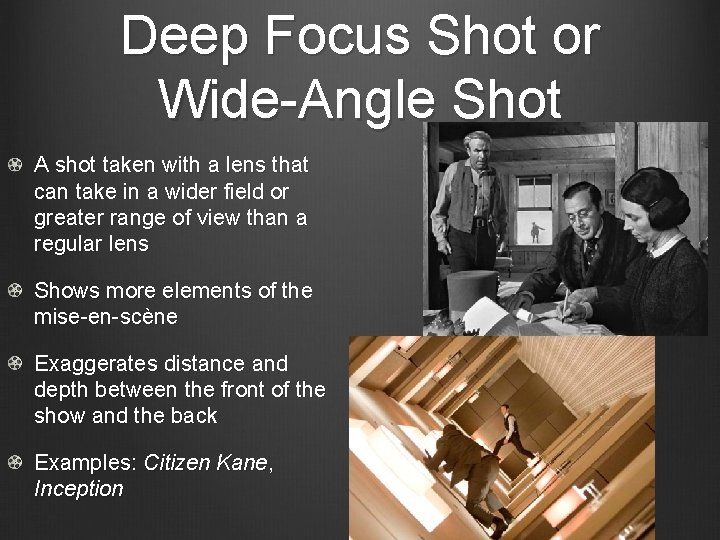
Deep Focus Shot or Wide-Angle Shot A shot taken with a lens that can take in a wider field or greater range of view than a regular lens Shows more elements of the mise-en-scène Exaggerates distance and depth between the front of the show and the back Examples: Citizen Kane, Inception
Commonly-Used Angles Bird’s-Eye View High Angle Eye-Level Shot Low Angle Oblique Angle
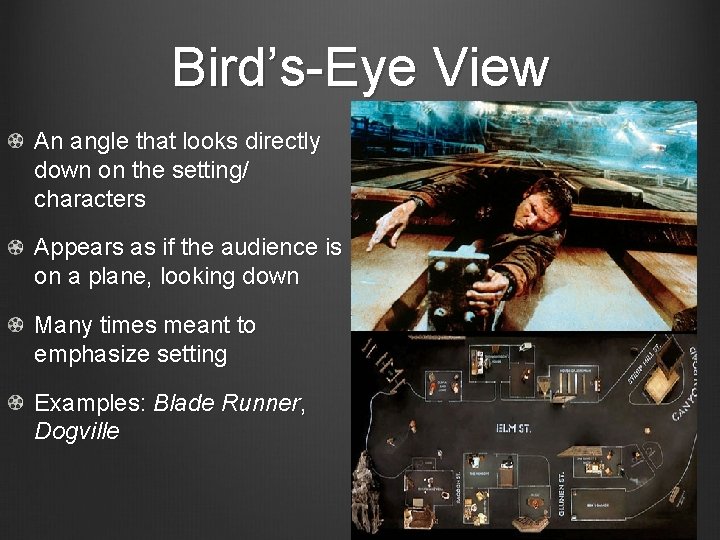
Bird’s-Eye View An angle that looks directly down on the setting/ characters Appears as if the audience is on a plane, looking down Many times meant to emphasize setting Examples: Blade Runner, Dogville
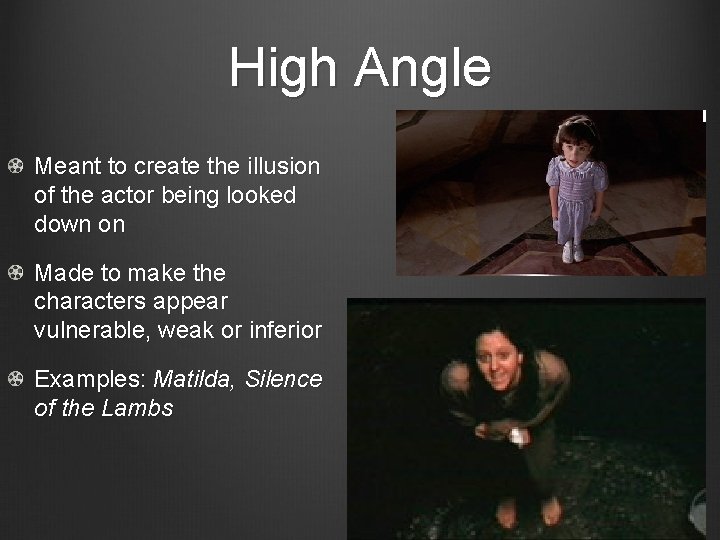
High Angle Meant to create the illusion of the actor being looked down on Made to make the characters appear vulnerable, weak or inferior Examples: Matilda, Silence of the Lambs
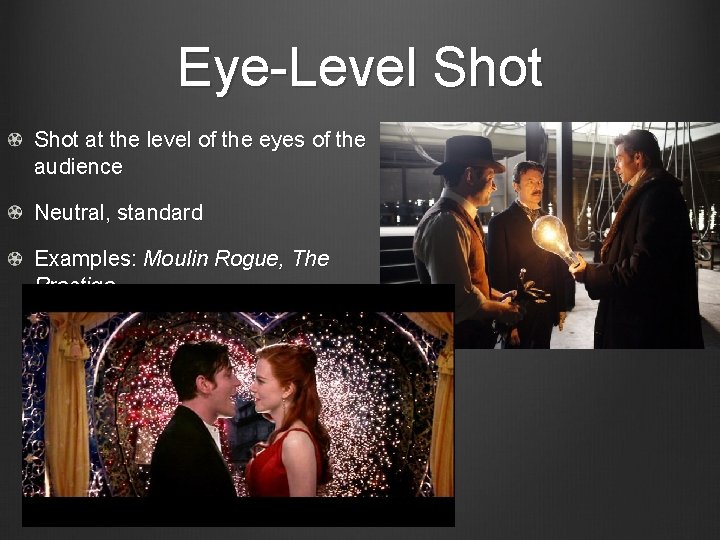
Eye-Level Shot at the level of the eyes of the audience Neutral, standard Examples: Moulin Rogue, The Prestige
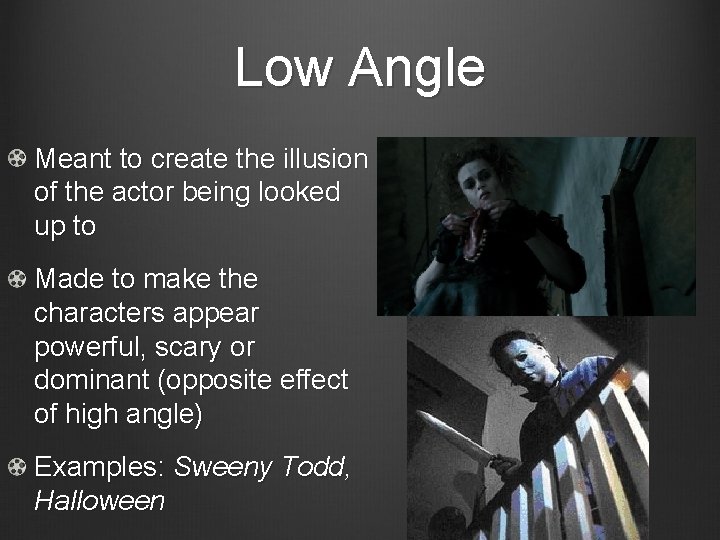
Low Angle Meant to create the illusion of the actor being looked up to Made to make the characters appear powerful, scary or dominant (opposite effect of high angle) Examples: Sweeny Todd, Halloween
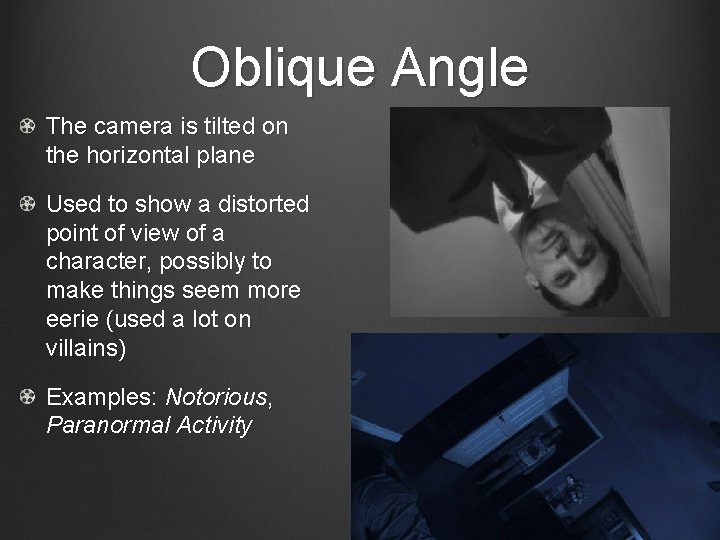
Oblique Angle The camera is tilted on the horizontal plane Used to show a distorted point of view of a character, possibly to make things seem more eerie (used a lot on villains) Examples: Notorious, Paranormal Activity
Commonly-Used Lighting Effects High Contrast Backlighting or “Halo Effect” Cool Colors or Warm Colors
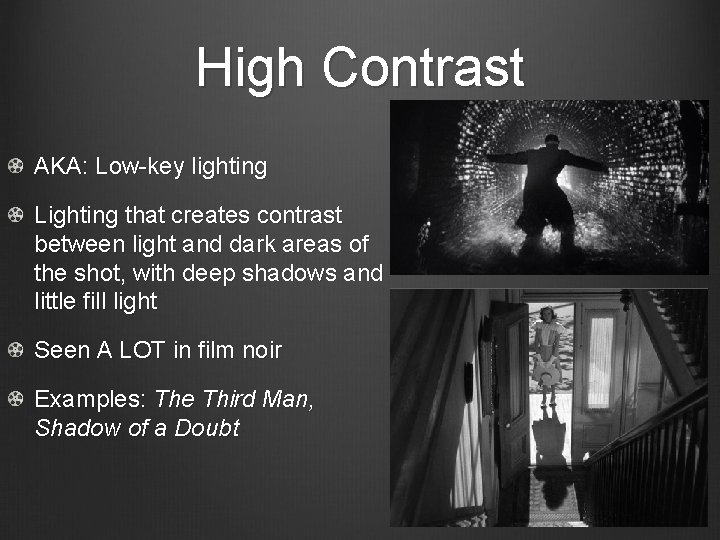
High Contrast AKA: Low-key lighting Lighting that creates contrast between light and dark areas of the shot, with deep shadows and little fill light Seen A LOT in film noir Examples: The Third Man, Shadow of a Doubt
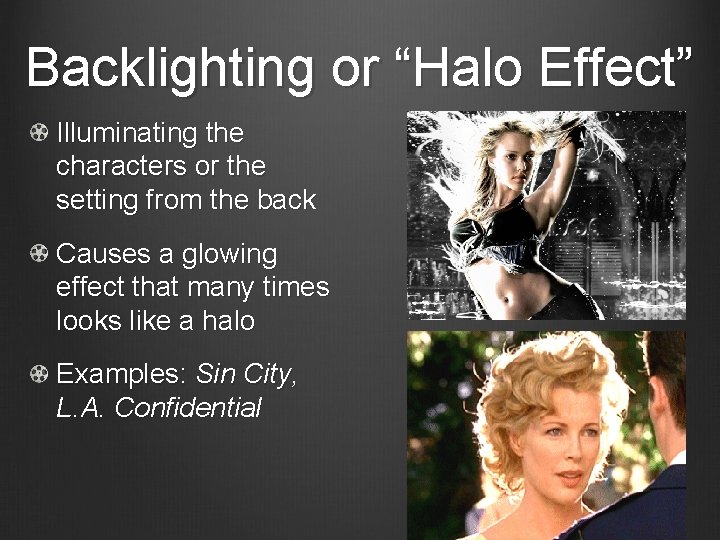
Backlighting or “Halo Effect” Illuminating the characters or the setting from the back Causes a glowing effect that many times looks like a halo Examples: Sin City, L. A. Confidential
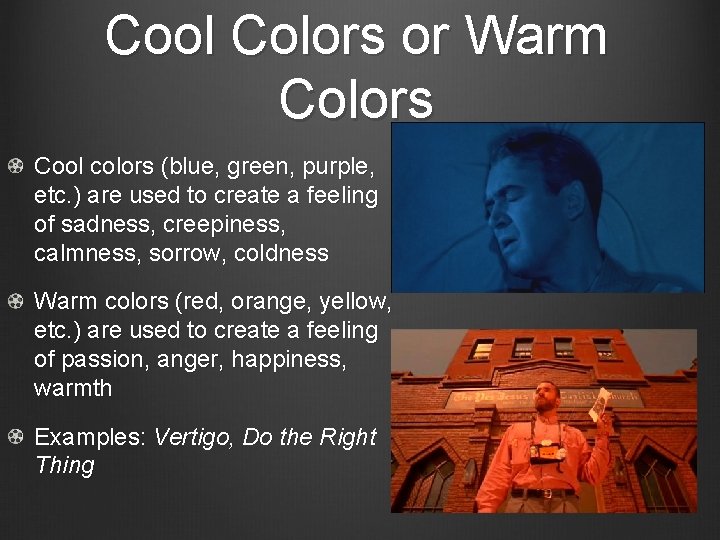
Cool Colors or Warm Colors Cool colors (blue, green, purple, etc. ) are used to create a feeling of sadness, creepiness, calmness, sorrow, coldness Warm colors (red, orange, yellow, etc. ) are used to create a feeling of passion, anger, happiness, warmth Examples: Vertigo, Do the Right Thing