
ShortTerm Time Evolution of Coronal Holes and Their
- Slides: 2
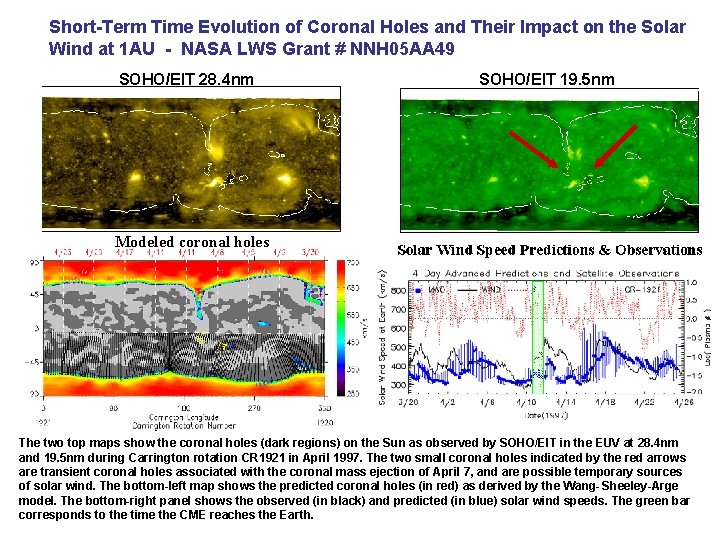
Short-Term Time Evolution of Coronal Holes and Their Impact on the Solar Wind at 1 AU - NASA LWS Grant # NNH 05 AA 49 SOHO/EIT 28. 4 nm SOHO/EIT 19. 5 nm Modeled coronal holes The two top maps show the coronal holes (dark regions) on the Sun as observed by SOHO/EIT in the EUV at 28. 4 nm and 19. 5 nm during Carrington rotation CR 1921 in April 1997. The two small coronal holes indicated by the red arrows are transient coronal holes associated with the coronal mass ejection of April 7, and are possible temporary sources of solar wind. The bottom-left map shows the predicted coronal holes (in red) as derived by the Wang- Sheeley-Arge model. The bottom-right panel shows the observed (in black) and predicted (in blue) solar wind speeds. The green bar corresponds to the time the CME reaches the Earth.
Short-Term Time Evolution of Coronal Holes and Their Impact on the Solar Wind at 1 AU - NASA LWS Grant # NNH 05 AA 49 Our study investigates the sources of solar wind during and after disturbed times associated with coronal mass ejections (CMEs) on the Sun. Slide 1 shows the observed and modeled coronal holes and solar wind speed around the time of the April 7 halo CME. The shock produced by the interplanetary coronal mass ejection (ICME) arrived at the Earth on April 10 followed by a magnetic cloud-like feature and then a high-speed solar wind stream. We modeled the ambient solar wind at the time of this CME to identify its coronal source region using the Wang-Sheeley-Arge (WSA) model. The objective is to establish how well we can model the solar wind after a CME and to determine what can be learned when the modeling fails to reproduce the observations. The overall agreement between the predicted and observed solar wind speed for CR 1921 is very good. As expected, the model misses the ICME since this is a model for the ambient solar wind, but it also misses the wind stream that follows afterwards. We investigated if such discrepancy could be caused by a problem in the observations of the polar magnetic field and concluded this was not the case. Our study indicates that the source of the moderate high speed following the ICME is either one of the two transient coronal holes associated with the CME or the narrow northern coronal hole extension. We find that the WSA model does not perform well when coronal holes are located near active regions. This can be because magnetic fields near active regions are non-potential or because some of the model’s assumptions (e. g. , radial fields, velocity relationship) are not valid near active regions and need to be modified. This study is important to improve solar wind predictions which are a crucial component of space weather predictions. This kind of studies are made possible by the availability of high-quality, synoptic, solar observations from space and ground observatories and by reliable heliospheric models for the ambient solar wind.