
Shortterm online booking platforms Re Airbnb Stayz and
Short-term on-line booking platforms
• Re Airbnb, Stayz and various other platforms. • Some are home-hosted, but the majority are entire homes. Deloitte Access state 62% nationally are entire properties, while Inside Airbnb say entire properties have gone up by 87% in the past year resulting in 70% being entire properties.
Benefits: • According to a Deloitte Access Economics Report, in 2015 -16 in Queensland, 343, 800 Airbnb guests generated $217 million in GSP. • Short-term on-line platforms are diversifying the tourism offerings and the experiences for tourists.
• However, according to Prof. Nicole Curran of Syd. Uni. , wherever on-line short-term rentals have proliferated, so too have conflicts with local residents and also conflicts with traditional tourism accommodation businesses. • The growth in the sector has also meant a significant growth in a new type of tourism – group holidays, especially for bucks/hens events and weddings.
According to Sydney University Researcher Nicole Gurran: • There are more than 3, 000 listings at Mornington Peninsular • There are more than 2, 000 listings in Byron Shire Inside Airbnb state that Byron Shire has 2, 655 Airbnb properties or 17% of all residences. (Byron has 15, 646 dwellings compared to Noosa’s 27, 512 residential properties)
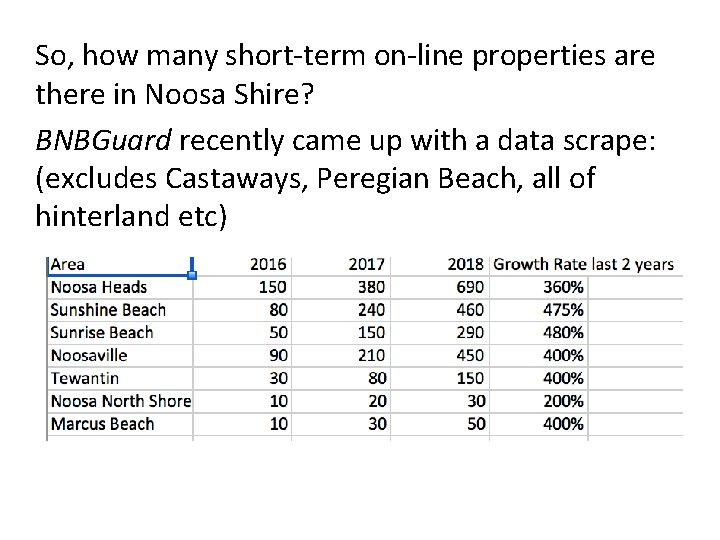
So, how many short-term on-line properties are there in Noosa Shire? BNBGuard recently came up with a data scrape: (excludes Castaways, Peregian Beach, all of hinterland etc)
• Bn. BGuard’s total listings across areas sampled = 2, 120 • Add indicative figures for Peregian Beach, Castaways Beach, Cooroy, Pomona, Boreen Pt etc, and probably finish with close to 3, 000 properties currently listed in Noosa Shire. • But we can’t get accurate figures because we can’t identify property addresses.
Tourism Levy All short-term on-line properties arguably benefit from destination marketing funded through the Tourism Levy. The Tourism Levy applies to all commercial properties (including traditional B&Bs plus all other forms of tourist accommodation. ) Currently the Levy is determined as a rate in the dollar based on property valuations. A different rate applies to Transitory Accommodation and to Commercial & Industrial land. Also differs between urban and rural. Very few short-term on-line rental properties (Airbnb, Stayz etc) are paying the Tourism Levy at present (less than 150).
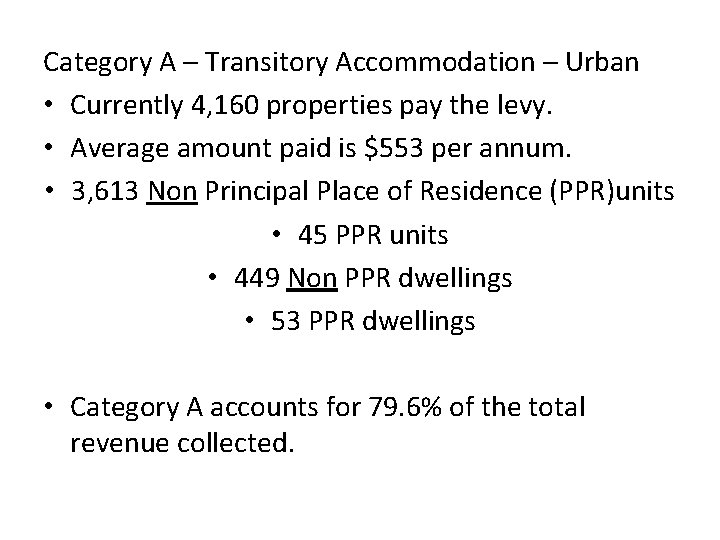
Category A – Transitory Accommodation – Urban • Currently 4, 160 properties pay the levy. • Average amount paid is $553 per annum. • 3, 613 Non Principal Place of Residence (PPR)units • 45 PPR units • 449 Non PPR dwellings • 53 PPR dwellings • Category A accounts for 79. 6% of the total revenue collected.
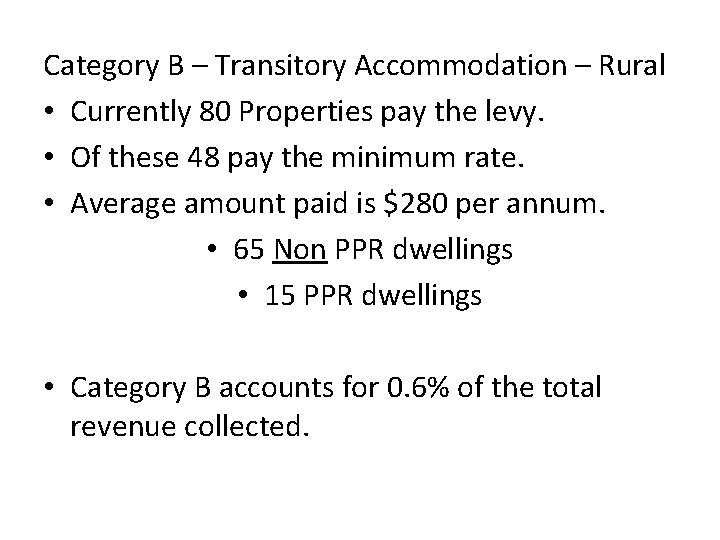
Category B – Transitory Accommodation – Rural • Currently 80 Properties pay the levy. • Of these 48 pay the minimum rate. • Average amount paid is $280 per annum. • 65 Non PPR dwellings • 15 PPR dwellings • Category B accounts for 0. 6% of the total revenue collected.
• Noosa Council is considering how we can apply the Tourism Levy in a way that is equitable and fair – e. g. where a retired couple letting out a spare room is not expected to pay the same Levy rate as an entire house. • One way of managing this may be to charge a lower rate to Principal Place of Residence properties on Airbnb/Stayz etc, and a different rate to Non PPR properties? • Noosa Council’s concern with the short-term online letting sector is not primarily about nonpayment of Levy funds. That is a peripheral matter.
• The real issue is how we can manage and plan for the impacts of this disruptive new industry sector. • We recognize that short-term on-line letting is here to stay. But the sector is also changing rapidly. As well as increasing numbers of entire properties being let, there also new businesses appearing that manage multiple properties. • So what exactly are dealing with? What is the situation here in Noosa Shire?
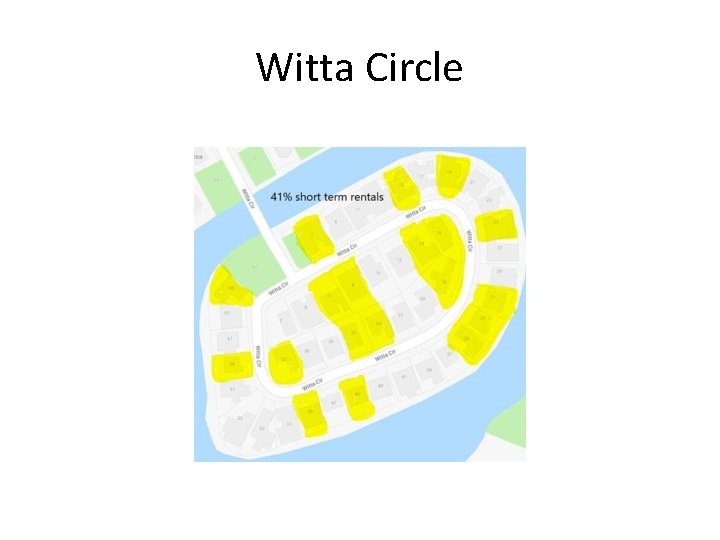
Witta Circle
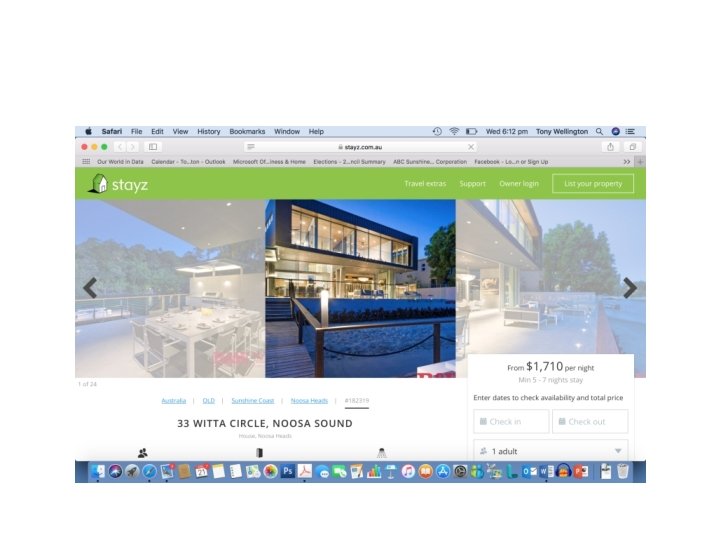
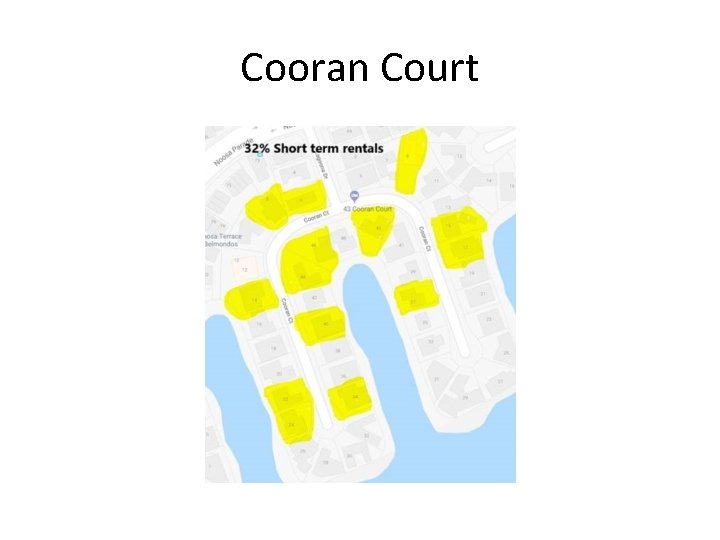
Cooran Court
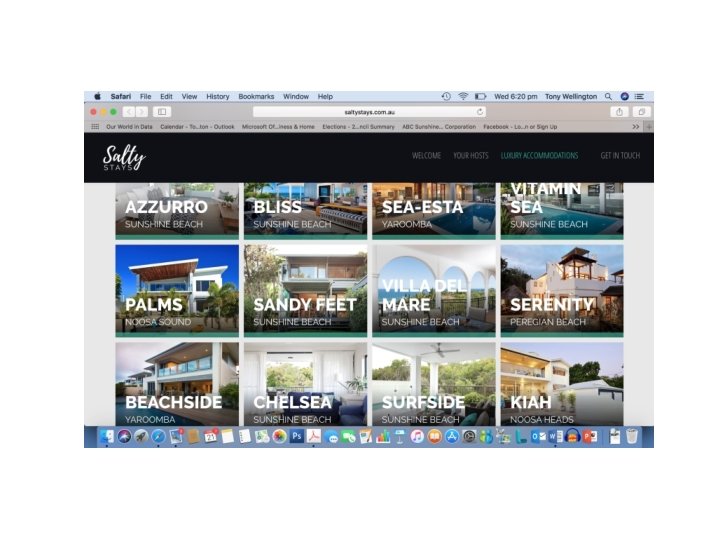
Not really a “peer-to-peer” relationship, which suggests an arrangement between equals. More often it is a business owner - customer relationship. Not a “sharing economy”, which suggests a benign barter system. More accurately, it is a profit-orientated economy, no different to the rest of the business economy. (Compare with a traditional B&B business. )
ISSUES: • Neighbour amenity (noise, parking, rubbish, inconsiderate use of common areas, party houses, etc) • Disruption to sense of community (mistrust, personal safety perceptions, alienation, etc) • Fire safety risks • Land use planning • Disappearing long-term rental stock • Upward pressure on rental prices • Housing affordability issues
Byron Bay Mayor Simon Richardson: • “Airbnb’s gutting our community. From our point of view it’s an illegal activity in a residential zone. ” • “Suffolk Park used to be the single mum’s capital of Australia. But now it’s been gutted because on some weeks every second house is empty, which means no-one’s volunteering at the surf club, no-one’s got their kids at school … you’re eroding the community. ” - Fairfax Media 13 April 2018
LACK OF DATA/TRANSPARENCY • Airbnb and Stayz refuse to supply property addresses. They claim that to do so would be a breach of privacy. • Their business model relies on secrecy so that many of their clients can avoid tax, planning and safety regulations. • Airbnb and Stayz are engaged in fierce lobbying to prevent forced disclosure at a State policy level.
What’s happening in Qld? • Following Noosa Council’s successful motion presented to last year’s LGAQ Conference, the State Government agreed to set up a reference group to consider the issues. • The Reference Group has met 3 times and shared information. Noosa and Cairns are the only LGAs. Also represented are Airbnb, Stayz, Accommodation Association of Aust. , Tourism & Events Qld, LGAQ, Qld Hotels Association, Property Council, Adventure Qld, Australian Timeshare & Holiday Ownership Council, plus other Gov. Departments and more!
• • EFFORTS ELSEWHERE: Byron Bay short-term holiday letting prohibited in all residential zones exempt if 3 br or less and rented for less than 90 days per year otherwise requires a DA part-time compliance officer engage private investigators to book and stay at properties Byron Council has 2 Land & Environment Court matters pending and 60 under investigation Considering taking legal action against NSW Gov.
Bass Coast Shire Council (which includes Phillip Island) • Using the Public Health & Wellbeing Act to insist that properties listed for short-term letting are registered with Council. However, they are unsure about the legality of this, and it has yet to be tested through legal challenge. • Registration is only for properties that sleep 6 or more, at a cost of $296 p. a. • They have 850 houses registered so far.
Busselton in WA • Uses a combination of local laws and planning regulations to manage Airbnb, Stayz etc. Basically, their local laws distinguish short-term accommodation and impose a fee (sort of like a tourism levy). • They have a register of short-term accommodation properties, and it is a breach of their local laws for property owners not to list such properties on the register. • The fee for registration is around $300 per year.
Busselton cont. • If a property attempts to hide their letting actions, the Council can also use their planning scheme to hit them with a breach notice and fine. The fines are quite substantial. • They have 600 properties listed on their register, but reckon there are probably around 700 more that they haven't been able to locate and which refuse to identify themselves. • Busselton have had one successful legal case against a property owner for operating a holiday home without approval.
IN CONCLUSION • More than anything, this is a planning issue. • Local Government’s role is to manage land use through planning schemes and strategic planning decisions. Regulation of land uses includes shared accommodation. • Just as we have traditionally managed home-based businesses, population densities, types of residential or tourist accommodation zones, transport corridors, etc. , so we need to be able to provide for the short-term on -line rental market whilst ensuring adequate resident amenity, place-making character, housing affordability, and appropriate public infrastructure.
International Examples (if time permits)
Many cities, like New York, Singapore, Berlin and Barcelona, have attempted to stop or control online short-term rentals. Why? Mainly because of impacts on housing stocks and affordability. * David Wachsmuth, a professor of Urban Planning at Mc. Gill University, found that in New York, Airbnb has indeed raised rents, and also removed housing from the rental market. The median household looking for a new apartment will pay $384 more per year than they would have three years ago, due to the growth of short-term rentals. * UQ Researcher Sara Dolnicar says rental prices in Barcelona went up by a third directly due to Airbnb.
Many locales limit entire properties being let and/or place time limits on stays. • New York State in October 2016 created restrictions on short-term rentals. In most of New York City, it’s now illegal to advertise or rent an entire apartment on a platform like Airbnb for less than 30 days. Home-hosted letting is OK but only for one or two guests. • In Amsterdam you can only host Airbnb guests for 60 days (and the city plans to shorten this period, to just 30 days).
• London created a deal with Airbnb to allow properties to be rented for 90 days in a given year as short-term rentals. Any more than 90 days and the owner has to apply for permission from council. Hefty fines are imposed on those who fail to cooperate. Airbnb has complied voluntarily, however, London has discovered the strict regulations don’t work. Many Airbnb business owners, especially those with multiple properties, simply move their listings between sites. They delist their property before the 90 day limit and create a new listing, or else fudge the address to get around the rules. • In February this year, BBC London asked competitors in the short-term letting market sites if they enforced the 90 -day rule or planned to do so. None said they did.
• San Francisco worked with Airbnb to institute a "one home, one host" policy, after which listings dropped 75%. This really hit the people renting multiple investment properties hard. However, as with London, they are finding ways around the rule (e. g. using friend's IDs).
• Denver allows a primary residence to be listed as a short-term rental as long as it is registered and pays extra fees. No investment properties (i. e. non PPR) are allowed to be listed. They’ve been strict about fining those who avoid registering, which has boosted compliance to about 75% of listings.
- Slides: 33