
Shortest Path in Large Graph A Memory Efficient
- Slides: 1
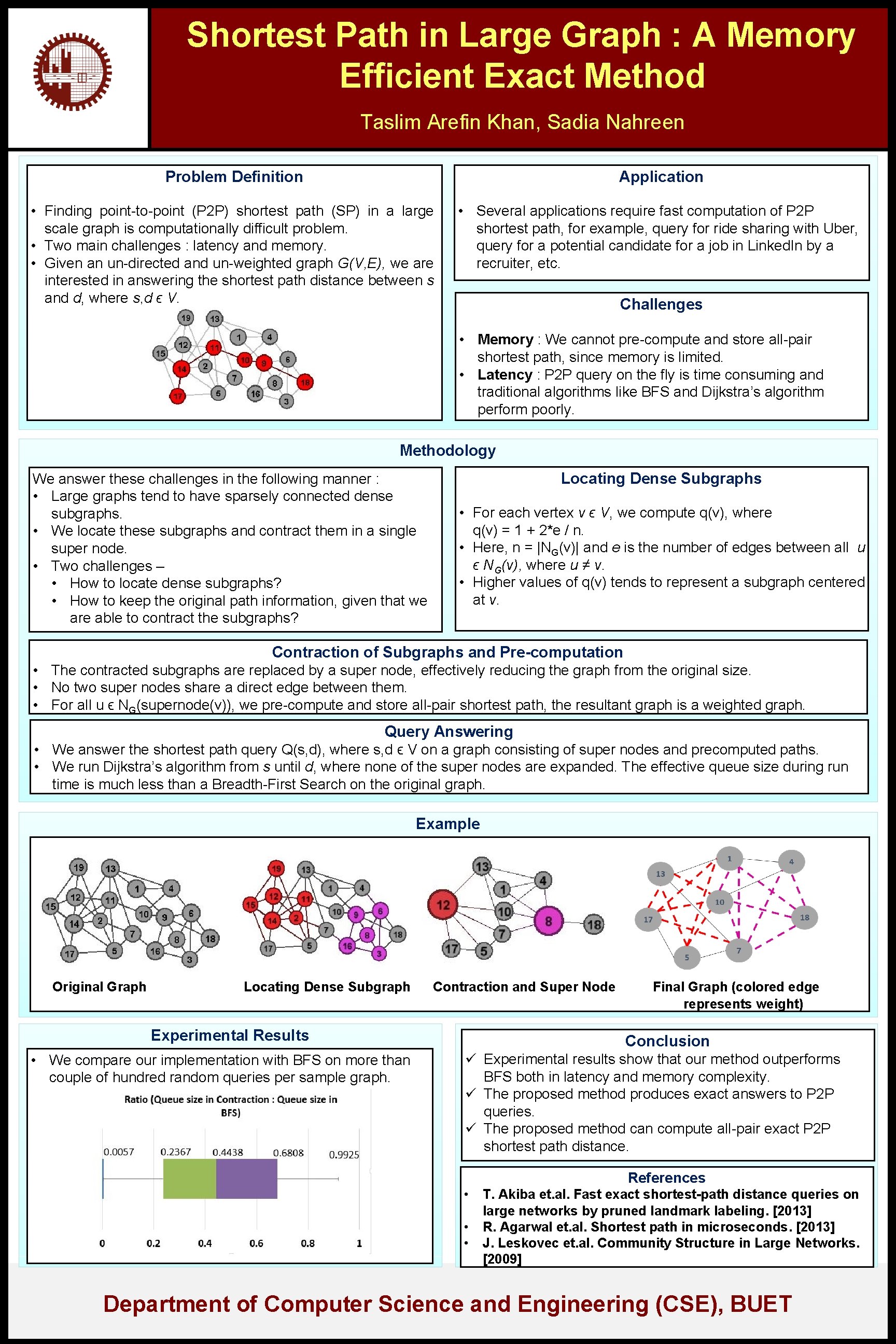
Shortest Path in Large Graph : A Memory Efficient Exact Method Taslim Arefin Khan, Sadia Nahreen Problem Definition Application • Finding point-to-point (P 2 P) shortest path (SP) in a large scale graph is computationally difficult problem. • Two main challenges : latency and memory. • Given an un-directed and un-weighted graph G(V, E), we are interested in answering the shortest path distance between s and d, where s, d ϵ V. • Several applications require fast computation of P 2 P shortest path, for example, query for ride sharing with Uber, query for a potential candidate for a job in Linked. In by a recruiter, etc. Challenges • Memory : We cannot pre-compute and store all-pair shortest path, since memory is limited. • Latency : P 2 P query on the fly is time consuming and traditional algorithms like BFS and Dijkstra’s algorithm perform poorly. Methodology We answer these challenges in the following manner : • Large graphs tend to have sparsely connected dense subgraphs. • We locate these subgraphs and contract them in a single super node. • Two challenges – • How to locate dense subgraphs? • How to keep the original path information, given that we are able to contract the subgraphs? Locating Dense Subgraphs • For each vertex v ϵ V, we compute q(v), where q(v) = 1 + 2*e / n. • Here, n = |NG(v)| and e is the number of edges between all u ϵ NG(v), where u ≠ v. • Higher values of q(v) tends to represent a subgraph centered at v. Contraction of Subgraphs and Pre-computation • The contracted subgraphs are replaced by a super node, effectively reducing the graph from the original size. • No two super nodes share a direct edge between them. • For all u ϵ NG(supernode(v)), we pre-compute and store all-pair shortest path, the resultant graph is a weighted graph. Query Answering • We answer the shortest path query Q(s, d), where s, d ϵ V on a graph consisting of super nodes and precomputed paths. • We run Dijkstra’s algorithm from s until d, where none of the super nodes are expanded. The effective queue size during run time is much less than a Breadth-First Search on the original graph. Example Original Graph Locating Dense Subgraph Contraction and Super Node Experimental Results • We compare our implementation with BFS on more than couple of hundred random queries per sample graph. Final Graph (colored edge represents weight) Conclusion ü Experimental results show that our method outperforms BFS both in latency and memory complexity. ü The proposed method produces exact answers to P 2 P queries. ü The proposed method can compute all-pair exact P 2 P shortest path distance. References • • • T. Akiba et. al. Fast exact shortest-path distance queries on large networks by pruned landmark labeling. [2013] R. Agarwal et. al. Shortest path in microseconds. [2013] J. Leskovec et. al. Community Structure in Large Networks. [2009] Department of Computer Science and Engineering (CSE), BUET