
Shortest Path Algorithms Andreas Klappenecker based on slides

Shortest Path Algorithms Andreas Klappenecker [based on slides by Prof. Welch] 1

Single Source Shortest Path Problem • Given: a directed or undirected graph G = (V, E), a source node s in V, and a weight function w: E -> R. • Goal: For each vertex t in V, find a path from s to t in G with minimum weight Warning! Negative weight cycles are a problem: s 4 t 5 2

Constant Weight Functions If the weights of all edges are all the same, then breadth-first search can be used to solve the single-source shortest path problem. Indeed, the tree rooted at s in the BFS forest is the solution. 3

Dijkstra’s Single Source Shortest Path Algorithm 4

Dijkstra's SSSP Algorithm • Assumes all edge weights are nonnegative • Similar to Prim's MST algorithm • Start with source node s and iteratively construct a tree rooted at s • Each node keeps track of tree node that provides cheapest path from s (not just cheapest path from any tree node) • At each iteration, include the node whose cheapest path from s is the overall cheapest 5

Prim's vs. Dijkstra's 4 5 4 1 s 6 Prim's MST 5 1 s 6 Dijkstra's SSSP 6
Implementing Dijkstra's Alg. • How can each node u keep track of its best path from s? • Keep an estimate, d[u], of shortest path distance from s to u • Use d as a key in a priority queue • When u is added to the tree, check each of u's neighbors v to see if u provides v with a cheaper path from s: • compare d[v] to d[u] + w(u, v) 7
Dijkstra's Algorithm • input: G = (V, E, w) and source node s // initialization • d[s] : = 0 • d[v] : = infinity for all other nodes v • initialize priority queue Q to contain all nodes using d values as keys 8
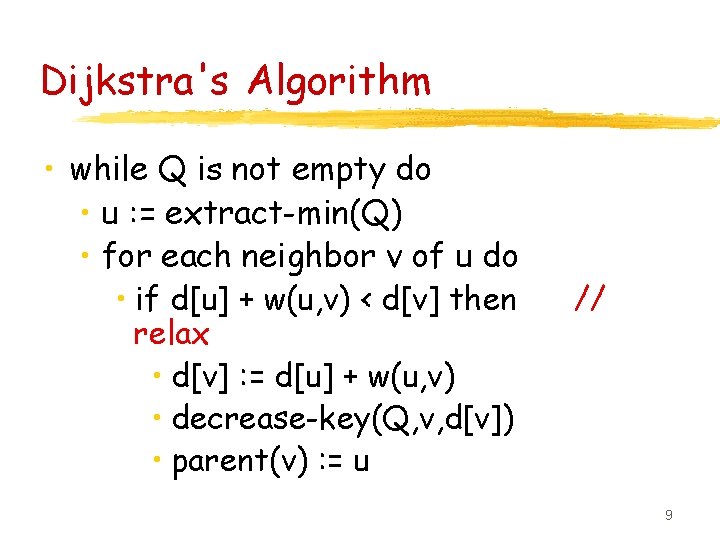
Dijkstra's Algorithm • while Q is not empty do • u : = extract-min(Q) • for each neighbor v of u do • if d[u] + w(u, v) < d[v] then relax • d[v] : = d[u] + w(u, v) • decrease-key(Q, v, d[v]) • parent(v) : = u // 9
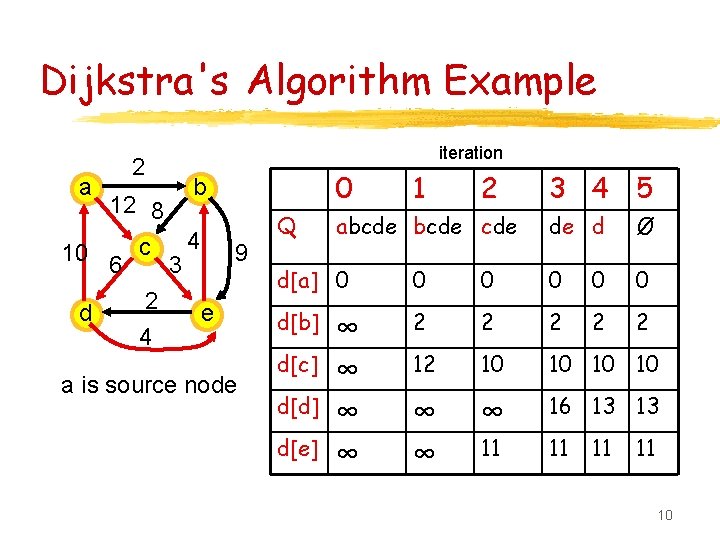
Dijkstra's Algorithm Example a 2 iteration 0 b 12 8 10 6 c 3 4 9 2 d e 4 a is source node Q d[c] d[d] d[e] 2 abcde cde d[a] 0 d[b] 1 ∞ ∞ 3 4 5 de d Ø 0 0 0 2 2 2 12 10 10 ∞ ∞ ∞ 16 13 13 11 11 10
Correctness of Dijkstra's Alg. • Let T i be the tree constructed after iteration of the while loop: i-th • The nodes in Ti are not in Q • The edges in Ti are indicated by parent variables • Show by induction on i that the path in T from s to u is a shortest path and has distance d[u], for all u in T i. • Basis: i = 1. s is the only node in T 1 and d[s] = 0. i 11
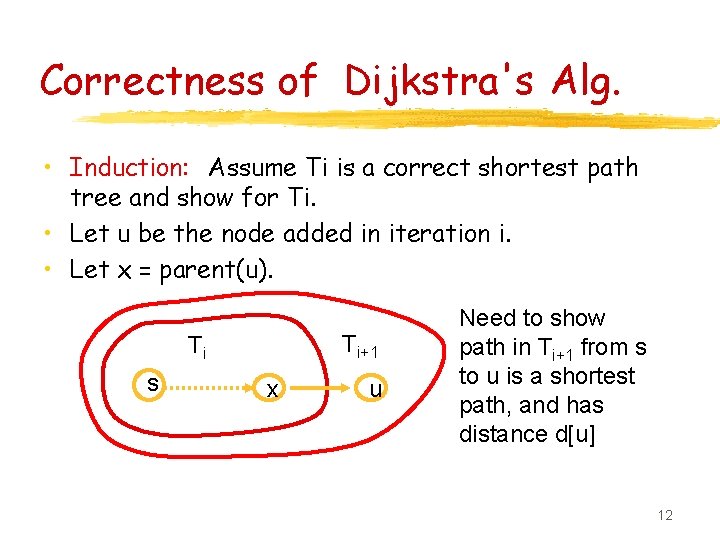
Correctness of Dijkstra's Alg. • Induction: Assume Ti is a correct shortest path tree and show for Ti. • Let u be the node added in iteration i. • Let x = parent(u). Ti+1 Ti s x u Need to show path in Ti+1 from s to u is a shortest path, and has distance d[u] 12
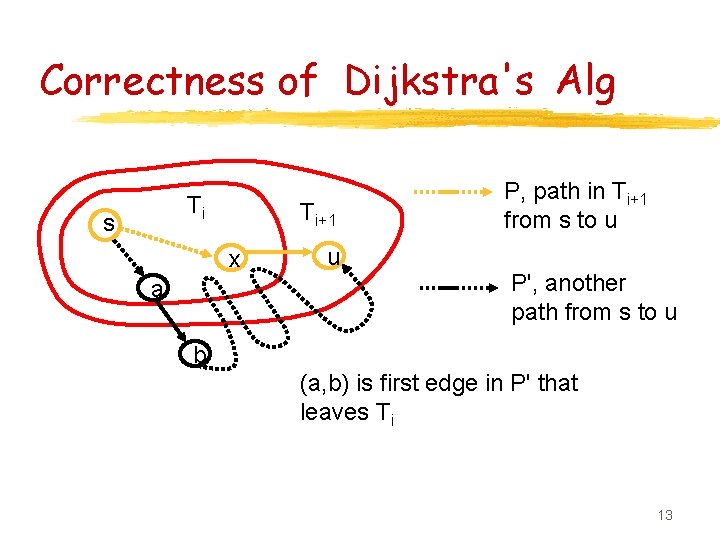
Correctness of Dijkstra's Alg Ti s Ti+1 x a u P, path in Ti+1 from s to u P', another path from s to u b (a, b) is first edge in P' that leaves Ti 13
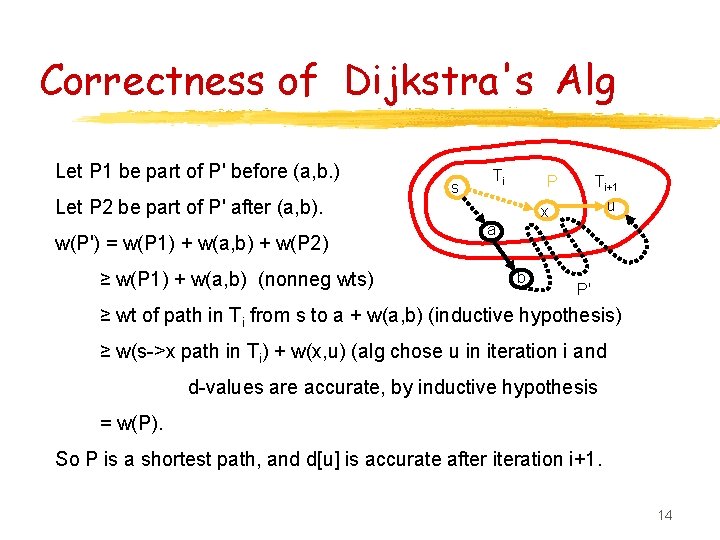
Correctness of Dijkstra's Alg Let P 1 be part of P' before (a, b. ) Let P 2 be part of P' after (a, b). w(P') = w(P 1) + w(a, b) + w(P 2) ≥ w(P 1) + w(a, b) (nonneg wts) s Ti P Ti+1 u x a b P' ≥ wt of path in Ti from s to a + w(a, b) (inductive hypothesis) ≥ w(s->x path in Ti) + w(x, u) (alg chose u in iteration i and d-values are accurate, by inductive hypothesis = w(P). So P is a shortest path, and d[u] is accurate after iteration i+1. 14

Running Time of Dijstra's Alg. • initialization: insert each node once • O(V T ins) • O(V) iterations of while loop • one extract-min per iteration => O(V T ex) • for loop inside while loop has variable number of iterations… • For loop has O(E) iterations total • one decrease-key per iteration => O(E • Total is O(V (T ins +T ex) + E Tdec) 15

Running Time using Binary Heaps and Fibonacci Heaps • O(V(T ins + T ex) + E Tdec) • If priority queue is implemented with a binary heap, then • Tins = T ex = Tdec = O(log V) • total time is O(E log V) • There are fancier implementations of the priority queue, such as Fibonacci heap: • Tins = O(1), T ex = O(log V), (amortized) • total time is O(V log V + E) Tdec = O(1) 16
Using Simpler Heap Implementations • O(V(T ins + T ex) + E Tdec) • If graph is dense, so that |E| = (V 2), then it doesn't help to make T ins and T ex to be at most O(V). • Instead, focus on making Tdec be small, say constant. • Implement priority queue with an unsorted array: • Tins = O(1), T ex = O(V), Tdec = O(1) • total is O(V 2) 17

The Bellman-Ford Algorithm 18

What About Negative Edge Weights? • Dijkstra's SSSP algorithm requires all edge weights to be nonnegative. This is too restrictive, since it suffices to outlaw negative weight cycles. • Bellman-Ford SSSP algorithm can handle negative edge weights. [It even can detect negative weight cycles if they exist. ] 19
Bellman-Ford: The Basic Idea • Consider each edge (u, v) and see if u offers v a cheaper path from s • compare d[v] to d[u] + w(u, v) • Repeat this process |V| - 1 times to ensure that accurate information propgates from s, no matter what order the edges are considered in 20

Bellman-Ford SSSP Algorithm • input: directed or undirected graph G = (V, E, w) //initialization • initialize d[v] to infinity and parent[v] to nil for all v in V other than the source • initialize d[s] to 0 and parent[s] to s // main body • for i : = 1 to |V| - 1 do • for each (u, v) in E do // consider in arbitrary order • if d[u] + w(u, v) < d[v] then • d[v] : = d[u] + w(u, v) • parent[v] : = u 21
Bellman-Ford SSSP Algorithm // check for negative weight cycles • for each (u, v) in E do • if d[u] + w(u, v) < d[v] then • output "negative weight cycle exists" 22
Running Time of Bellman-Ford • O(V) iterations of outer for loop • O(E) iterations of inner for loop • O(VE) time total 23

Correctness of Bellman-Ford Assume no negative-weight cycles. Lemma: d[v] is never an underestimate of the actual shortest path distance from s to v. Lemma: If there is a shortest s-to-v path containing at most i edges, then after iteration i of the outer for loop, d[v] is at most the actual shortest path distance from s to v. Theorem: Bellman-Ford is correct. This follows from the two lemmas and the fact that every shortest path has at most |V| - 1 edges. 24
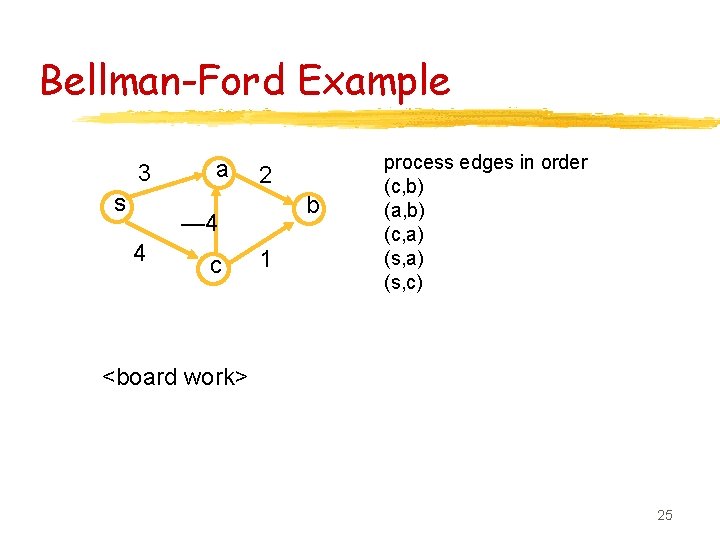
Bellman-Ford Example 3 s a 2 b — 4 4 c 1 process edges in order (c, b) (a, b) (c, a) (s, c) <board work> 25

Correctness of Bellman-Ford • Suppose there is a negative weight cycle. • Then the distance will decrease even after iteration |V| - 1 • shortest path distance is negative infinity • This is what the last part of the code checks for. 26

The Boost Graph Library The BGL contains generic implementations of all the graph algorithms that we have discussed: • Breadth-First-Search • Depth-First-Search • Kruskal’s MST algorithm • Prim’s MST algorithm • Strongly Connected Components • Dijkstra’s SSSP algorithm • Bellman-Ford SSSP algorithm I recommend that you gain experience with this useful library. Recommended reading: The Boost Graph Library by J. G. Siek, L. -Q. Lee, and A. Lumsdaine, Addison-Wesley, 2002. 27
- Slides: 27