
Shorter Labels for Routing in Trees Pawel Gawrychowski
Shorter Labels for Routing in Trees Pawel Gawrychowski, Wojciech Janczewski, Jakub Lopuszanski R 09942139 林宏信 R 08946008 呂明修 F 08945028 劉昕 D 05945012 周裕人
Slide Overview ● What is a Routing Labels Scheme? ● About this Paper ● Method 1 (Introduction) ● Method 1 (Encoding Algorithm) ● ○ Encoding (Single Node Example) ○ Encoding (Two Nodes Example) ○ Encoding (Three Nodes Example) ○ Encoding (More Complex Example) Method 1 (Decoding Algorithm) ○ Decoding (Three Nodes Example) ○ Decoding (More Complex Example) 2
Slide Overview ● ● ● Method 1 (Conclusion) ○ Final Structure of A Lable ○ Length of A Label Method 2 ○ Classes & Groups ○ Final Structure of A Lable ○ Length of A Label Method 3 ○ ● Final Structure and Length of A Lable Conclusion 3
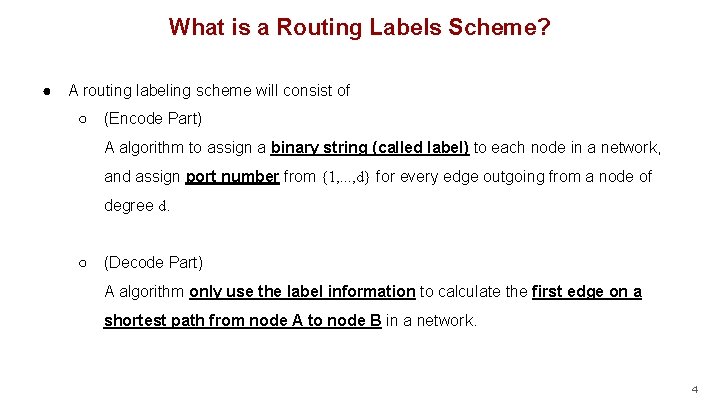
What is a Routing Labels Scheme? ● A routing labeling scheme will consist of ○ (Encode Part) A algorithm to assign a binary string (called label) to each node in a network, and assign port number from {1, . . . , d} for every edge outgoing from a node of degree d. ○ (Decode Part) A algorithm only use the label information to calculate the first edge on a shortest path from node A to node B in a network. 4

What is a Routing Labels Scheme? ● A trivial example: (encode the full information) ● In this case: The length of label is nlog(n). ● Note: For each number in {1, . . . , n} we can use log(n) bit to store. (binary encoding) (log = log 2 in this slide) 5
About this Paper ● Shorter Labels for Routing in Trees is published on SODA (ACM-SIAM Symposium of Discrete Algorithms) 2021. (Top conference in discrete algorithms domain) ● In this paper Shorter Labels for Routing in Trees The authors propose ○ An encoding method with label legnth logn + O((loglog(n))²). ○ A decoding method with polylogarithmic time. note: polylogarithmic time is better than polynomial time, it replaces the x by log(x). ○ (extending version) Label length logn + O((loglog(n)3) ) and constant decoding time. 6
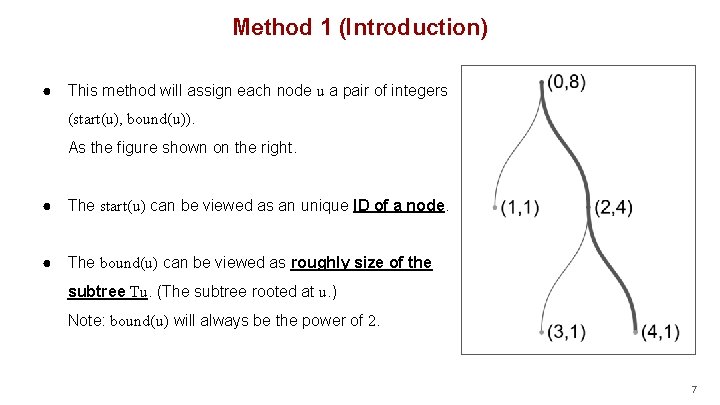
Method 1 (Introduction) ● This method will assign each node u a pair of integers (start(u), bound(u)). As the figure shown on the right. ● The start(u) can be viewed as an unique ID of a node. ● The bound(u) can be viewed as roughly size of the subtree Tu. (The subtree rooted at u. ) Note: bound(u) will always be the power of 2. 7
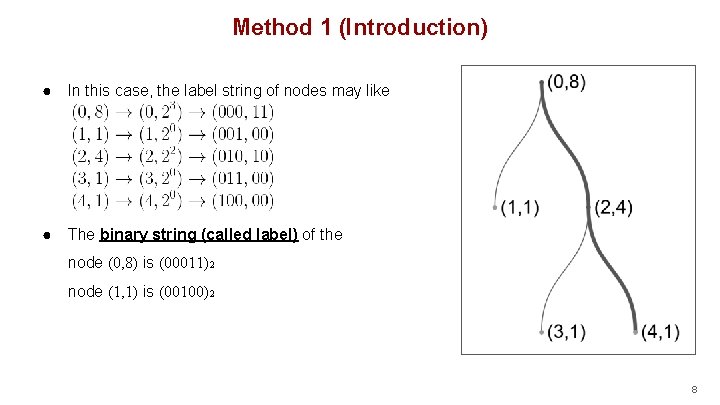
Method 1 (Introduction) ● In this case, the label string of nodes may like ● The binary string (called label) of the node (0, 8) is (00011)2 node (1, 1) is (00100)2 8
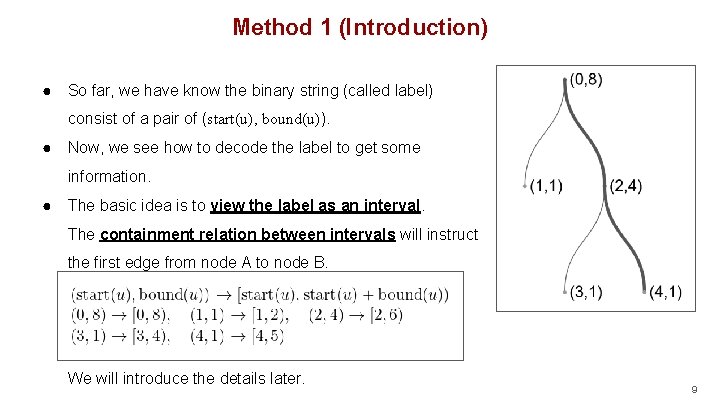
Method 1 (Introduction) ● So far, we have know the binary string (called label) consist of a pair of (start(u), bound(u)). ● Now, we see how to decode the label to get some information. ● The basic idea is to view the label as an interval. The containment relation between intervals will instruct the first edge from node A to node B. We will introduce the details later. 9
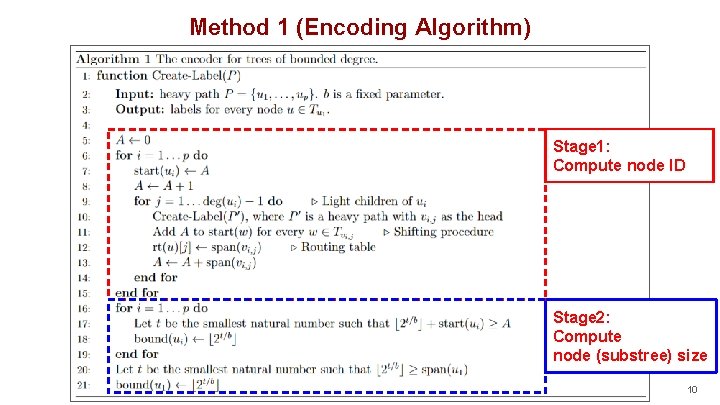
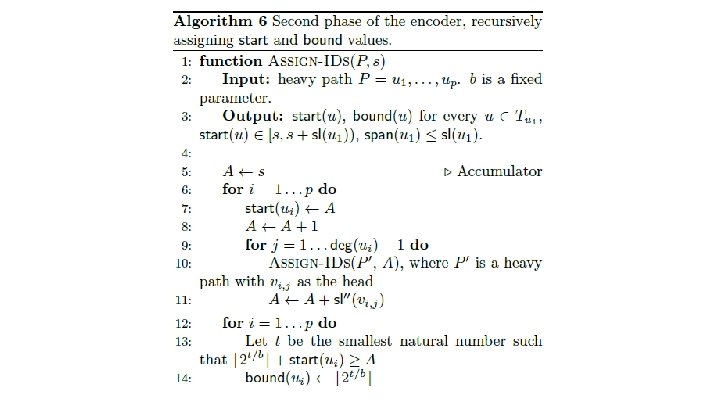
Method 1 (Encoding Algorithm) Stage 1: Compute node ID Stage 2: Compute node (substree) size 10
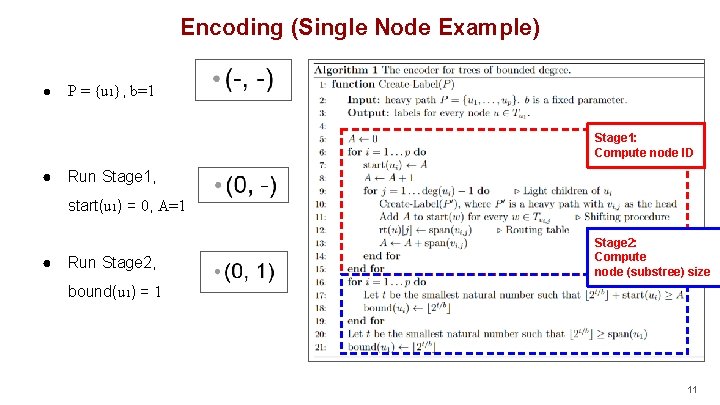
Encoding (Single Node Example) ● P = {u 1}, b=1 Stage 1: Compute node ID ● Run Stage 1, start(u 1) = 0, A=1 ● Run Stage 2, Stage 2: Compute node (substree) size bound(u 1) = 1 11
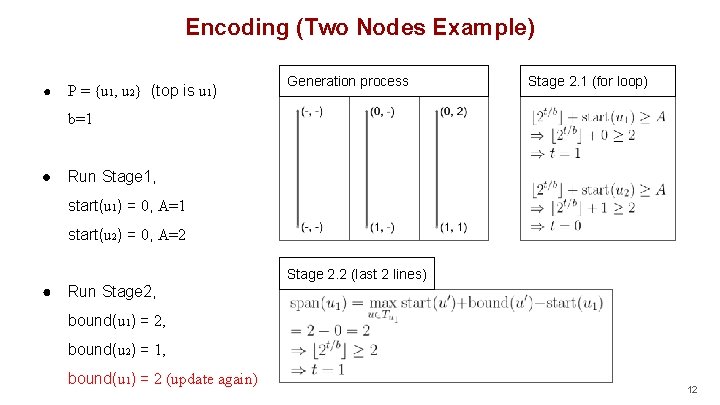
Encoding (Two Nodes Example) ● P = {u 1, u 2} (top is u 1) Generation process Stage 2. 1 (for loop) b=1 ● Run Stage 1, start(u 1) = 0, A=1 start(u 2) = 0, A=2 Stage 2. 2 (last 2 lines) ● Run Stage 2, bound(u 1) = 2, bound(u 2) = 1, bound(u 1) = 2 (update again) 12
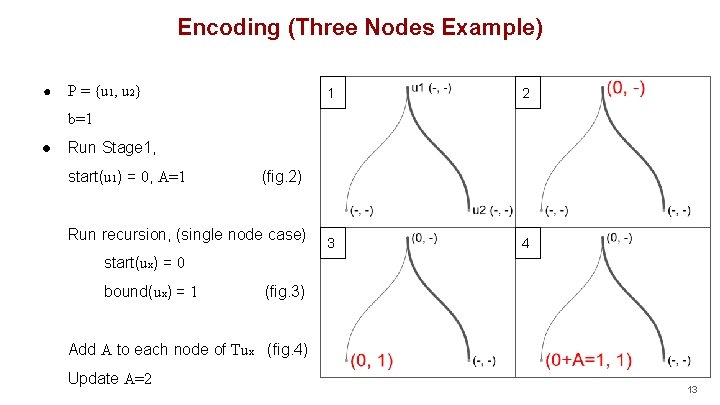
Encoding (Three Nodes Example) ● P = {u 1, u 2} 1 2 3 4 b=1 ● Run Stage 1, start(u 1) = 0, A=1 (fig. 2) Run recursion, (single node case) start(ux) = 0 bound(ux) = 1 (fig. 3) Add A to each node of Tux (fig. 4) Update A=2 13
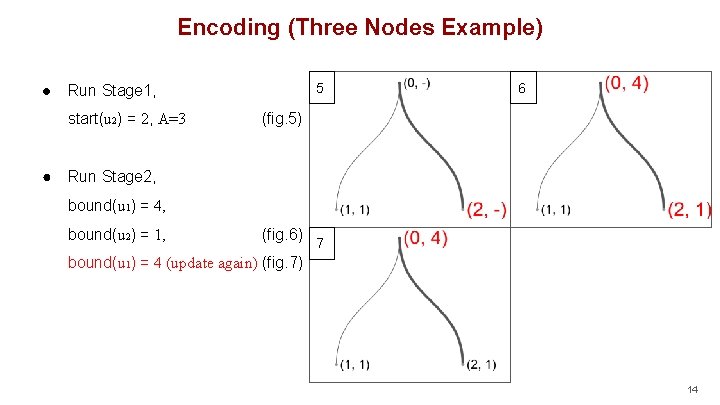
Encoding (Three Nodes Example) ● start(u 2) = 2, A=3 ● 5 Run Stage 1, 6 (fig. 5) Run Stage 2, bound(u 1) = 4, bound(u 2) = 1, (fig. 6) 7 bound(u 1) = 4 (update again) (fig. 7) 14
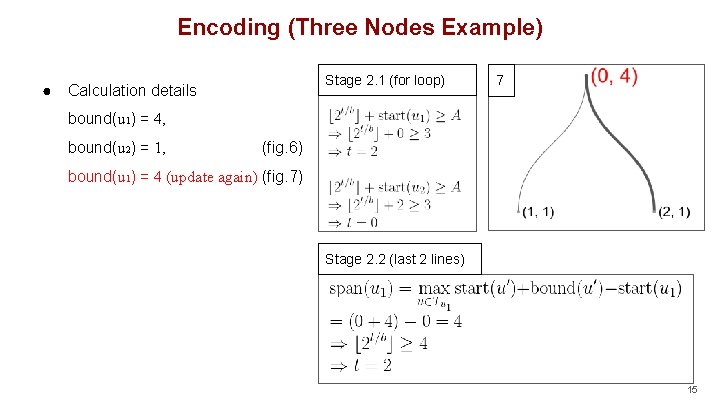
Encoding (Three Nodes Example) ● Stage 2. 1 (for loop) Calculation details 7 bound(u 1) = 4, bound(u 2) = 1, (fig. 6) bound(u 1) = 4 (update again) (fig. 7) Stage 2. 2 (last 2 lines) 15
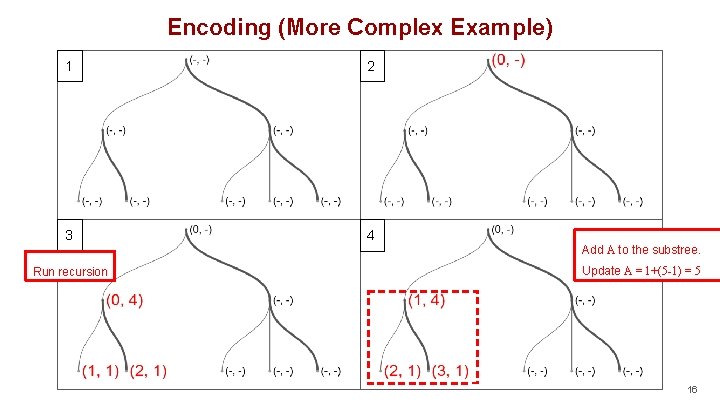
Encoding (More Complex Example) 1 2 3 4 Run recursion Add A to the substree. Update A = 1+(5 -1) = 5 16
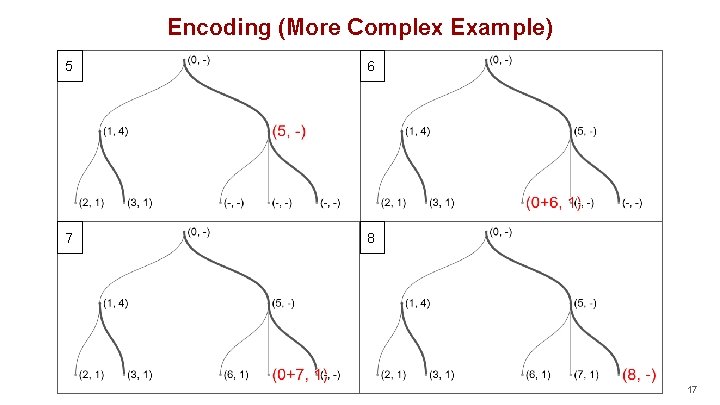
Encoding (More Complex Example) 5 6 7 8 17
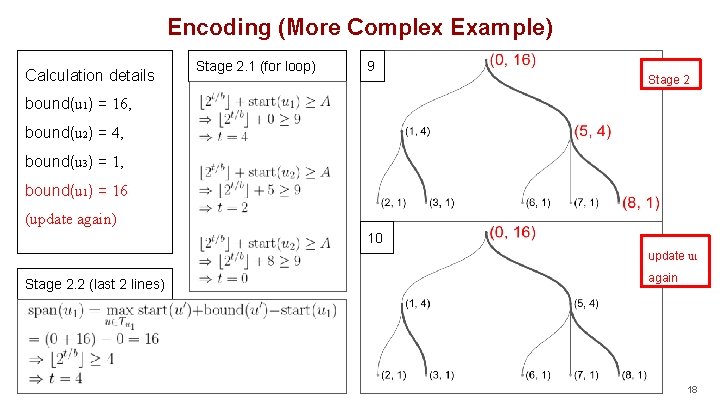
Encoding (More Complex Example) Calculation details Stage 2. 1 (for loop) 9 Stage 2 bound(u 1) = 16, bound(u 2) = 4, bound(u 3) = 1, bound(u 1) = 16 (update again) 10 update u 1 Stage 2. 2 (last 2 lines) again 18
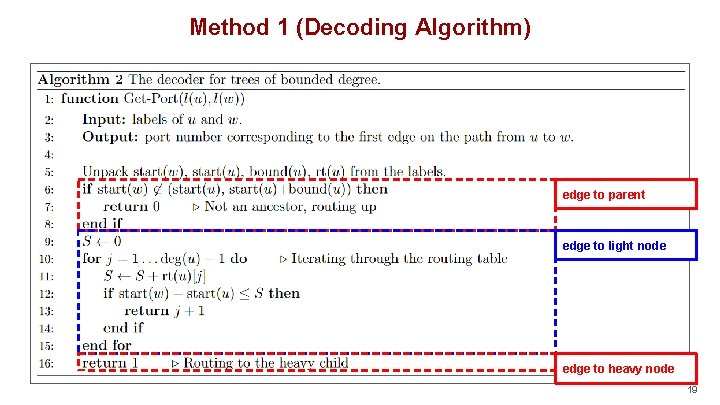
Method 1 (Decoding Algorithm) edge to parent edge to light node edge to heavy node 19
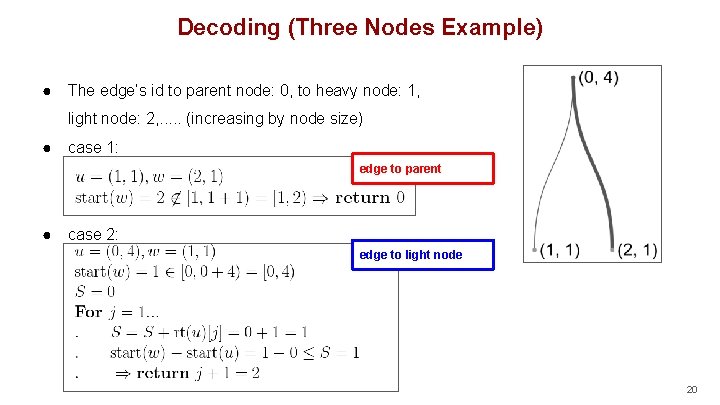
Decoding (Three Nodes Example) ● The edge’s id to parent node: 0, to heavy node: 1, light node: 2, . . . (increasing by node size) ● case 1: edge to parent ● case 2: edge to light node 20
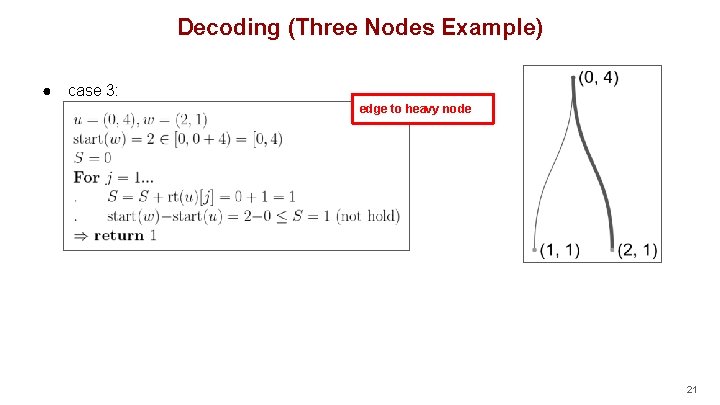
Decoding (Three Nodes Example) ● case 3: edge to heavy node 21
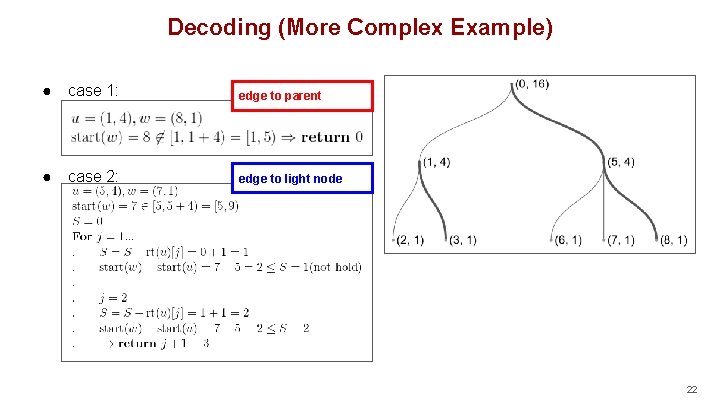
Decoding (More Complex Example) ● case 1: edge to parent ● case 2: edge to light node 22
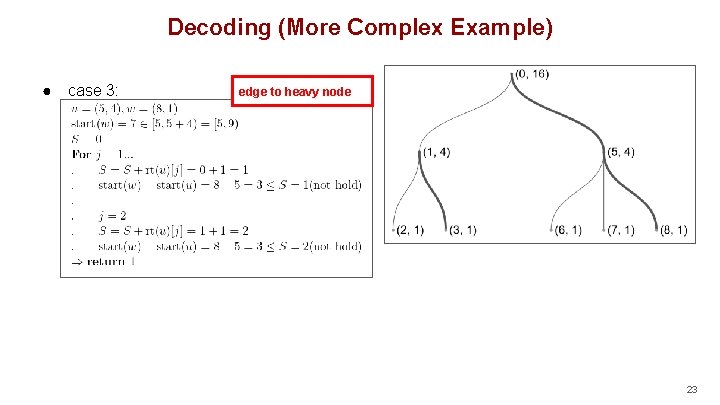
Decoding (More Complex Example) ● case 3: edge to heavy node 23
![Final structure of a label 1. start(u). 2. bound(u)=[2 t/b] stored as t in](http://slidetodoc.com/presentation_image_h2/37f3e1e5eacd782e01353e4e54b15bc7/image-24.jpg "Final structure of a label 1. start(u). 2. bound(u)=[2 t/b] stored as t in")
Final structure of a label 1. start(u). 2. bound(u)=[2 t/b] stored as t in binary. 3. small’(u). 4. routing table rt(u) storing the number of big children of every possible size. 5. level(u).
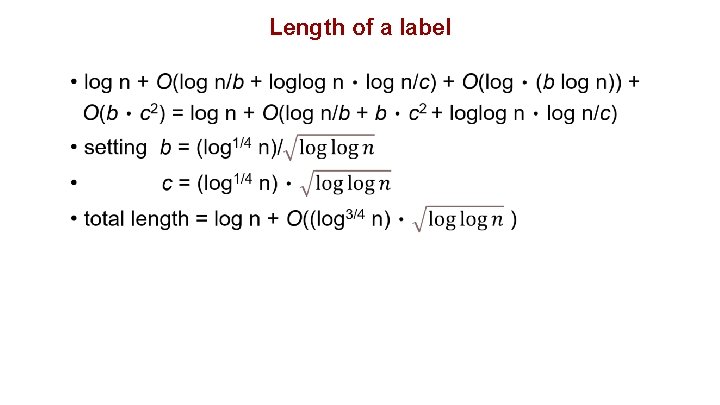
Length of a label
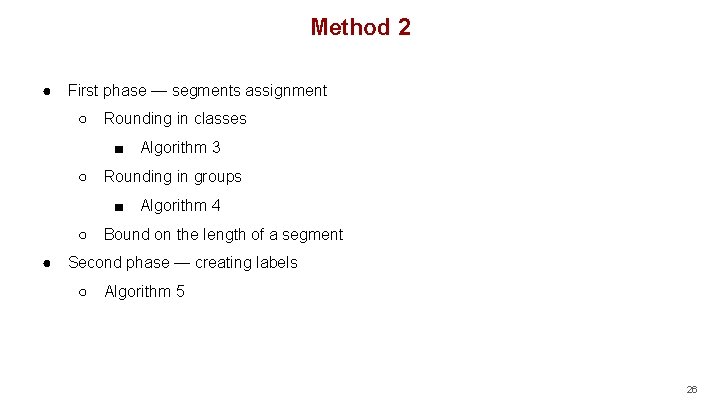
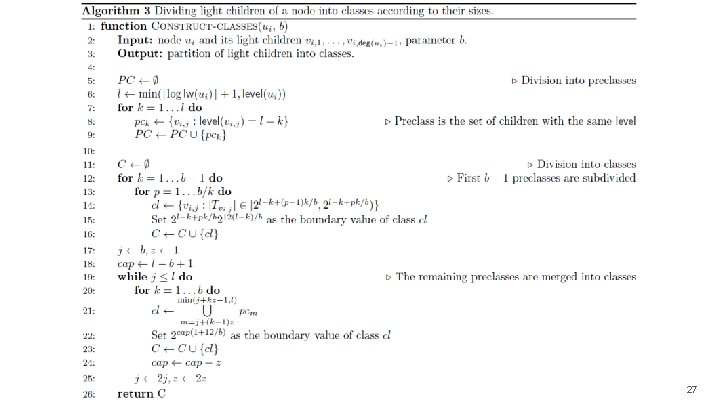
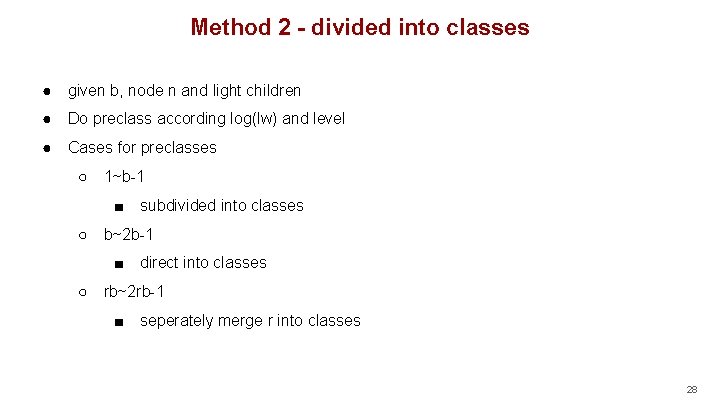
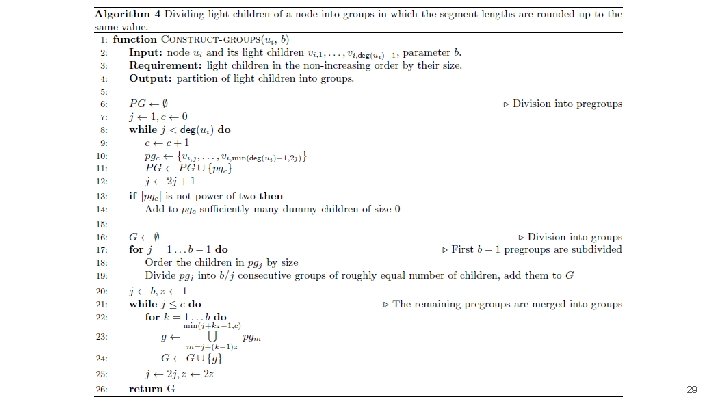
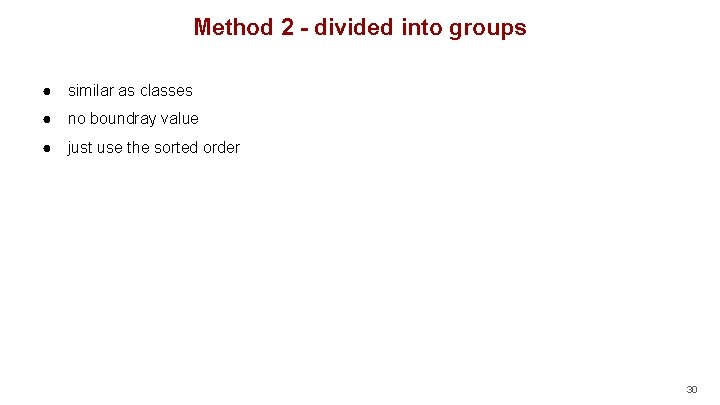
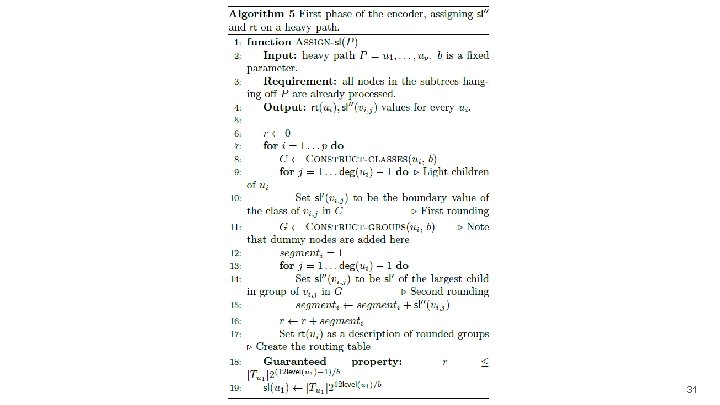
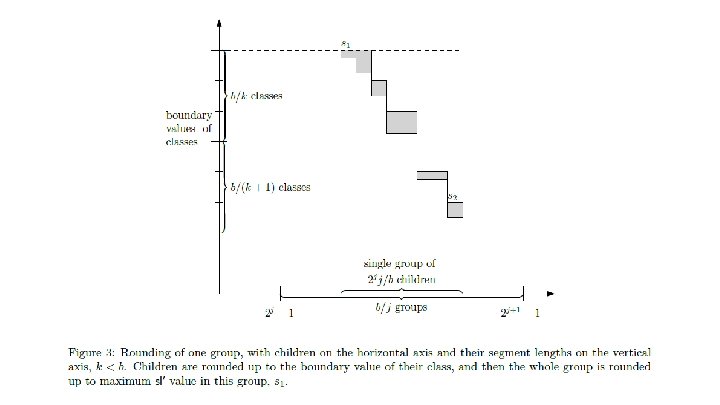
Method 2 ● First phase — segments assignment ○ Rounding in classes ■ ○ Rounding in groups ■ ○ ● Algorithm 3 Algorithm 4 Bound on the length of a segment Second phase — creating labels ○ Algorithm 5 26
title 27
Method 2 - divided into classes ● given b, node n and light children ● Do preclass according log(lw) and level ● Cases for preclasses ○ 1~b-1 ■ ○ b~2 b-1 ■ ○ subdivided into classes direct into classes rb~2 rb-1 ■ seperately merge r into classes 28
title 29
Method 2 - divided into groups ● similar as classes ● no boundray value ● just use the sorted order 30
title 31
![Final structure of a label 1. start(u). 2. bound(u)=[2 t/b] stored as t. 3.](http://slidetodoc.com/presentation_image_h2/37f3e1e5eacd782e01353e4e54b15bc7/image-34.jpg "Final structure of a label 1. start(u). 2. bound(u)=[2 t/b] stored as t. 3.")
Final structure of a label 1. start(u). 2. bound(u)=[2 t/b] stored as t. 3. an encoding of rt(u). 4. log lw(u). 5. level(u). 6. log(deg(u)-1).
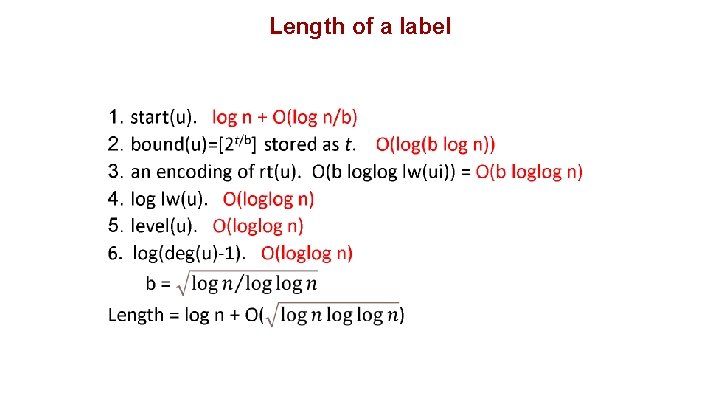
Length of a label
Method 3 ● ● ● The idea is that if the binary expansion of start(u) happens to have some trailing zeroes, then we can save some bits by removing these trailing zeroes, assuming that we are additionally storing their number. Thus, we add O(log n) bits to every label, but then are able to substantially shorten some of them. Add O(log n) bits to every label, but then are able to substantially shorten some of them. The saved space can be used to store a relatively big routing table.
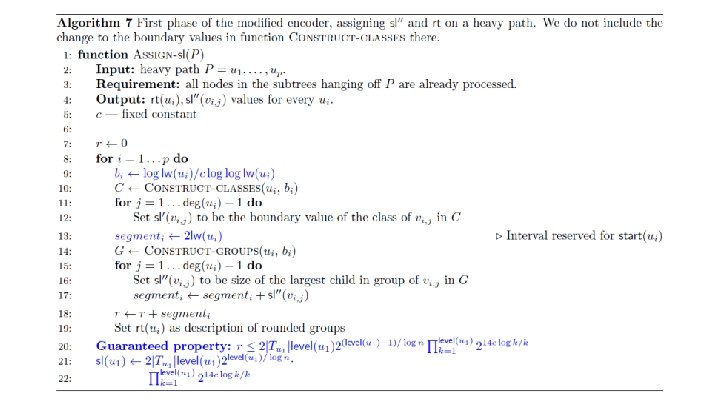
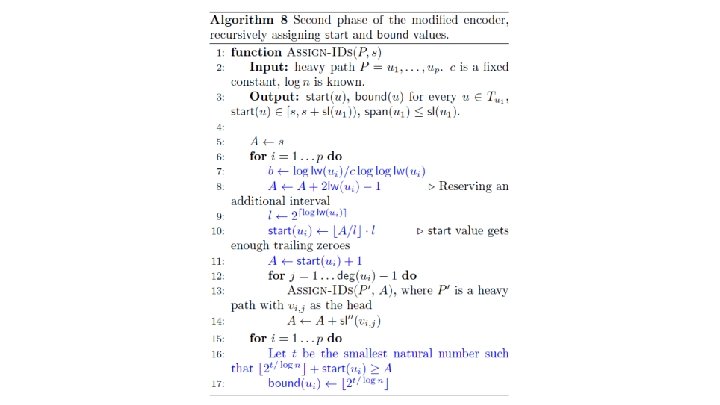
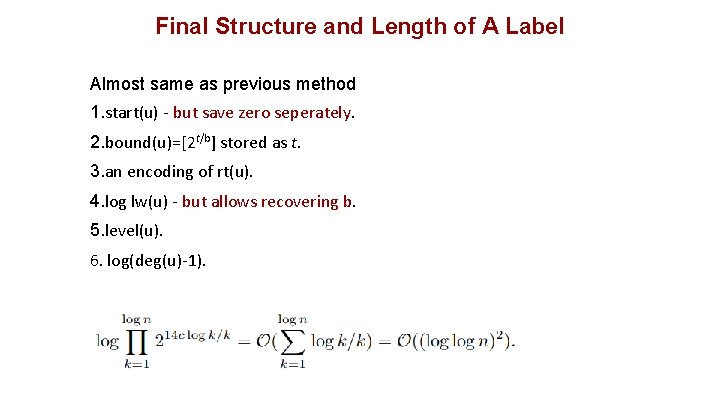
Final Structure and Length of A Label Almost same as previous method 1. start(u) - but save zero seperately. 2. bound(u)=[2 t/b] stored as t. 3. an encoding of rt(u). 4. log lw(u) - but allows recovering b. 5. level(u). 6. log(deg(u)-1).
Conclusion ● In this paper Shorter Labels for Routing in Trees The authors propose ○ An encoding method with label legnth logn +O((loglog(n))²). ○ A decoding method with polylogarithmic time. note: polylogarithmic time is better than polynomial time, it replaces the x by log(x). ○ Guess (no prove) the upper bound of the Designer-port routing problem. 40
- Slides: 40