
Shortcuts and the Indirect Method Sara Larkin Math
- Slides: 7
Shortcuts and the Indirect Method Sara Larkin Math Consultant Iowa Educational Services for the Blind and Visually Impaired
Shortcuts/Indirect Method Comments • Use these only once the student understands the basics of counting, addition, and subtraction • The student should be able to understand why the shortcut is possible and the reasoning behind it • The student should not do these shortcuts as part of a memorized rote process
The FIVE Bead (addition) • If there aren’t enough beads to add, see if there is a five bead available to use • If so, move the five bead down • Compensate for the difference in what was added • Examples • 23 + 25 = 48 • 425 + 63 = 488
The FIVE Bead (subtraction) • If there aren’t enough beads to subtract, see if there is a five bead available to use • If so, move the five bead away • Compensate for the difference in what was subtracted • Examples • 76 – 35 = 41 • 386 – 72 = 314
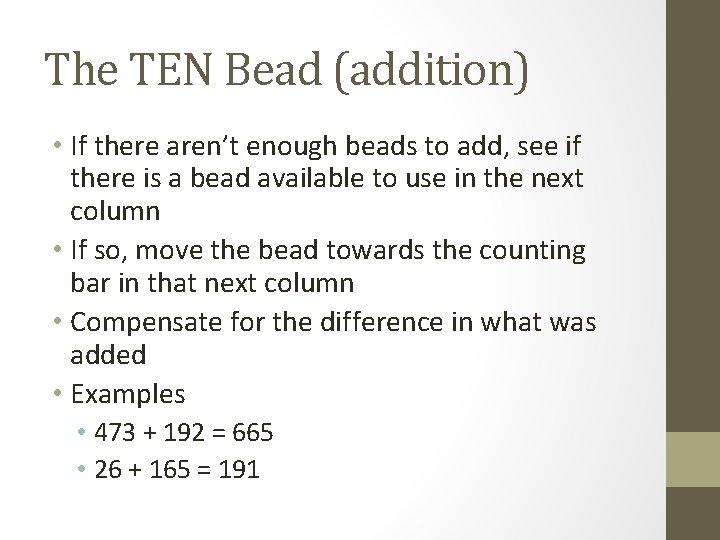
The TEN Bead (addition) • If there aren’t enough beads to add, see if there is a bead available to use in the next column • If so, move the bead towards the counting bar in that next column • Compensate for the difference in what was added • Examples • 473 + 192 = 665 • 26 + 165 = 191
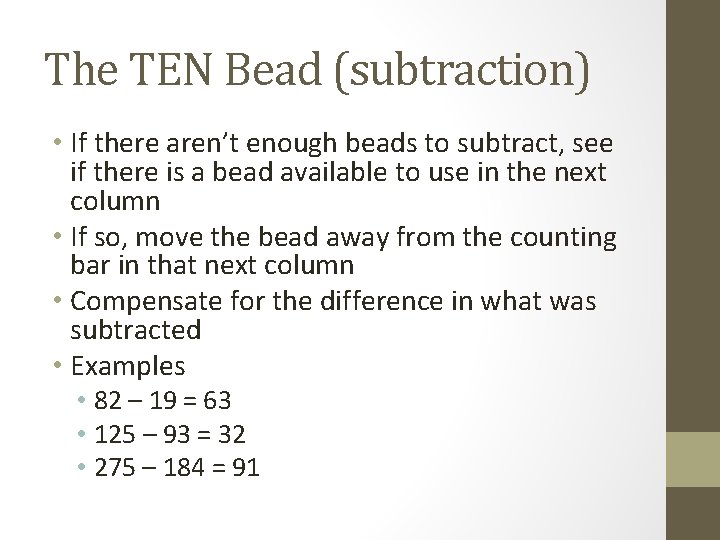
The TEN Bead (subtraction) • If there aren’t enough beads to subtract, see if there is a bead available to use in the next column • If so, move the bead away from the counting bar in that next column • Compensate for the difference in what was subtracted • Examples • 82 – 19 = 63 • 125 – 93 = 32 • 275 – 184 = 91
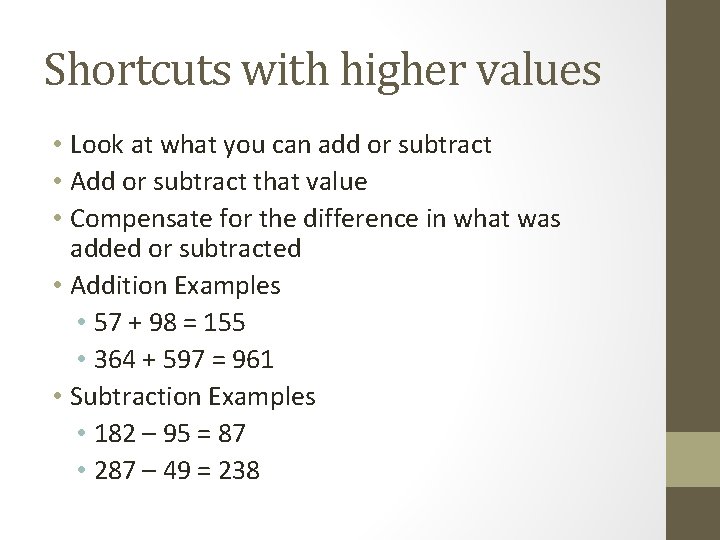
Shortcuts with higher values • Look at what you can add or subtract • Add or subtract that value • Compensate for the difference in what was added or subtracted • Addition Examples • 57 + 98 = 155 • 364 + 597 = 961 • Subtraction Examples • 182 – 95 = 87 • 287 – 49 = 238