
Short Story Seminar SymbolsStructureCharacteristicsCriticism Symbols are often based
Short Story Seminar Symbols/Structure/Characteristics/Criticism
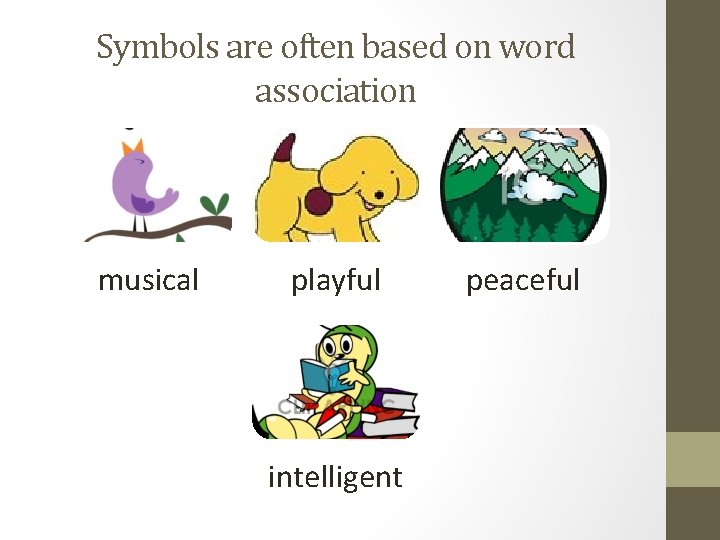
Symbols are often based on word association musical playful intelligent peaceful
Numbers as symbols • The number three often represents the Holy Trinity (Father, Son, and Holy Ghost), or mind/body/spirit, or even the cycle of life: birth/life/death.
4 • Four is also common as it could refer to the seasons, the number of human limbs, or the elements of earth, wind, fire, and water. Combining the meanings of numbers three and four leads to the number seven that joins together God and man. It could also represent other pivotal ideas like the days of the week, the days of creation, or the deadly sins.
Symbols in short stories • Colors • The use of color suggests that there is a deeper meaning.
• Caution • Hope Purple • Love • Warning Yellow/gold Red Here are some common colors: • Royalty • Magic
Water as a symbol • Water can appear in many forms in literature including lakes, rivers, streams, rain, or waterfalls. Generally, water symbolizes a spiritual awakening or a behavioral rebirth.
Light & Dark Symbols • These two opposing forces have contrary meanings. Light could symbolize spiritual or intellectual enlightenment, or even hope. Darkness represents dejection, ignorance, or sometimes evil and death.
Common objects as symbols • Hourglasses, clocks, or other timetelling devices: passage of time • Bridge: connection, transformation • Heart: love or emotion • Shadows: darkness, impending evil • Masks: cover, conceal, or disguise
Nature as a Symbol • Seasons: spring=birth, summer=life, fall=aging, winter=death • Mountains: ambitions, obstacles • Valleys: depression, rock bottom • Fire: knowledge, life, transformation, healing, passion, energy • Ice: coldness, ignorance, fruitlessness, impotence • Trees: knowledge or life • Forests: evil or fear
The Short Story Genre • A short story is a brief work of literature, usually written in narrative prose… • Emerging from earlier oral storytelling traditions in the 17 th century
• The short story features a small cast of named characters, and focuses on a self-contained incident with the intent of evoking a "single effect" or mood.
Elements of the short story • The short story has the following dramatic structure: • Exposition -the introduction of setting, situation and protagonist,
• Complication- the event that introduces the conflict: rising action
• Crisis-the decisive moment for the protagonist and his commitment to a course of action: climax (the point of highest interest in terms of the conflict and the point with the most action)
• Falling action and resolution-the point when the conflict is resolved • Because of their length, short stories often combine these two elements to wrap up the story
The Essential Question • The reader is always left with an unanswerable yet debatable question(s) at the end of the story. The purpose of the short story is for you, the reader to rethink what you believe to be true or just.
Examples of 2 symbols with 2 quotes in every short story Symbol 2 Examples(quotes) What does the symbol represent and therefore what is the deeper meaning?
Critical Perspective • Approaches to Analysis and Interpretation of Literature:
Why We Read? • (2)-We read to teach political, social and demographic changes • (4)It is morally good for readers to assimilate. • (8)stories are read to tech us valuable lessons viewed as educationally and morally good for readers • (9) Literary works should be read to challenge conventional ways of behaving and orthodox ways of thinking.
What we read? • (4) What we read comes from the canon, why we read is because of the benefit of learning. • (9) It is people of today of both genders and of various cultures, races, and ethnicities, who are debating not only what should be part of the canon of literature, but whether the very idea of a canon is viable at all.
How We Read • (2)-Grasping the moral of the story, which depends on gender, race, religion, and nationalities • (4)- Literary works contain layers of meaning which have to analyzed to understand its complex meaning. What we read can be interpreted in many different ways depending on who the reader is. • (5) With every work of literature, every reader finds different meanings that pertains to them. • (8) Perspective should be based off of personal opinion.
Biographical Perspectives • A form of criticism that analyzes a writer’s biography to show the relationship between the author’s life and his/her works of literature. • Must research the Author’s life • Then identify what part of the work was influenced by his life
Historical Perspective • Provides a context of background information in order to understand the work/literature. • Social attitudes and cultural practices are prevalent in the text based upon the time period in which the work was written. The time period is researched.
Historical Perspective…Con’t • Readers must contextualize the story-social background and the intellectual mores of the time period is necessary for understanding how literary works were perceived in their time and how it reflects the ideas and attitudes of that time.
Psychological Perspective • Relies on how certain works of literature affected by an author’s mind and personality. • Consider Freud's psychoanalytic interpretation of human development, dreams and symbolism
Feminist Perspective The concepts of gender in literature were created off patriarchal biases, which means men dominated literature throughout history. Feminist perspective looks for ways that females are portrayed inferiorly to males.
Mythological Perspective • Identifies extraordinary stories with ordinary morals. (Mr. Death) • A myth typically are written to explain unknown phenomenon's such as death and birth and tie them back to explain universal patterns that represent common human experiences. (Also the use of symbols)
Historical Perspective • (2) -Old historicism looks at language and structure of the passage, while new historicism looks at other pieces from the same time period to reveal cultural attitudes. • (4) Every piece of literature has a historical perspective which can be old or new depending on if the piece has primary sources or a general reference to history. • (5) Provides a context of background information in order to understand the work/literature. • (8) Social attitudes and cultural practices are prevalent in the text based upon the time period in which the work was written. • (9) Understanding the social background and the intellectual currents of the time period is necessary for understanding how literary works were perceived in their time and how it reflects the ideas and attitudes of that time.
Feminist Perspective • (2)The concepts of gender in literature were created off patriarchal biases, which means men dominated literature throughout history • (4)Reflects the male dominated society and their unfair advantages. • (5) The feminist look to literature as an opportunity to change society as a whole.
Mythological Perspective • (2)Myths are stories about origins, or how things came to be. • Mythological Perspective is being able to take these archetypes ( universal symbols) from myths, and apply them to other stories with a similar or same archetype. • (4)Myths or stories include reoccurring patterns, universal symbols, and human experiences. It is important to approach literary works with an open mind to understand all literary symbols or journeys. • (5) Mythological perspective helps the reader understand what guiding factors are behind what the author writes and the moral principles expressed by the character.
Biographical Perspectives • (2) Many stories are influenced by events in the writer’s life • Even if not directly written about author, the style of writing still reflects the author. • (4) A form of criticism, which analyzes a writer’s biography to show the relationship between the author’s life and works of literature. • (5) Biography’s can be used for the author to get their agenda across to readers • (8) Readers gain information from the story by learning about the authors life. • (9) The passage talks about whether the biographical behaviors of an author benefits or deters one from successfully analyzing a piece of literature.
Psychological Perspective • (2)We can use Freud psychoanalytic to make intelligent observations about the characters. • Relies on symbolism to determine the unconscious desires of both the characters in the work and the author • (4) Psychological criticism doesn’t criticize the short story but the thoughts and imagination of the actual author and how he/she reflects it in the piece of literature • (5) It is how certain works of literature affected by an author’s mind and personality. • (8)Psychological critics are more interested in the creative processes of writers than in their literary works. • (9) Linked with author’s mental and emotional characteristics. • 3 mental functions- id(desire), superego(standards) and ego(balance between other two)
Mythological Perspective • (8) Myths tell the story about how something came to be • (8) They represent human experiences, such as life, death, or a moral journey • (8) Mythological Perspectives tell extraordinary stories with ordinary morals. Any ordinary story can be told to portray a moral, however, mythology is a more entertaining way to tell a story. • (9) A myth typically are written to explain unknown phenomenon's such as death and birth and tie them back to explain universal patterns that represent common human experiences.
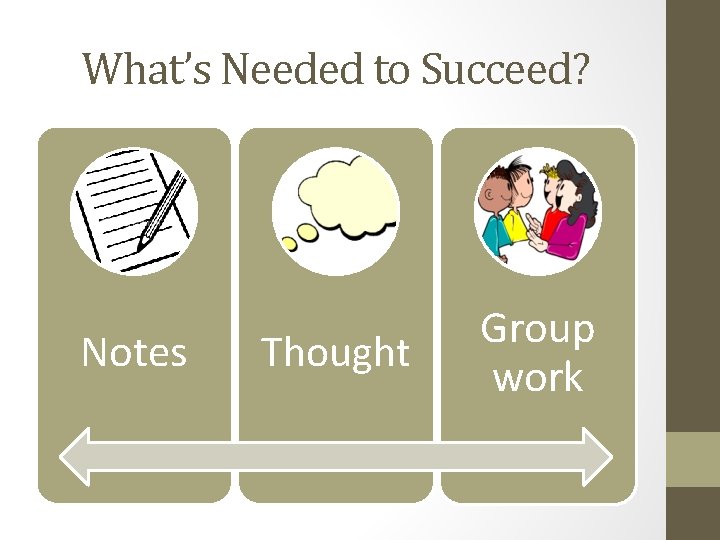
What’s Needed to Succeed? Notes Thought Group work
Start Here: What is Poignant? • What is one important aspect that you want the class to walk away with concerning the critical perspectives topic that your group was assigned? • Write this idea, fact or concept on an index card…
Collaborative Short Story #1 • On every distributed index card please include the period, title of the short story; students in the group that are present, and notes written in bullets. The start of quotes may be added with the paragraph & page number noted. *All references should be read from the text- not the notecard.
Collaborative Short Story #1 -a • Task for today: • Plot Summary –lol • (language of literature required) • Identify the parts of the short story • Climax… must be proven Setting – and the influence on the characters and the plot
Collaborative Short Story #2 • Characterization of the protagonist • 2 -3 Essential Questions • With possible answers • 2 -3 symbols with it’s significance explained • (must identify where the symbol is found 2 -3 times)
Prepare to: teach your short story
- Slides: 40