
Short Stories The Short Story Characteristics Plot the
- Slides: 18
Short Stories
The Short Story Characteristics Plot: the story is usually a brief account of one dominant incident, but has a well defined introduction, rising action, climax, and conclusion. The conclusion is often sudden and dramatic. A short story begins “in media res”: Latin for “in the middle of things” Mood and Atmosphere: focuses on one primary mood, such as suspense, fear, mystery, or humour. Character: the story usually revolves around a single character, revealing rather than developing his or her character.
Plot Elements Plot is the action of the story; the sequence of incidents portraying the conflict(s) of the central character. Exposition/Introduction: The events that tell us about the character, setting, etc. Inciting Force: The event that introduces the conflict and compels the main character to act. Rising Action: The events that build towards the climax. Climax: The highest point of the story, in which the main conflict is faced. It is the turning point in the story, after which events move towards a solution to the conflict. Falling Action: All the events that take place after the climax. Resolution: all the loose ends are tied up.
Plot Elements Foreshadowing: A hint of forthcoming events. Flashback: story begins at the present and goes back in time to explain events that led to the present.
Plot Elements Conflict: plot is driven by conflict in a story. Conflict is the struggle between various elements in a work of fiction; often a struggle for self-preservation. Types of conflict include: Human vs. Nature Human vs. Self Human vs. God/Fate
Irony: is a literary device or situation that depends on the existence of at least two separate and contrasting levels of meaning or experience. Four specific types of irony are: Dramatic irony – depends on the audience’s knowing something that the protagonist has not yet realized. Situational irony – exists when what happens is at odds with what the story’s situation leads readers to expect will happen (story takes a twist). Tragic irony – exists when fate frustrates any effort a character might make to control or reverse his or her destiny. Verbal irony – can be expressed as understatement, hyperbole, or sarcasm; words mean the opposite of what is really meant
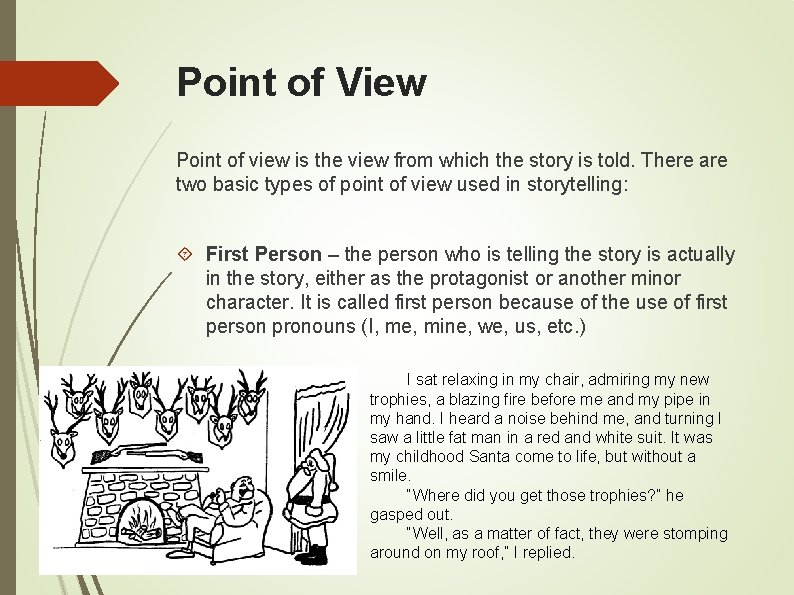
Point of View Point of view is the view from which the story is told. There are two basic types of point of view used in storytelling: First Person – the person who is telling the story is actually in the story, either as the protagonist or another minor character. It is called first person because of the use of first person pronouns (I, me, mine, we, us, etc. ) I sat relaxing in my chair, admiring my new trophies, a blazing fire before me and my pipe in my hand. I heard a noise behind me, and turning I saw a little fat man in a red and white suit. It was my childhood Santa come to life, but without a smile. “Where did you get those trophies? ” he gasped out. “Well, as a matter of fact, they were stomping around on my roof, ” I replied.
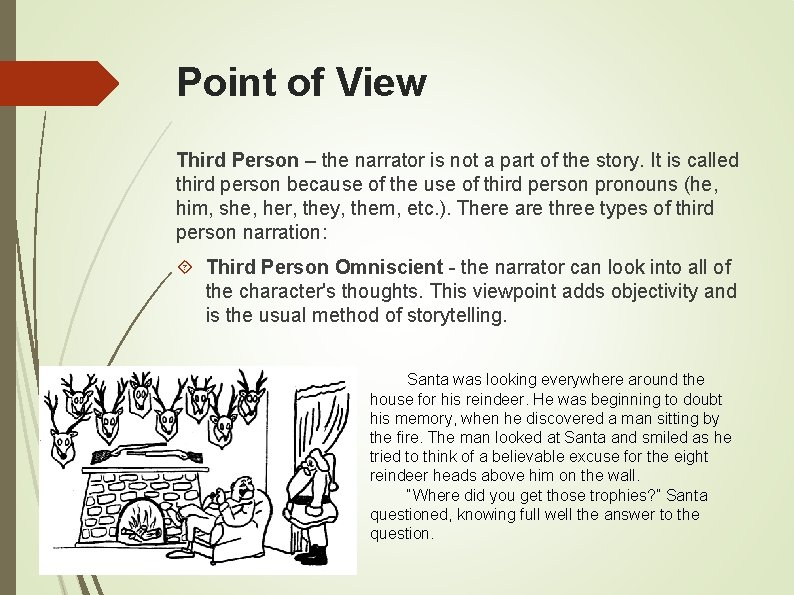
Point of View Third Person – the narrator is not a part of the story. It is called third person because of the use of third person pronouns (he, him, she, her, they, them, etc. ). There are three types of third person narration: Third Person Omniscient - the narrator can look into all of the character's thoughts. This viewpoint adds objectivity and is the usual method of storytelling. Santa was looking everywhere around the house for his reindeer. He was beginning to doubt his memory, when he discovered a man sitting by the fire. The man looked at Santa and smiled as he tried to think of a believable excuse for the eight reindeer heads above him on the wall. “Where did you get those trophies? ” Santa questioned, knowing full well the answer to the question.
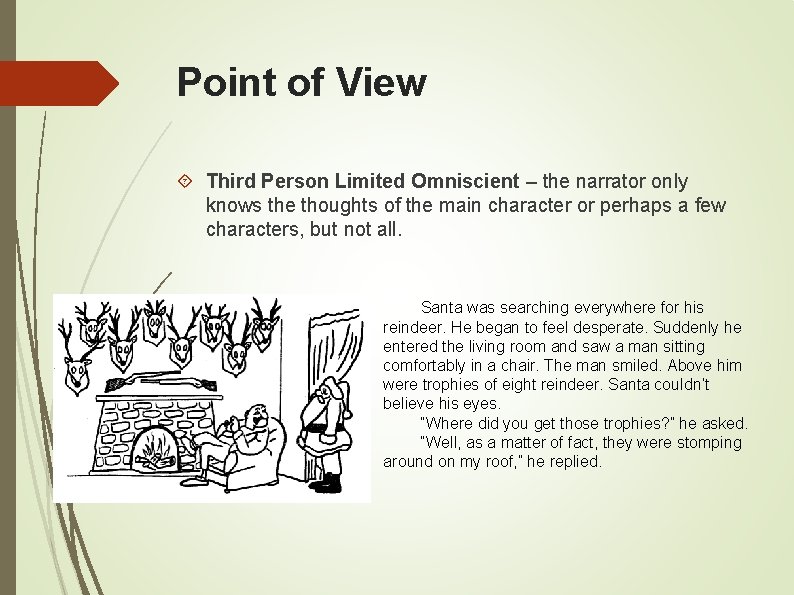
Point of View Third Person Limited Omniscient – the narrator only knows the thoughts of the main character or perhaps a few characters, but not all. Santa was searching everywhere for his reindeer. He began to feel desperate. Suddenly he entered the living room and saw a man sitting comfortably in a chair. The man smiled. Above him were trophies of eight reindeer. Santa couldn’t believe his eyes. “Where did you get those trophies? ” he asked. “Well, as a matter of fact, they were stomping around on my roof, ” he replied.
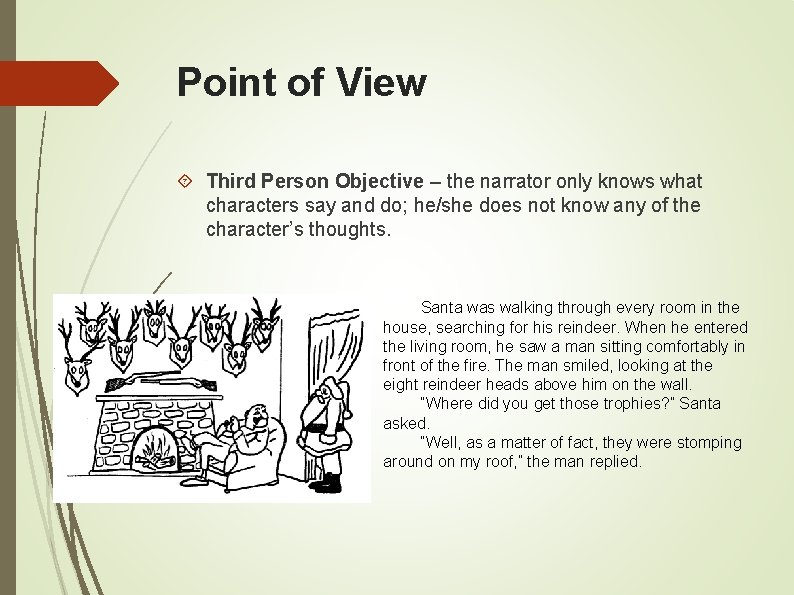
Point of View Third Person Objective – the narrator only knows what characters say and do; he/she does not know any of the character’s thoughts. Santa was walking through every room in the house, searching for his reindeer. When he entered the living room, he saw a man sitting comfortably in front of the fire. The man smiled, looking at the eight reindeer heads above him on the wall. “Where did you get those trophies? ” Santa asked. “Well, as a matter of fact, they were stomping around on my roof, ” the man replied.
The Lady or the Tiger? Handout – Questions. Point of View – The story is told from third person point of view at the beginning. How does the point of view change, and what is the effect of the change?
The Lady or the Tiger? Handout – Questions. Writing Assignment – Although “The Lady or the Tiger? ” may seem to be a frustrating story without a clear ending, many argue that it does have a concrete ending, but the reader just has to interpret it. Choose whether you think the lady or the tiger was behind the door and use specific evidence from the story to prove your point. There is evidence for both sides, so either choice can be a good answer as long as you argue it well. Write five paragraphs (intro, three body paragraphs, conclusion) and use several specific examples and quotations from the story to support your theory.
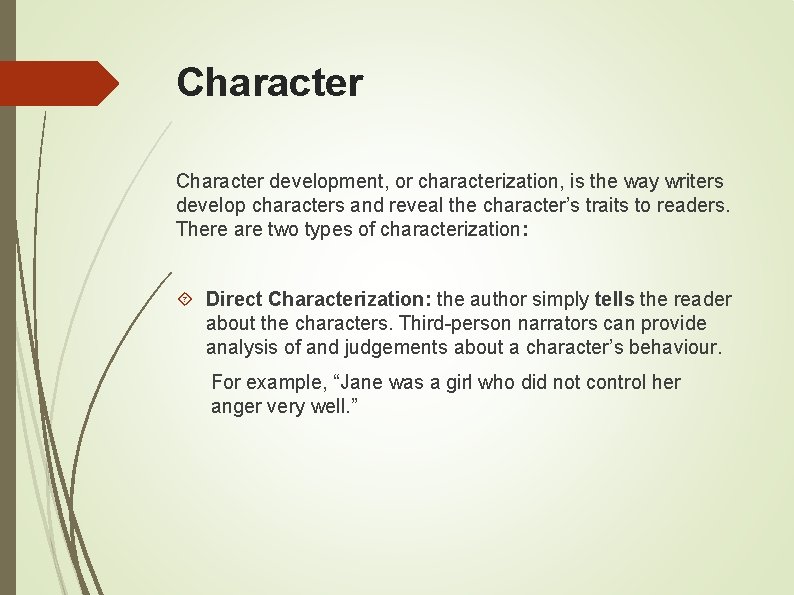
Character development, or characterization, is the way writers develop characters and reveal the character’s traits to readers. There are two types of characterization: Direct Characterization: the author simply tells the reader about the characters. Third-person narrators can provide analysis of and judgements about a character’s behaviour. For example, “Jane was a girl who did not control her anger very well. ”
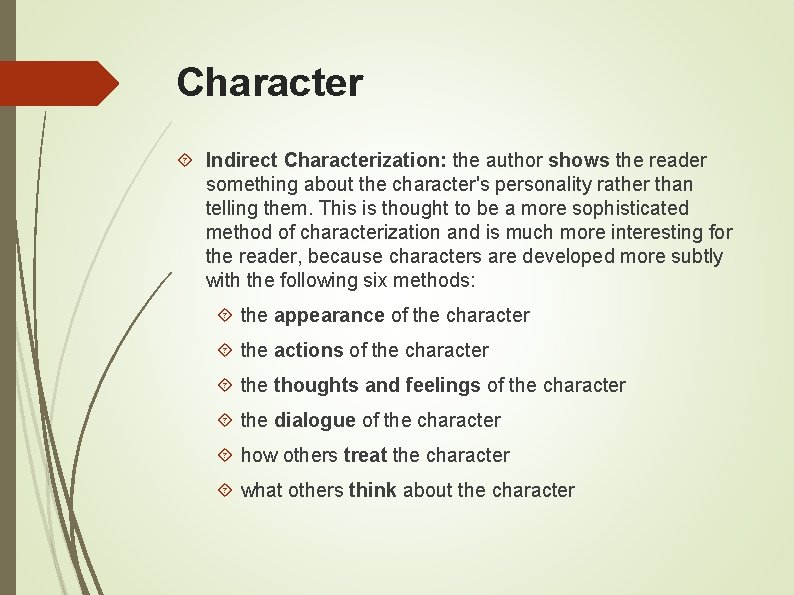
Character Indirect Characterization: the author shows the reader something about the character's personality rather than telling them. This is thought to be a more sophisticated method of characterization and is much more interesting for the reader, because characters are developed more subtly with the following six methods: the appearance of the character the actions of the character the thoughts and feelings of the character the dialogue of the character how others treat the character what others think about the character
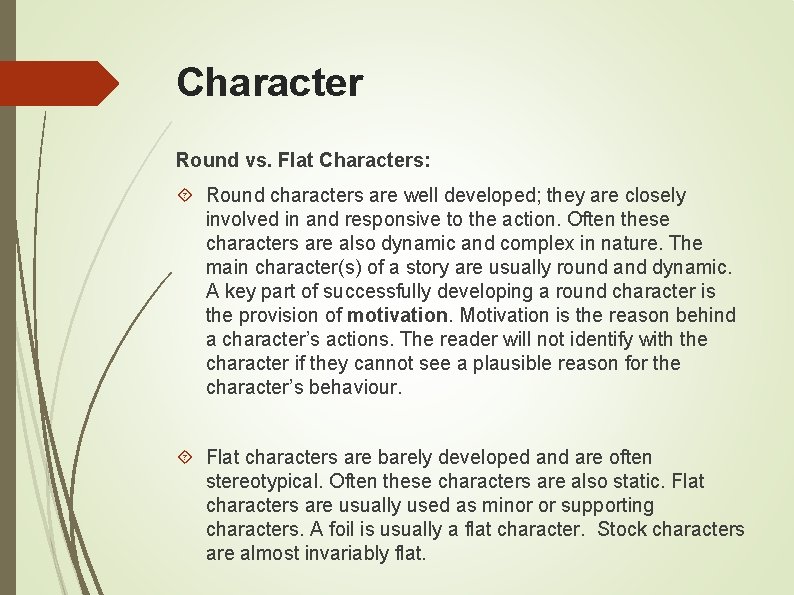
Character Round vs. Flat Characters: Round characters are well developed; they are closely involved in and responsive to the action. Often these characters are also dynamic and complex in nature. The main character(s) of a story are usually round and dynamic. A key part of successfully developing a round character is the provision of motivation. Motivation is the reason behind a character’s actions. The reader will not identify with the character if they cannot see a plausible reason for the character’s behaviour. Flat characters are barely developed and are often stereotypical. Often these characters are also static. Flat characters are usually used as minor or supporting characters. A foil is usually a flat character. Stock characters are almost invariably flat.
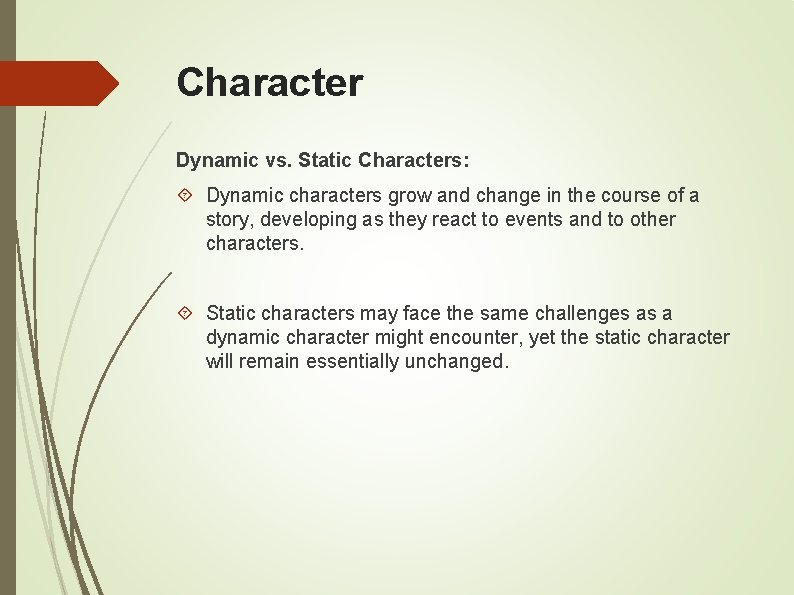
Character Dynamic vs. Static Characters: Dynamic characters grow and change in the course of a story, developing as they react to events and to other characters. Static characters may face the same challenges as a dynamic character might encounter, yet the static character will remain essentially unchanged.
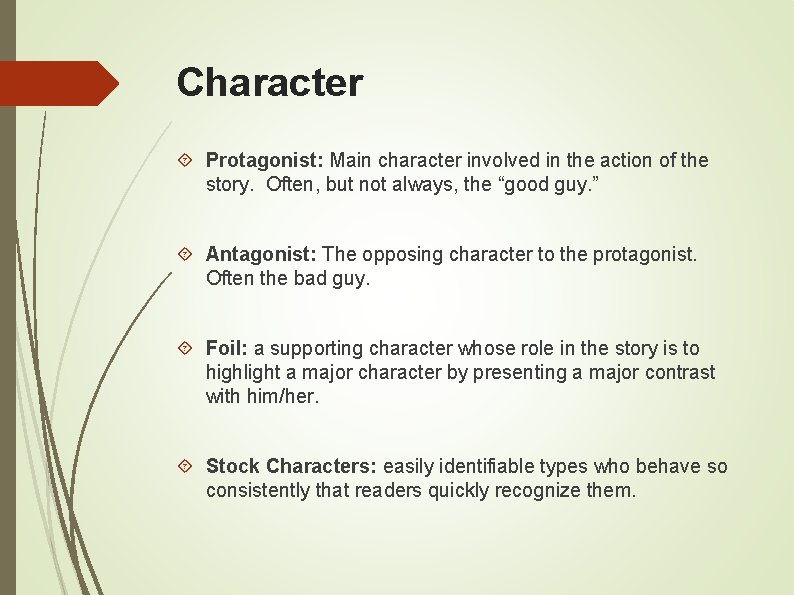
Character Protagonist: Main character involved in the action of the story. Often, but not always, the “good guy. ” Antagonist: The opposing character to the protagonist. Often the bad guy. Foil: a supporting character whose role in the story is to highlight a major character by presenting a major contrast with him/her. Stock Characters: easily identifiable types who behave so consistently that readers quickly recognize them.
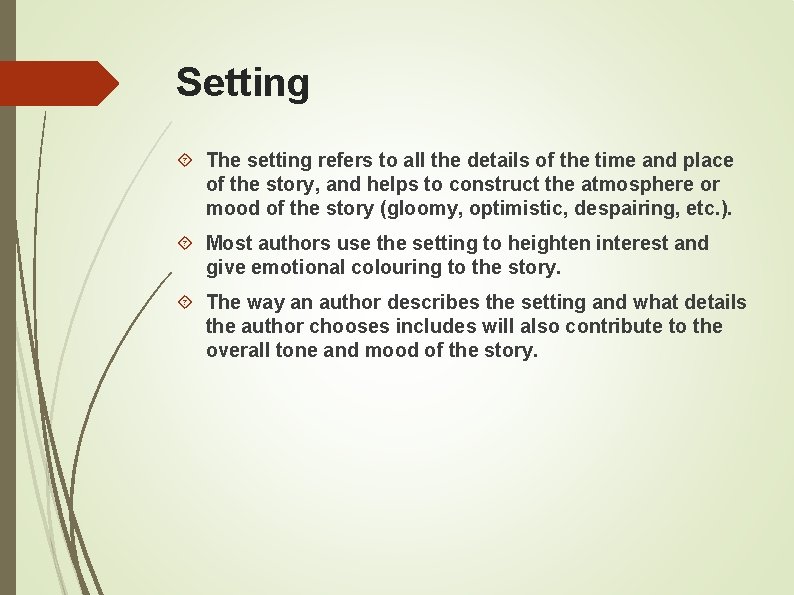
Setting The setting refers to all the details of the time and place of the story, and helps to construct the atmosphere or mood of the story (gloomy, optimistic, despairing, etc. ). Most authors use the setting to heighten interest and give emotional colouring to the story. The way an author describes the setting and what details the author chooses includes will also contribute to the overall tone and mood of the story.