
Short Line Fault o o Skeats Described L
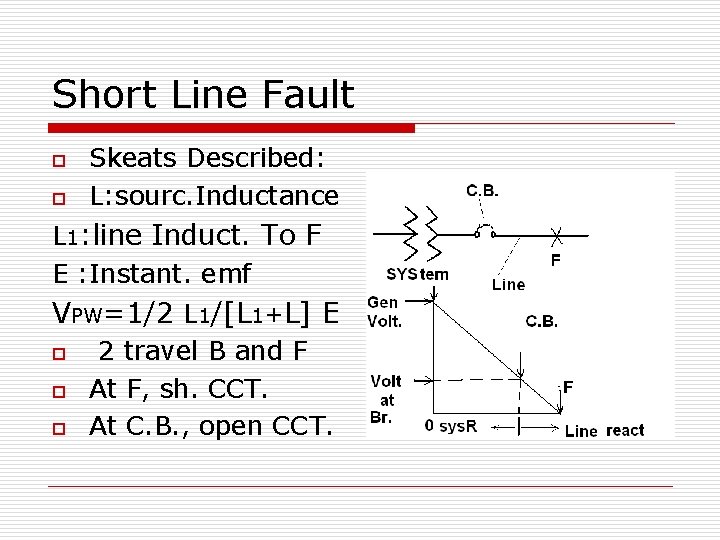
Short Line Fault o o Skeats Described: L: sourc. Inductance L 1: line Induct. To F E : Instant. emf VPW=1/2 L 1/[L 1+L] E o o o 2 travel B and F At F, sh. CCT. At C. B. , open CCT.
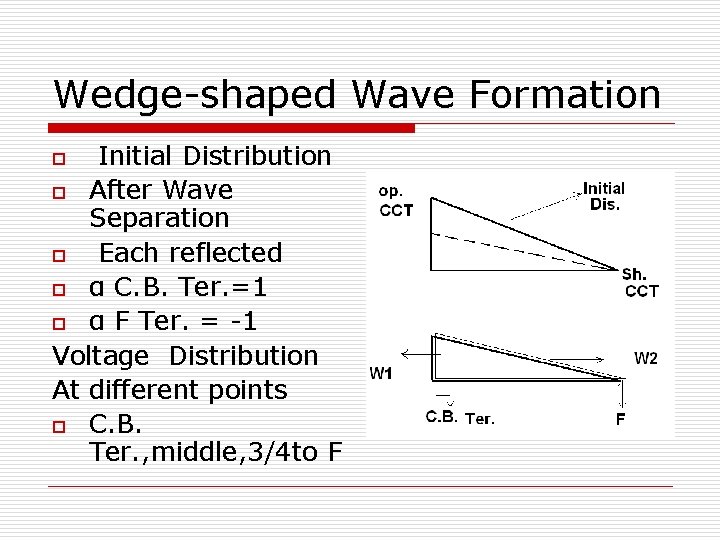
Wedge-shaped Wave Formation Initial Distribution o After Wave Separation o Each reflected o α C. B. Ter. =1 o α F Ter. = -1 Voltage Distribution At different points o C. B. Ter. , middle, 3/4 to F o
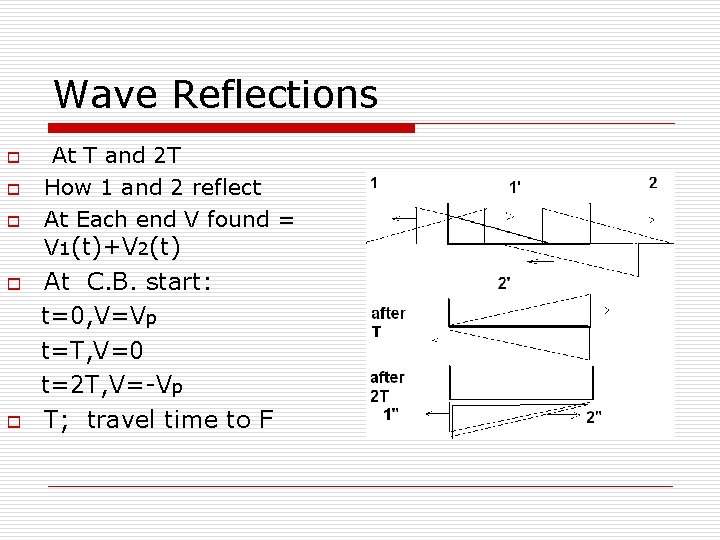
Wave Reflections o o o At T and 2 T How 1 and 2 reflect At Each end V found = V 1(t)+V 2(t) At C. B. start: t=0, V=Vp t=T, V=0 t=2 T, V=-Vp T; travel time to F
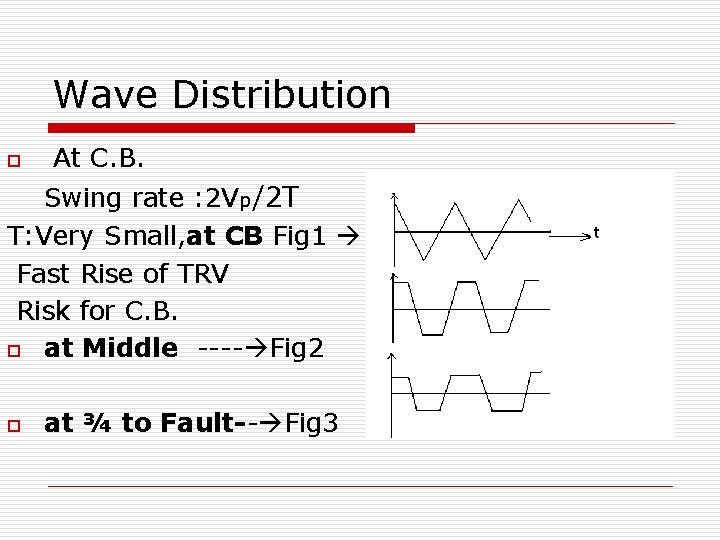
Wave Distribution o At C. B. Swing rate : 2 Vp/2 T T: Very Small, at CB Fig 1 Fast Rise of TRV Risk for C. B. o at Middle ---- Fig 2 o at ¾ to Fault-- Fig 3
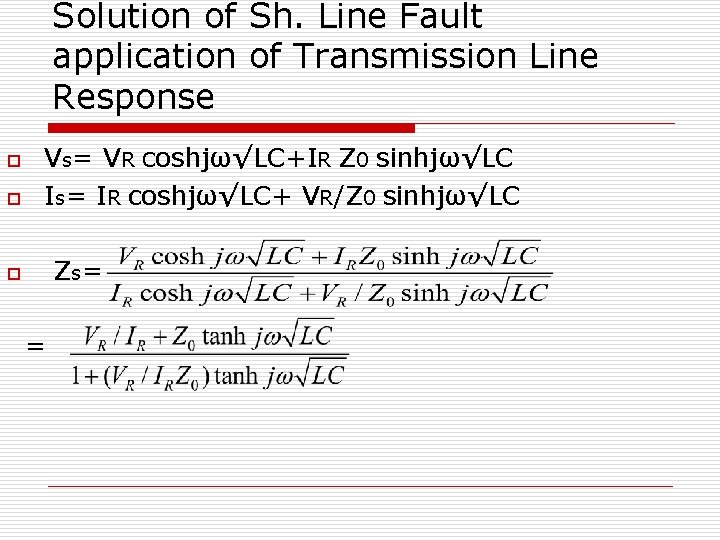
Solution of Sh. Line Fault application of Transmission Line Response o o Vs= VR Coshjω√LC+IR Z 0 sinhjω√LC Is= IR coshjω√LC+ VR/Z 0 sinhjω√LC Zs= o =
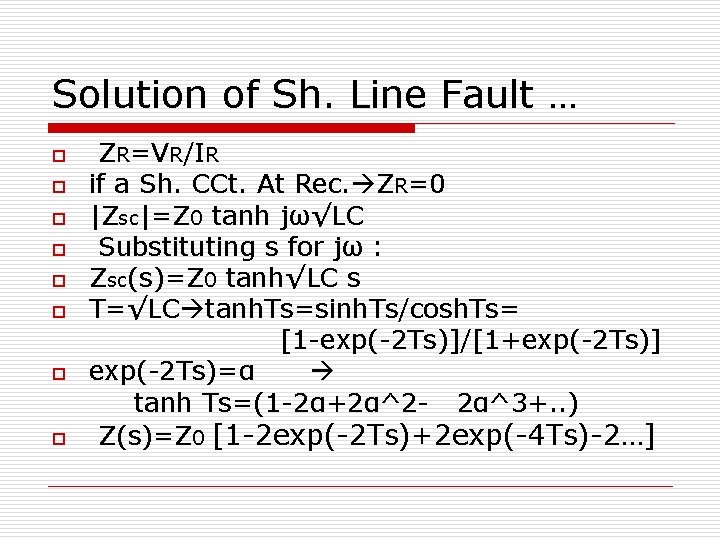
Solution of Sh. Line Fault … o o o o ZR=VR/IR if a Sh. CCt. At Rec. ZR=0 |Zsc|=Z 0 tanh jω√LC Substituting s for jω : Zsc(s)=Z 0 tanh√LC s T=√LC tanh. Ts=sinh. Ts/cosh. Ts= [1 -exp(-2 Ts)]/[1+exp(-2 Ts)] exp(-2 Ts)=α tanh Ts=(1 -2α+2α^2 - 2α^3+. . ) Z(s)=Z 0 [1 -2 exp(-2 Ts)+2 exp(-4 Ts)-2…]
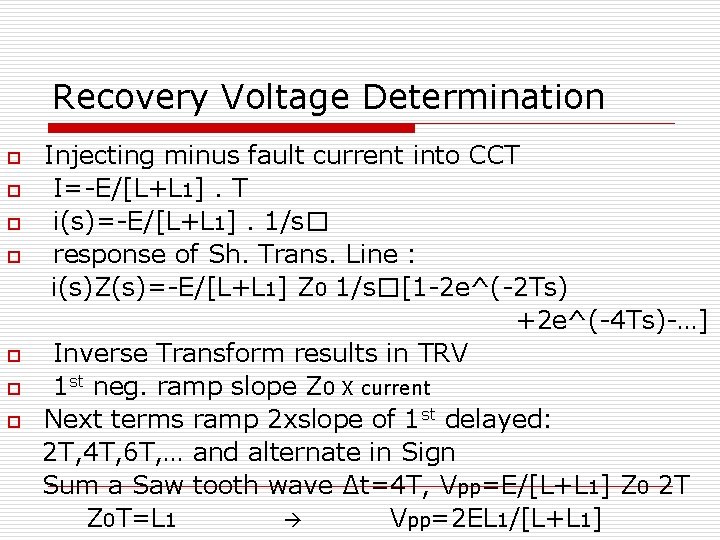
Recovery Voltage Determination o o o o Injecting minus fault current into CCT I=-E/[L+L 1]. T i(s)=-E/[L+L 1]. 1/s� response of Sh. Trans. Line : i(s)Z(s)=-E/[L+L 1] Z 0 1/s�[1 -2 e^(-2 Ts) +2 e^(-4 Ts)-…] Inverse Transform results in TRV 1 st neg. ramp slope Z 0 X current Next terms ramp 2 xslope of 1 st delayed: 2 T, 4 T, 6 T, … and alternate in Sign Sum a Saw tooth wave ∆t=4 T, Vpp=E/[L+L 1] Z 0 2 T Z 0 T=L 1 Vpp=2 EL 1/[L+L 1]
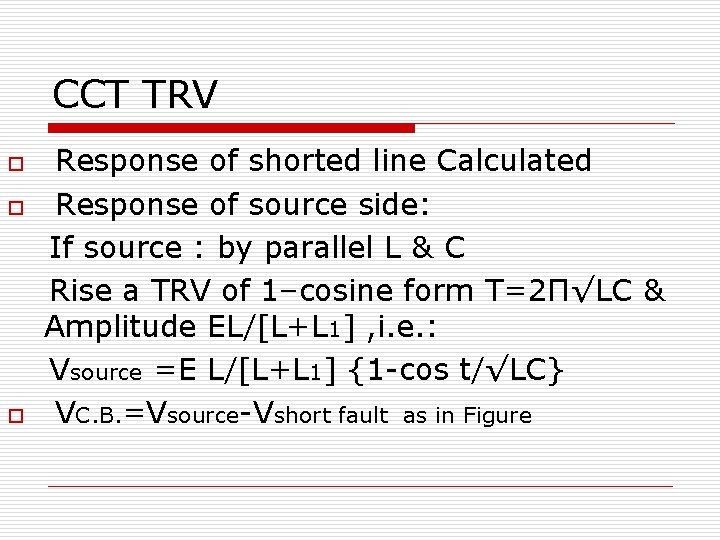
CCT TRV o o o Response of shorted line Calculated Response of source side: If source : by parallel L & C Rise a TRV of 1–cosine form T=2Π√LC & Amplitude EL/[L+L 1] , i. e. : Vsource =E L/[L+L 1] {1 -cos t/√LC} VC. B. =Vsource-Vshort fault as in Figure
Transformer Transient Model o o o Have the greatest exposure to electrical Transients (after Transmission line) Different Model for specific studies Transformer Model for: Switching on OPEN CCT Im & Ih+e so a parallel RL CCT, & Cg capacitance of winding with length l R 0=V�/W 0 Cg/l per unit length & small fraction (Cg/l)∆x
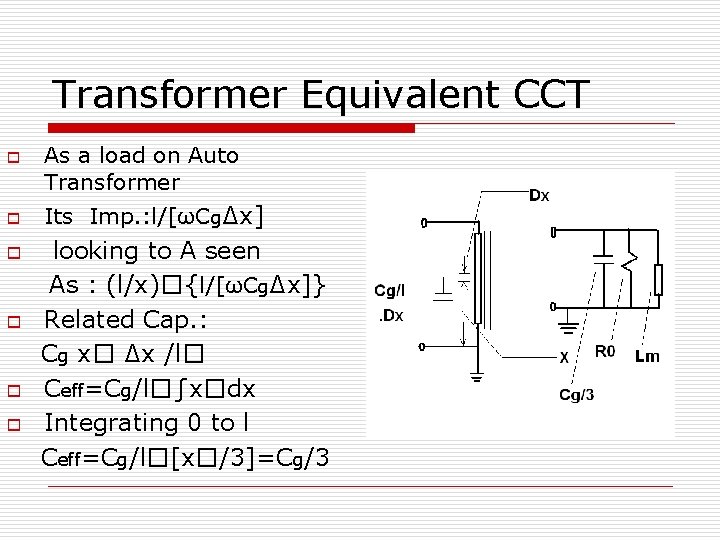
Transformer Equivalent CCT o o o As a load on Auto Transformer Its Imp. : l/[ωCg∆x] looking to A seen As : (l/x)�{l/[ωCg∆x]} Related Cap. : Cg x� ∆x /l� Ceff=Cg/l�∫x�dx Integrating 0 to l Ceff=Cg/l�[x�/3]=Cg/3
Other Models o o Terminal Model & Detailed Model 1 - Based on Name plate Information A paper, not discussed here 2 -Software for Transformer Transient Study , not discussed here Internal Model for a Transformer for special studies
Internal Model o o o for our purpose Detailed one not desirable Divide the time after surge into: 1 - extremely short (about fraction of μs) 2 - Next in range of m S and seconds 3 - the steady state In the fraction of μs no current penetrate to inductance only displacements currents to Capacitances
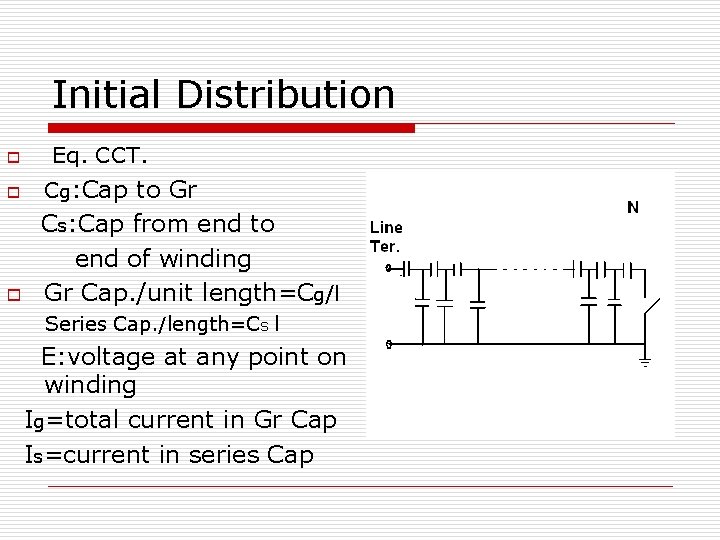
Initial Distribution o Eq. CCT. o Cg: Cap to Gr o Cs: Cap from end to end of winding Gr Cap. /unit length=Cg/l Series Cap. /length=Cs l E: voltage at any point on winding Ig=total current in Gr Cap Is=current in series Cap
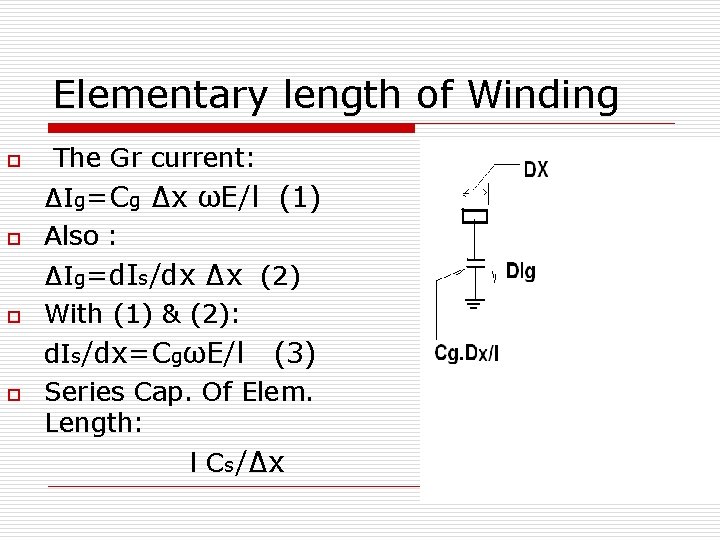
Elementary length of Winding o The Gr current: o ∆Ig=Cg ∆x ωE/l (1) Also : o ∆Ig=d. Is/dx ∆x (2) With (1) & (2): o d. Is/dx=CgωE/l (3) Series Cap. Of Elem. Length: l Cs/∆x
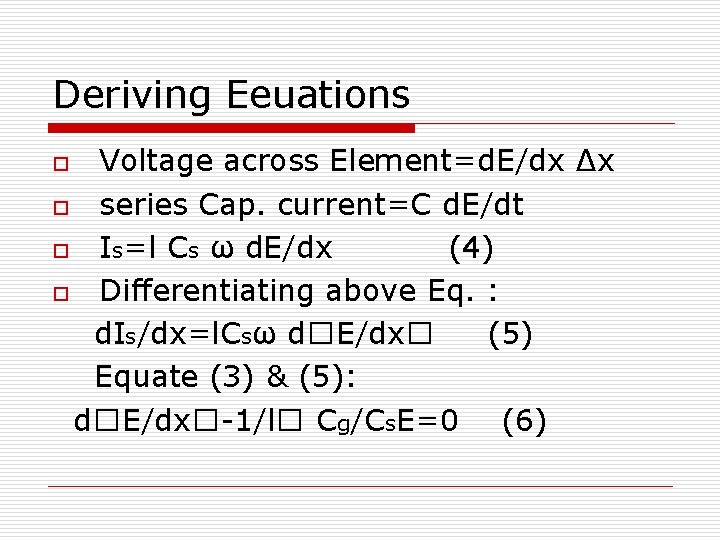
Deriving Eeuations Voltage across Element=d. E/dx ∆x o series Cap. current=C d. E/dt o Is=l Cs ω d. E/dx (4) o Differentiating above Eq. : d. Is/dx=l. Csω d�E/dx� (5) Equate (3) & (5): d�E/dx�-1/l� Cg/Cs. E=0 (6) o
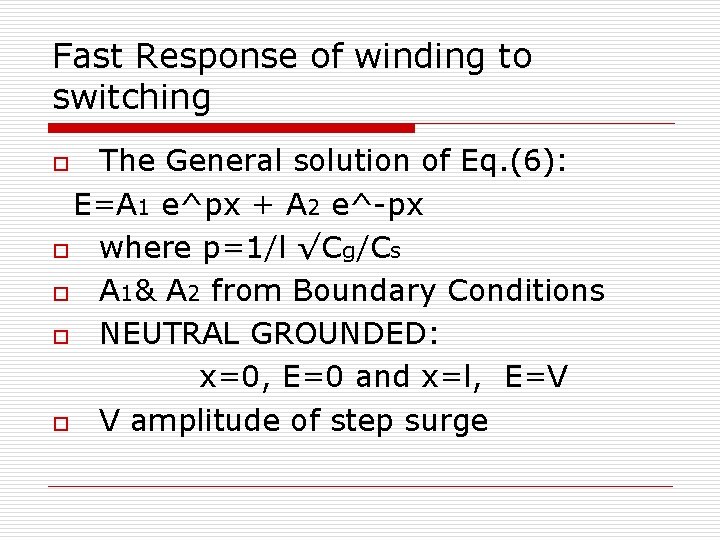
Fast Response of winding to switching The General solution of Eq. (6): E=A 1 e^px + A 2 e^-px o where p=1/l √Cg/Cs o A 1& A 2 from Boundary Conditions o NEUTRAL GROUNDED: x=0, E=0 and x=l, E=V o V amplitude of step surge o
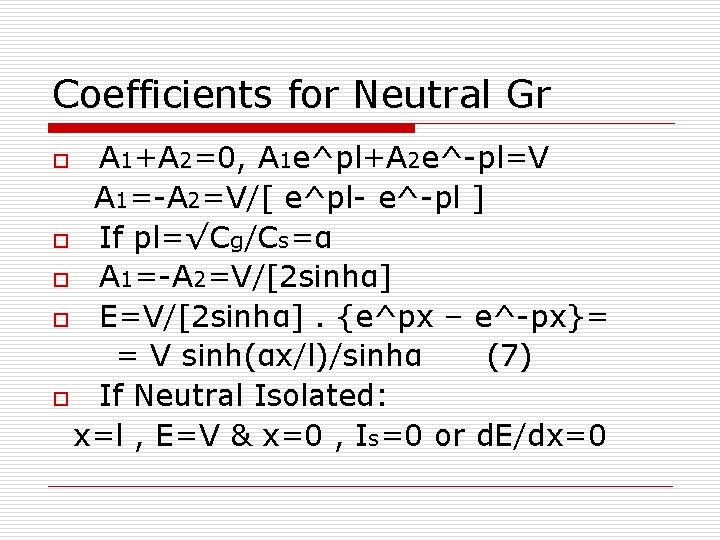
Coefficients for Neutral Gr A 1+A 2=0, A 1 e^pl+A 2 e^-pl=V A 1=-A 2=V/[ e^pl- e^-pl ] o If pl=√Cg/Cs=α o A 1=-A 2=V/[2 sinhα] o E=V/[2 sinhα]. {e^px – e^-px}= = V sinh(αx/l)/sinhα (7) o If Neutral Isolated: x=l , E=V & x=0 , Is=0 or d. E/dx=0 o
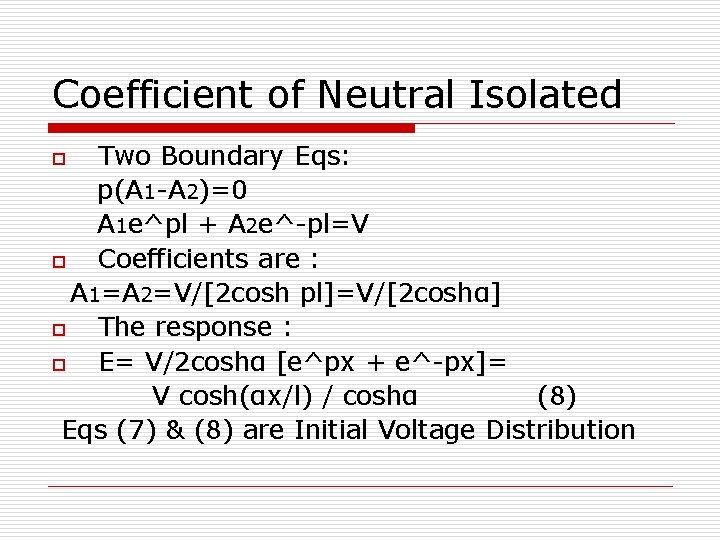
Coefficient of Neutral Isolated Two Boundary Eqs: p(A 1 -A 2)=0 A 1 e^pl + A 2 e^-pl=V o Coefficients are : A 1=A 2=V/[2 cosh pl]=V/[2 coshα] o The response : o E= V/2 coshα [e^px + e^-px]= V cosh(αx/l) / coshα (8) Eqs (7) & (8) are Initial Voltage Distribution o
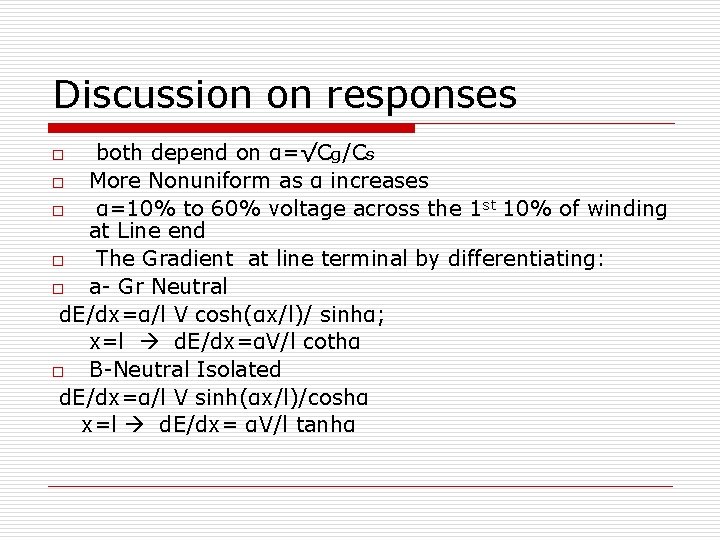
Discussion on responses both depend on α=√Cg/Cs o More Nonuniform as α increases o α=10% to 60% voltage across the 1 st 10% of winding at Line end o The Gradient at line terminal by differentiating: o a- Gr Neutral d. E/dx=α/l V cosh(αx/l)/ sinhα; x=l d. E/dx=αV/l cothα o B-Neutral Isolated d. E/dx=α/l V sinh(αx/l)/coshα x=l d. E/dx= αV/l tanhα o
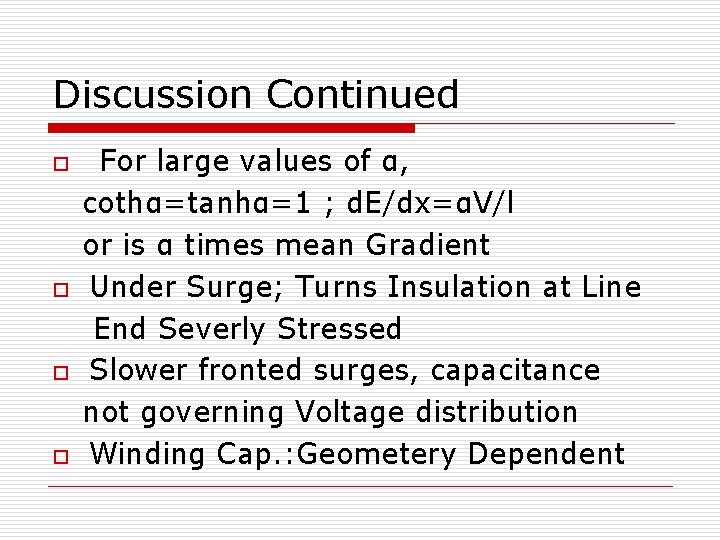
Discussion Continued o o For large values of α, cothα=tanhα=1 ; d. E/dx=αV/l or is α times mean Gradient Under Surge; Turns Insulation at Line End Severly Stressed Slower fronted surges, capacitance not governing Voltage distribution Winding Cap. : Geometery Dependent
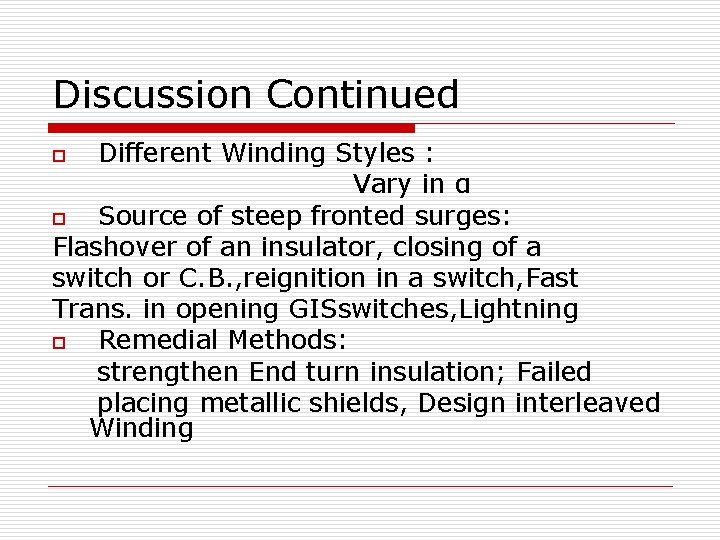
Discussion Continued Different Winding Styles : Vary in α o Source of steep fronted surges: Flashover of an insulator, closing of a switch or C. B. , reignition in a switch, Fast Trans. in opening GISswitches, Lightning o Remedial Methods: strengthen End turn insulation; Failed placing metallic shields, Design interleaved Winding o
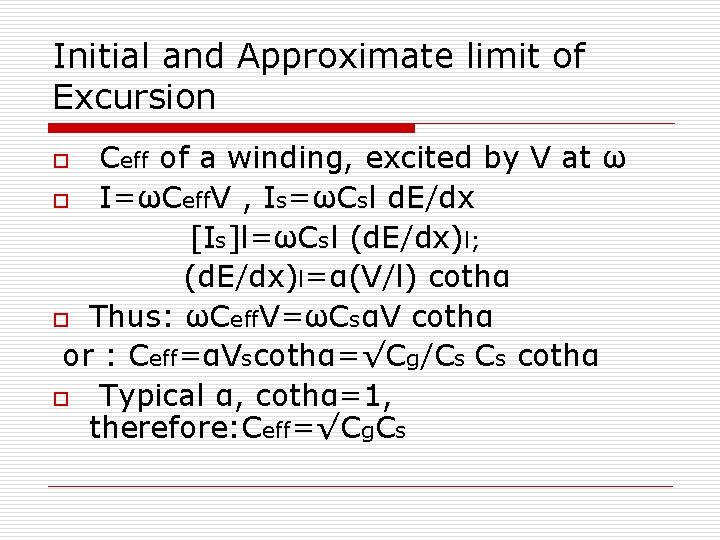
Initial and Approximate limit of Excursion Ceff of a winding, excited by V at ω o I=ωCeff. V , Is=ωCsl d. E/dx [Is]l=ωCsl (d. E/dx)l; (d. E/dx)l=α(V/l) cothα o Thus: ωCeff. V=ωCsαV cothα or : Ceff=αVscothα=√Cg/Cs Cs cothα o Typical α, cothα=1, therefore: Ceff=√Cg. Cs o
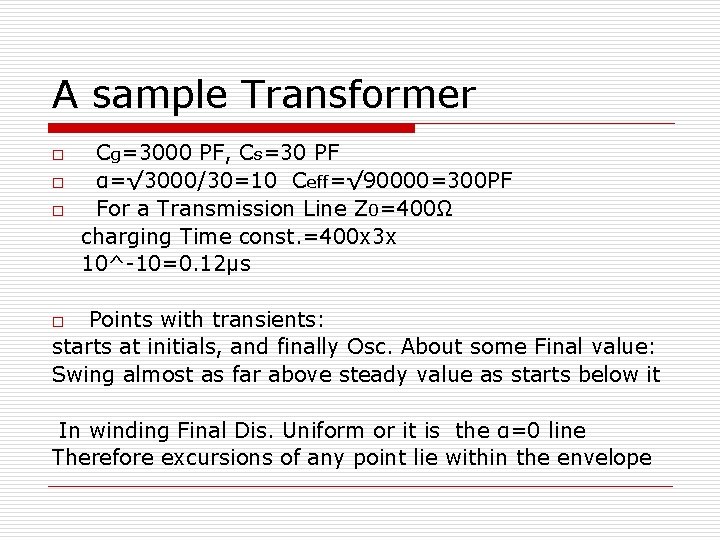
A sample Transformer o o o Cg=3000 PF, Cs=30 PF α=√ 3000/30=10 Ceff=√ 90000=300 PF For a Transmission Line Z 0=400Ω charging Time const. =400 x 3 x 10^-10=0. 12μs Points with transients: starts at initials, and finally Osc. About some Final value: Swing almost as far above steady value as starts below it o In winding Final Dis. Uniform or it is the α=0 line Therefore excursions of any point lie within the envelope
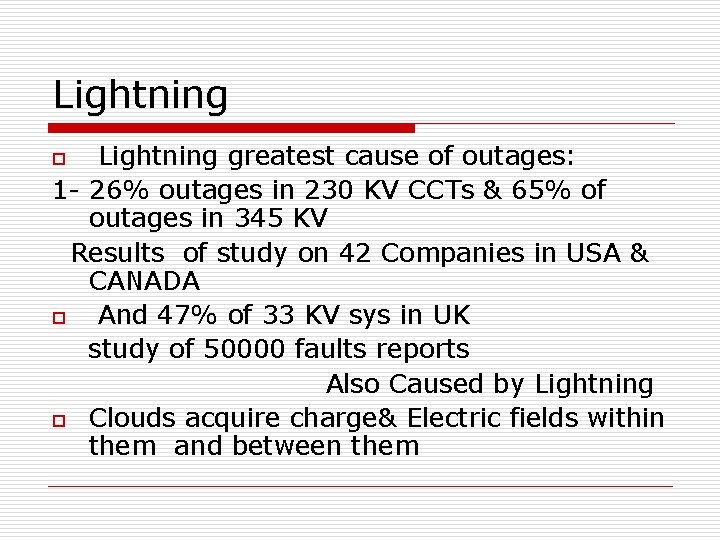
Lightning greatest cause of outages: 1 - 26% outages in 230 KV CCTs & 65% of outages in 345 KV Results of study on 42 Companies in USA & CANADA o And 47% of 33 KV sys in UK study of 50000 faults reports Also Caused by Lightning o Clouds acquire charge& Electric fields within them and between them o
Development o o o When E excessive: space Insulation Breakdown or lightning flash occur A high current discharge Those terminate on or near power lines similar to: close a switch between cloud & line or adjacent earth a direct con. Or through mutual coupling
Lightning surge Disturbance on a line Traveling wave o Travel both Direction, 1/2 IZ 0 I: lightning current Z 0=Surge Imp. Line o The earth carries a net negatve charge of 5 x 10^5 C, downward E=0. 13 KV/m o An equivalent pos. charge in space o Upper Atmosph. Mean potential of 300 KV relative to earth o
Lightning o o Localized charge of thunder clouds superimposes its field on the fine weather field, freq. causing it to reverse As charges within cloud & by induction on earth below, field sufficient Breakdown(30 KV/cm) Photographic evidence: a stepped leader stroke, random manner &short steps from cloud to earth Then a power return stroke moves up the ionized channel prepared by leader
Interaction Between Lightning & Power System o
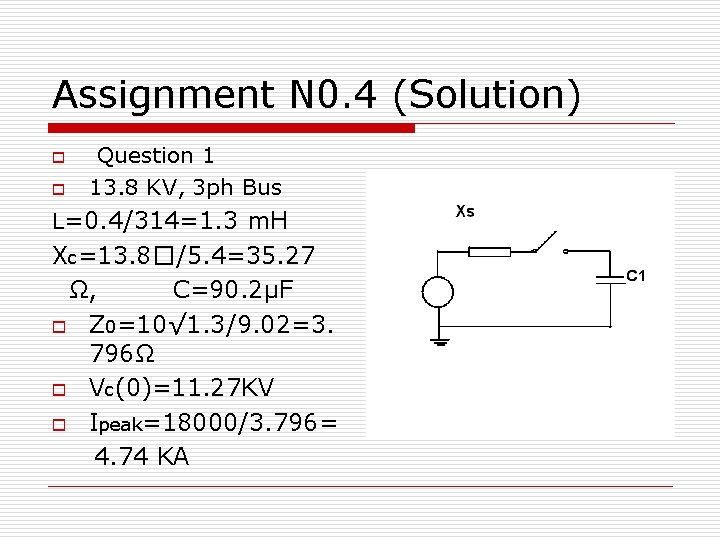
Assignment N 0. 4 (Solution) o o Question 1 13. 8 KV, 3 ph Bus L=0. 4/314=1. 3 m. H Xc=13. 8�/5. 4=35. 27 Ω, C=90. 2μF o Z 0=10√ 1. 3/9. 02=3. 796Ω o Vc(0)=11. 27 KV o Ipeak=18000/3. 796= 4. 74 KA
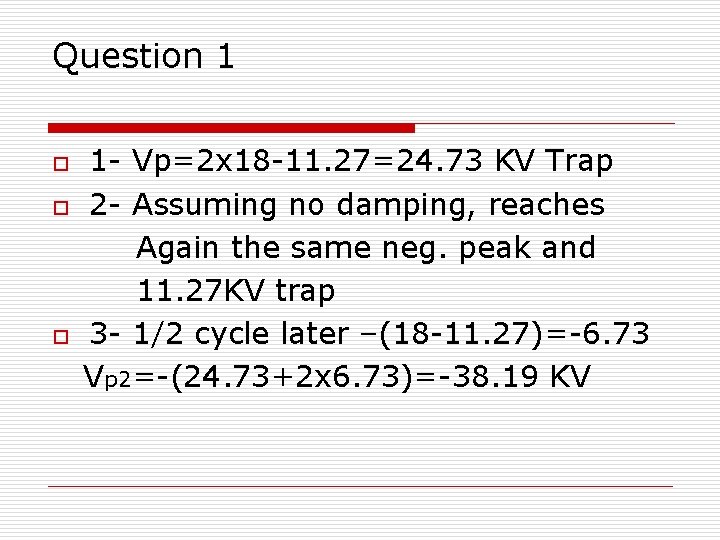
Question 1 o o o 1 - Vp=2 x 18 -11. 27=24. 73 KV Trap 2 - Assuming no damping, reaches Again the same neg. peak and 11. 27 KV trap 3 - 1/2 cycle later –(18 -11. 27)=-6. 73 Vp 2=-(24. 73+2 x 6. 73)=-38. 19 KV
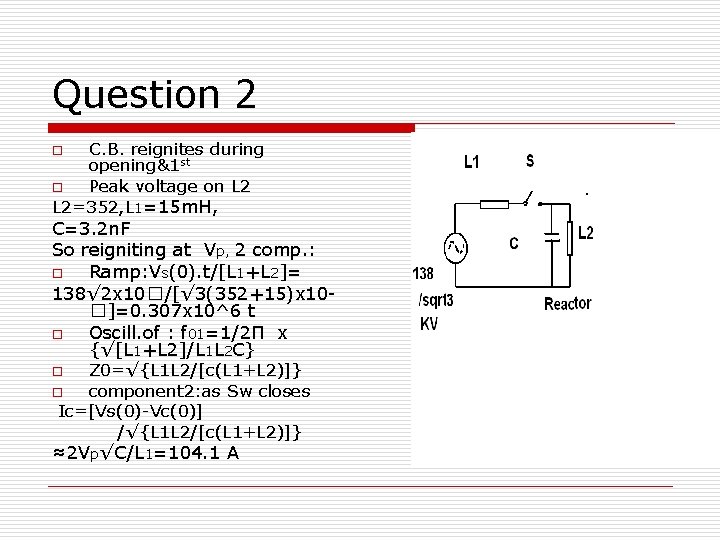
Question 2 C. B. reignites during opening&1 st o Peak voltage on L 2=352, L 1=15 m. H, o C=3. 2 n. F So reigniting at Vp, 2 comp. : o Ramp: Vs(0). t/[L 1+L 2]= 138√ 2 x 10�/[√ 3(352+15)x 10�]=0. 307 x 10^6 t o Oscill. of : f 01=1/2Π x {√[L 1+L 2]/L 1 L 2 C} Z 0=√{L 1 L 2/[c(L 1+L 2)]} o component 2: as Sw closes Ic=[Vs(0)-Vc(0)] /√{L 1 L 2/[c(L 1+L 2)]} o ≈2 Vp√C/L 1=104. 1 A
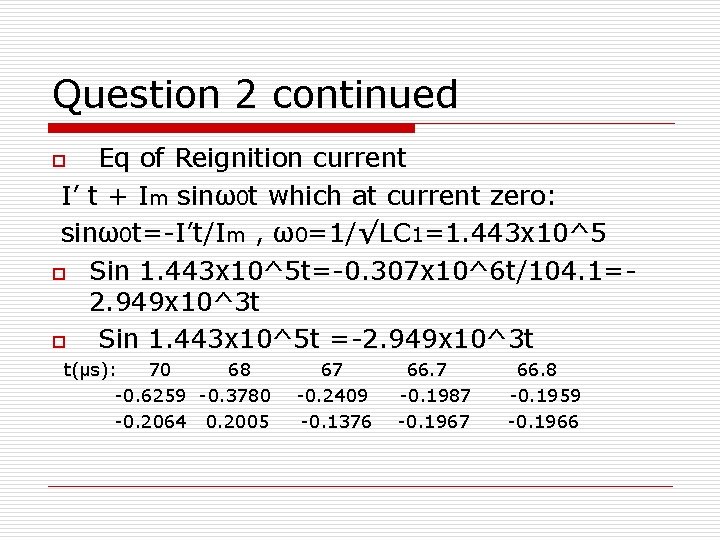
Question 2 continued Eq of Reignition current I’ t + Im sinω0 t which at current zero: sinω0 t=-I’t/Im , ω0=1/√LC 1=1. 443 x 10^5 o Sin 1. 443 x 10^5 t=-0. 307 x 10^6 t/104. 1=2. 949 x 10^3 t o Sin 1. 443 x 10^5 t =-2. 949 x 10^3 t o t(μs): 70 68 -0. 6259 -0. 3780 -0. 2064 0. 2005 67 -0. 2409 -0. 1376 66. 7 -0. 1987 -0. 1967 66. 8 -0. 1959 -0. 1966
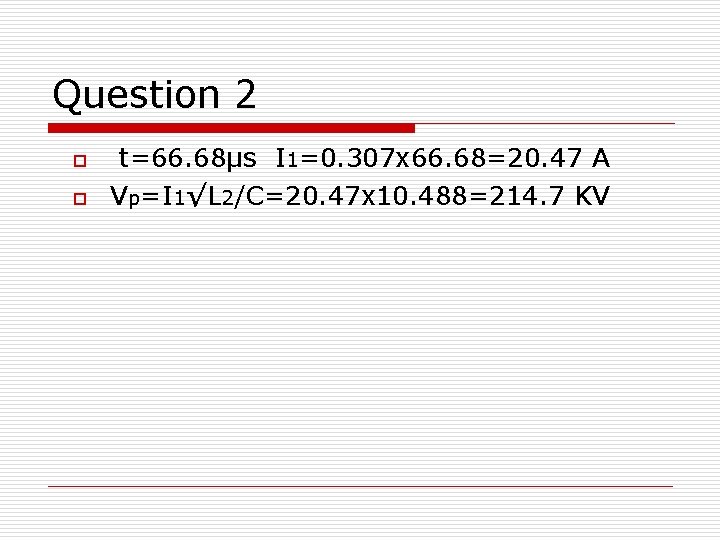
Question 2 o o t=66. 68μs I 1=0. 307 x 66. 68=20. 47 A Vp=I 1√L 2/C=20. 47 x 10. 488=214. 7 KV
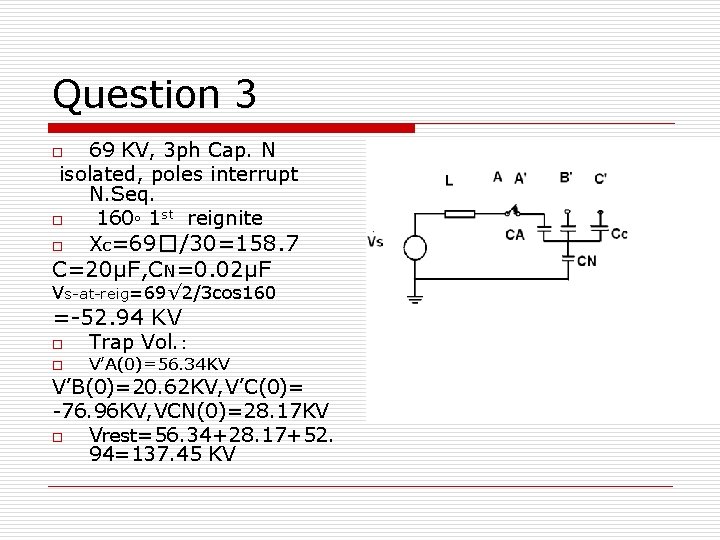
Question 3 69 KV, 3 ph Cap. N isolated, poles interrupt N. Seq. o 160◦ 1 st reignite o Xc=69�/30=158. 7 o C=20μF, CN=0. 02μF Vs-at-reig=69√ 2/3 cos 160 =-52. 94 KV o o Trap Vol. : V’A(0)=56. 34 KV V’B(0)=20. 62 KV, V’C(0)= -76. 96 KV, VCN(0)=28. 17 KV o Vrest=56. 34+28. 17+52. 94=137. 45 KV
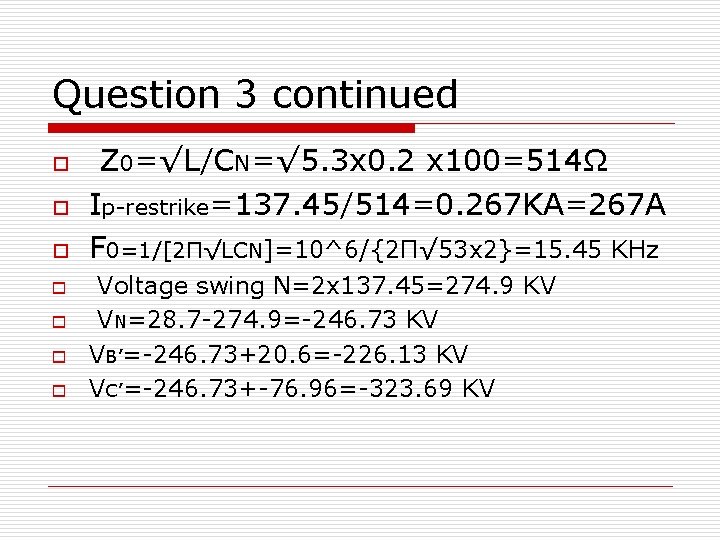
Question 3 continued o o o o Z 0=√L/CN=√ 5. 3 x 0. 2 x 100=514Ω Ip-restrike=137. 45/514=0. 267 KA=267 A F 0=1/[2Π√LCN]=10^6/{2Π√ 53 x 2}=15. 45 KHz Voltage swing N=2 x 137. 45=274. 9 KV VN=28. 7 -274. 9=-246. 73 KV VB’=-246. 73+20. 6=-226. 13 KV VC’=-246. 73+-76. 96=-323. 69 KV
- Slides: 35