
SHORT DOCUMENTARY PROJECT Week 1 Documentary conventions Evidence


- Slides: 23
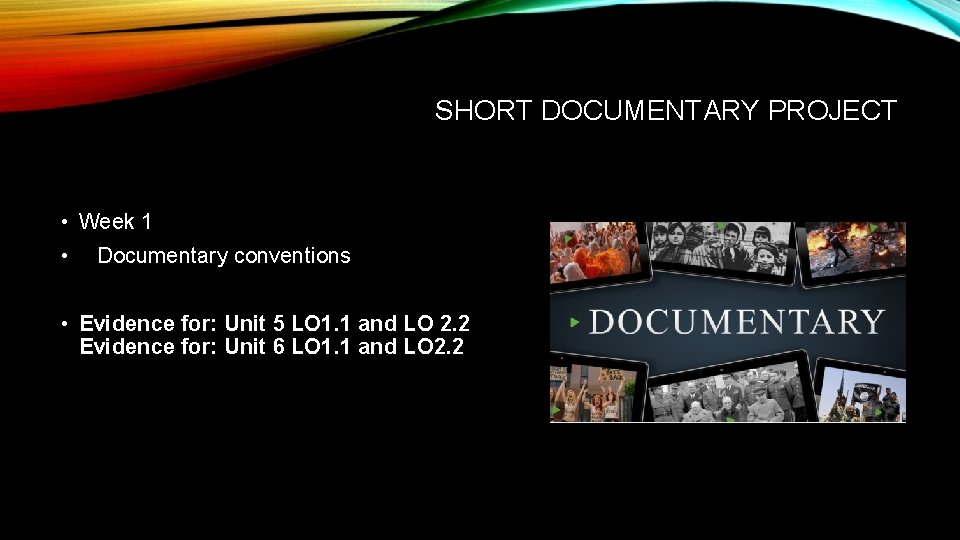
SHORT DOCUMENTARY PROJECT • Week 1 • Documentary conventions • Evidence for: Unit 5 LO 1. 1 and LO 2. 2 Evidence for: Unit 6 LO 1. 1 and LO 2. 2
FEATURE FILMS • If you are going to see a feature film at the cinema, what are your expectations? • Story? • Production Values? • People?
FEATURE FILM CONVENTIONS • • • Actors Stars and celebrities Beautiful images/photography/FX Tell a story/often fictional To entertain Commercially viable Great sound Smooth camera movements Polished/Sets/Costumes/Props Genre based – horror, western, sci-fi, romantic comedy, etc
DOCUMENTARIES • How do documentaries differ? • Take a few minutes to write down your thoughts so we can share some of them
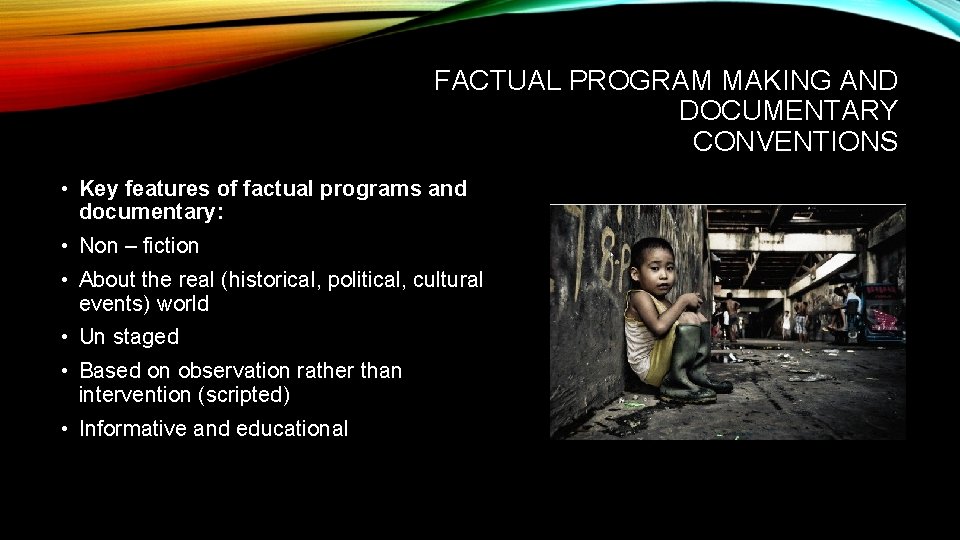
FACTUAL PROGRAM MAKING AND DOCUMENTARY CONVENTIONS • Key features of factual programs and documentary: • Non – fiction • About the real (historical, political, cultural events) world • Un staged • Based on observation rather than intervention (scripted) • Informative and educational
WATCH TRAILER OF A DOCUMENTARY • https: //www. youtube. com/watch? v=Vm. Xnwyu. Pqfw • Note down some observations as to why this is clearly a documentary film • What would you expect from the whole film? 1. Truth? 2. Story? 3. My point of view? 4. Entertainment? 5. What do you think my aims were? 6. What did I want the audience to do? 7. Call to action?
SOME COMMON DIFFERENCES • For me documentaries are more often made because of a passion to tell a an important story as opposed to commercial or profit driven motives. • They are usually slow to make and often difficult to complete • Emotive subjects are common • People want change to result from the film • Film-maker is trying to persuade • Tens or hundreds of hours of footage to edit
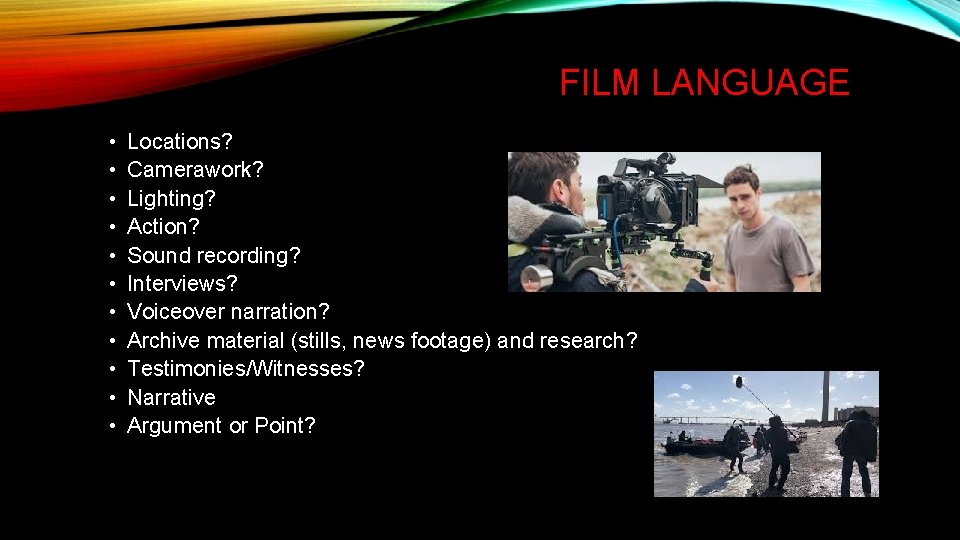
FILM LANGUAGE • • • Locations? Camerawork? Lighting? Action? Sound recording? Interviews? Voiceover narration? Archive material (stills, news footage) and research? Testimonies/Witnesses? Narrative Argument or Point?
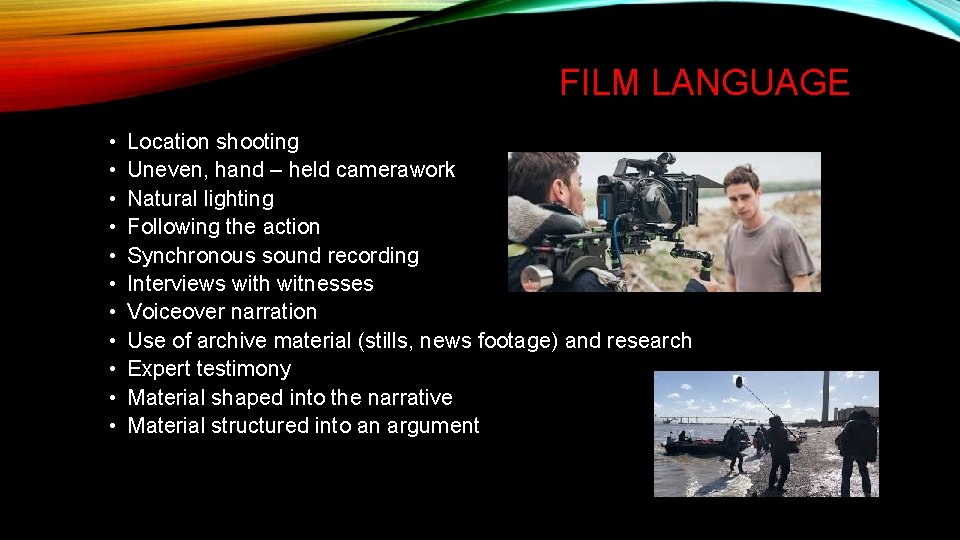
FILM LANGUAGE • • • Location shooting Uneven, hand – held camerawork Natural lighting Following the action Synchronous sound recording Interviews with witnesses Voiceover narration Use of archive material (stills, news footage) and research Expert testimony Material shaped into the narrative Material structured into an argument
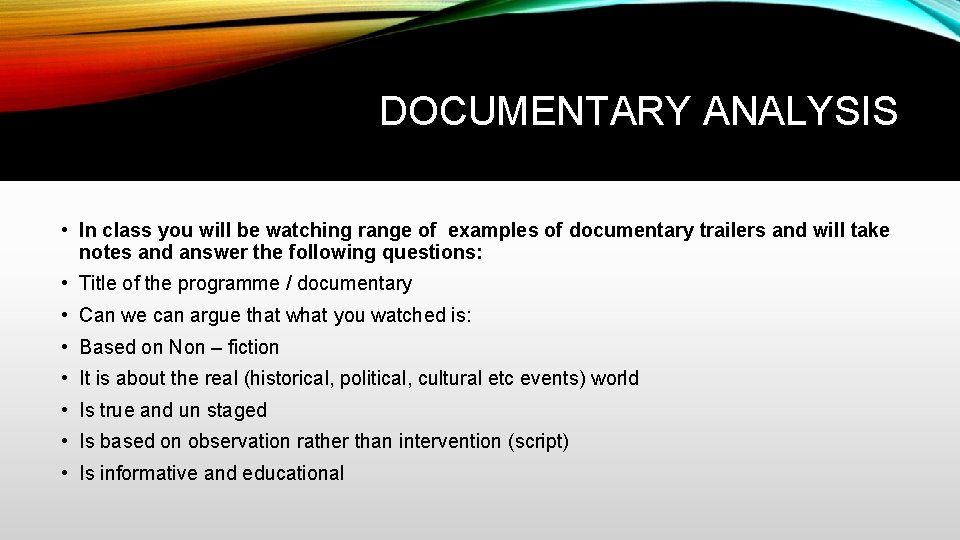
DOCUMENTARY ANALYSIS • In class you will be watching range of examples of documentary trailers and will take notes and answer the following questions: • Title of the programme / documentary • Can we can argue that what you watched is: • Based on Non – fiction • It is about the real (historical, political, cultural etc events) world • Is true and un staged • Is based on observation rather than intervention (script) • Is informative and educational
THE TILLMAN STORY • https: //www. youtube. com/watch? v=Aqt. Tg_Ze 4 Tw
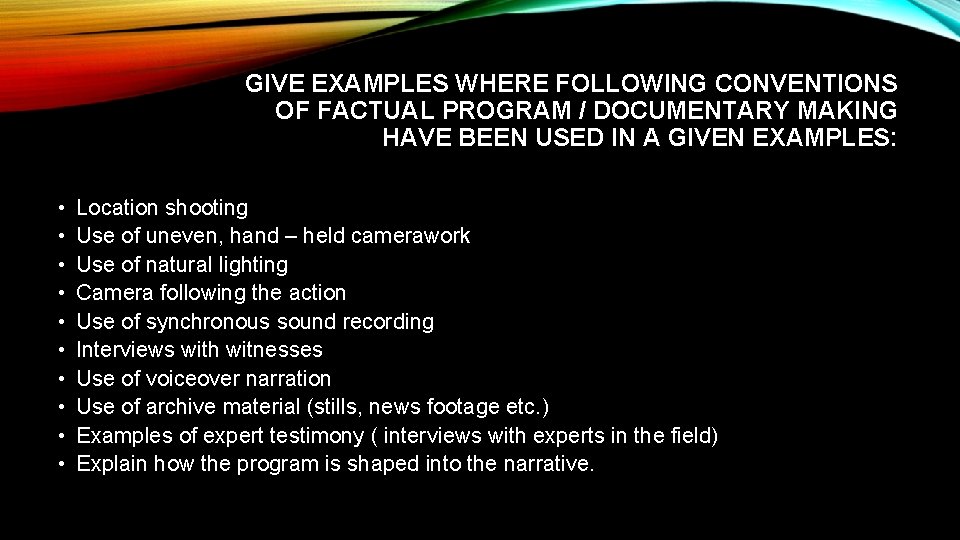
GIVE EXAMPLES WHERE FOLLOWING CONVENTIONS OF FACTUAL PROGRAM / DOCUMENTARY MAKING HAVE BEEN USED IN A GIVEN EXAMPLES: • • • Location shooting Use of uneven, hand – held camerawork Use of natural lighting Camera following the action Use of synchronous sound recording Interviews with witnesses Use of voiceover narration Use of archive material (stills, news footage etc. ) Examples of expert testimony ( interviews with experts in the field) Explain how the program is shaped into the narrative.
THE THIN BLUE LINE • https: //www. youtube. com/watch? v=d. NL 5 A 4 D 0 G 4 g
THE INTERRUPTERS • https: //www. youtube. com/watch? v=SC 1 EOm 4 o_0 A
BLACKFISH • https: //www. youtube. com/watch? v=f. LOe. H-Oq_1 Y
CAPITALISM – A LOVE STORY • https: //www. youtube. com/watch? v=Je. ROn. VUADj 0
PROJECT NIM • https: //www. youtube. com/watch? v=q. J 3 d 0 Pczp. C 4
COMPARE TWO DOCUMENTARIES • What the two documentaries have in common (subject matter) • How those two documentaries differ ( for example one is formal with the series approach to the subject matter, while the other is more of investigative nature typical of Michael Moore’s style of documentaries) Give specific examples in your answers to this question. • Have you seen other documentaries of the similar nature and style to the ones we have watched in the class, give specific examples. • What is the main massage and what we can learn from each documentary.
WHAT ARE THE CHALLENGES FOR DOCUMENTARY MAKERS IN THESE ROLES? • Director? • Producer? • Camera?
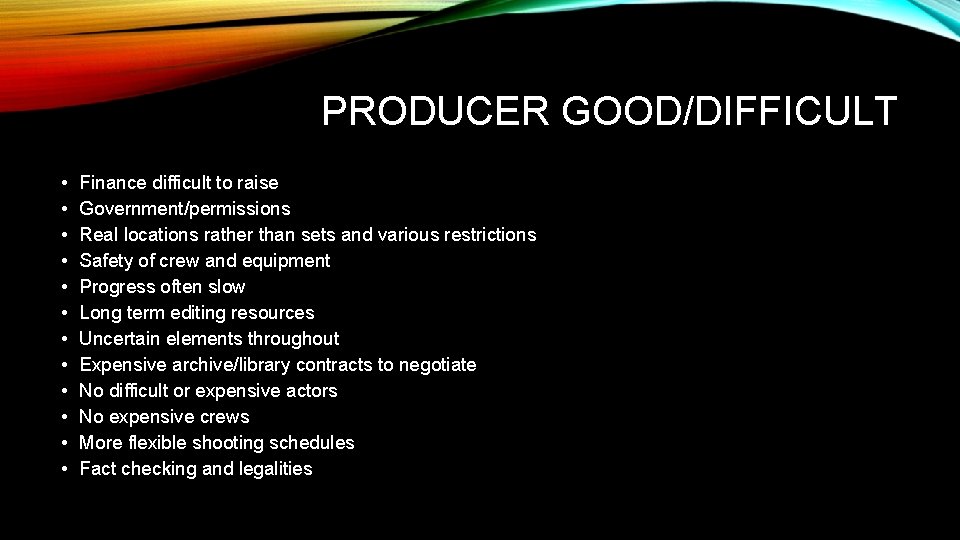
PRODUCER GOOD/DIFFICULT • • • Finance difficult to raise Government/permissions Real locations rather than sets and various restrictions Safety of crew and equipment Progress often slow Long term editing resources Uncertain elements throughout Expensive archive/library contracts to negotiate No difficult or expensive actors No expensive crews More flexible shooting schedules Fact checking and legalities
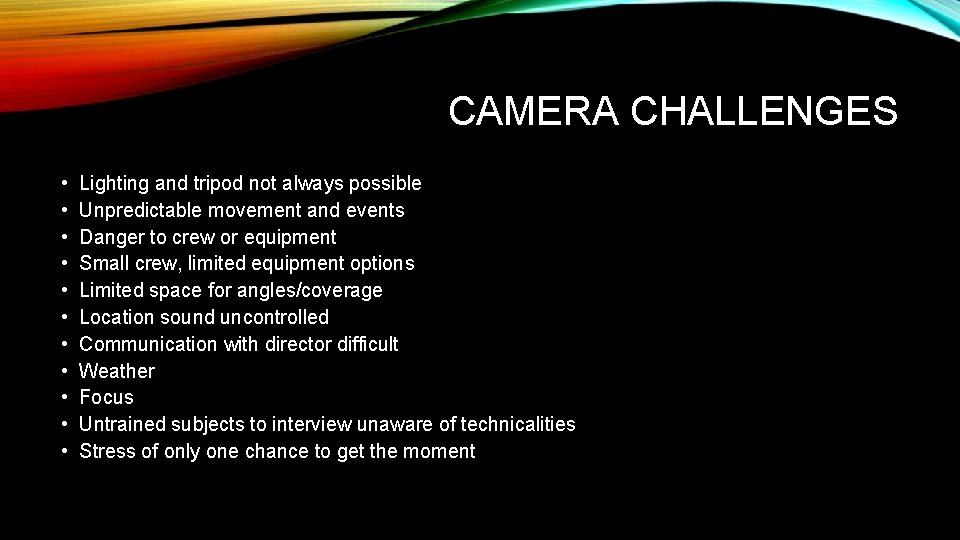
CAMERA CHALLENGES • • • Lighting and tripod not always possible Unpredictable movement and events Danger to crew or equipment Small crew, limited equipment options Limited space for angles/coverage Location sound uncontrolled Communication with director difficult Weather Focus Untrained subjects to interview unaware of technicalities Stress of only one chance to get the moment
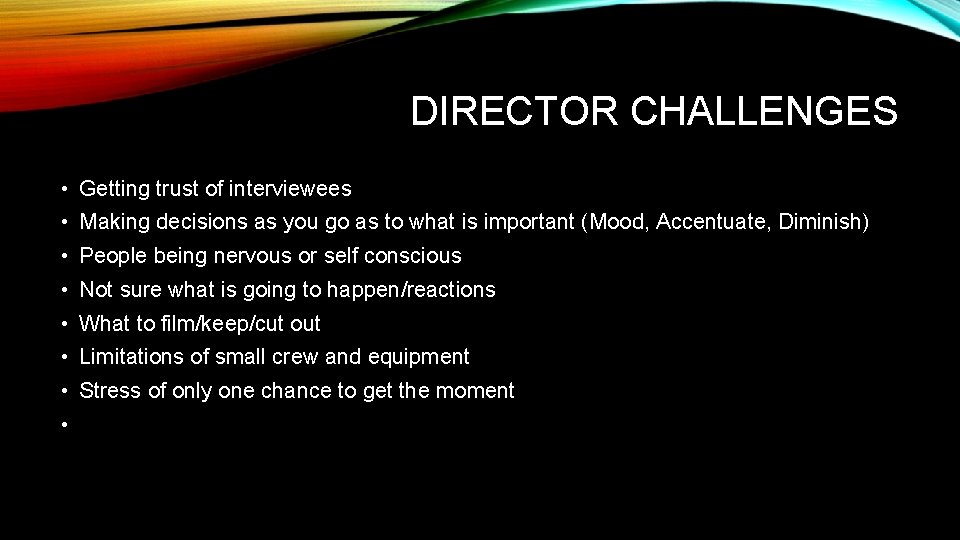
DIRECTOR CHALLENGES • Getting trust of interviewees • Making decisions as you go as to what is important (Mood, Accentuate, Diminish) • People being nervous or self conscious • Not sure what is going to happen/reactions • What to film/keep/cut out • Limitations of small crew and equipment • Stress of only one chance to get the moment •
THE ART OF DOCUMENTARY MAKING EXTENSION TASK • As an extension task you might want to watch this documentary in your own time to inform yourself about the art of documentary filmmaking and some well known filmmakers. • Please click on the link to get the access to documentary: • ‘The art of documentary filmmaking’ • https: //www. youtube. com/watch? v=o. T 3 Mvbfotv. Q