
Shorelines Highly Capable Program Presentation to the Community
Shoreline’s Highly Capable Program Presentation to the Community Spring, 2017
Tonight’s Agenda üOverview of Upcoming Changes to Highly Capable üOptions for Families üInstructional Models üInsights from Teachers üQuestions and Answers
Shoreline Highly Capable Program Vision Shoreline School District will be a leader in highly capable education through pursuing excellence and promoting lifelong learning for all our highly capable students.
Shoreline Highly Capable Program Mission (Part I) To achieve our vision, Shoreline Schools will: 1. Create opportunities for all students to gain equitable access to appropriate instruction; 2. Enhance programs for Highly Capable students to more closely reflect the diversity of our community; 3. Offer flexible, integrated programming and service delivery models kindergarten through grade 12; 4. Expand pathways to access appropriate instruction in both magnet and home schools; 5. Provide options to access appropriate instruction in single subject areas; and 6. Support the emotional and social needs of our students through ongoing professional development of our educators. 4
Shoreline Highly Capable Program Mission (Part II) To be successful in our mission, Shoreline Schools will: 1. Provide challenging and rigorous learning opportunities to highly capable students that will elevate all learners throughout our district; 2. Communicate effectively the characteristics and needs of highly capable students to the community; 3. Improve outreach to families and staff, including multilingual and historically underserved families; and 4. Review eligibility requirements and identification procedures periodically with the objective of improving opportunities for access to services for highly capable students.
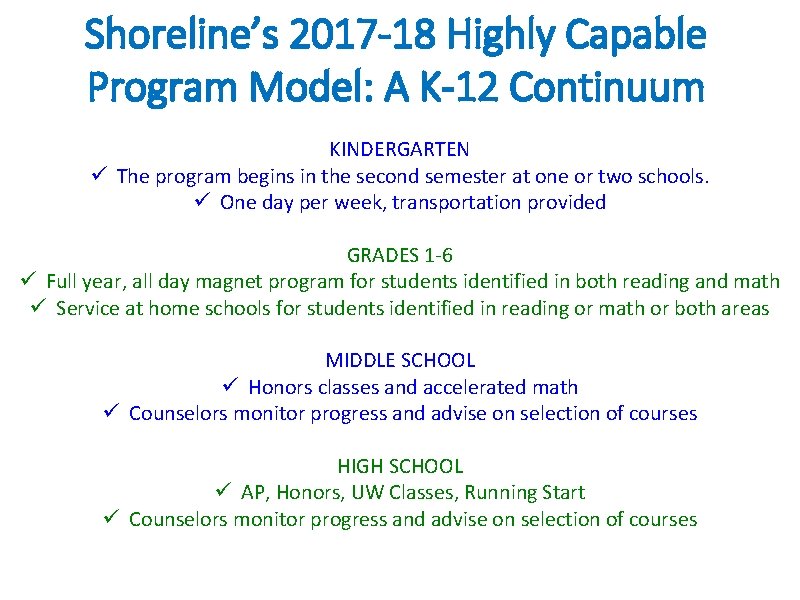
Shoreline’s 2017 -18 Highly Capable Program Model: A K-12 Continuum KINDERGARTEN ü The program begins in the second semester at one or two schools. ü One day per week, transportation provided GRADES 1 -6 ü Full year, all day magnet program for students identified in both reading and math ü Service at home schools for students identified in reading or math or both areas MIDDLE SCHOOL ü Honors classes and accelerated math ü Counselors monitor progress and advise on selection of courses HIGH SCHOOL ü AP, Honors, UW Classes, Running Start ü Counselors monitor progress and advise on selection of courses
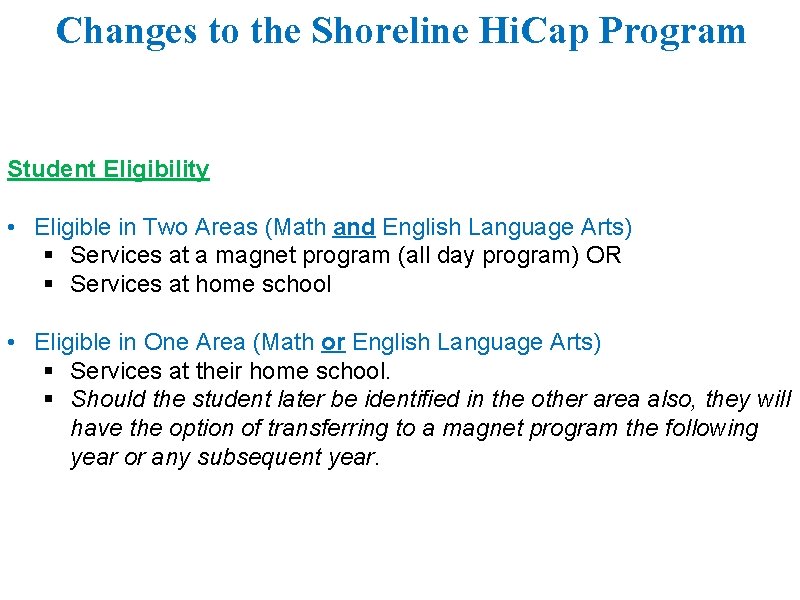
Changes to the Shoreline Hi. Cap Program Student Eligibility • Eligible in Two Areas (Math and English Language Arts) § Services at a magnet program (all day program) OR § Services at home school • Eligible in One Area (Math or English Language Arts) § Services at their home school. § Should the student later be identified in the other area also, they will have the option of transferring to a magnet program the following year or any subsequent year.
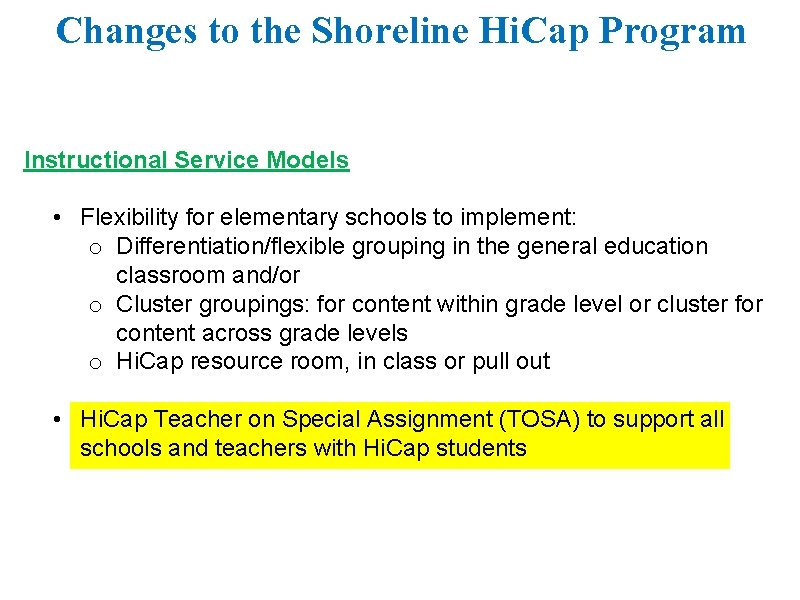
Changes to the Shoreline Hi. Cap Program Instructional Service Models • Flexibility for elementary schools to implement: o Differentiation/flexible grouping in the general education classroom and/or o Cluster groupings: for content within grade level or cluster for content across grade levels o Hi. Cap resource room, in class or pull out • Hi. Cap Teacher on Special Assignment (TOSA) to support all schools and teachers with Hi. Cap students
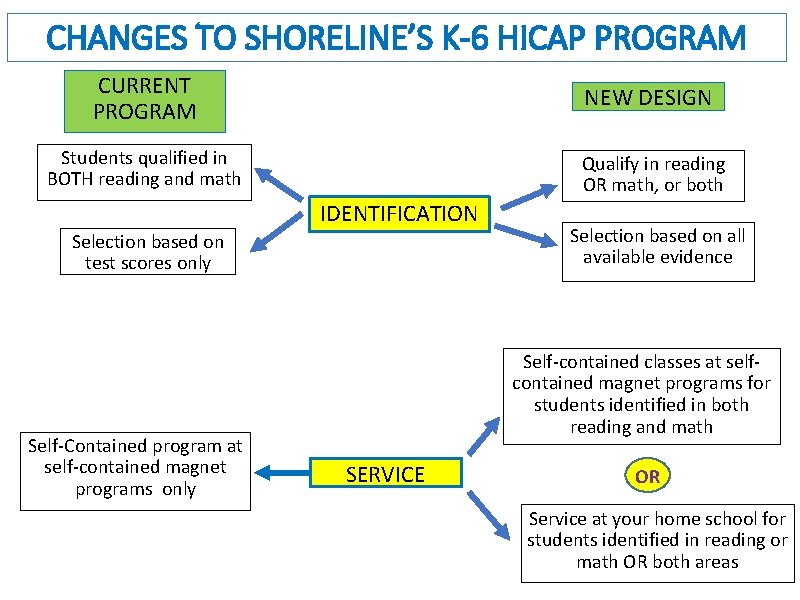
CHANGES TO SHORELINE’S K-6 HICAP PROGRAM CURRENT PROGRAM NEW DESIGN Students qualified in BOTH reading and math Qualify in reading OR math, or both IDENTIFICATION Selection based on test scores only Self-Contained program at self-contained magnet programs only Selection based on all available evidence Self-contained classes at selfcontained magnet programs for students identified in both reading and math SERVICE OR Service at your home school for students identified in reading or math OR both areas
How Will Program Changes Affect Students Already in the Program? Every student who is already in the Highly Capable program at the time changes are made will continue to be served in the program. The range of services will be expanded, but once a student is identified as Highly Capable they will continue to be eligible for the program through graduation. The goal of these changes is to increase our ability to serve identified students.
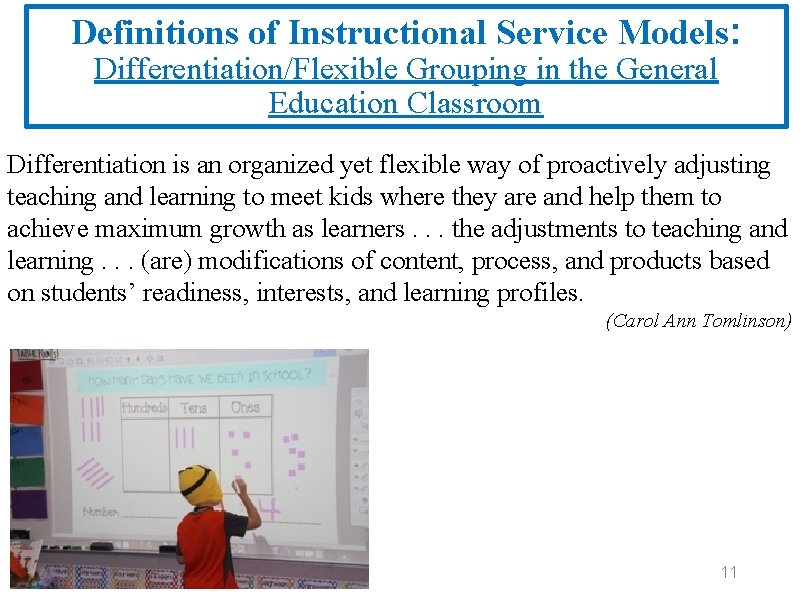
Definitions of Instructional Service Models: Differentiation/Flexible Grouping in the General Education Classroom Differentiation is an organized yet flexible way of proactively adjusting teaching and learning to meet kids where they are and help them to achieve maximum growth as learners. . . the adjustments to teaching and learning. . . (are) modifications of content, process, and products based on students’ readiness, interests, and learning profiles. (Carol Ann Tomlinson) 11
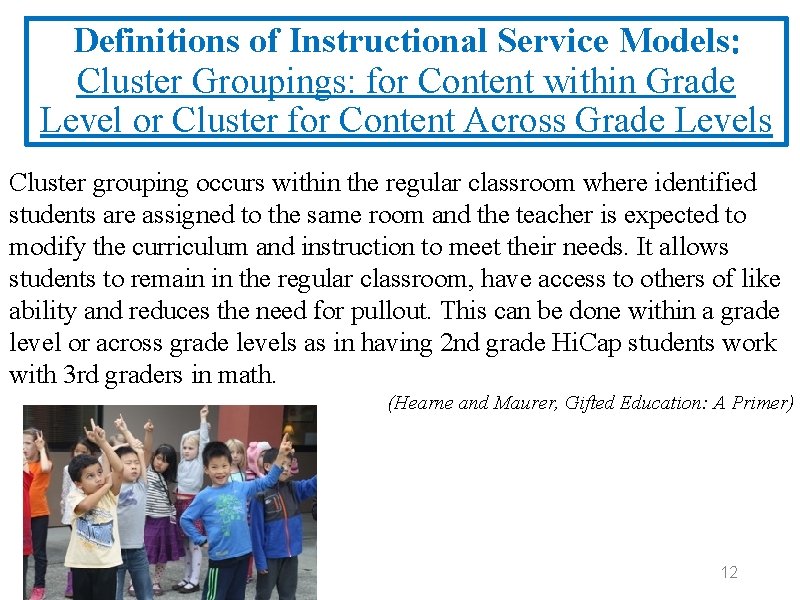
Definitions of Instructional Service Models: Cluster Groupings: for Content within Grade Level or Cluster for Content Across Grade Levels Cluster grouping occurs within the regular classroom where identified students are assigned to the same room and the teacher is expected to modify the curriculum and instruction to meet their needs. It allows students to remain in the regular classroom, have access to others of like ability and reduces the need for pullout. This can be done within a grade level or across grade levels as in having 2 nd grade Hi. Cap students work with 3 rd graders in math. (Hearne and Maurer, Gifted Education: A Primer) 12
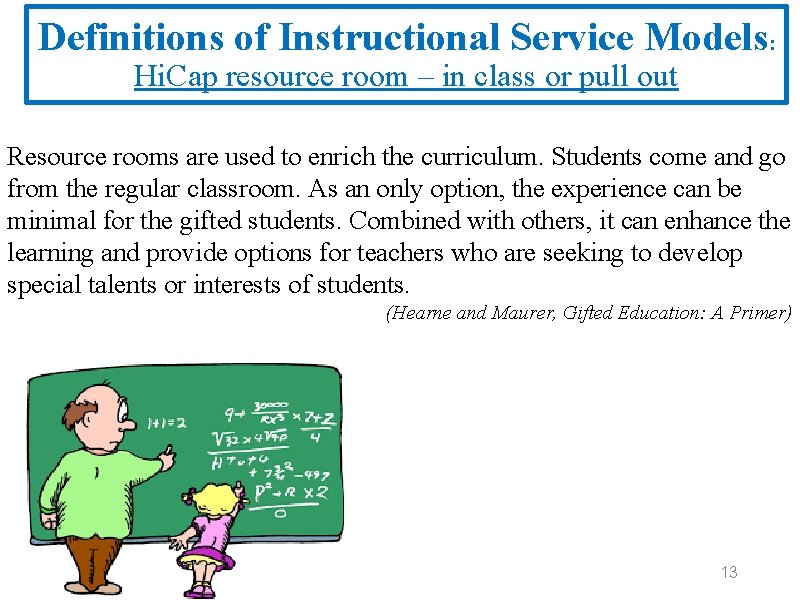
Definitions of Instructional Service Models: Hi. Cap resource room – in class or pull out Resource rooms are used to enrich the curriculum. Students come and go from the regular classroom. As an only option, the experience can be minimal for the gifted students. Combined with others, it can enhance the learning and provide options for teachers who are seeking to develop special talents or interests of students. (Hearne and Maurer, Gifted Education: A Primer) 13
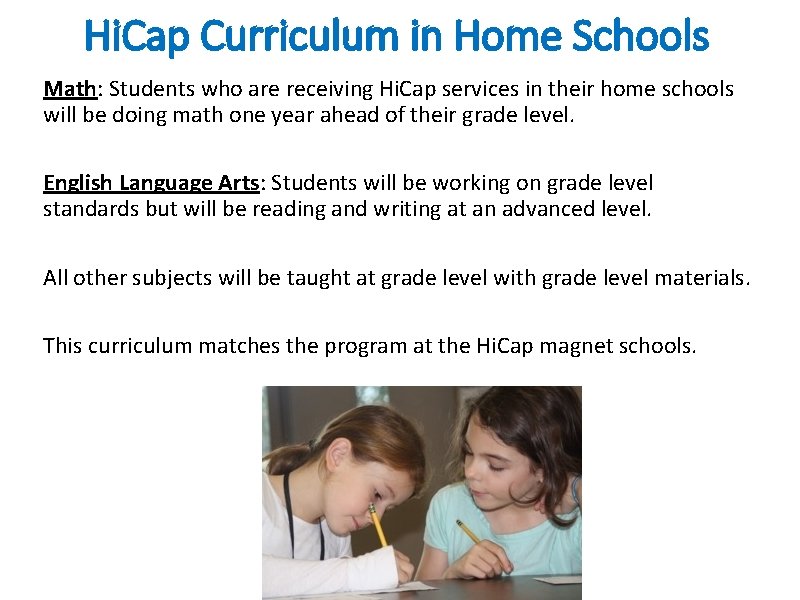
Hi. Cap Curriculum in Home Schools Math: Students who are receiving Hi. Cap services in their home schools will be doing math one year ahead of their grade level. English Language Arts: Students will be working on grade level standards but will be reading and writing at an advanced level. All other subjects will be taught at grade level with grade level materials. This curriculum matches the program at the Hi. Cap magnet schools.
Next Steps in Hi. Cap Support and Communication In order to support our students, families, and staff in the implementation of this new model we will be: • Developing an ongoing program of teacher training for Hi. Cap • Hiring a Hi. Cap teacher on special assignment to support all our schools • Reviewing our assessment and selection procedures to create greater equity and opportunity for highly capable students • Forming a Hi. Cap Advisory including parents and staff to give us guidance on how to proceed • Holding four Hi. Cap community meetings each school year • Publishing a regular Hi. Cap newsletter • Frequently updating our Hi. Cap Q&A site

May 16, 2017 Presentation on Gifted Education Dr. Nancy Hertzog Director, Robinson Center for Young Scholars University of Washington Co-Sponsored by Shoreline Public Schools and Shoreline Hi. Cap Advocacy Group 6: 30 -8: 30 pm, Shoreline Center More information to come
Coming Soon! Shoreline Hi. Cap Advisory Committee To be formed this spring A new way for Shoreline parents, administrators, and teachers to come together to: ü Learn together ü Provide opportunity for feedback on implementation ü Plan district community events ü Provide information for Hi. Cap newsletters More information to come
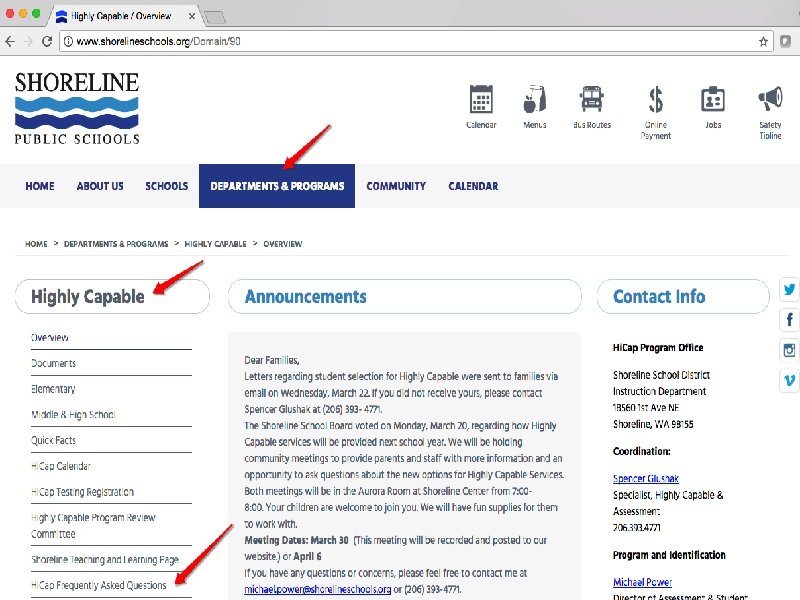
District Contacts Highly Capable Program Office: 206 -393 -4771 Michael Power Director of Assessment and Student Learning michael. power@shorelineschools. org Spencer Glushak Assessment & Hi. Cap Program Specialist spencer. glushak@shorelineschools. org Website: http: //www. shorelineschools. org/Domain/90
State and National Resources • State Office of the Superintendent of Public Instructional Services - 360725 -6100 www. k 12. wa. us/Highly. Capable/ • Washington Association for Gifted Children www. waetag. net • Washington Administrative Code (WAC) Chapter 392 -170 Special Service Program-Highly Capable Students http: //apps. leg. wa. gov/WAC/default. aspx? cite=392 -170 • The Halbert & Nancy Robinson Center for Young Scholars at the University of Washington: 206 -543 -4160 depts. washington. edu/cscy/ • National Association for Gifted Children www. nagc. org

Questions?
- Slides: 21