
SHOCK Phil Ukrainetz MD PGY 5 Jeff Plant


- Slides: 126
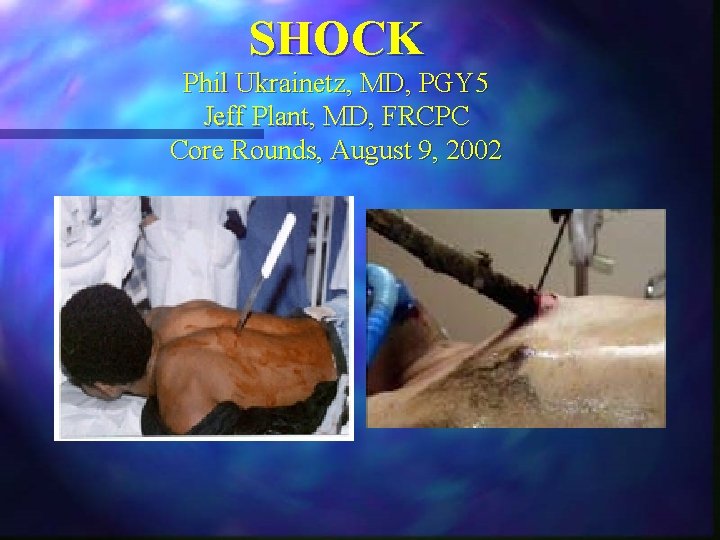
SHOCK Phil Ukrainetz, MD, PGY 5 Jeff Plant, MD, FRCPC Core Rounds, August 9, 2002
Shock talk outline In the trenches approach n What’s the evidence n What is on the horizon n
Shock definition A condition of the circulatory system whereby there is inadequate tissue nourishment and removal of toxic metabolites
Better shock definition Inadequate blood flow secondary to decreased cardiac output or maldistributed output that results in irreversible tissue damage
Why is my sphincter tone so high? Shock is the transition between life and death n Cornerstone of emergency medicine n You need to know it cold n
Shock: assert yourself and know your team Preparation: n Who’s the boss n Know names of staff n Assign tasks including reinforcing that you are running the code (AKA: shut-up or leave)
Shock: the set up T: Triage n V: Vitals including C/S and O 2 sat n M: Pulse-ox, ACF IV x 2, cardiac monitor, O 2 NRB n
Your role as code leader Your position is at the foot of the bed with your hand on the pts femoral artery and your eyes on the monitor n Do not get roped into procedures n Direct specific people for specific tasks n Close the loop - “Please intubate the patient and let me know when it is done” - then check that tasks have been completed. n
Shock: it is as simple as ABC’s C: quick look because early defibrillation makes such a difference n A: if they will take a tube give it (have sux on hand), confirm tube n B: adequate vent and ox n C: fluids then pressors n S: sugar and temp n
Shock: you want a directed history Do not wait for the info - ask these questions: n A: Allergies n M: Medications - cardiac CCB/BB/Dig n P: PMHX - surgery? n L: Last meal - who cares but it makes AMPLE a word n E: Events leading up
Shock: how do I know they are in shock? Confirm shock n Encephalopathic - MAP of 50 before decr CBF - do not rely ALOC to diagnose shock n Hypotense n Tachypnea n Oliguria - sensitive at < 0. 5 cc/kg/hr n Cold skin
Shock: how do I diagnose the etiology Head to toe etiologic clues: n Head: pupils, neck stiffness, JVD n Chest: muffled HS, S 3, murmur, crackles n Abdo: peritonitis, tense n Skin: warm, cold, purpura fulminans
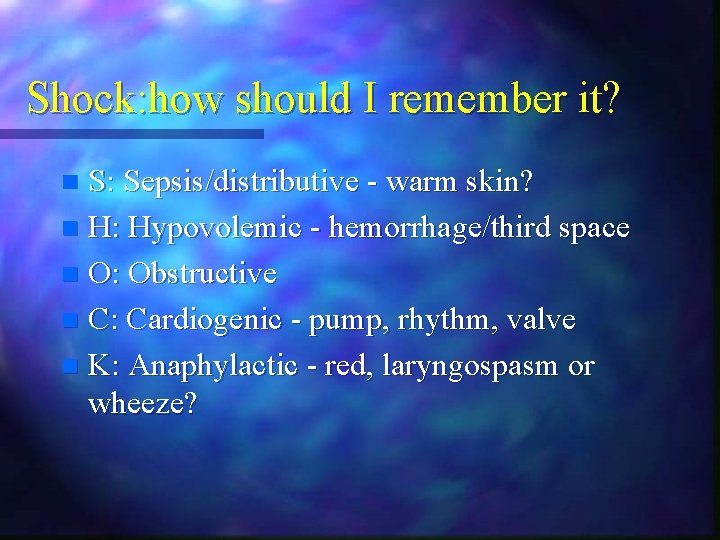
Shock: how should I remember it? S: Sepsis/distributive - warm skin? n H: Hypovolemic - hemorrhage/third space n O: Obstructive n C: Cardiogenic - pump, rhythm, valve n K: Anaphylactic - red, laryngospasm or wheeze? n
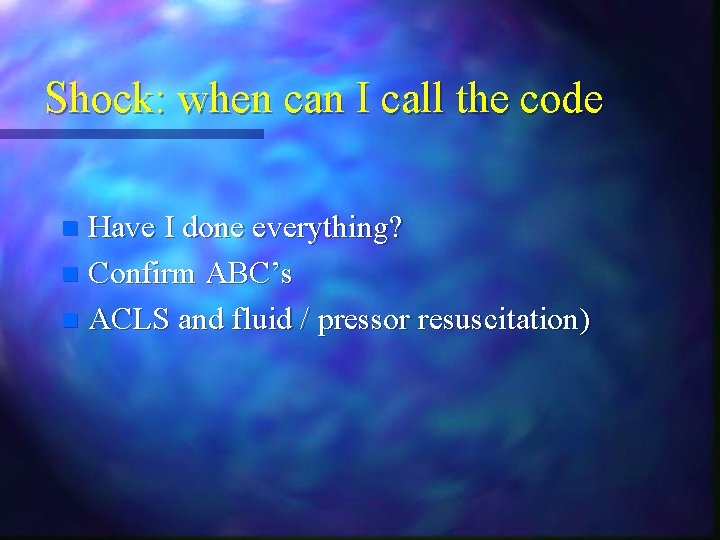
Shock: when can I call the code Have I done everything? n Confirm ABC’s n ACLS and fluid / pressor resuscitation) n
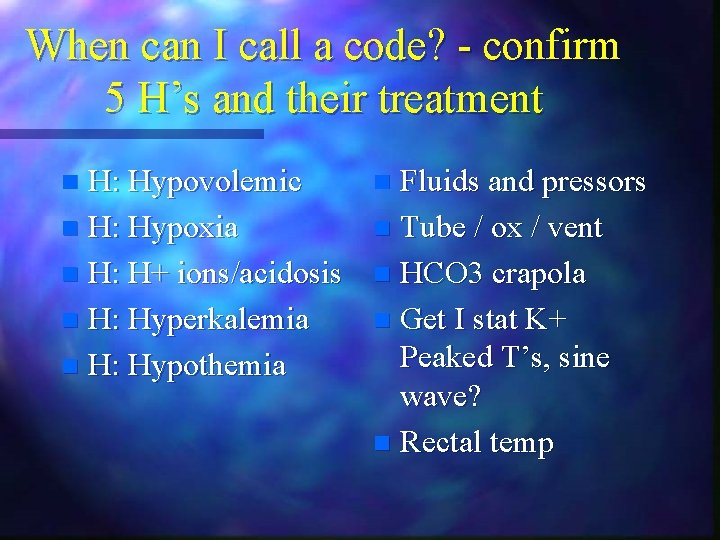
When can I call a code? - confirm 5 H’s and their treatment H: Hypovolemic n H: Hypoxia n H: H+ ions/acidosis n H: Hyperkalemia n H: Hypothemia n Fluids and pressors n Tube / ox / vent n HCO 3 crapola n Get I stat K+ Peaked T’s, sine wave? n Rectal temp n
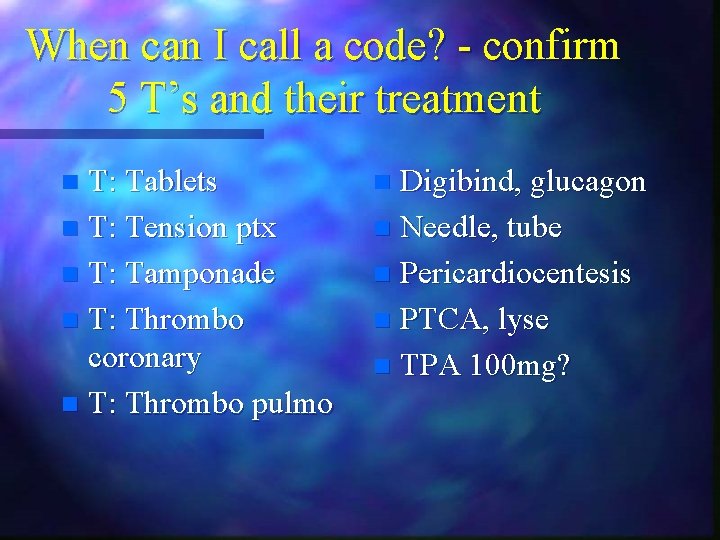
When can I call a code? - confirm 5 T’s and their treatment T: Tablets n T: Tension ptx n T: Tamponade n T: Thrombo coronary n T: Thrombo pulmo n Digibind, glucagon n Needle, tube n Pericardiocentesis n PTCA, lyse n TPA 100 mg? n
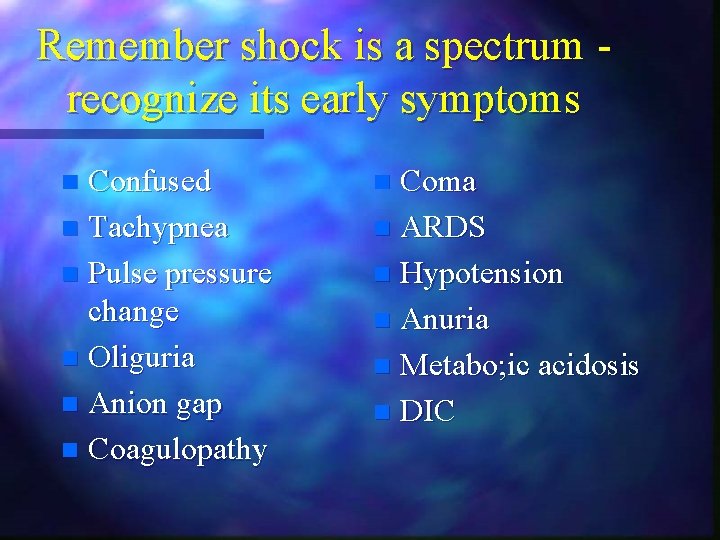
Remember shock is a spectrum recognize its early symptoms Confused n Tachypnea n Pulse pressure change n Oliguria n Anion gap n Coagulopathy n Coma n ARDS n Hypotension n Anuria n Metabo; ic acidosis n DIC n
Shock classifications: how to rally in an exam Simplest: vasogenic, cardiogenic, hypovolemic n Quantitative vs qualitative n SHOCK mnemonic n It doesn’t matter how you do it just be comprehensive and be able to rattle it off n
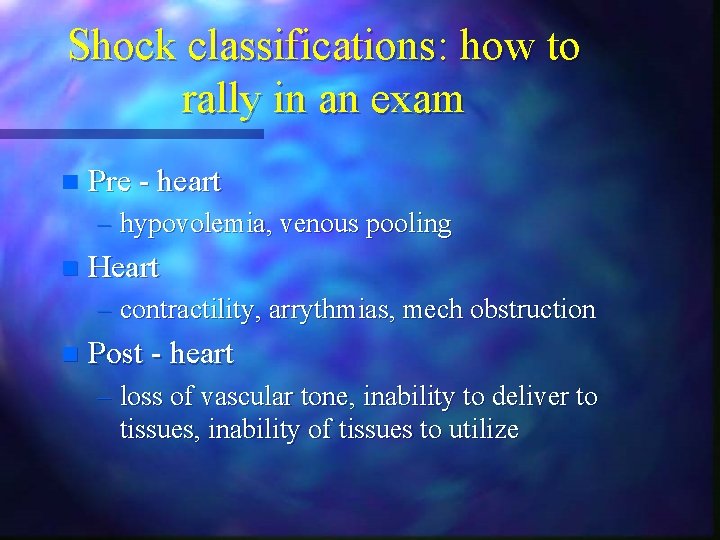
Shock classifications: how to rally in an exam n Pre - heart – hypovolemia, venous pooling n Heart – contractility, arrythmias, mech obstruction n Post - heart – loss of vascular tone, inability to deliver to tissues, inability of tissues to utilize
Quantitative shock: circulatory defect Quantitative: large area of decreased tissue perfusion secondary to a circulatory defect n Vasogenic, hypovolemic and cardiogenic in origin n Compensate with hyperdynamic state; HR, CO increased and clamp down n Correct the circulatory defect n
Qualitative shock: altered milieau Affects the metabolic milieau from the getgo n Sepsis, hemoglobinopathies, crush, heat, cell poisons n Do not necessarily have a compensatory period n Identify the toxin and customize management n
Shock unifying features: Disrupted cellular homeostasis n Think failed anaerobic metabolism n Acidosis n Calcium influx, SR pukes n Failed ion gradients and cellular pumps n Cell edema and death n
Some other $25 cent words to throw around Membrane lipid peroxidation n Free radicals n Nitric oxide damage n Enzymatic denaturation n “Inflammatory mediators” n
How does our body compensate? Counter-regulatory mediators n Catecholamines, glucocorticoids, angiotensin, vasopressin, insulin n Increased substrates: glucose, TG and FFA n Anaerobic metabolism: incr CO 2: 02 ratio n
Oxygen metabolism Shock is a state of oxidative phosphorylative failure n Loss of autoregulation n Inability to match demand n Paralyze paradoxers: 50 -100% increase in 02 demands, 50% decrease in CBF n DELIVER 02!!!!!!! n
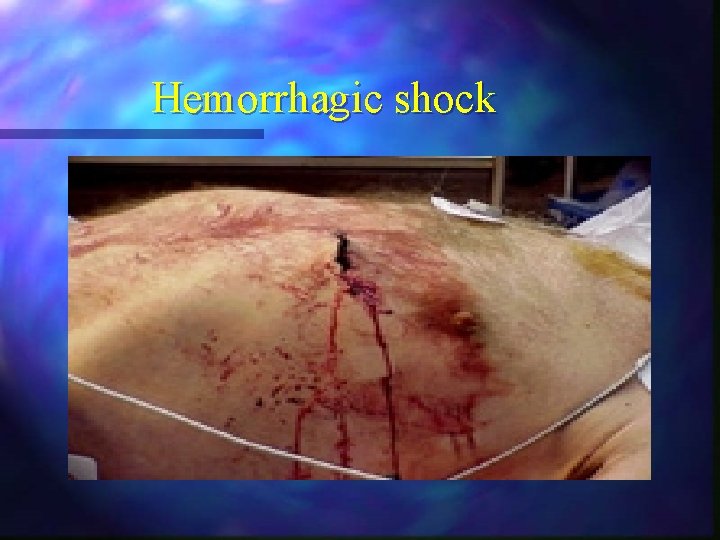
Hemorrhagic shock
Case n 50 year old male MVA victim, HR is 120, BP is 100/75, RR is 20 complaining of abdominal and chest pain. What is the likely blood loss?
What is the utility of the Hemorrhagic Shock Classification?
Classification utility It makes you consider the signs of shock n It makes you aware that you can have significant blood loss with very little signs or symptoms n It tells you that patients become hypotensive late so don’t wait n
Compensatory mechanisms for blood loss Cardiac: increase rate to 150 then diminished returns n Resistance: catecholamines increase diastolic pressure, narrowed pulse pressure n Capacitance: shunt from catechol receptor rich gut and skin, decreased renal function means increased vascular colume n
Case n 14 year old male MVA victim, weighing 50 kg has a fractured femur, seat belt sign and a GCS of 14. The accident happened right outside ACH only minutes ago. His heart rate is 95, BP is 95/65, RR is 20. Do these vitals make you sweat?
Supine vitals sensitivity I would sweat, supine vitals are: n Not very sensitive n 15% loss has no change in vitals n 30% loss before hypotense n Act early and aggressively - especially in kids. They crump late and fast.
Case n Nurse comes to you saying “The girl involved in the slow speed (5 km/hr) rear end MVC, the one who is complaining of abdominal pain has an orthostatic increase of 20 BPM”. Is this useful information?
Orthostatic vitals Consider the context, however in the absence of concerning trauma they are not sensitive n Normal euvolemic patients average an orthostatic increase of 15 BPM, therefore an orthostatic increase of 20 BPM is not helpful n A meaningful orthostatic increase is 30 BPM and this requires a 20% loss of blood volume. n
Hemorrhagic shock management n Management – ABCs, vascular access, crystalloid bolus X 2, blood transfusion prn – Search for the cause of blood loss: CXR, abdo and pelvis – controversies crystalloid versus colloid n immediate versus delayed n small versus large volume resuscitation n Optimal endpoints of resuscitation n
Case n An ICU nurse gawks at you when you ask to give the hemorrhagic shock patient NS. She remarks you should pull up your MAST pants and start giving pentaspan, albumin or something useful - is she right?
Colloids Albumin, protoplasm protein fraction, hydroxyethylstarch, gelatin, dextran n Advantages n – less fluid required, more volume in vascular space, potential to draw fluid in from tissues n Disadvantages – expensive, allergic reactions, coagulopathies
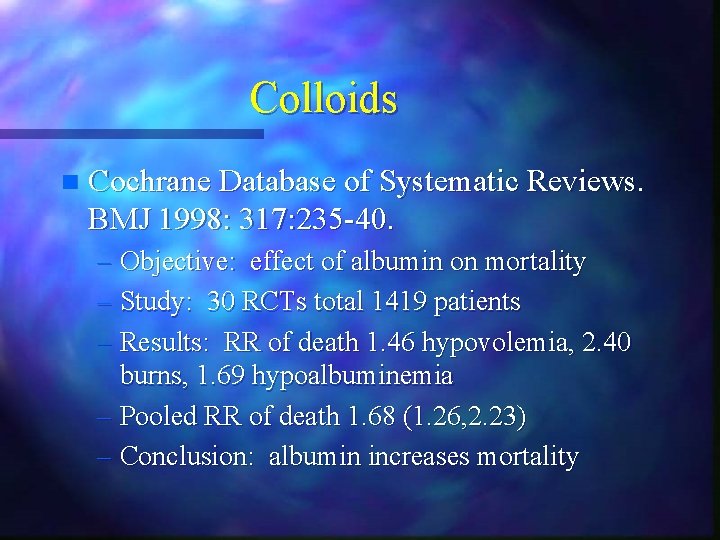
Colloids n Cochrane Database of Systematic Reviews. BMJ 1998: 317: 235 -40. – Objective: effect of albumin on mortality – Study: 30 RCTs total 1419 patients – Results: RR of death 1. 46 hypovolemia, 2. 40 burns, 1. 69 hypoalbuminemia – Pooled RR of death 1. 68 (1. 26, 2. 23) – Conclusion: albumin increases mortality
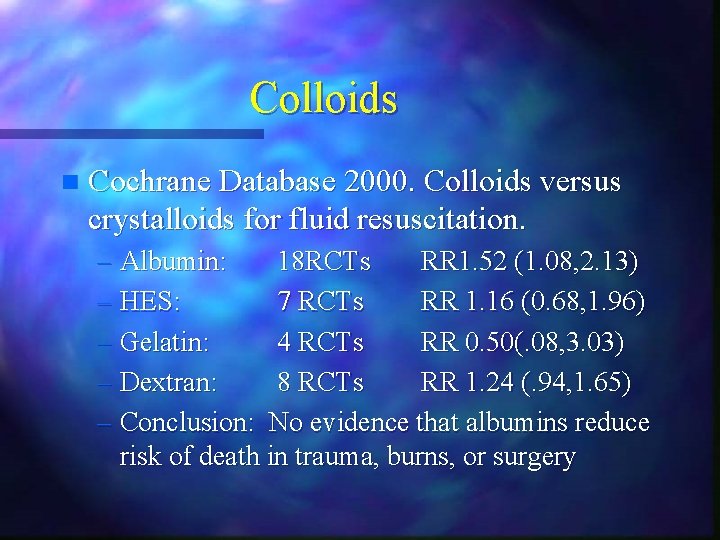
Colloids n Cochrane Database 2000. Colloids versus crystalloids for fluid resuscitation. – Albumin: 18 RCTs RR 1. 52 (1. 08, 2. 13) – HES: 7 RCTs RR 1. 16 (0. 68, 1. 96) – Gelatin: 4 RCTs RR 0. 50(. 08, 3. 03) – Dextran: 8 RCTs RR 1. 24 (. 94, 1. 65) – Conclusion: No evidence that albumins reduce risk of death in trauma, burns, or surgery
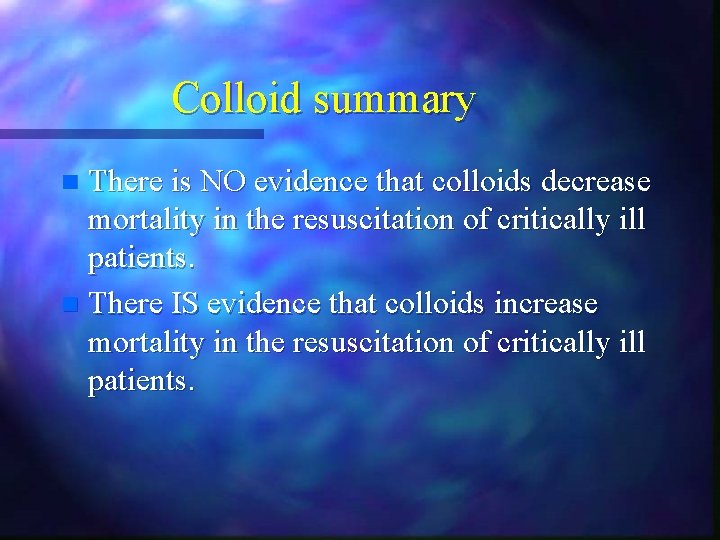
Colloid summary There is NO evidence that colloids decrease mortality in the resuscitation of critically ill patients. n There IS evidence that colloids increase mortality in the resuscitation of critically ill patients. n
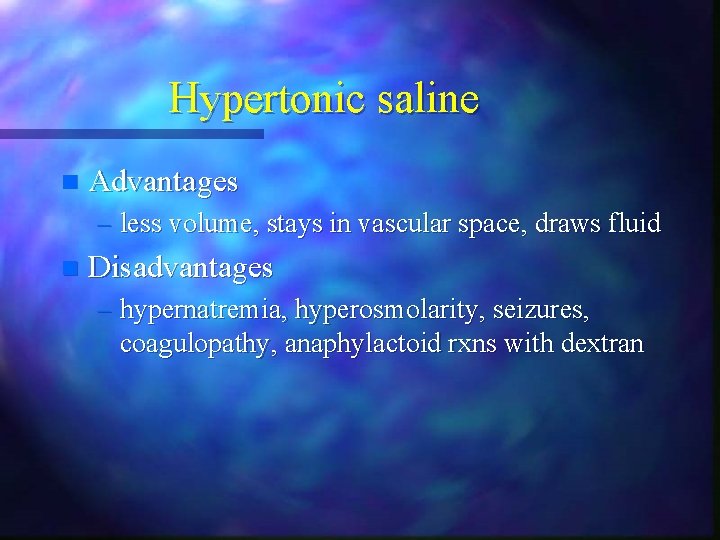
Hypertonic saline n Advantages – less volume, stays in vascular space, draws fluid n Disadvantages – hypernatremia, hyperosmolarity, seizures, coagulopathy, anaphylactoid rxns with dextran
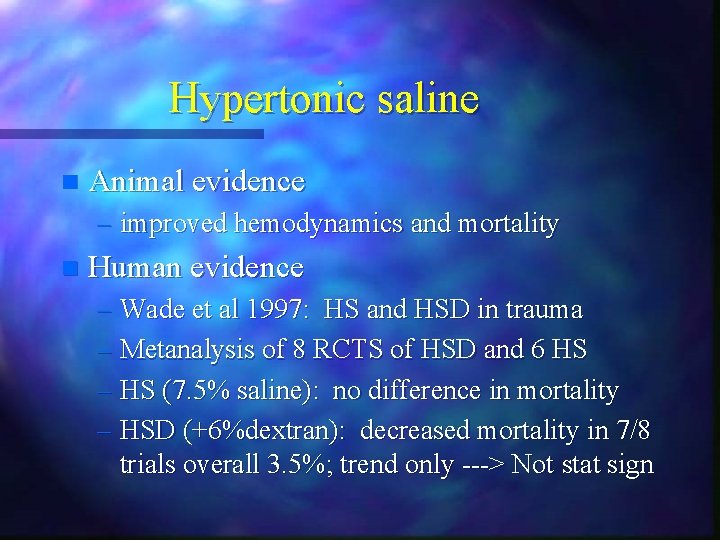
Hypertonic saline n Animal evidence – improved hemodynamics and mortality n Human evidence – Wade et al 1997: HS and HSD in trauma – Metanalysis of 8 RCTS of HSD and 6 HS – HS (7. 5% saline): no difference in mortality – HSD (+6%dextran): decreased mortality in 7/8 trials overall 3. 5%; trend only ---> Not stat sign
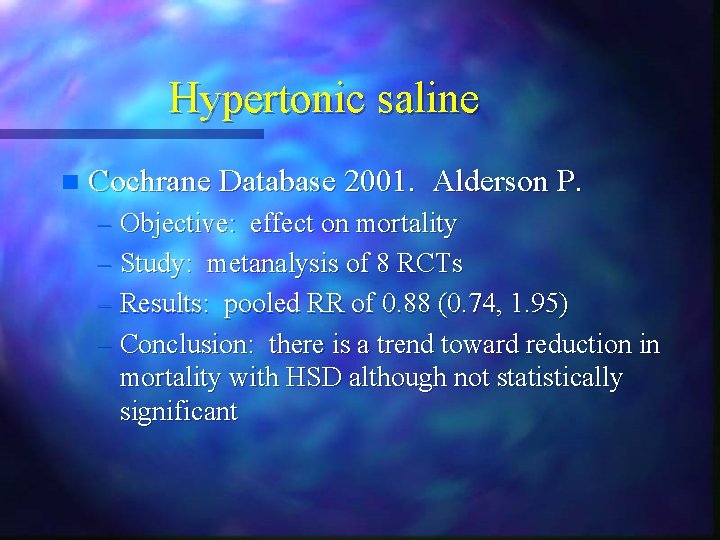
Hypertonic saline n Cochrane Database 2001. Alderson P. – Objective: effect on mortality – Study: metanalysis of 8 RCTs – Results: pooled RR of 0. 88 (0. 74, 1. 95) – Conclusion: there is a trend toward reduction in mortality with HSD although not statistically significant
Hypertonic saline summary There is evidence of TRENDS toward lower mortality in resuscitation with hypertonic saline but statistical significance has not been demonstrated ………… n More RCTs are needed………. . n
Case n A 20 year old male comes in with a knife wound to his abdomen. He is bleeding profusely. The trauma surgeon will be here in 10 minutes. The patients systolic is 70. How much and what fluid would you like Doctor?
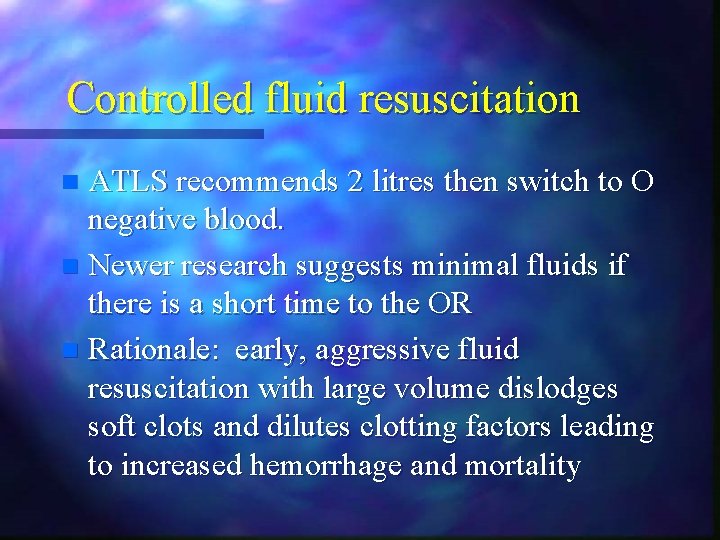
Controlled fluid resuscitation ATLS recommends 2 litres then switch to O negative blood. n Newer research suggests minimal fluids if there is a short time to the OR n Rationale: early, aggressive fluid resuscitation with large volume dislodges soft clots and dilutes clotting factors leading to increased hemorrhage and mortality n
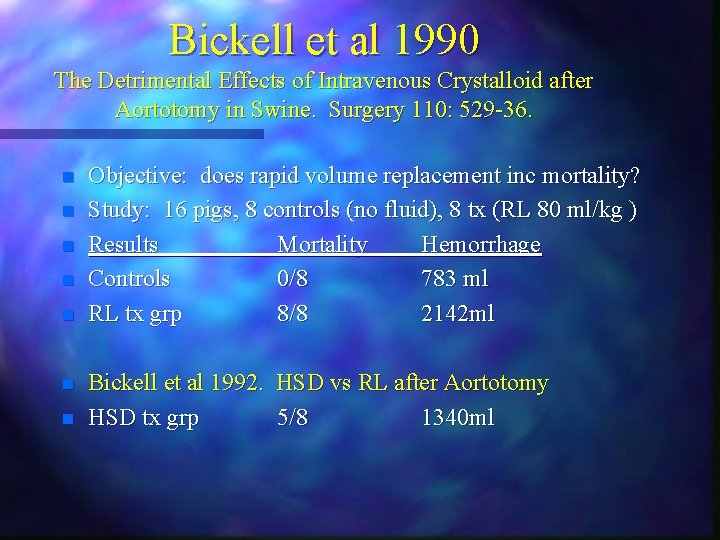
Bickell et al 1990 The Detrimental Effects of Intravenous Crystalloid after Aortotomy in Swine. Surgery 110: 529 -36. n n n n Objective: does rapid volume replacement inc mortality? Study: 16 pigs, 8 controls (no fluid), 8 tx (RL 80 ml/kg ) Results Mortality Hemorrhage Controls 0/8 783 ml RL tx grp 8/8 2142 ml Bickell et al 1992. HSD vs RL after Aortotomy HSD tx grp 5/8 1340 ml
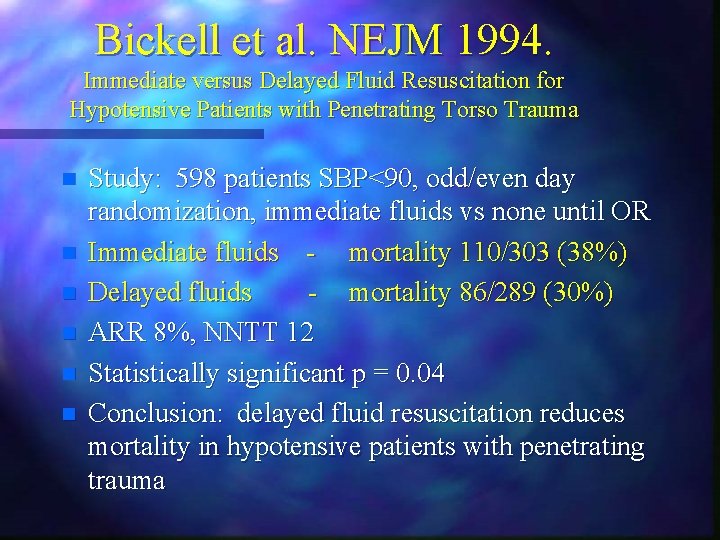
Bickell et al. NEJM 1994. Immediate versus Delayed Fluid Resuscitation for Hypotensive Patients with Penetrating Torso Trauma n n n Study: 598 patients SBP<90, odd/even day randomization, immediate fluids vs none until OR Immediate fluids - mortality 110/303 (38%) Delayed fluids - mortality 86/289 (30%) ARR 8%, NNTT 12 Statistically significant p = 0. 04 Conclusion: delayed fluid resuscitation reduces mortality in hypotensive patients with penetrating trauma
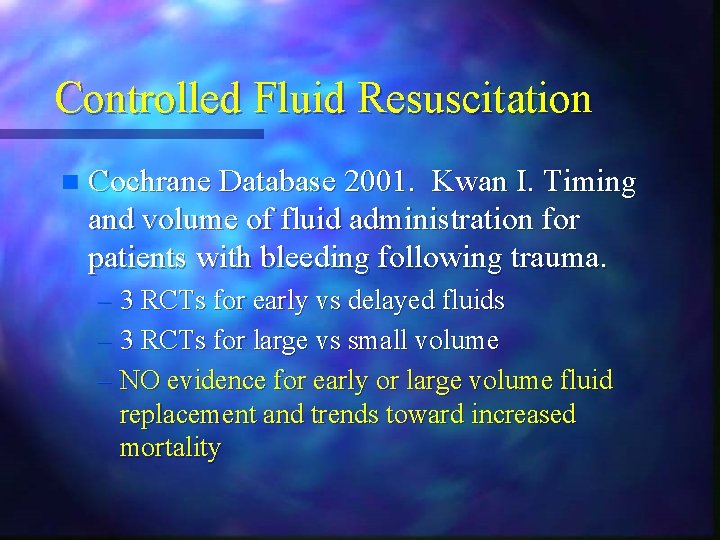
Controlled Fluid Resuscitation n Cochrane Database 2001. Kwan I. Timing and volume of fluid administration for patients with bleeding following trauma. – 3 RCTs for early vs delayed fluids – 3 RCTs for large vs small volume – NO evidence for early or large volume fluid replacement and trends toward increased mortality
Controlled Fluid Resuscitation Conclusions There is evidence (limited) that early, large volume aggressive fluid resuscitation increases mortality in penetrating trauma. n Further study needed on penetrating trauma without immediate access to OR and for blunt trauma and CHI n
Case n You can’t get an IV in your exsanguinating patient. A med student whips out a sternal intraosseus infuser - Is it safe? Does it work? Do people use these?
Sternal Intraosseus Infusion Rationale: n Average IV times are 1. 5 to 10 min n Too many outright failures to start IV’s n Sternum easy to locate and access n High red marrow content
Sternal Intraosseus Infusion FAST system (First Access for Shock and trauma, Pyng Medical Corp. , Vancouver, BC) n Intraosseus infusion system with depth control n
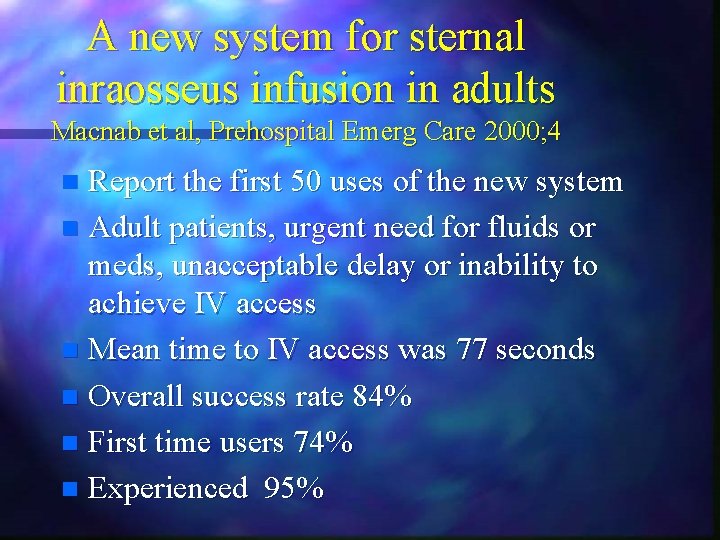
A new system for sternal inraosseus infusion in adults Macnab et al, Prehospital Emerg Care 2000; 4 Report the first 50 uses of the new system n Adult patients, urgent need for fluids or meds, unacceptable delay or inability to achieve IV access n Mean time to IV access was 77 seconds n Overall success rate 84% n First time users 74% n Experienced 95% n
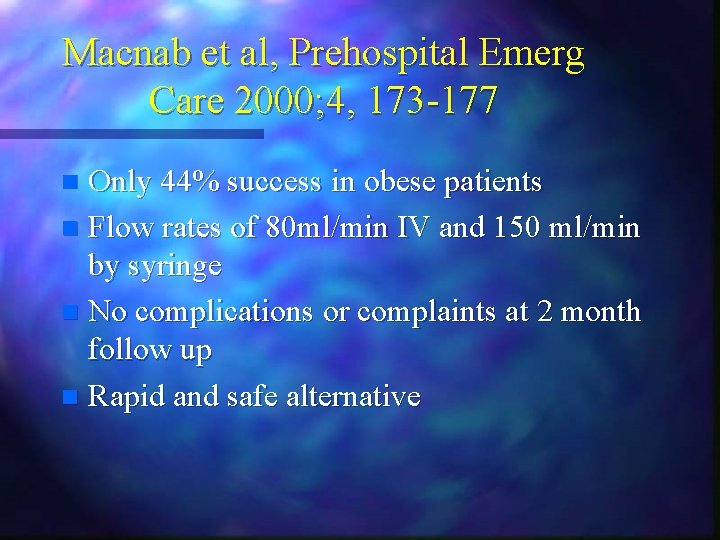
Macnab et al, Prehospital Emerg Care 2000; 4, 173 -177 Only 44% success in obese patients n Flow rates of 80 ml/min IV and 150 ml/min by syringe n No complications or complaints at 2 month follow up n Rapid and safe alternative n
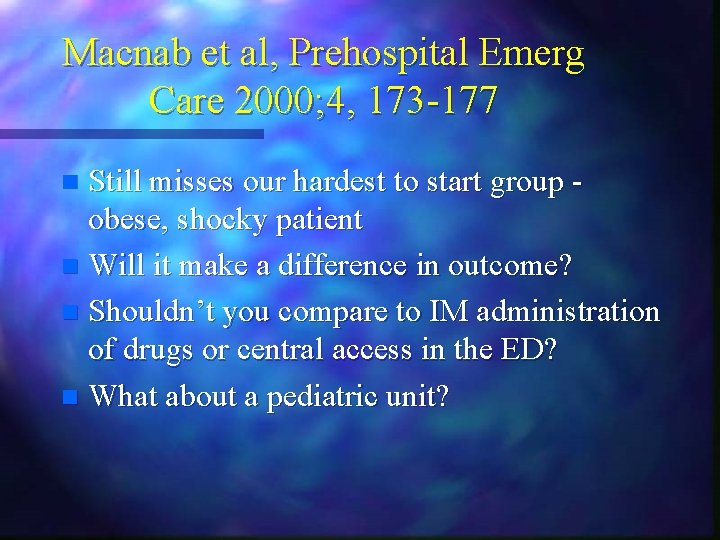
Macnab et al, Prehospital Emerg Care 2000; 4, 173 -177 Still misses our hardest to start group obese, shocky patient n Will it make a difference in outcome? n Shouldn’t you compare to IM administration of drugs or central access in the ED? n What about a pediatric unit? n
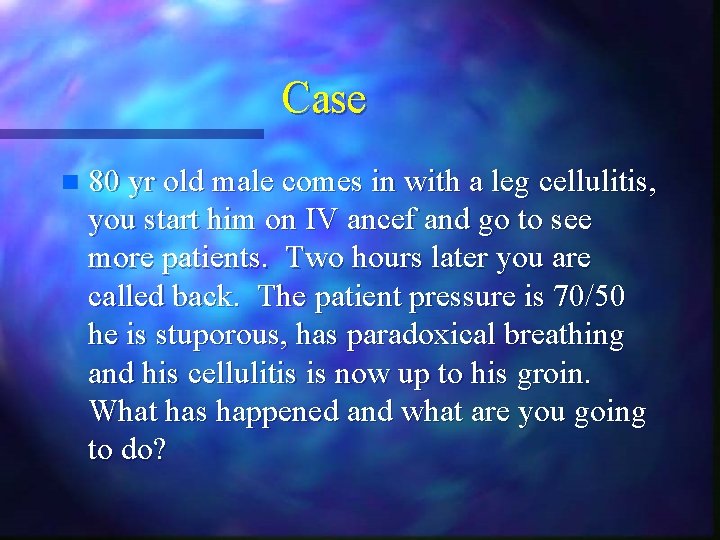
Case n 80 yr old male comes in with a leg cellulitis, you start him on IV ancef and go to see more patients. Two hours later you are called back. The patient pressure is 70/50 he is stuporous, has paradoxical breathing and his cellulitis is now up to his groin. What has happened and what are you going to do?
Sepsis Microbiologic cause of shock. Typically secondary to gram negative endotoxins but also due to gram positive, parasitic and fungal infections n Gram positive infxn ~ 35 – 40% n Gram negative infxn ~ 55 – 60% n Most common sites n – Lung, abdomen, urinary tract
Hemodynamic changes with sepsis Compensating: n Endotoxin decreased SVR with n Compensatory increase in cardiac output. n Presents as hyperdynamic, warm patient.
Hemodynamic changes with sepsis Decompensating: n Can appear like cardiogenic shock n Bacterial myocardial depressant n Increased pulmonary pressures (ARDS) n Pump failure and decreased forward flow n Presents as cold patient in failure. Poor prognosis
Sepsis general treatment TVM n ABC’S n 2 litres crystalloid n Pressors Levo>dopamine n Early empiric antibiotics n
Fluid resuscitation Important in septic shock n Initially relative hypovolemia/fluid defecits n Low CO and filling pressures which may respond to volume n Increased blood and plasma volumes associated with enhanced survival and increased CO n – Weil MH et al. , AM J Med 1978
Vincent J-L, et al. , Intensive Care Medicine (2001) Colloids and Crystalloid each work well n Colloids in Europe, Crystalloids in NA n Uncertain if one superior n Need 2 -4 x more volume with crystalloid for same filling pressures n
Fluids and sepsis summary n Aggressive fluid challenge important – Dx clue – Important physiologically n Will improve myocardial performance and O 2 delivery
Vasopressors n Cornerstone of Rx together with fluids and antibiotics n Goal: increase MAP and therefore end organ perfusion n First line agents: – Dopamine or levophed
Most common choices n Dopamine: – 1 -5 ug/kg/min ~ dopaminergic – 5 -10 ug/kg/min ~ beta activity – >10 ug/kg/min ~ alpha activity n Levophed: – Potent alpha agonist – Some beta properties
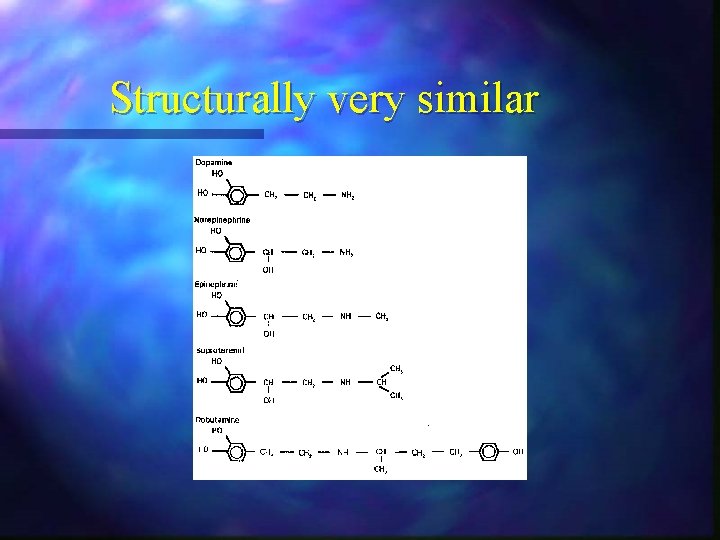
Structurally very similar
Dopamine In past/and still with many, dopamine preferred agent n Effects well established n Physicians comfortable with use n
Norepinephrine Concern with levophed worsening end organ hypoperfusion n Based on limited evidence n Older studies on pressors, levophed used as last resort and thus poor outcomes n – Hesselvik JF, et al. , Crit Care Med 1989
Norepinephrine n Norepinephrine improves renal blood flow and tissue oxygenation in patients with septic shock: – Desjars et al. , Crit Care Med 1989 – Rendl-Wenzel et al. , Intensive Care Med 1993. – Meadows et al. , Crit Care Med 1988 – Martin C. , et al. , Crit Care Medicine 2000
Dopamine versus norepinephrine Martin et al. , Chest 1993 n Marik et al. , JAMA 1994 n Small studies (n=20), surrogate markers n Levophed has favourable effect on hemodynamics and end organ perfusion as compared to dopamine n
Pressor summary Dopamine/Levophed first line agents n Levophed may be the superior agent in septic shock n Make sure the pump is full first n Avoid supranormal restoration of MAP n Invasive monitoring req’d n
Bochud et al. , Intensive Care Medicine 2001 n 4 retrospective studies of gram neg bacteremia – Mc. Cabe et al. , Arch Intern Med 1962. – Bryant et al. , Arch Intern Med 1971. – Freid et al. , Arch Intern Med 1968. – Young et al. , Ann Intern Med 1977.
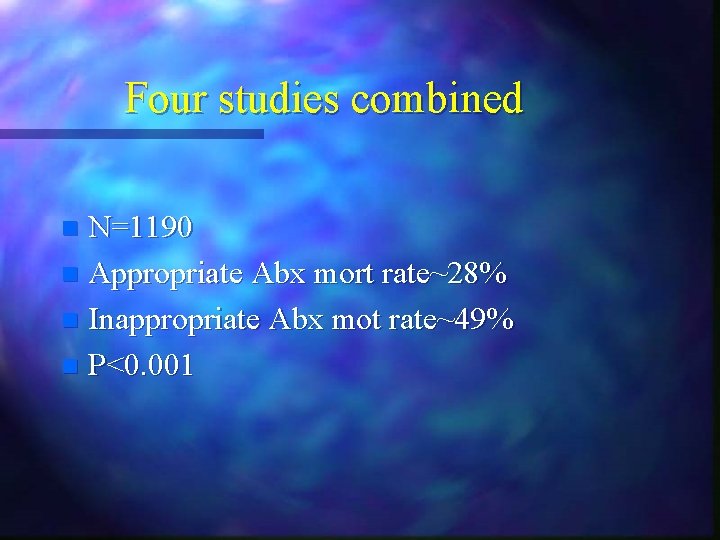
Four studies combined N=1190 n Appropriate Abx mort rate~28% n Inappropriate Abx mot rate~49% n P<0. 001 n
Intensive Care Medicine 2001 n Early appropriate antimicrobial Rx improves the outcome of patients with blood borne infections and severe sepsis or septic shock. . in patients with both gram negative and positive bacteremia
Empirical antibiotic choices Carbapenem n B-lactam + aminoglycoside n 3 rd/4 th generation cephalosporin n ? Extended spectrum penicillin n
La message n Initial rapid appropriate antibiotics in patients with severe sepsis/septic shock can be life saving
Case n Despite Dop at 20 u/min/kg and Levo at 4 ug/min the cellulitic patient still only has a pressure of 80 systolic. He is tubed and has no urine output by foley. What else is in your arsenal?
Steroids in septic shock Rationale: n Anti-inflammatory n Relative adrenal insufficiency in many of cases of refractory shock n Upregulates catecholamine receptors n Hopefully immunosuppression and bleed risk did not counter benefits
Interest in Roids Interest since the 1940’s n Known beneficial in n – Pediatric bacterial meningitis – Typhoid fever – PCP pneumonia
Early mega-dose steroid trials 1930 s mega-dose steroids (methylprednisolone 30/mg/kg x 3 -4 doses) n Trend towards increased mortality with corticosteroids n No beneficial effect in septic shock patients n Increase incidence of GI bleeding n Trend towards increased mortality from secondary infections n
Newer steroid trials in the 1990’s Revisited the steroid issue except at small doses n They aimed to replace steroids for a “Relative adrenal insufficiency” n Researchers hoped get catecholamine sensitivity and anti-inflammatory effects still n
Bollaert et al. , Critical Care Medicine 1998 Double-blind, placebo controlled n Septic shock pts according to ACCP criteria or pressors >48 hrs n Solu-cortef 100 mg IV q 8 hrs x 5 days vs. placebo with tapering n Baseline pt characteristics similar n
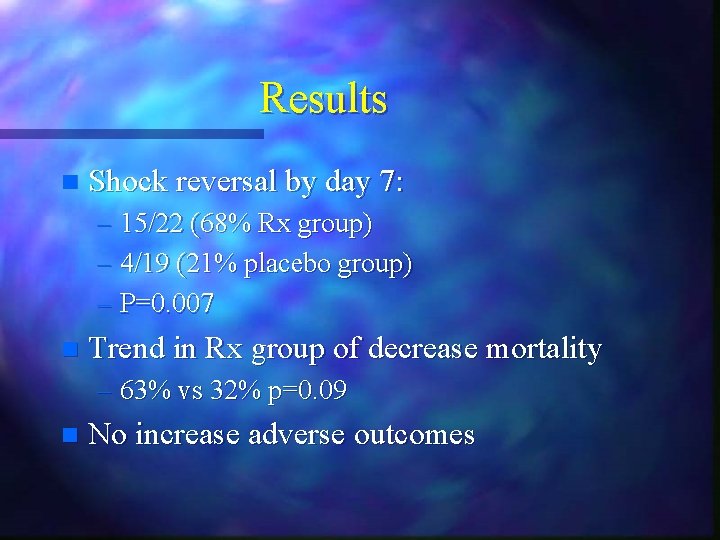
Results n Shock reversal by day 7: – 15/22 (68% Rx group) – 4/19 (21% placebo group) – P=0. 007 n Trend in Rx group of decrease mortality – 63% vs 32% p=0. 09 n No increase adverse outcomes
Briegel et al. , Crit Care Med 1999. Double blind, randomized, placebo controlled (n=40) n Pts in septic shock n Pts included if on vasopressors less than 72 hrs n Randomized to solu-cortef 100 mg IV then low dose infusion n Primary end point = time to shock reversal n
Results Shock reversal 2 days in Rx group vs. 7 days in placebo (p=0. 005) n Mortality unaffected by Rx n 1 GI bleed in Rx group n
Annane et al. , Crit Care Med, 2001 Review of the steroid literature n Conclusions – NO ROLE FOR HIGH DOSE STEROIDS – Growing evidence for replacement steroids in pressor dependent septic shock n
Case n A 10 year old tubed patient comes into PICU with febrile status epilepticus. . You astutely start him empirically on vanco and cefotaxime. Two hours later the child is coughing up blood, hypoxemic despite your best efforts and has a BP of 70/40 on maximum pressors? What is the latest agent for septic shock?
Activated Protein C Rationale: n Pro-fibrinolytic n Anti-thrombotic n Anti-inflammatory n
Bernard et al. , NEJM 2001 Randomized, double blind(phase 3 trial) n N=1690 severe sepsis n Placebo vs. APC n End point 28 day mortality n
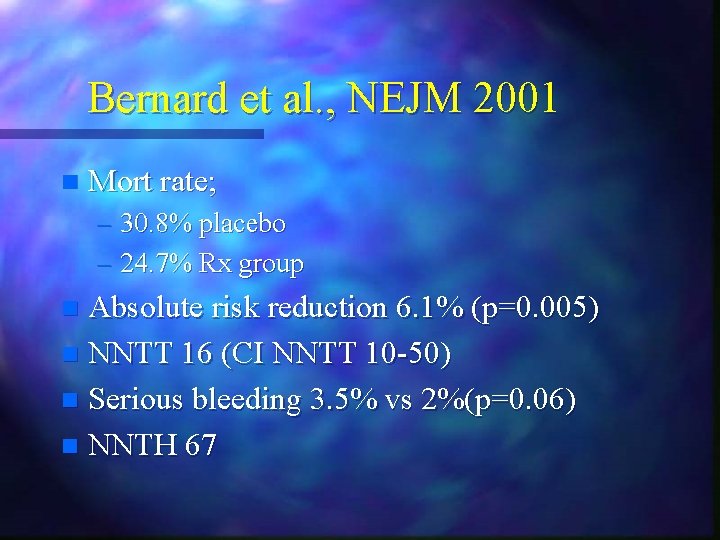
Bernard et al. , NEJM 2001 n Mort rate; – 30. 8% placebo – 24. 7% Rx group Absolute risk reduction 6. 1% (p=0. 005) n NNTT 16 (CI NNTT 10 -50) n Serious bleeding 3. 5% vs 2%(p=0. 06) n NNTH 67 n
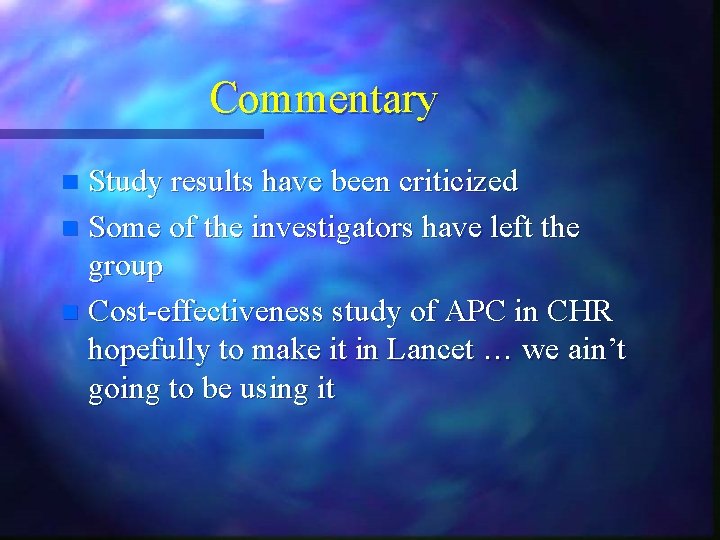
Commentary Study results have been criticized n Some of the investigators have left the group n Cost-effectiveness study of APC in CHR hopefully to make it in Lancet … we ain’t going to be using it n
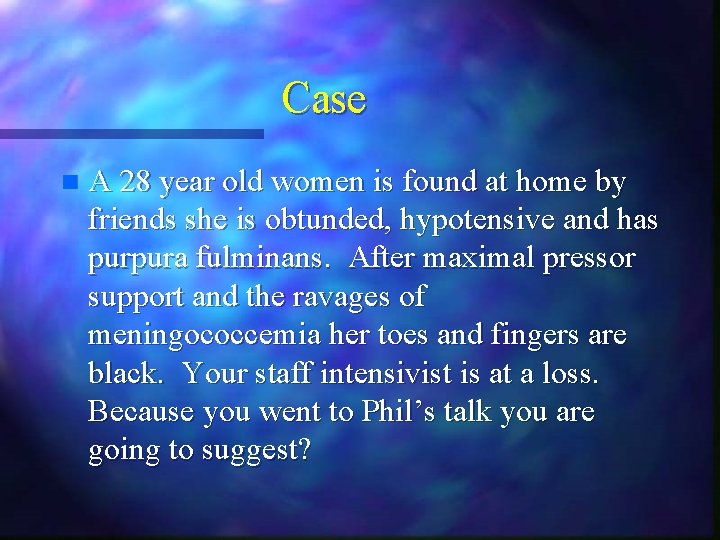
Case n A 28 year old women is found at home by friends she is obtunded, hypotensive and has purpura fulminans. After maximal pressor support and the ravages of meningococcemia her toes and fingers are black. Your staff intensivist is at a loss. Because you went to Phil’s talk you are going to suggest?
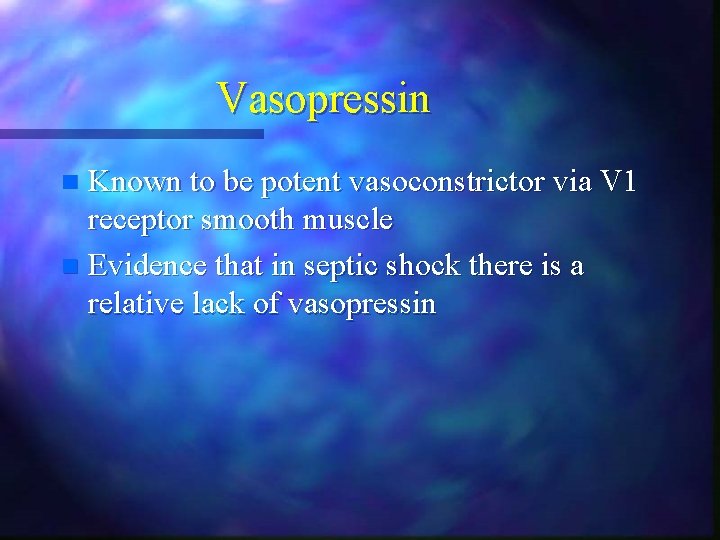
Vasopressin Known to be potent vasoconstrictor via V 1 receptor smooth muscle n Evidence that in septic shock there is a relative lack of vasopressin n
Vasopressin Malay et al. , J Trauma 1999 n Tsuneyoshi et al. , Crit Care Medicine 2001 n Studies limited by design and small numbers (N=10) n Surrogate markers not mortality used as end -points n
Vasopressin does increase MAP in pts with septic shock n ? Improved mortality n Larger studies required n ? Consider in ED as alternative to high dose pressors n
Sepsis management summary Don’t forget fluids n Levophed works better than dopamine n Don’t delay giving appropriate ABX n Increasing evidence for steroids in refractory septic shock n ? Activated protein C/vasopressin in future n
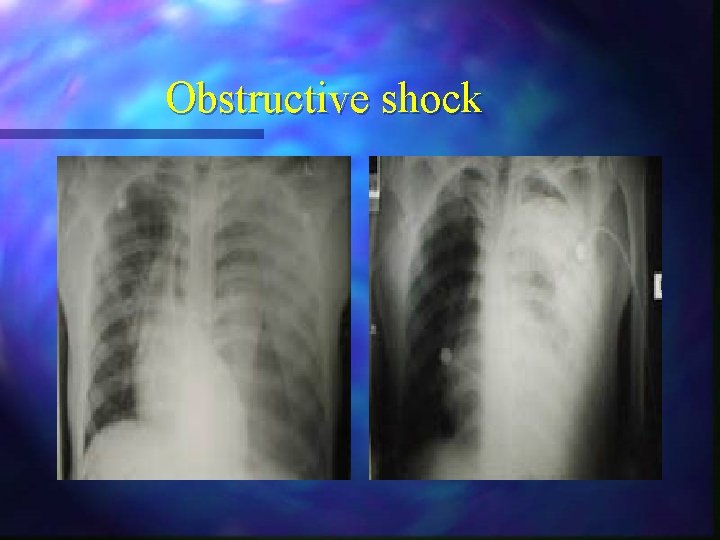
Obstructive shock
Case n 28 year old female, known breast cancer comes in in extremis. She is cyanotic, has a JVD to her ear, lungs are dry and she is hypotense with a systolic BP of 70. You are positive she has a PE and you have TPA in hand - are you going to lyse her?
PE and shock Needs to take out 50% of lung surface area n Increase pulmonary pressures to 40 mm. HG n Cause backflow and septal shift n Hypotense, JVD +/- cyanosis n
Lysis and massive PE Not been studied enough to prove lysis improves survival in PE induced shock n Lysis does improve RV dilation, tricuspid regurgitation and cardiac output in submassive PE n I would treat with 02, fluids and pressors and get a CT or echo n If TPA is to be given: 100 mg bolus? Over 30 min? 2 hours? - no consensus n
Case n 25 yr old male, left sided anterior chest wound. Two hypotensive episodes where patient almost passes out. In between he is alert and talking and says his chest just hurts. There is no Beck’s triad - he has two IV’s in. What do you want to do?
Pericardial tamponade stats 2% of penetrating chest trauma n Stab > GSW n Beck’s triad only in 1/3 n CXR will often reveal a globular heart, ED ultrasound will typically confirm clinically significant tamponade n
Case n 42 year old male comes in c/o crushing retrosternal chest pain and is hypotensive at 80/60. The patient is having an anterolateral infarct by EKG. How would you manage the patient?
Cardiogenic shock n Management – small fluid boluses – invasive monitoring – vasopressors norepinephrine n dopamine n dobutamine n
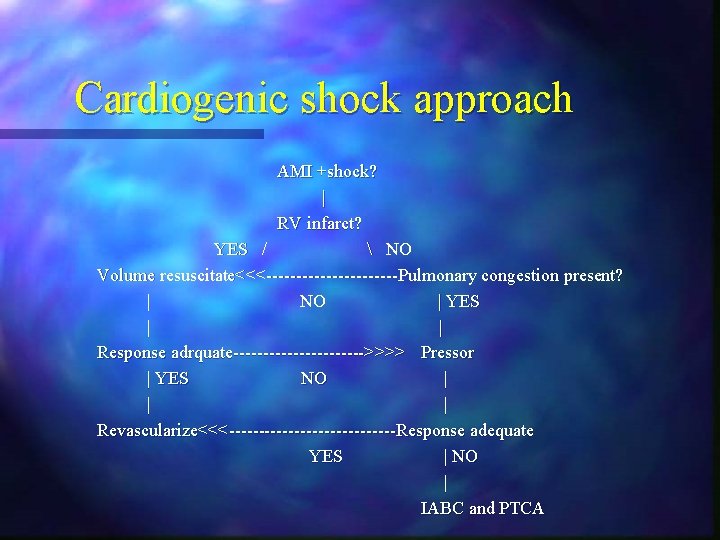
Cardiogenic shock approach AMI +shock? | RV infarct? YES / NO Volume resuscitate<<<-----------Pulmonary congestion present? | NO | YES | | Response adrquate----------->>>> Pressor | YES NO | | | Revascularize<<<--------------Response adequate YES | NO | IABC and PTCA
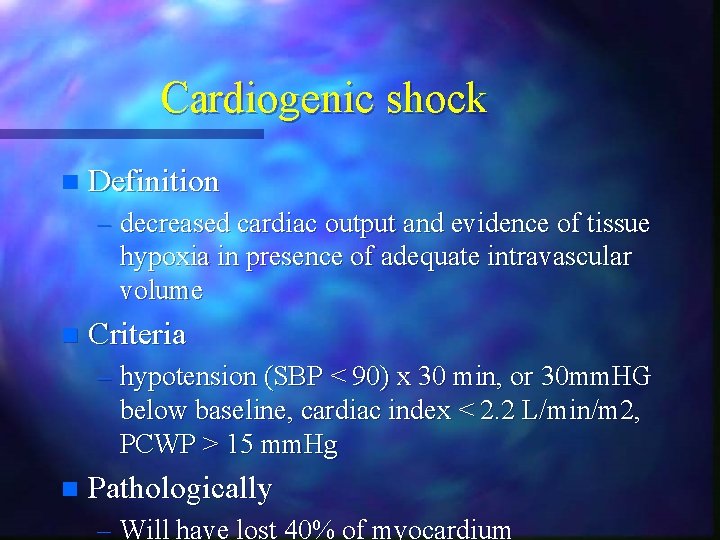
Cardiogenic shock n Definition – decreased cardiac output and evidence of tissue hypoxia in presence of adequate intravascular volume n Criteria – hypotension (SBP < 90) x 30 min, or 30 mm. HG below baseline, cardiac index < 2. 2 L/min/m 2, PCWP > 15 mm. Hg n Pathologically – Will have lost 40% of myocardium
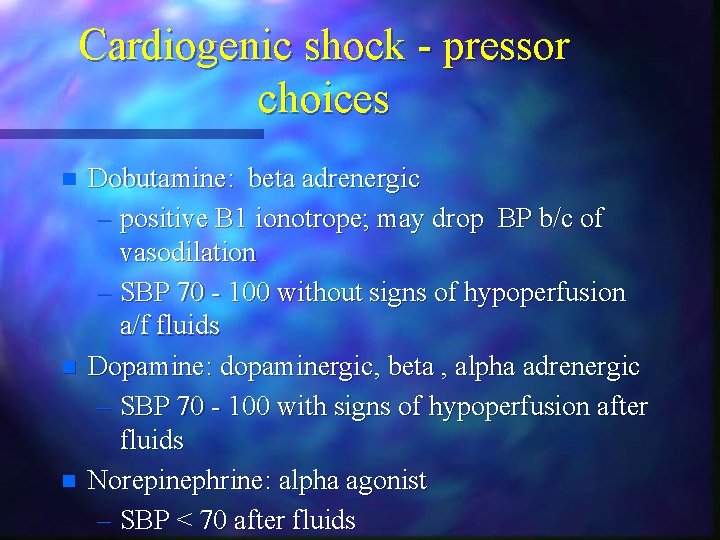
Cardiogenic shock - pressor choices n n n Dobutamine: beta adrenergic – positive B 1 ionotrope; may drop BP b/c of vasodilation – SBP 70 - 100 without signs of hypoperfusion a/f fluids Dopamine: dopaminergic, beta , alpha adrenergic – SBP 70 - 100 with signs of hypoperfusion after fluids Norepinephrine: alpha agonist – SBP < 70 after fluids
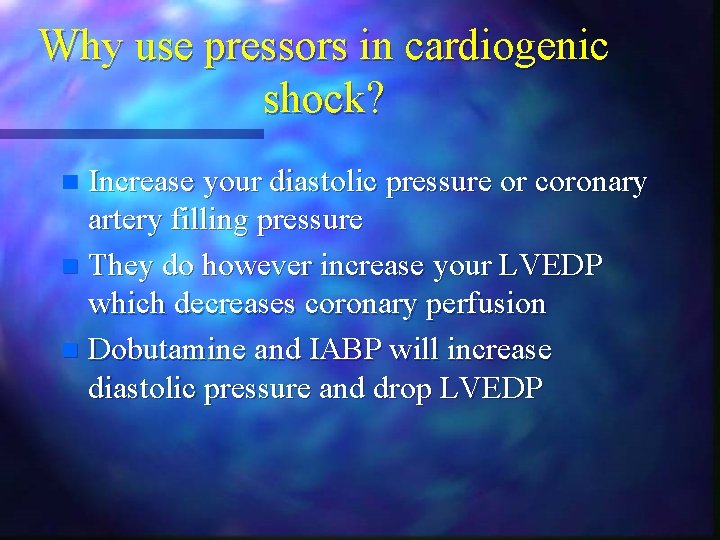
Why use pressors in cardiogenic shock? Increase your diastolic pressure or coronary artery filling pressure n They do however increase your LVEDP which decreases coronary perfusion n Dobutamine and IABP will increase diastolic pressure and drop LVEDP n
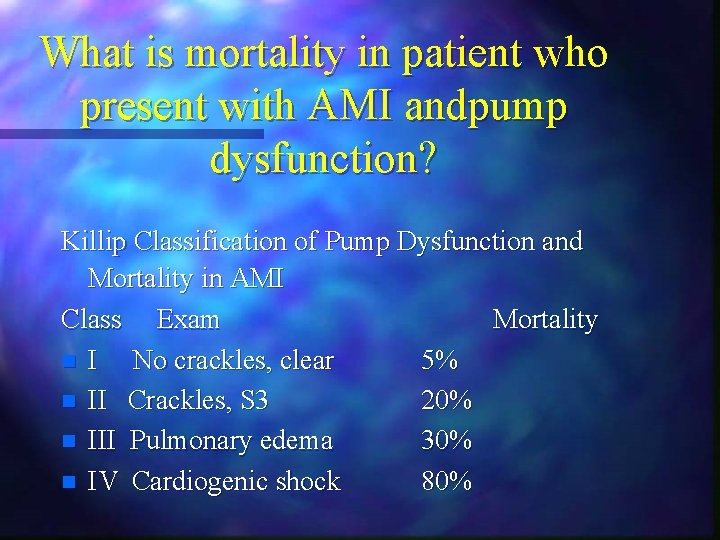
What is mortality in patient who present with AMI andpump dysfunction? Killip Classification of Pump Dysfunction and Mortality in AMI Class Exam Mortality n I No crackles, clear 5% n II Crackles, S 3 20% n III Pulmonary edema 30% n IV Cardiogenic shock 80%
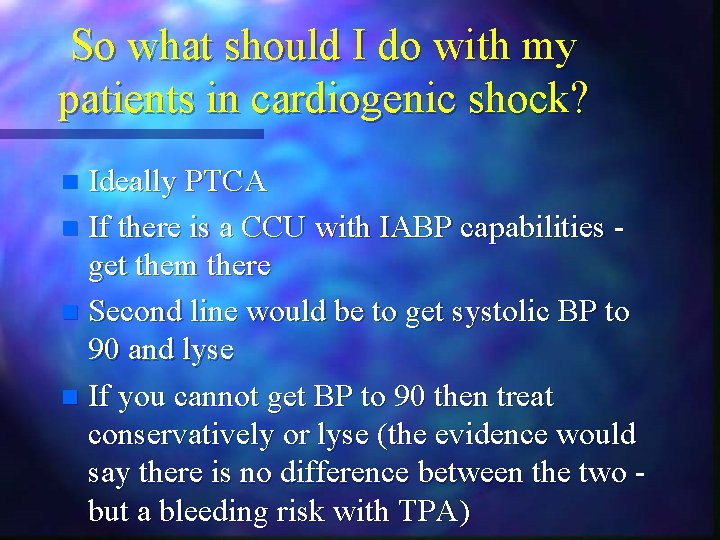
So what should I do with my patients in cardiogenic shock? Ideally PTCA n If there is a CCU with IABP capabilities get them there n Second line would be to get systolic BP to 90 and lyse n If you cannot get BP to 90 then treat conservatively or lyse (the evidence would say there is no difference between the two but a bleeding risk with TPA) n
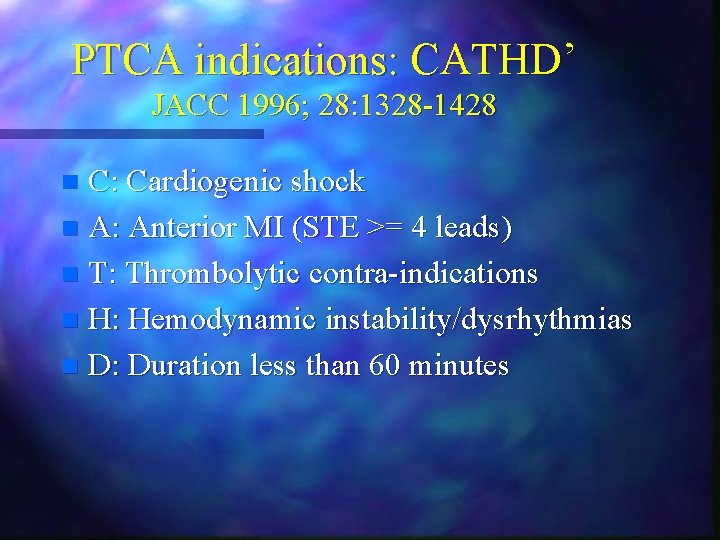
PTCA indications: CATHD’ JACC 1996; 28: 1328 -1428 C: Cardiogenic shock n A: Anterior MI (STE >= 4 leads) n T: Thrombolytic contra-indications n H: Hemodynamic instability/dysrhythmias n D: Duration less than 60 minutes n
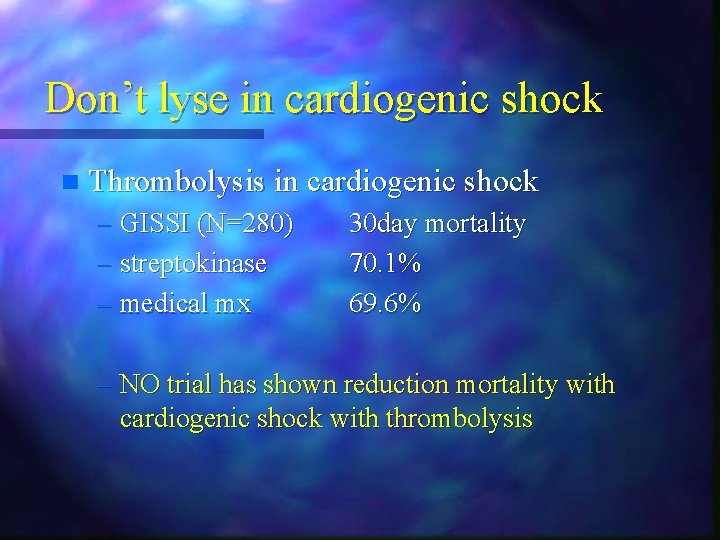
Don’t lyse in cardiogenic shock n Thrombolysis in cardiogenic shock – GISSI (N=280) – streptokinase – medical mx 30 day mortality 70. 1% 69. 6% – NO trial has shown reduction mortality with cardiogenic shock with thrombolysis
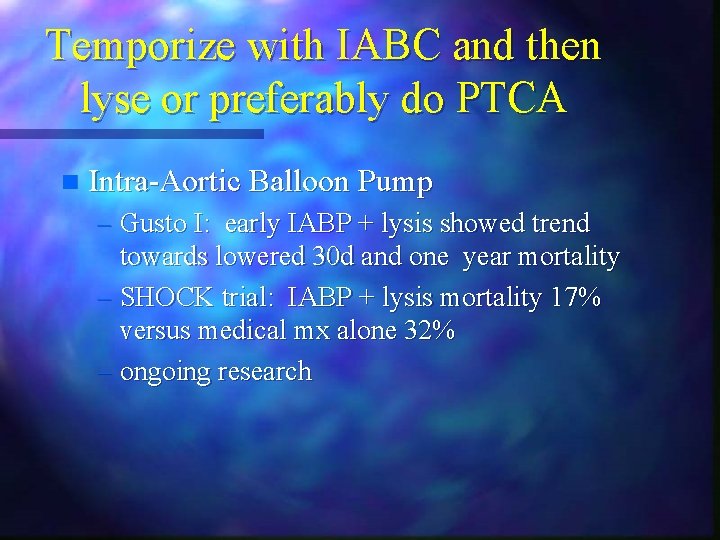
Temporize with IABC and then lyse or preferably do PTCA n Intra-Aortic Balloon Pump – Gusto I: early IABP + lysis showed trend towards lowered 30 d and one year mortality – SHOCK trial: IABP + lysis mortality 17% versus medical mx alone 32% – ongoing research
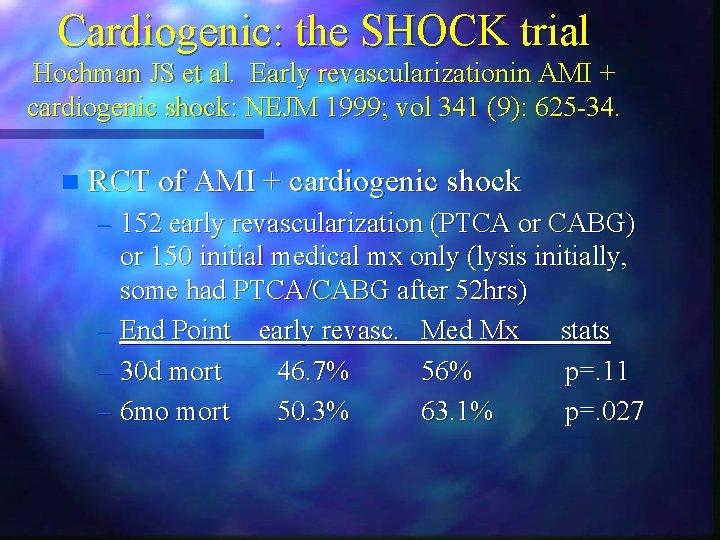
Cardiogenic: the SHOCK trial Hochman JS et al. Early revascularizationin AMI + cardiogenic shock: NEJM 1999; vol 341 (9): 625 -34. n RCT of AMI + cardiogenic shock – 152 early revascularization (PTCA or CABG) or 150 initial medical mx only (lysis initially, some had PTCA/CABG after 52 hrs) – End Point early revasc. Med Mx stats – 30 d mort 46. 7% 56% p=. 11 – 6 mo mort 50. 3% 63. 1% p=. 027
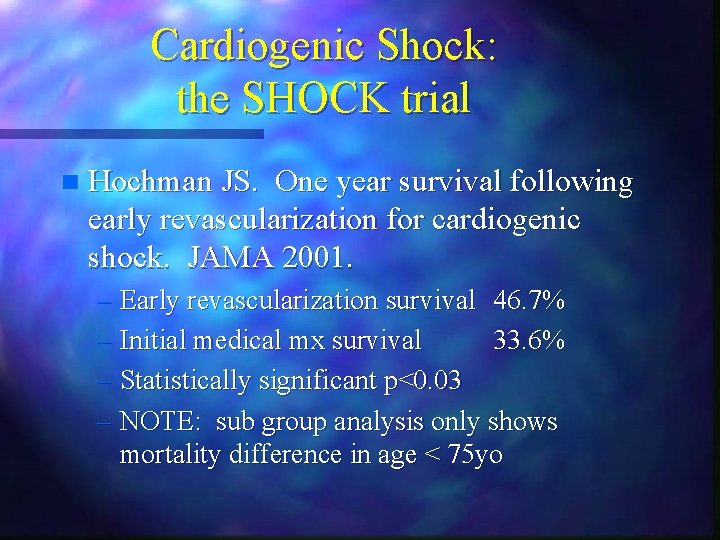
Cardiogenic Shock: the SHOCK trial n Hochman JS. One year survival following early revascularization for cardiogenic shock. JAMA 2001. – Early revascularization survival 46. 7% – Initial medical mx survival 33. 6% – Statistically significant p<0. 03 – NOTE: sub group analysis only shows mortality difference in age < 75 yo
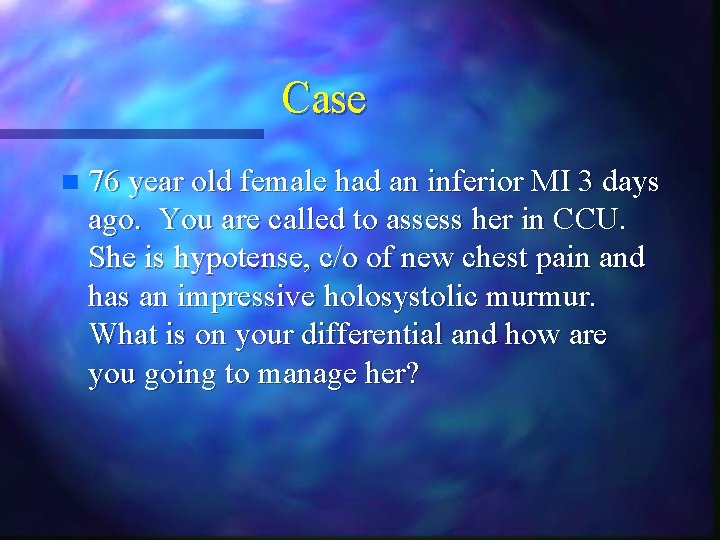
Case n 76 year old female had an inferior MI 3 days ago. You are called to assess her in CCU. She is hypotense, c/o of new chest pain and has an impressive holosystolic murmur. What is on your differential and how are you going to manage her?
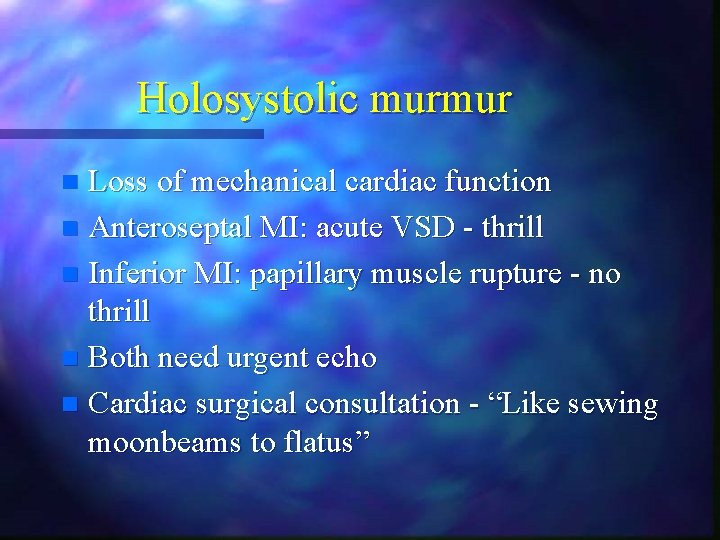
Holosystolic murmur Loss of mechanical cardiac function n Anteroseptal MI: acute VSD - thrill n Inferior MI: papillary muscle rupture - no thrill n Both need urgent echo n Cardiac surgical consultation - “Like sewing moonbeams to flatus” n
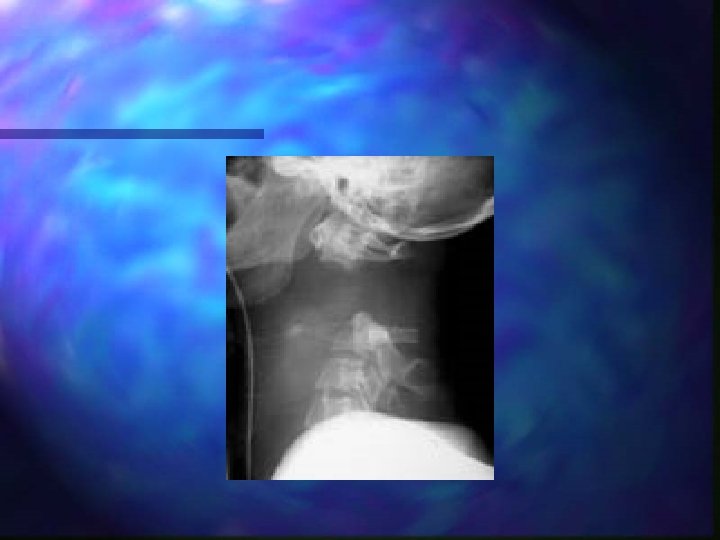
Case n A 20 year old male roofer comes in within 30 minutes of his accident. He cannot move or feel anything below his shoulders. He is arreflexic, hypotense and bradycardic. Is this spinal shock or neurogenic shock? How are you going to treat him?
Neurogenic shock Cervical spine transections that result in transection of sympathetic fibres n Loss of sympathetic tone and unopposed vagal tone n Patients present bradycardic and hypotensive n Spinal shock can present identically n
Neurogenic shock Still give fluids n Give dopamine, phenylephrine or ephedrine n Use atropine for bradycardia and intubation n T 4 transections are the lowest lesions that will give you neurogenic shock n
Case n 28 year old female comes in post bee sting. She is glowing red, hypotense and stridorous. How are you going to manage her? What is your epi approach?
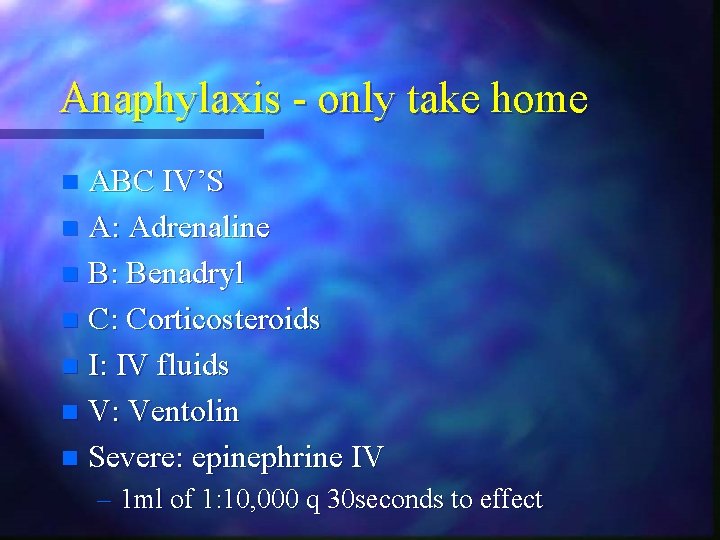
Anaphylaxis - only take home ABC IV’S n A: Adrenaline n B: Benadryl n C: Corticosteroids n I: IV fluids n V: Ventolin n Severe: epinephrine IV n – 1 ml of 1: 10, 000 q 30 seconds to effect
Thanks Simon Bartley n Idan Khan n Rob Hall n Jeff Plant n Morad Hameed n
Keep the dream alive….