
Shipping Blood Components and Products Training Quiz Click

Shipping Blood Components and Products Training Quiz Click to start
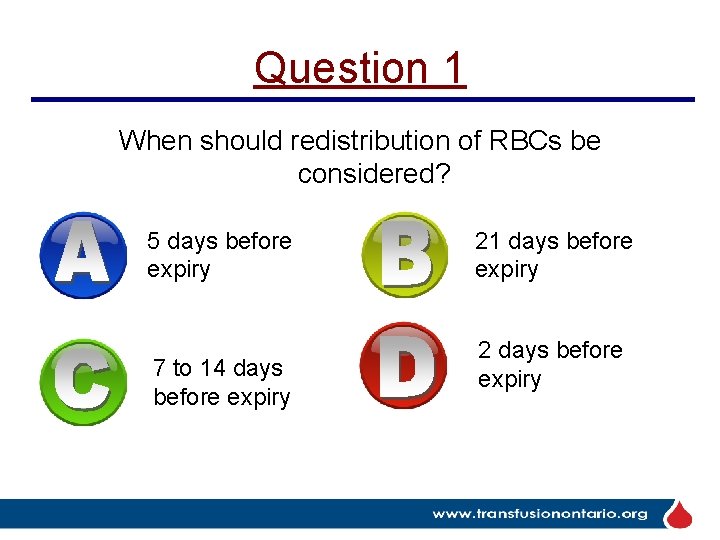
Question 1 When should redistribution of RBCs be considered? 5 days before expiry 7 to 14 days before expiry 21 days before expiry 2 days before expiry
Wrong Answer! Depending on the site that will be receiving the components, it is usually between 7 and 14 days to allow the site enough time to use it before it expires.
Correct! • Between 7 and 14 days is enough time for the receiving site to ensure that the product gets used before expiry. • It is important to always contact the receiving site to inform them that there will be RBCs being sent to them for redistribution to give them a heads up. Click to go to the next question
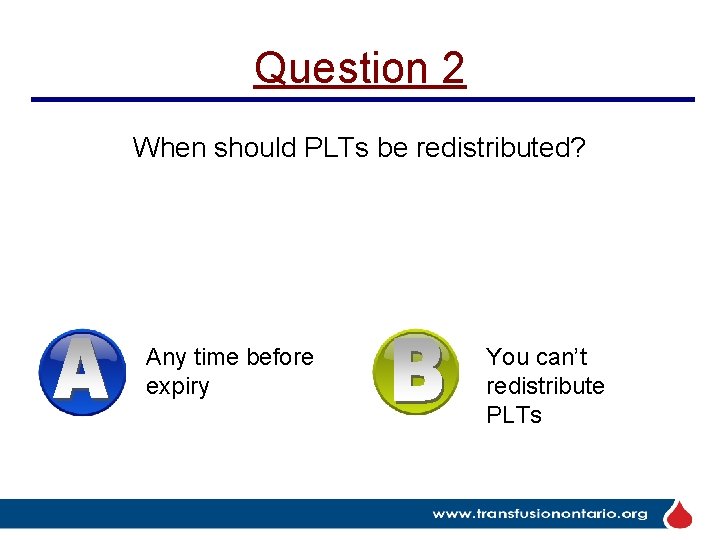
Question 2 When should PLTs be redistributed? Any time before expiry You can’t redistribute PLTs
Wrong Answer! It is encouraged to redistribute PLTs if its feasible any time before the unit expires. The receiving site must be consulted prior to shipping them to ensure they can be used before expiry
Correct! • It is encouraged to redistribute PLTs if its feasible any time before the unit expires. The receiving site must be consulted prior to shipping them to ensure they can be used before expiry Click to go to the next question
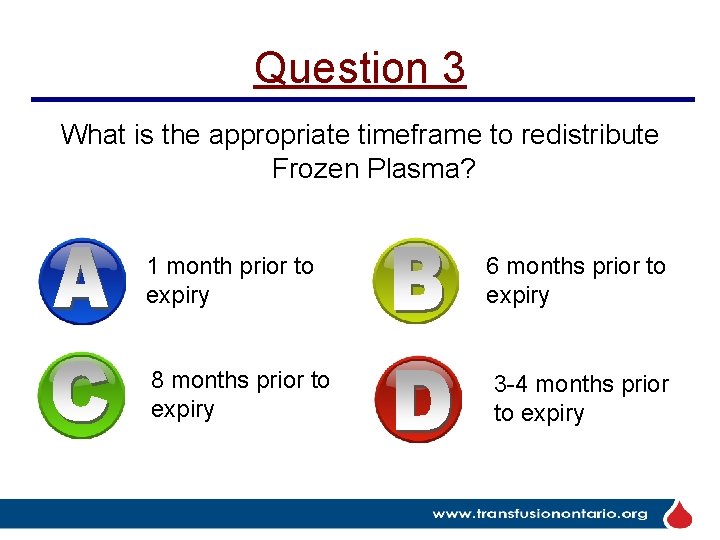
Question 3 What is the appropriate timeframe to redistribute Frozen Plasma? 1 month prior to expiry 8 months prior to expiry 6 months prior to expiry 3 -4 months prior to expiry
Wrong Answer! When redistributing frozen plasma to a larger site, it is good to ship when there is about 3 to 4 months remaining of shelf life. This way the receiving site will have sufficient time to use it.
Correct! • When redistributing frozen plasma to a larger site, it is good to ship when there is about 3 to 4 months remaining of shelf life. This way the receiving site will have sufficient time to use it. Click to go to the next question
Question 4 When should Plasma Protein Products be redistributed? 7 to 10 days prior to expiry One month prior expiry 4 to 6 months prior to expiry 2 months prior to expiry
Wrong Answer! • Plasma products should be considered for redistribution when the shelf life remaining is at 6 months and it is anticipated that the products will more than likely not be used between that 4 to 6 month mark.
Correct! • Plasma products should be considered for redistribution when the shelf life remaining is at 6 months and it is anticipated that the products will more than likely not be used between that 4 to 6 month mark. Click to go to the next question
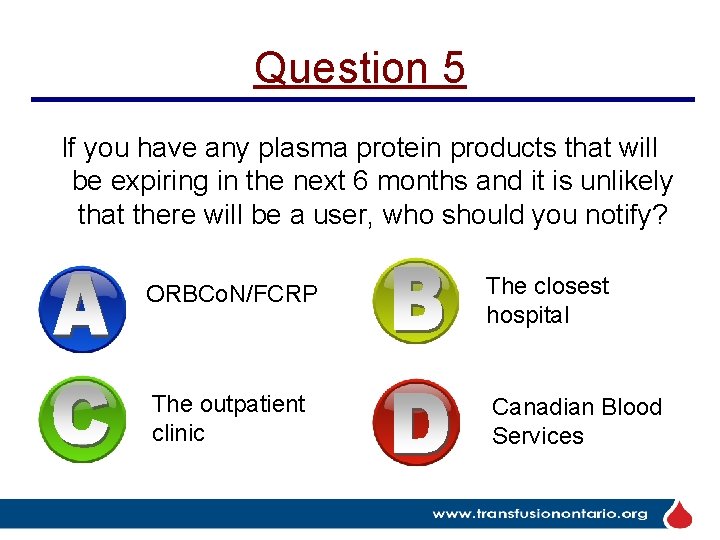
Question 5 If you have any plasma protein products that will be expiring in the next 6 months and it is unlikely that there will be a user, who should you notify? ORBCo. N/FCRP The closest hospital The outpatient clinic Canadian Blood Services
Wrong Answer! • Plasma Protein products that need to be redistributed should be passed on to ORBCo. N or FCRP to ensure that the products are redistributed to a site that will be able to use the product. • Also it is important to keep track of how much product is being redistributed as this is reported back to the Ministry of Health every year.
Correct! • Plasma Protein products that need to be redistributed should be passed on to ORBCo. N or FCRP to ensure that the products are redistributed to a site that will be able to use the product. • Also it is important to keep track of how much product is being redistributed as this is reported back to the Ministry of Health every year. Click to go to the next question
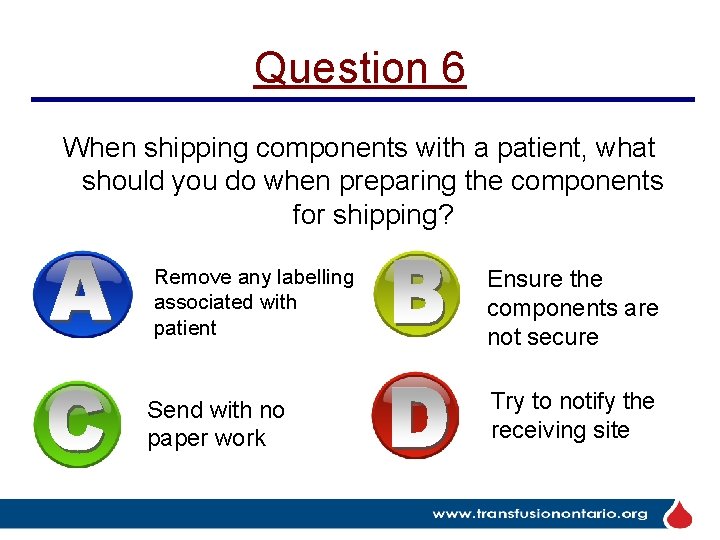
Question 6 When shipping components with a patient, what should you do when preparing the components for shipping? Remove any labelling associated with patient Send with no paper work Ensure the components are not secure Try to notify the receiving site

Wrong Answer! • The technologist preparing the components to be shipped should notify the destination Transfusion Services if known and fax the Inter-hospital Exchange Form. This is very helpful for reporting and tracking on patient arrival at destination facility.

Correct! • The technologist preparing the components to be shipped should notify the destination Transfusion Services if known and fax the Interhospital Transfer Form. This is very helpful for reporting and tracking on patient arrival at destination facility. Click to go to the next question
Question 7 What form should be sent with any redistributed components or products LIS print out only Inter-hospital Transfer Form LIS Print out and Inter-hospital redistribution Form Inventory check list
Wrong Answer! • All redistributed components or products should be shipped with a completed Inter-hospital Redistribution Form, and for those sites that use LIS batch transfer lists, these are attached to the form and indicated in Section B as “See attached LIS Printout”. • You do not have to transcribe all the units/Lot #s from the LIS transfer list unless the numbers do not match the numbers found on the unit or product. They have to match
Correct! • All redistributed components or products should be shipped with a completed Inter-hospital Redistribution Form, and for those sites that use LIS batch transfer lists, these are attached to the form and indicated in Section B as “See attached LIS Printout”. • You do not have to transcribe all the units/Lot #s from the LIS transfer list unless the numbers do not match the numbers found on the unit or product. They have to match Click to go to the next question
Question 8 What shipping container should be used for shipping RBCs to another facility for redistribution or transfer with patient? E 38 container Smith Box J 82 container Coleman cooler
Wrong Answer! • Shipping any RBCs should be packed in a J 82 shipping container. This container has been validated to maintain the acceptable temperature for RBCs for up to 18 hours when ice packs and gel packs are preconditioned according to the ORBCo. N/FCRP validation.
Correct! • Shipping any RBCs should be packed in a J 82 shipping container. • This container has been validated to maintain the acceptable temperature for RBCs for up to 18 hours when shipped in warm ambient temperatures and ice packs and gel packs are pre-conditioned according to the ORBCo. N/FCRP validation. • Some sites can use the Credo Cube EMT containers (formerly called MTS Golden Hour) these have been validated to maintain temperatures for 24 hours Click to go to the next question
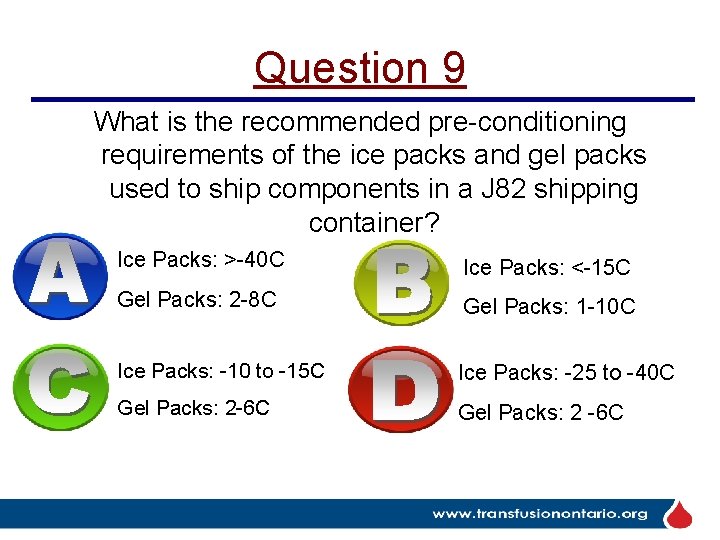
Question 9 What is the recommended pre-conditioning requirements of the ice packs and gel packs used to ship components in a J 82 shipping container? Ice Packs: >-40 C Ice Packs: <-15 C Gel Packs: 2 -8 C Gel Packs: 1 -10 C Ice Packs: -10 to -15 C Ice Packs: -25 to -40 C Gel Packs: 2 -6 C Gel Packs: 2 -6 C
Wrong Answer! • ORBCo. N and FCRP have validated the J 82 shipping container based on pre-conditioning of the ice packs between -25 C and -40 C, as most hospitals have access to freezers that are in that temperature range. Any ice packs that are pre-conditioned outside of this temperature range will need it’s own validation and these results must be made available to any site requesting it if products are shipped to them using a different temperature range.
Correct! • ORBCo. N and FCRP have validated the J 82 shipping container based on pre-conditioning of the ice packs between -25 C and -40 C, as most hospitals have access to freezers that are in that temperature range. Any ice packs that are pre-conditioned outside of this temperature range will need it’s own validation and these results must be made available to any site requesting it if products are shipped to them using a different pre-conditioning process. Click to go to the next question
Question 10 Before you any container leaves your site for redistribution or shipment with a patient, what should you check? The courier is on it’s way When the container will be returned The tamper proof devices is securely on The name of the courier
Wrong Answer! • It is extremely important to ensure that the tamper proof device is securely fastened to the shipping container to ensure integrity of the components/products packed inside. • The receiving hospital has a right to discard any components or products that arrive without a security seal attached to the container.
Correct! • It is extremely important to ensure that the tamper proof device is securely fastened to the shipping container to ensure integrity of the components/products packed inside. • The receiving hospital has a right to discard any components or products that arrive without a security seal attached to the container. Click to go to the next question

Congratulations! • You have completed the competency quiz for shipping blood components and products training module.
- Slides: 32