
SHIPMOUNTED ROBOTIC ARM FOR AUTONOMOUS OPERATIONS All Energy
SHIP-MOUNTED ROBOTIC ARM FOR AUTONOMOUS OPERATIONS All. Energy 19 Conference 16 May 2019 David W Kirkley
Ship-mounted Robotic Arm for Autonomous Operations • Introduction • This presentation is a progress report • It describes the work already done that was partially funded by Innovate UK (Neptune project) • It also describes the current ASSP project that is being supported by the ERDF–funded Marine-I programme • And ideas on future marine robotic activity

Ship-mounted Robotic Arm for Autonomous Operations • • • NEPTUNE PROJECT Aim was to transfer personnel from a ship to an offshore structure, e. g. platform or wind turbine Concept involved an articulated arm with a personnel carrier. Ship motion removed from carrier by motion compensation in all six degrees of freedom (Heave, roll, pitch, surge, sway, yaw) Carrier moved to target, so no relative movement on arrival (space-stabilisation)
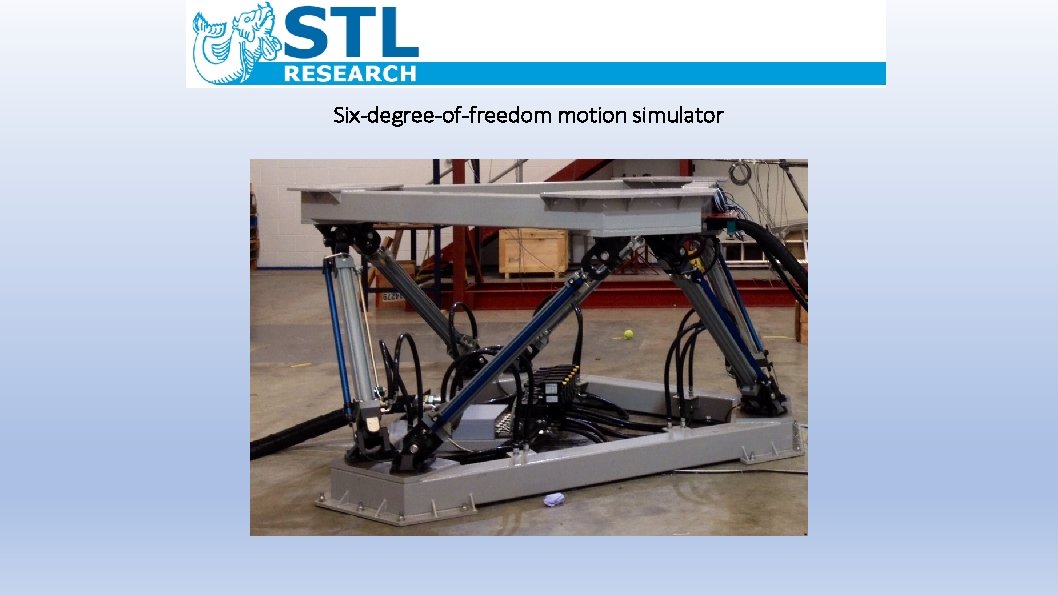
Six-degree-of-freedom motion simulator
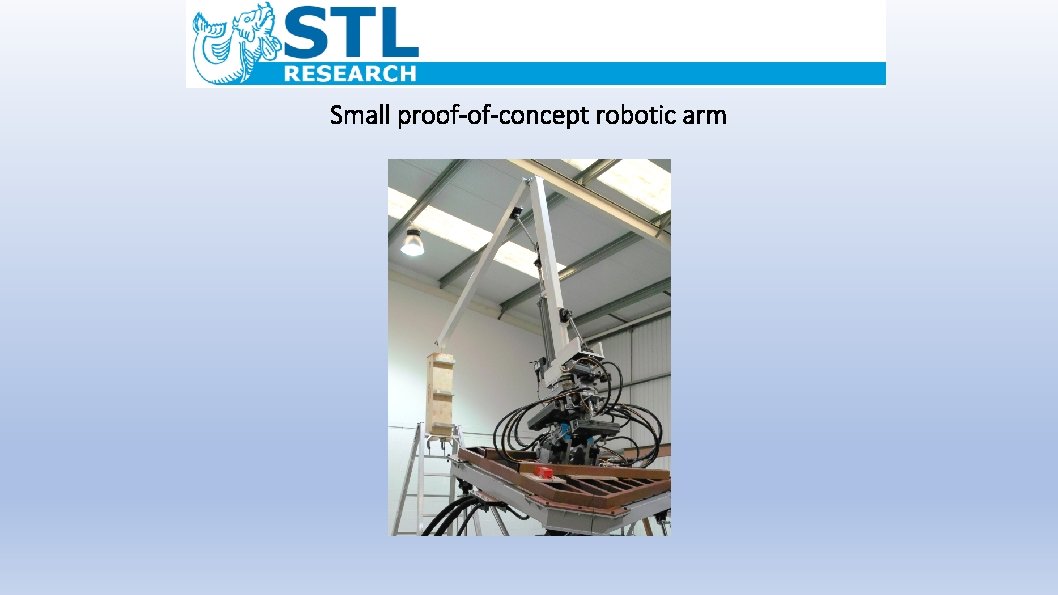
Small proof-of-concept robotic arm
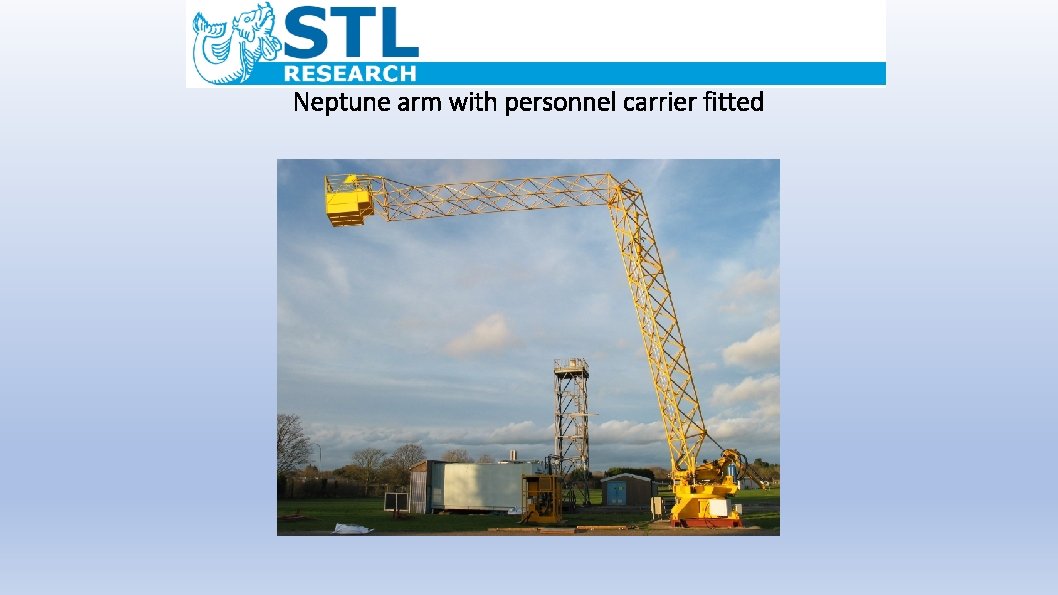
Neptune arm with personnel carrier fitted
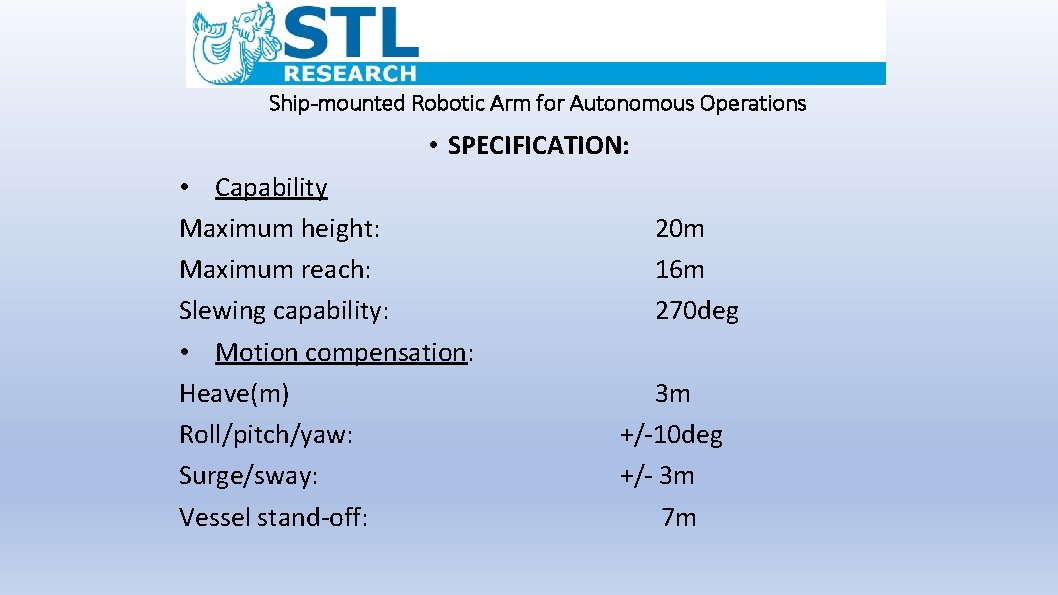
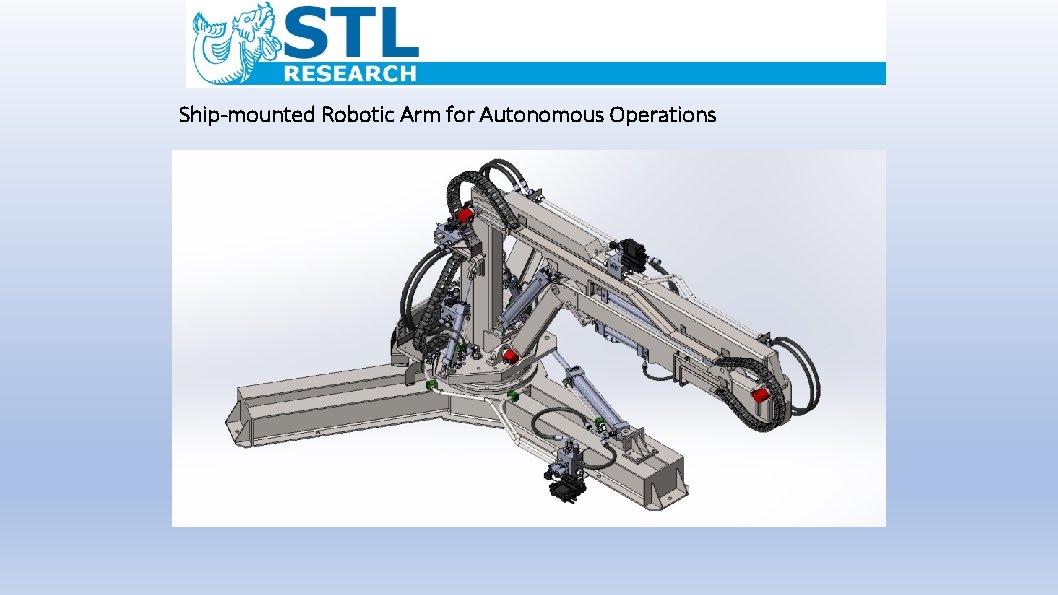
Ship-mounted Robotic Arm for Autonomous Operations • SPECIFICATION: • Capability Maximum height: Maximum reach: Slewing capability: • Motion compensation: Heave(m) Roll/pitch/yaw: Surge/sway: Vessel stand-off: 20 m 16 m 270 deg 3 m +/-10 deg +/- 3 m 7 m
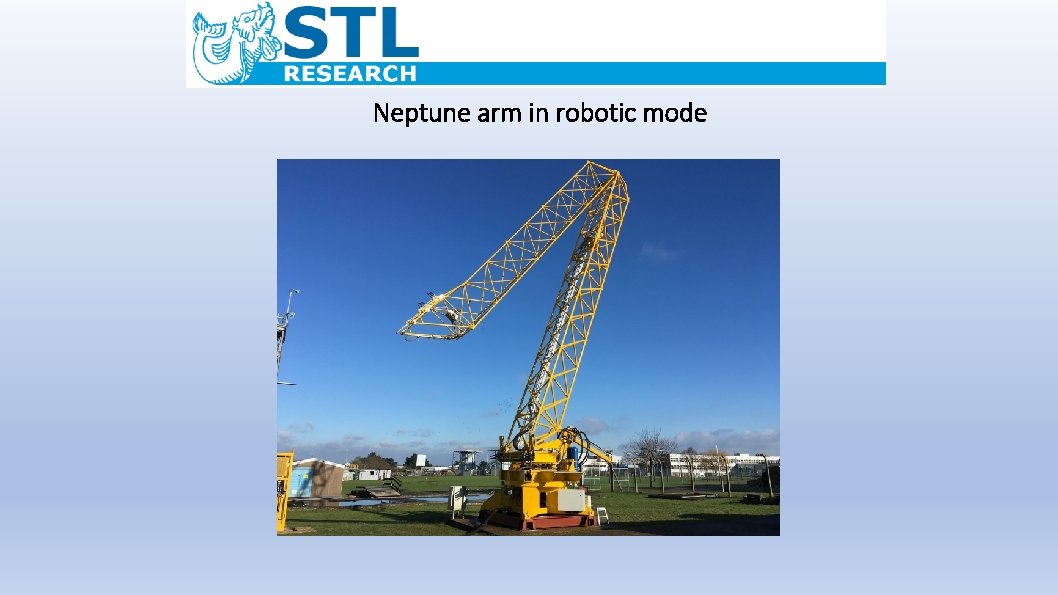
Neptune arm in robotic mode
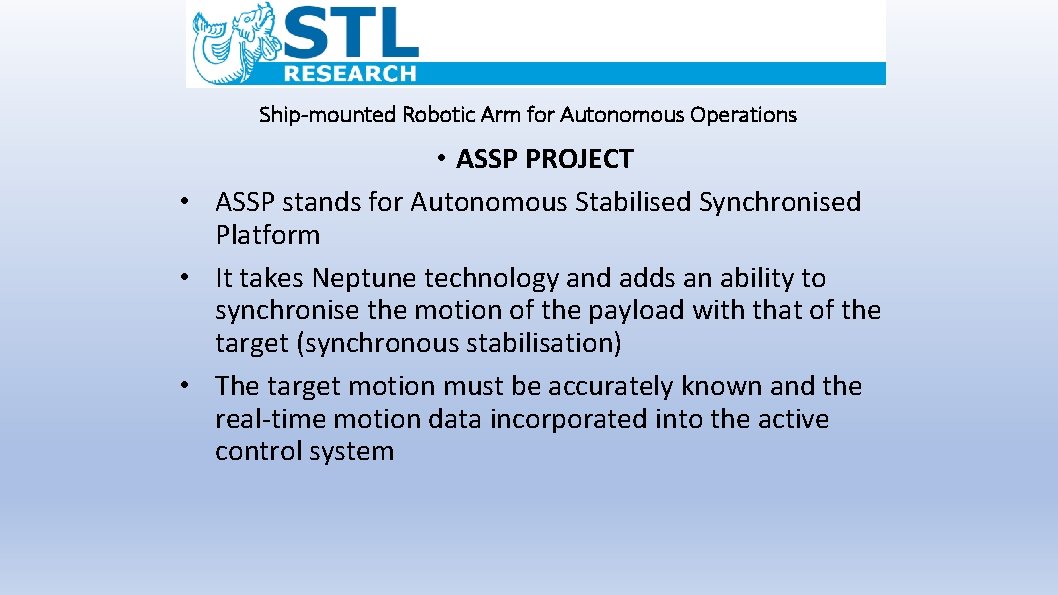
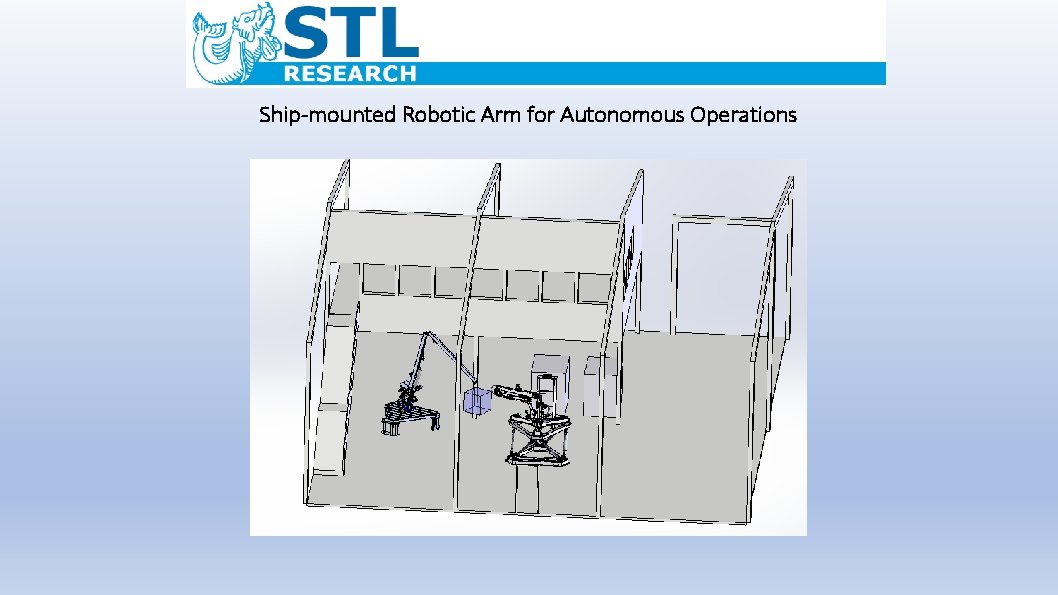
Ship-mounted Robotic Arm for Autonomous Operations • ASSP PROJECT • ASSP stands for Autonomous Stabilised Synchronised Platform • It takes Neptune technology and adds an ability to synchronise the motion of the payload with that of the target (synchronous stabilisation) • The target motion must be accurately known and the real-time motion data incorporated into the active control system
Ship-mounted Robotic Arm for Autonomous Operations ASSP PROJECT (2) • Target motion can be measured with motion-sensors on the target. Motion data is sent by radio-telemetry link to the control system, or • The robotic arm is fitted with remote motion-sensing equipment, e. g. stereo camera and photogrammetry, so no active devices are needed on the target
Ship-mounted Robotic Arm for Autonomous Operations
Ship-mounted Robotic Arm for Autonomous Operations
Ship-mounted Robotic Arm for Autonomous Operations SOME APPLICATIONS • Cargo transfer (e. g. ship to ship or to wind-turbine) • Personnel transfer (e. g. ship to platform or windturbine, or to FPSO or SPM) • Launch and recovery (e. g. ROV, AUV, FRB) • Cable handling and mooring (FPSO, SPM, tug) • Autonomous Surface Vessels (ASV’s)
Ship-mounted Robotic Arm for Autonomous Operations POTENTIAL MARKET (1) Offshore support vessels • The target market: The global fleet of offshore support vessels engaged in transport of supplies, offshore construction and decommissioning, inspection/maintenance of offshore assets, survey/site-assessment and more. • The size of the market*: A 2014 OECD report gives global numbers for the following relevant vessel categories: Anchor Handling Tug Supply 2779; Platform Support Vessels 1819; Subsea Support Vessels) 380; Offshore Construction 110; Subsea Umbilicals, Risers, Flowlines 148; TOTAL 5236 * OECD report (C/WP 6(2014)73/FINAL, “Offshore vessels, mobile offshore drilling units, floating production unit market review”
Ship-mounted Robotic Arm for Autonomous Operations POTENTIAL MARKET (2) Autonomous surface vessels • Most ASV’s are small (<15 m) at present and only engage in contactless operations, e. g. survey • Robotic arms would enable cargo transfer and other intervention tasks to be performed • Special tools are needed for specific tasks • The market cannot yet be quantified • Autonomous robotic capability is essential if ASV’s are to have a major economic impact
Ship-mounted Robotic Arm for Autonomous Operations 1. 2. 3. 4. CONCLUSIONS Ship-motion compensation of a robotic arm has been demonstrated (space-stabilisation) and should enable ship-to-stationary-target operations Extending the capability to include moving targets is work in progress There is a global fleet of over 5000 offshore support vessels that could potentially benefit by adopting robotic capability Robotic capability is essential if ASV’s are to have a major economic impact

Ship-mounted Robotic Arm for Autonomous Operations Thanks for listening
- Slides: 17