
Shipboard Fiber Optic Cables Design Enhancements 2019 ELECTRICAL
Shipboard Fiber Optic Cables Design Enhancements 2019 ELECTRICAL PANEL PROJECT 2019 -477 Project Update Giovanni Tomasi NSRP Electrical Technologies Panel Meeting – December 11 -12, 2019
SHIPBOARD FIBER OPTIC CABLES DESIGN ENHANCEMENTS PROJECT TABLE OF CONTENTS • Project Objectives • Project Team • Methodology • Schedule • Findings • Next Steps
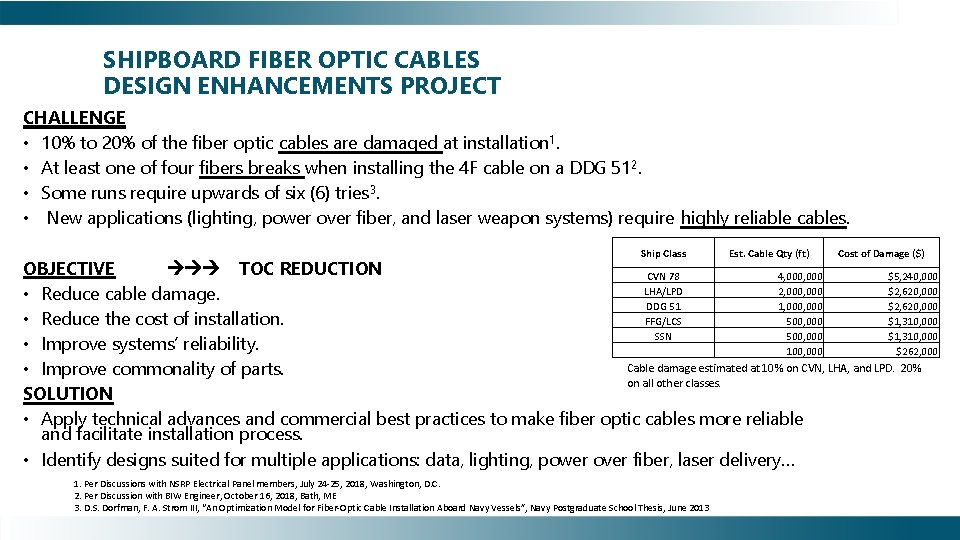
SHIPBOARD FIBER OPTIC CABLES DESIGN ENHANCEMENTS PROJECT CHALLENGE • 10% to 20% of the fiber optic cables are damaged at installation 1. • At least one of four fibers breaks when installing the 4 F cable on a DDG 512. • Some runs require upwards of six (6) tries 3. • New applications (lighting, power over fiber, and laser weapon systems) require highly reliable cables. Ship Class Est. Cable Qty (ft) Cost of Damage ($) OBJECTIVE TOC REDUCTION CVN 78 4, 000 $5, 240, 000 LHA/LPD 2, 000 $2, 620, 000 • Reduce cable damage. DDG 51 1, 000 $2, 620, 000 FFG/LCS 500, 000 $1, 310, 000 • Reduce the cost of installation. SSN 500, 000 $1, 310, 000 • Improve systems’ reliability. 100, 000 $262, 000 Cable damage estimated at 10% on CVN, LHA, and LPD. 20% • Improve commonality of parts. on all other classes. SOLUTION • Apply technical advances and commercial best practices to make fiber optic cables more reliable and facilitate installation process. • Identify designs suited for multiple applications: data, lighting, power over fiber, laser delivery… 1. Per Discussions with NSRP Electrical Panel members, July 24 -25, 2018, Washington, D. C. 2. Per Discussion with BIW Engineer, October 16, 2018, Bath, ME 3. D. S. Dorfman, F. A. Strom III, “An Optimization Model for Fiber-Optic Cable Installation Aboard Navy Vessels”, Navy Postgraduate School Thesis, June 2013

SHIPBOARD FIBER OPTIC CABLES DESIGN ENHANCEMENTS PROJECT TEAM • Lead: RSL Fiber Systems • Support: Penn State University, Applied Research Lab, Electro-Optics Ctr. • Shipyards: Austal USA, Newport News Shipbuilding, Ingalls Shipbuilding, Bath Iron Works • US Navy: SUPSHIP GC, NSWCDD • Fiber Optic Cable Manufacturer: OFS Fitel • NSRP Project Manager: Nick Laney • NSRP PTR: Walt Skalniak

SHIPBOARD FIBER OPTIC CABLES DESIGN ENHANCEMENTS PROJECT METHODS AND PROCEDURES 1. 2. 3. TASK 1 - Identify Causes of Cables’ Failure: • Evaluation of the existing M 85045 cables, installation, and failure mechanisms (Visits to shipyards, observation of installations, meetings with AITs). • Identify the ideal performance parameters to minimize/eliminate cable failures. TASK 2 - Identify Design Enhancements: • Investigate new commercial and military cable designs, materials, constructions, and installation hardware. • Determine how they may be applied to reduce/eliminate cable breakage. • Retain/enhance critical shipboard cable characteristics: low smoke, low toxicity, zero halogen, water blocked. TASK 3 - Minimize Impact of Design Enhancements: • Compatibility with legacy hardware, installation and fiber termination methods, require no AITs’ re-training.
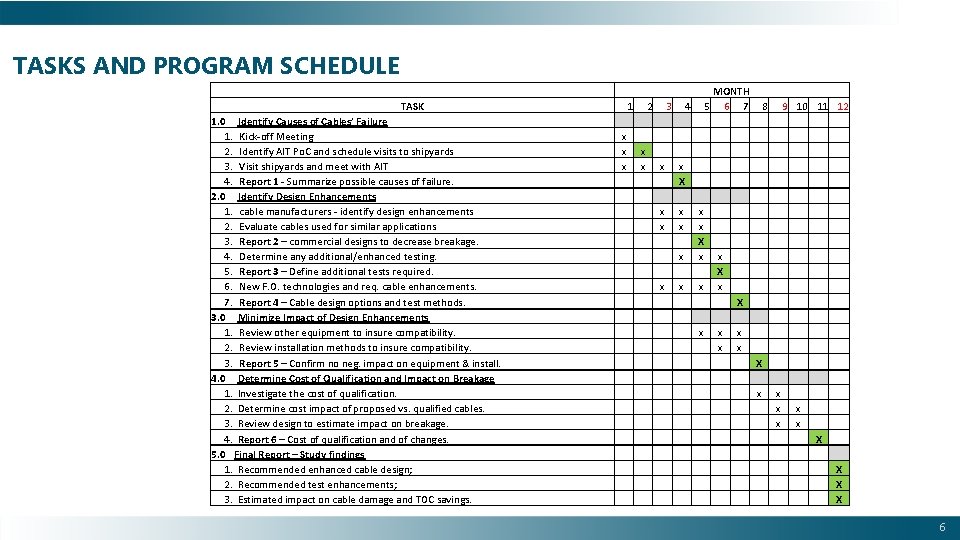
TASKS AND PROGRAM SCHEDULE TASK 1. 0 Identify Causes of Cables’ Failure 1. Kick-off Meeting 2. Identify AIT Po. C and schedule visits to shipyards 3. Visit shipyards and meet with AIT 4. Report 1 - Summarize possible causes of failure. 2. 0 Identify Design Enhancements 1. cable manufacturers - identify design enhancements 2. Evaluate cables used for similar applications 3. Report 2 – commercial designs to decrease breakage. 4. Determine any additional/enhanced testing. 5. Report 3 – Define additional tests required. 6. New F. O. technologies and req. cable enhancements. 7. Report 4 – Cable design options and test methods. 3. 0 Minimize Impact of Design Enhancements 1. Review other equipment to insure compatibility. 2. Review installation methods to insure compatibility. 3. Report 5 – Confirm no neg. impact on equipment & install. 4. 0 Determine Cost of Qualification and Impact on Breakage 1. Investigate the cost of qualification. 2. Determine cost impact of proposed vs. qualified cables. 3. Review design to estimate impact on breakage. 4. Report 6 – Cost of qualification and of changes. 5. 0 Final Report – Study findings 1. Recommended enhanced cable design; 2. Recommended test enhancements; 3. Estimated impact on cable damage and TOC savings. 1 x x x 2 x x 3 4 x x X x x x MONTH 5 6 7 x x x X x x x 8 9 10 11 12 x X x x x X X 6
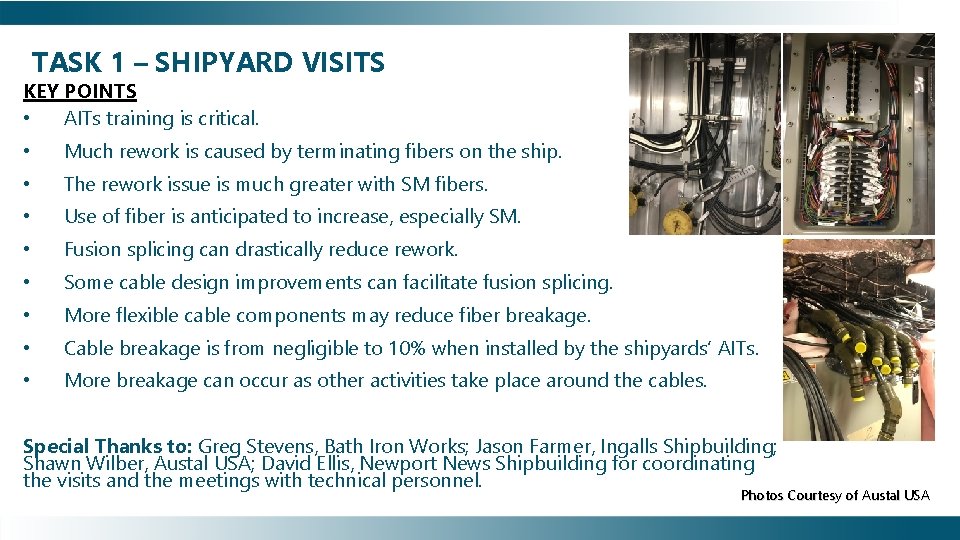
TASK 1 – SHIPYARD VISITS KEY POINTS • AITs training is critical. • Much rework is caused by terminating fibers on the ship. • The rework issue is much greater with SM fibers. • Use of fiber is anticipated to increase, especially SM. • Fusion splicing can drastically reduce rework. • Some cable design improvements can facilitate fusion splicing. • More flexible cable components may reduce fiber breakage. • Cable breakage is from negligible to 10% when installed by the shipyards’ AITs. • More breakage can occur as other activities take place around the cables. Special Thanks to: Greg Stevens, Bath Iron Works; Jason Farmer, Ingalls Shipbuilding; Shawn Wilber, Austal USA; David Ellis, Newport News Shipbuilding for coordinating the visits and the meetings with technical personnel. Photos Courtesy of Austal USA
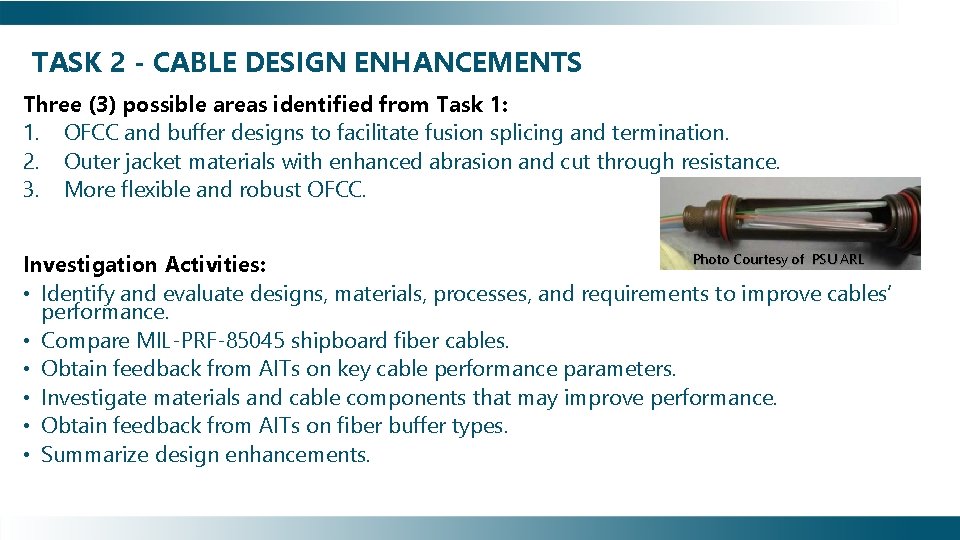
TASK 2 - CABLE DESIGN ENHANCEMENTS Three (3) possible areas identified from Task 1: 1. OFCC and buffer designs to facilitate fusion splicing and termination. 2. Outer jacket materials with enhanced abrasion and cut through resistance. 3. More flexible and robust OFCC. Photo Courtesy of PSU ARL Investigation Activities: • Identify and evaluate designs, materials, processes, and requirements to improve cables’ performance. • Compare MIL-PRF-85045 shipboard fiber cables. • Obtain feedback from AITs on key cable performance parameters. • Investigate materials and cable components that may improve performance. • Obtain feedback from AITs on fiber buffer types. • Summarize design enhancements.
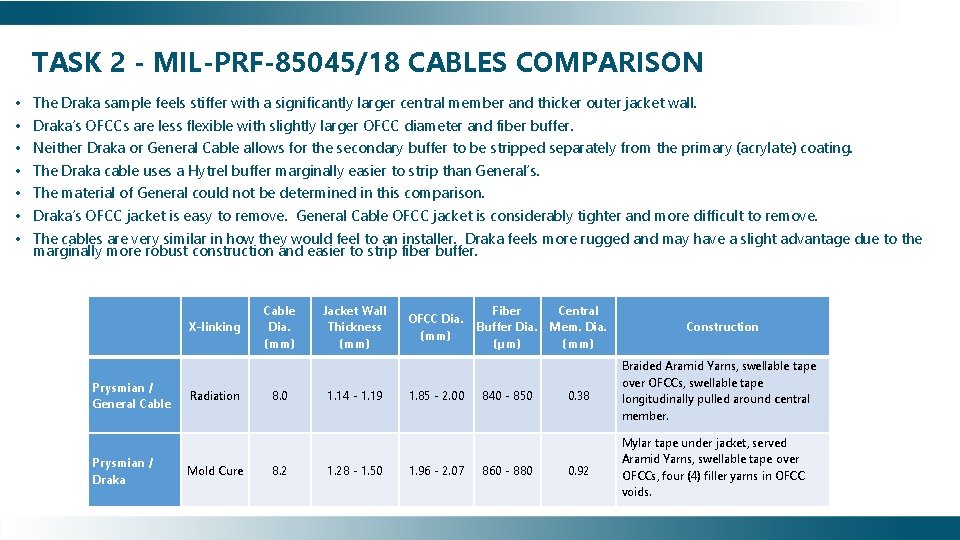
TASK 2 - MIL-PRF-85045/18 CABLES COMPARISON • • The Draka sample feels stiffer with a significantly larger central member and thicker outer jacket wall. Draka’s OFCCs are less flexible with slightly larger OFCC diameter and fiber buffer. Neither Draka or General Cable allows for the secondary buffer to be stripped separately from the primary (acrylate) coating. The Draka cable uses a Hytrel buffer marginally easier to strip than General’s. The material of General could not be determined in this comparison. Draka’s OFCC jacket is easy to remove. General Cable OFCC jacket is considerably tighter and more difficult to remove. The cables are very similar in how they would feel to an installer. Draka feels more rugged and may have a slight advantage due to the marginally more robust construction and easier to strip fiber buffer. X-linking Prysmian / General Cable Prysmian / Draka Radiation Mold Cure Cable Dia. (mm) 8. 0 8. 2 Jacket Wall Thickness (mm) 1. 14 - 1. 19 1. 28 - 1. 50 OFCC Dia. (mm) 1. 85 - 2. 00 1. 96 - 2. 07 Fiber Buffer Dia. (µm) 840 - 850 860 - 880 Central Mem. Dia. (mm) Construction 0. 38 Braided Aramid Yarns, swellable tape over OFCCs, swellable tape longitudinally pulled around central member. 0. 92 Mylar tape under jacket, served Aramid Yarns, swellable tape over OFCCs, four (4) filler yarns in OFCC voids.
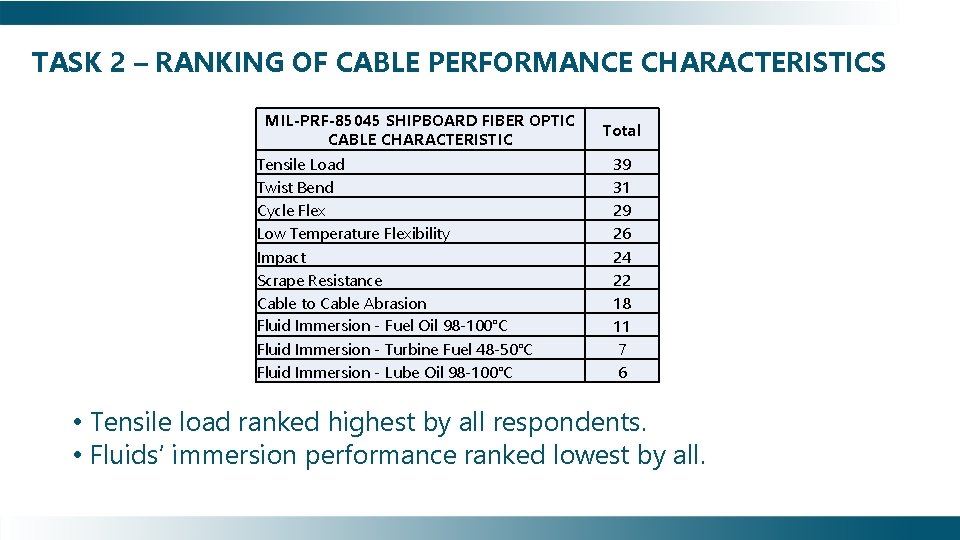
TASK 2 – RANKING OF CABLE PERFORMANCE CHARACTERISTICS MIL-PRF-85045 SHIPBOARD FIBER OPTIC CABLE CHARACTERISTIC Tensile Load Twist Bend Cycle Flex Low Temperature Flexibility Impact Scrape Resistance Cable to Cable Abrasion Fluid Immersion - Fuel Oil 98 -100°C Fluid Immersion - Turbine Fuel 48 -50°C Fluid Immersion - Lube Oil 98 -100°C Total 39 31 29 26 24 22 18 11 7 6 • Tensile load ranked highest by all respondents. • Fluids’ immersion performance ranked lowest by all.
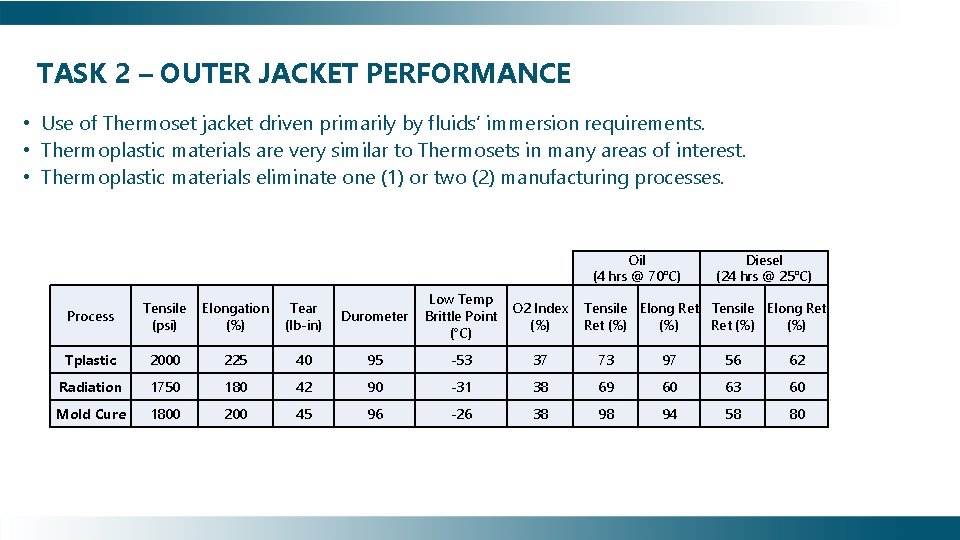
TASK 2 – OUTER JACKET PERFORMANCE • Use of Thermoset jacket driven primarily by fluids’ immersion requirements. • Thermoplastic materials are very similar to Thermosets in many areas of interest. • Thermoplastic materials eliminate one (1) or two (2) manufacturing processes. Oil (4 hrs @ 70°C) Diesel (24 hrs @ 25°C) Durometer Low Temp Brittle Point (°C) O 2 Index (%) 40 95 -53 37 73 97 56 62 180 42 90 -31 38 69 60 63 60 200 45 96 -26 38 98 94 58 80 Process Tensile (psi) Elongation (%) Tear (lb-in) Tplastic 2000 225 Radiation 1750 Mold Cure 1800 Tensile Elong Ret Ret (%) (%)
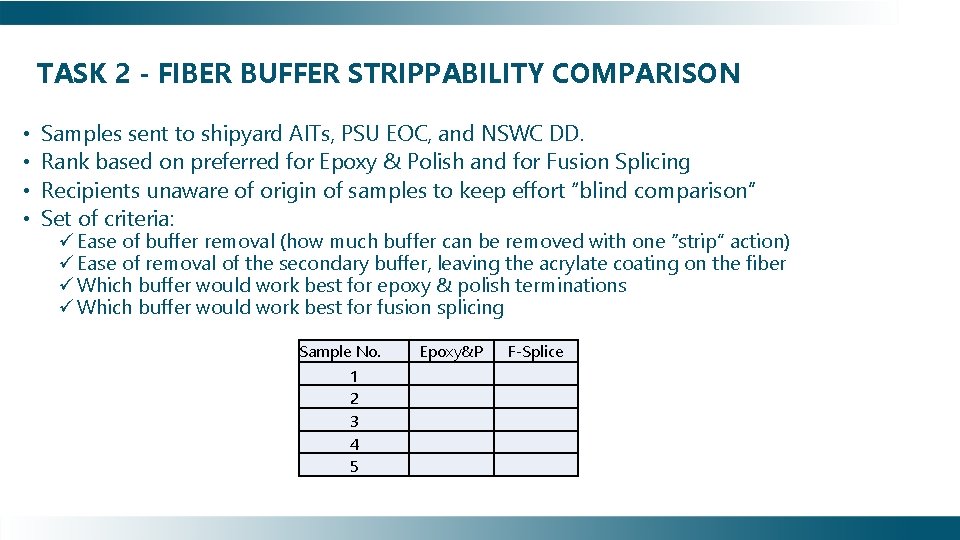
TASK 2 - FIBER BUFFER STRIPPABILITY COMPARISON • • Samples sent to shipyard AITs, PSU EOC, and NSWC DD. Rank based on preferred for Epoxy & Polish and for Fusion Splicing Recipients unaware of origin of samples to keep effort “blind comparison” Set of criteria: ü Ease of buffer removal (how much buffer can be removed with one “strip” action) ü Ease of removal of the secondary buffer, leaving the acrylate coating on the fiber ü Which buffer would work best for epoxy & polish terminations ü Which buffer would work best for fusion splicing Sample No. 1 2 3 4 5 Epoxy&P F-Splice
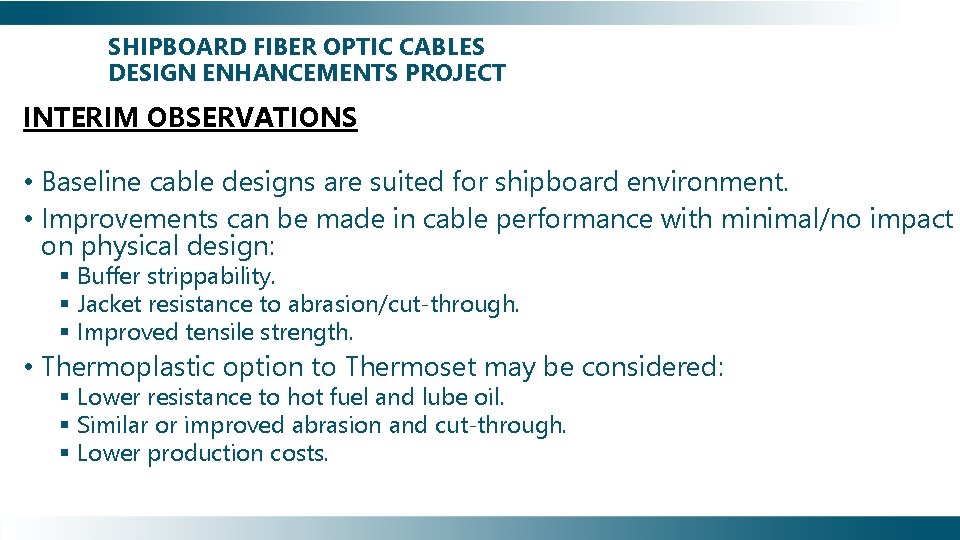
SHIPBOARD FIBER OPTIC CABLES DESIGN ENHANCEMENTS PROJECT INTERIM OBSERVATIONS • Baseline cable designs are suited for shipboard environment. • Improvements can be made in cable performance with minimal/no impact on physical design: § Buffer strippability. § Jacket resistance to abrasion/cut-through. § Improved tensile strength. • Thermoplastic option to Thermoset may be considered: § Lower resistance to hot fuel and lube oil. § Similar or improved abrasion and cut-through. § Lower production costs.
SHIPBOARD FIBER OPTIC CABLES DESIGN ENHANCEMENTS PROJECT NEXT STEPS 1. Quarterly Report 3: Task 2 and Task 3 Findings [Due Dec 31, 2019] 2. Determine cost impact of design enhancements (qualification, additional testing, ancillary equipment modifications…)[Complete by Feb 28, 2020] 3. Final Report [Due March 31, 2020]

QUESTIONS? 15
- Slides: 15