
Shipboard Fiber Optic Cables Design Enhancement Lower TOC
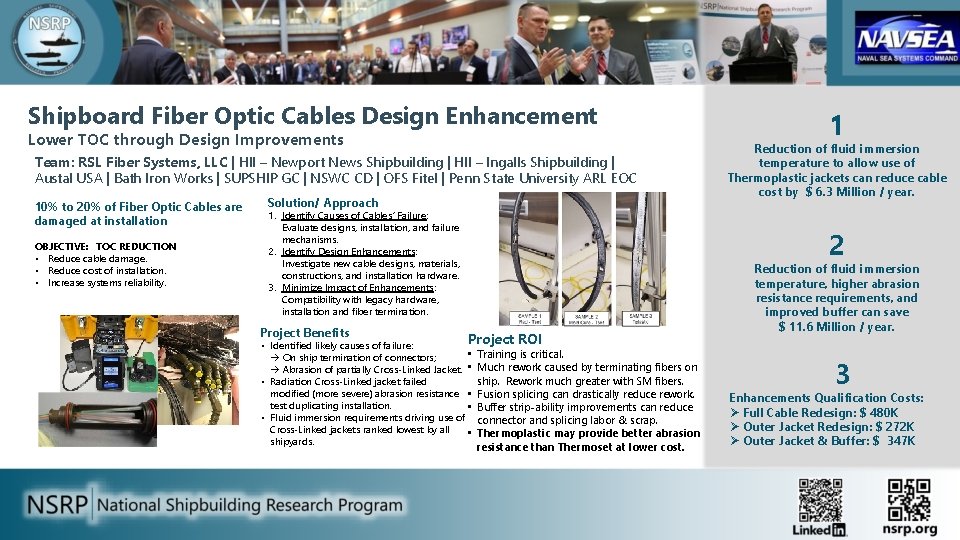
Shipboard Fiber Optic Cables Design Enhancement Lower TOC through Design Improvements Team: RSL Fiber Systems, LLC | HII – Newport News Shipbuilding | HII – Ingalls Shipbuilding | Austal USA | Bath Iron Works | SUPSHIP GC | NSWC CD | OFS Fitel | Penn State University ARL EOC 10% to 20% of Fiber Optic Cables are damaged at installation OBJECTIVE: TOC REDUCTION • Reduce cable damage. • Reduce cost of installation. • Increase systems reliability. Solution/ Approach 1. Identify Causes of Cables’ Failure: Evaluate designs, installation, and failure mechanisms. 2. Identify Design Enhancements: Investigate new cable designs, materials, constructions, and installation hardware. 3. Minimize Impact of Enhancements: Compatibility with legacy hardware, installation and fiber termination. Project Benefits Project ROI • Identified likely causes of failure: • Training is critical. On ship termination of connectors; Abrasion of partially Cross-Linked Jacket. • Much rework caused by terminating fibers on ship. Rework much greater with SM fibers. • Radiation Cross-Linked jacket failed modified (more severe) abrasion resistance • Fusion splicing can drastically reduce rework. test duplicating installation. • Buffer strip-ability improvements can reduce • Fluid immersion requirements driving use of connector and splicing labor & scrap. Cross-Linked jackets ranked lowest by all • Thermoplastic may provide better abrasion shipyards. resistance than Thermoset at lower cost. 1 Reduction of fluid immersion temperature to allow use of Thermoplastic jackets can reduce cable cost by $ 6. 3 Million / year. 2 Reduction of fluid immersion temperature, higher abrasion resistance requirements, and improved buffer can save $ 11. 6 Million / year. 3 Enhancements Qualification Costs: Ø Full Cable Redesign: $ 480 K Ø Outer Jacket Redesign: $ 272 K Ø Outer Jacket & Buffer: $ 347 K
- Slides: 1