
Shinto By Toan Nguyen Introduction Shinto is a
Shinto By: Toan Nguyen
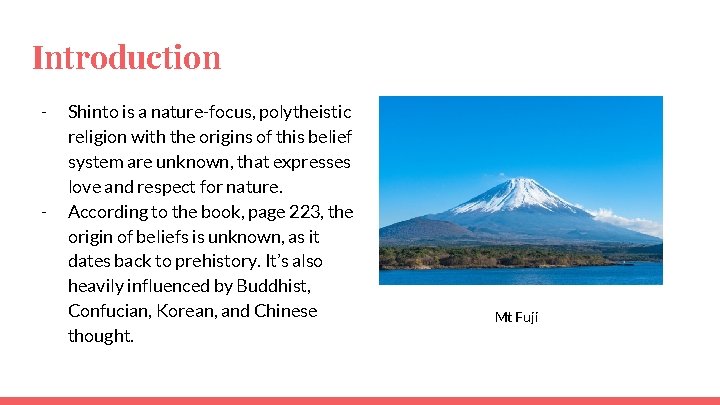
Introduction - - Shinto is a nature-focus, polytheistic religion with the origins of this belief system are unknown, that expresses love and respect for nature. According to the book, page 223, the origin of beliefs is unknown, as it dates back to prehistory. It’s also heavily influenced by Buddhist, Confucian, Korean, and Chinese thought. Mt Fuji
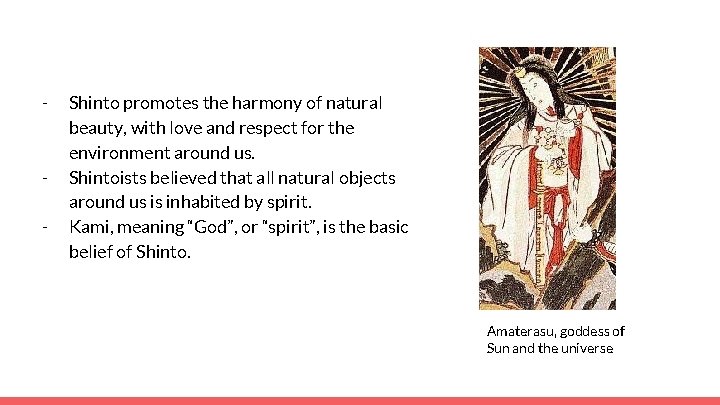
- - Shinto promotes the harmony of natural beauty, with love and respect for the environment around us. Shintoists believed that all natural objects around us is inhabited by spirit. Kami, meaning “God”, or “spirit”, is the basic belief of Shinto. Amaterasu, goddess of Sun and the universe
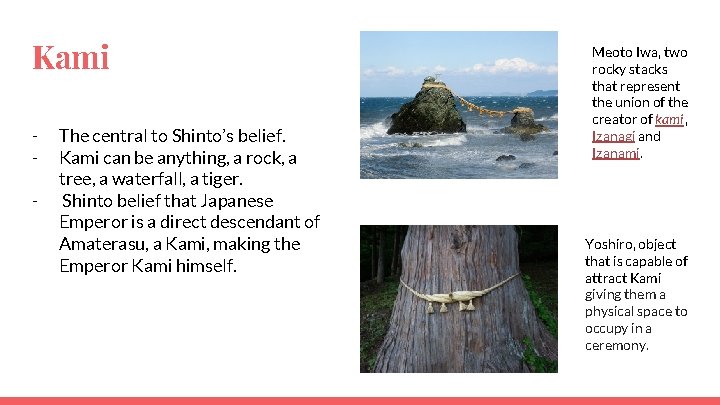
Kami - The central to Shinto’s belief. Kami can be anything, a rock, a tree, a waterfall, a tiger. Shinto belief that Japanese Emperor is a direct descendant of Amaterasu, a Kami, making the Emperor Kami himself. Meoto Iwa, two rocky stacks that represent the union of the creator of kami, Izanagi and Izanami. Yoshiro, object that is capable of attract Kami giving them a physical space to occupy in a ceremony.
The four affirmations of Shinto practitioner uses the word “affirmations” to describe their basic beliefs, meaning “things that we agree are good”, which is: - Affirmation of tradition and the family Affirmation of the love of nature Affirmation of physical cleanliness Affirmation of matsuri

Practices - - - Shinto worship Kami in shrines, which is usually dedicate to a specific Kami. People can go there to honor the Kami, or pray for good fortune, and the kami will sometimes respond back. Usually the shrine is take care by the local communities or by families.
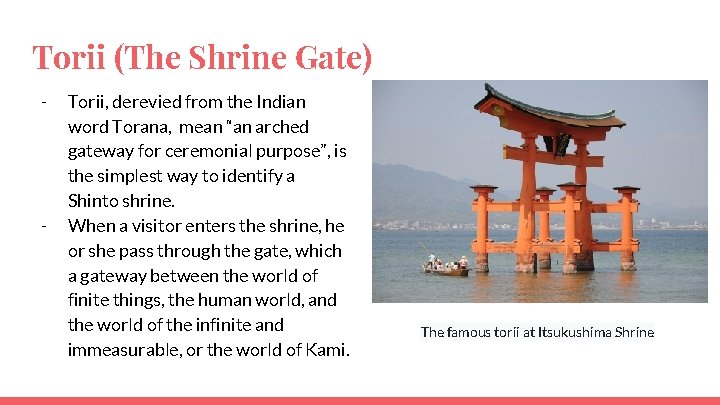
Torii (The Shrine Gate) - - Torii, derevied from the Indian word Torana, mean “an arched gateway for ceremonial purpose”, is the simplest way to identify a Shinto shrine. When a visitor enters the shrine, he or she pass through the gate, which a gateway between the world of finite things, the human world, and the world of the infinite and immeasurable, or the world of Kami. The famous torii at Itsukushima Shrine
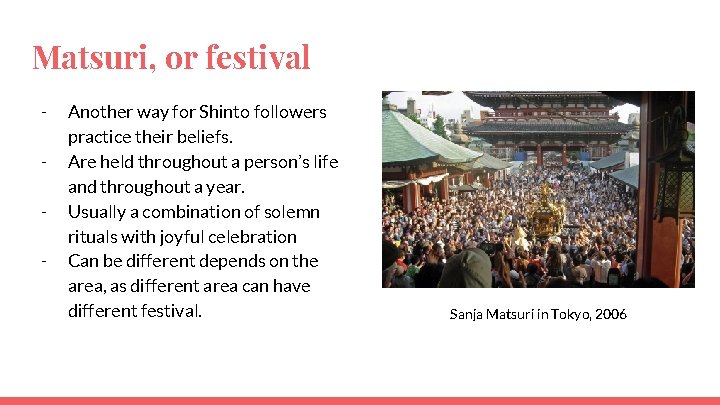
Matsuri, or festival - Another way for Shinto followers practice their beliefs. Are held throughout a person’s life and throughout a year. Usually a combination of solemn rituals with joyful celebration Can be different depends on the area, as different area can have different festival. Sanja Matsuri in Tokyo, 2006
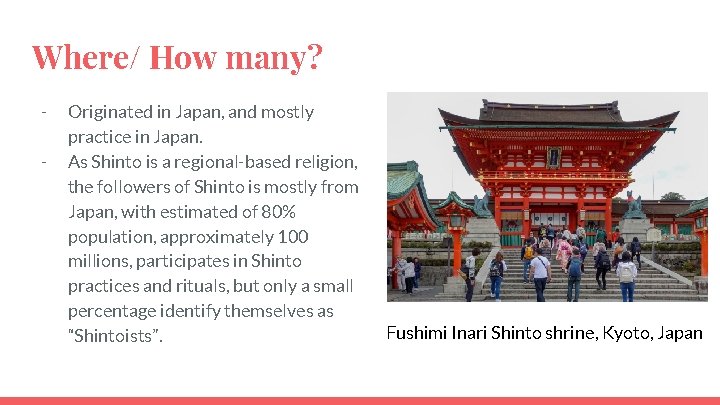
Where/ How many? - Originated in Japan, and mostly practice in Japan. As Shinto is a regional-based religion, the followers of Shinto is mostly from Japan, with estimated of 80% population, approximately 100 millions, participates in Shinto practices and rituals, but only a small percentage identify themselves as “Shintoists”. Fushimi Inari Shinto shrine, Kyoto, Japan
Reference - - Living Religion, tenth edition. https: //en. wikipedia. org/wiki/Shinto#Demographics https: //www. bbc. co. uk/religions/shinto/holydays/matsuri. shtml https: //en. wikipedia. org/wiki/Japanese_festivals http: //diversiton. com/more-religions-and-beliefs/shinto/ https: //www. britannica. com/topic/Shinto/Ritual-practices-and-institutions https: //www. britannica. com/topic/matsuri http: //www. home. worldcom. ch/~negenter/474 b. Gateway. Jp. F_E. html https: //www. onmarkproductions. com/html/shinto. shtml https: //en. wikipedia. org/wiki/Torii
- Slides: 10