
SHINJINRUI THE GENERATION EPITOMISED IN KITCHEN Setting the


- Slides: 9
SHINJINRUI - THE GENERATION EPITOMISED IN KITCHEN Setting the context for Kitchen Extract from How Japan’s Shinjinrui Define Their Generation: An Exploratory Collective Case Study By Hachtmann, Frauke, Kitagawa and Yoko.
BANANA YOSHIMOTO – A VOICE OF THE SHINJINRUI GENERATION
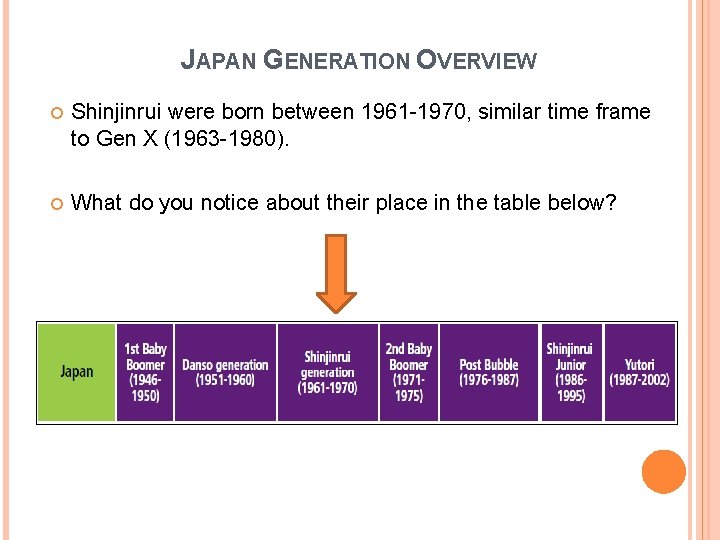
JAPAN GENERATION OVERVIEW Shinjinrui were born between 1961 -1970, similar time frame to Gen X (1963 -1980). What do you notice about their place in the table below?
SHINJINRUI The most recent study investigating Gen Xers specifically in Japan describes the cohort as “children who have grown up in […] an affluent, wealthy, powerful, influential, arrogant Japan (Herbig & Borstorff, 1995, p. 49). The term “Shinjinrui” (new breed) was developed during 1985, meaning “shinjin-rui” (new faces) and “shin-jinrui” (new human race). Nearly 120 million individuals in Japan fall into the Shinjinrui category. They are highly trained and expect high-level jobs.
SHINJINRUI Researchers also coined the term “Shirake Sedai” (the “reactionless” generation) because they do not show any interest in politics at all (Woronoff, 1981). Members of the Shinjinrui are believed to be spoilt and overprotected because their parents always provided them with what they wanted. Although they are well educated, they have difficulties making decisions because everything was always done for them.
SHINJINRUI Some call them the “goldfish generation” because they “have to be hand-fed everything” (Herbig & Borstorff, 1995, p. 50). The study further claims that young Japanese do not respect their parents. This phenomenon led to the attitude that it is acceptable not to help others, which is a direct contrast to existing Confucian values that build the foundation for traditional Japanese virtues such as loyalty, hard work, and respect for elders. They also expect a higher standard of living than the previous generation (Herbig & Borstorff, 1995).
SHINJINRUI In fact, Shinjinrui appear to be the exact opposite of their predecessors who lived to work. Instead, they work to live, are practical, easy-going, and “disturbingly money-minded” (p. 51). In addition, “kojinshugi” (individualism) is desirable among members of this generation. They value freedom of expression but not to the point where they might stand out. Friends are also very important to this cohort because they provide a sense of security.
SHINJINRUI Herbig and Borstorff describe the Shinjinrui as “egocentric and selfish” (p. 52), more concerned with short-term problems that affect themselves than caring about the well being of the group. They conclude that Japan is becoming a “nation of individuals, each engaged in the pursuit of his or her own personal goals” (p. 53). In addition, they view Japan as a victim instead of an aggressor because their education emphasizes the attacks on Hiroshima and Nagasaki. They appear to be overly nationalistic compared to their predecessors.
IN SUMMARY, the Shinjinrui work to live, to enjoy their family and not commit themselves entirely to their work, company, and country.