
Shingles An update for 2018 19 Vaccine Preventable

Shingles An update for 2018 -19 Vaccine Preventable Disease Programme: promoting immunisation in Wales
Notes to trainers • This template slide set has been produced to assist with the delivery of local training, to explain current influenza epidemiology, and evidence, to share key information, and promote positive messages about the shingles vaccination programme vaccination • The content is not exhaustive, local trainers should check prior to use and amend as appropriate. This template is designed to allow slides to be added/removed to suit local delivery and to meet the specific needs of those attending training • It is important to critically appraise sources of information prior to using them in the training session • Material in this document may be reproduced without prior permission provided it is done so accurately, with acknowledgement to Public Health Wales NHS Trust Vaccine Preventable Disease Programme Shingles update slides 2018/19
Learning objectives At the end of this training session, learners will be able to: • Describe shingles and the associated complications • Outline the current shingles vaccination programme identifying the eligible cohorts • Describe the contraindications and precautions associated with administering the live shingles vaccine • Outline possible adverse reactions of the live shingles vaccine • Describe further sources of information Shingles update slides 2018/19
What is shingles? • Shingles is a viral infection of the nerve cells and surrounding skin • The virus that causes shingles (Varicella Zoster Virus) also causes chickenpox • After a person recovers from chickenpox infection, the virus stays dormant in the nerve cells and can reactivate at a later stage • Shingles can develop at any time, and is most likely in older age groups • It is estimated that around 50, 000 cases of shingles occur each year in people aged 70 and over (England Wales) • Around 10 -20% of cases of shingles result in ophthalmic shingles • Around 4% of cases result in long term sequelae (including pain) Shingles update slides 2018/19
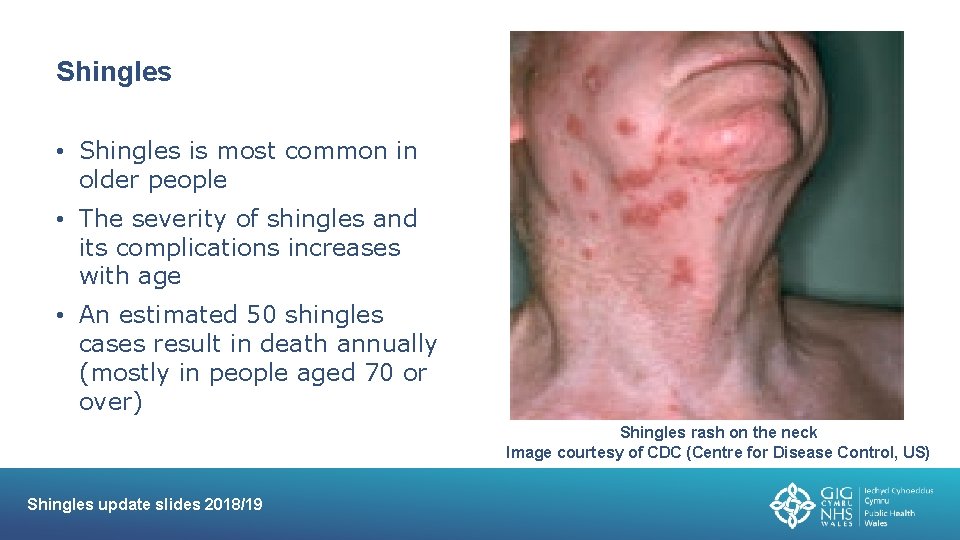
Shingles • Shingles is most common in older people • The severity of shingles and its complications increases with age • An estimated 50 shingles cases result in death annually (mostly in people aged 70 or over) Shingles rash on the neck Image courtesy of CDC (Centre for Disease Control, US) Shingles update slides 2018/19
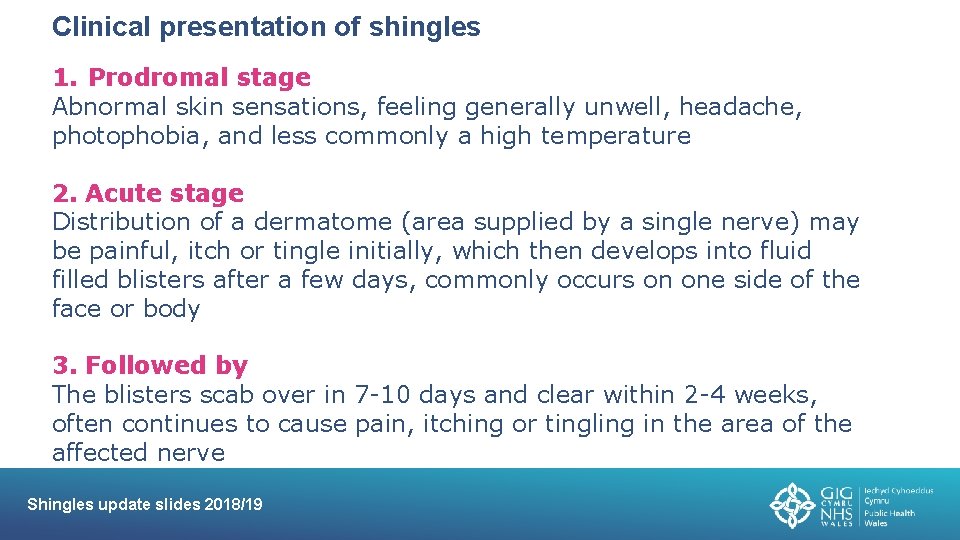
Clinical presentation of shingles 1. Prodromal stage Abnormal skin sensations, feeling generally unwell, headache, photophobia, and less commonly a high temperature 2. Acute stage Distribution of a dermatome (area supplied by a single nerve) may be painful, itch or tingle initially, which then develops into fluid filled blisters after a few days, commonly occurs on one side of the face or body 3. Followed by The blisters scab over in 7 -10 days and clear within 2 -4 weeks, often continues to cause pain, itching or tingling in the area of the affected nerve Shingles update slides 2018/19

Infectious period of shingles Shingles cannot be transmitted from one person to another • A person who has not had chickenpox previously may develop chickenpox as a result of exposure to the shingles virus through direct contact with the fluid filled blisters • A person with shingles is only infectious (i. e. can cause chickenpox in a susceptible contact) when the fluid filled blister rash is present • Shingles is less infectious than chickenpox and covering the rash will greatly reduce the risk of exposure to those nonimmune to chickenpox • A person is NOT infectious before the rash appears • A person is NOT infectious when the rash has crusted over Shingles update slides 2018/19

Possible complications of shingles Shingles can lead to hospitalisation and death Complications are more likely in adults over 50 years of age, with severity of illness increasing with age The most common complications are • Post herpetic neuralgia (PHN) • Secondary bacterial skin infections Other less common complications include • Peripheral motor neuropathy/paresis • Facial palsy, ophthalmic Zoster • Peripheral motor neuropathy • Encephalitis is a very rare complication Shingles update slides 2018/19
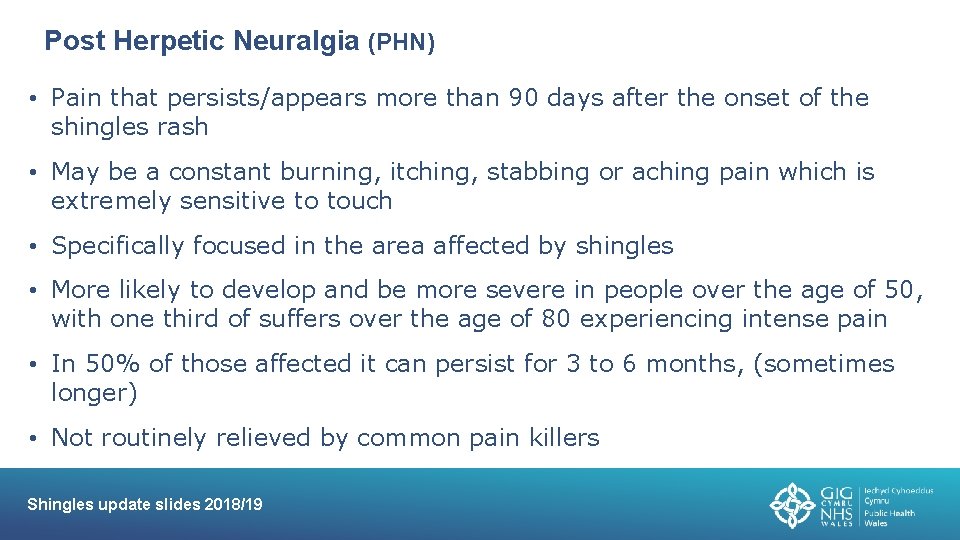
Post Herpetic Neuralgia (PHN) • Pain that persists/appears more than 90 days after the onset of the shingles rash • May be a constant burning, itching, stabbing or aching pain which is extremely sensitive to touch • Specifically focused in the area affected by shingles • More likely to develop and be more severe in people over the age of 50, with one third of suffers over the age of 80 experiencing intense pain • In 50% of those affected it can persist for 3 to 6 months, (sometimes longer) • Not routinely relieved by common pain killers Shingles update slides 2018/19
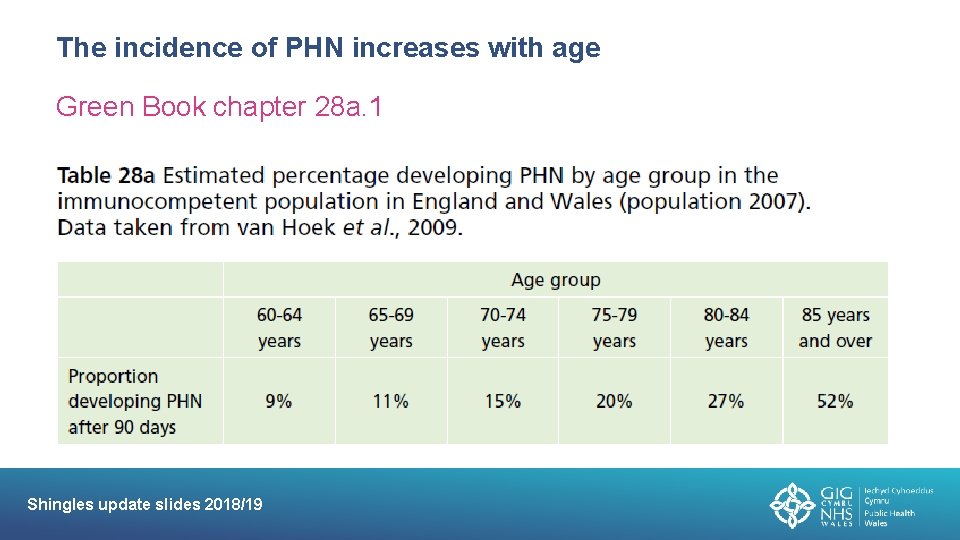
The incidence of PHN increases with age Green Book chapter 28 a. 1 Shingles update slides 2018/19
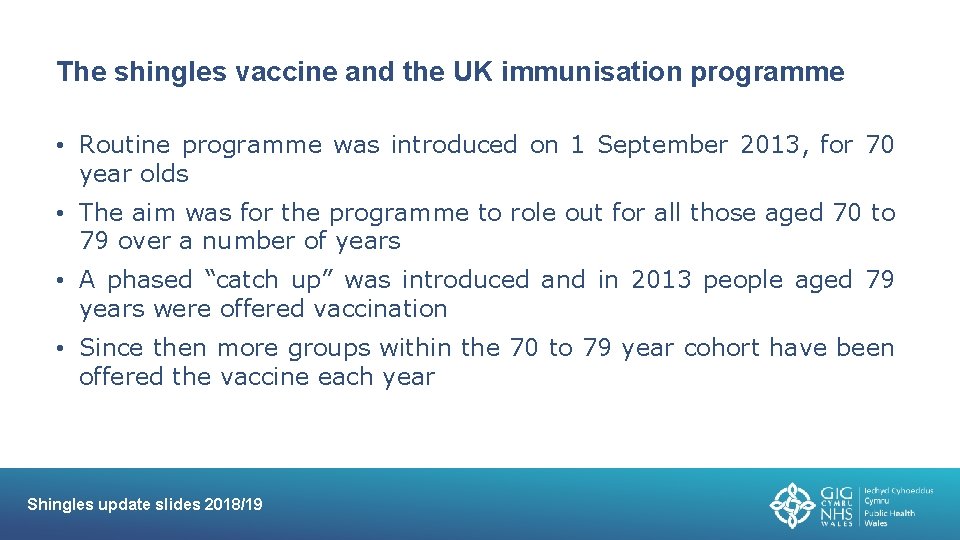
The shingles vaccine and the UK immunisation programme • Routine programme was introduced on 1 September 2013, for 70 year olds • The aim was for the programme to role out for all those aged 70 to 79 over a number of years • A phased “catch up” was introduced and in 2013 people aged 79 years were offered vaccination • Since then more groups within the 70 to 79 year cohort have been offered the vaccine each year Shingles update slides 2018/19
The shingles vaccine and the UK immunisation programme There is no requirement for practices to operate active call and recall systems but it would be good practice to do so. Template letters of invitation can be found at: http: //nww. immunisation. wales. nhs. uk/shingles-vaccinationprogramme-2018 -19 • Version 1 (advising the patient to contact the surgery to make an appointment) Eng/Cym • Version 2 (containing advice regarding an appointment that has been made) Eng/Cym Shingles update slides 2018/19
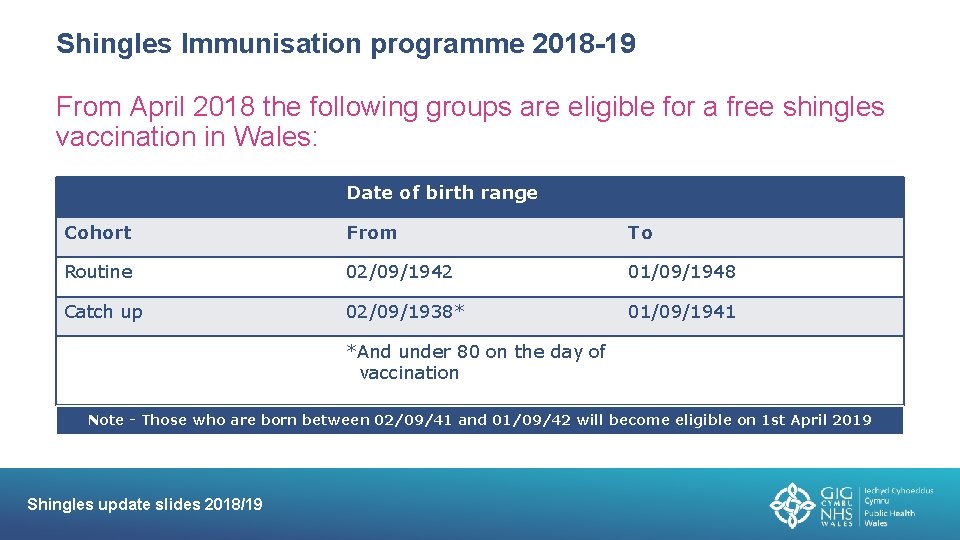
Shingles Immunisation programme 2018 -19 From April 2018 the following groups are eligible for a free shingles vaccination in Wales: Date of birth range Cohort From To Routine 02/09/1942 01/09/1948 Catch up 02/09/1938* 01/09/1941 *And under 80 on the day of vaccination Note - Those who are born between 02/09/41 and 01/09/42 will become eligible on 1 st April 2019 Shingles update slides 2018/19

Shingles Immunisation programme 2018 -19 Shingles vaccine eligibility - http: //www. nhsdirect. wales. nhs. uk/Shingles/ • Eligibility is defined by an individual’s age on 1 st September of each year, and they may receive the vaccine from 1 st April that year • Once an individual reaches their 80 th birthday they are no longer eligible for a shingles vaccination as part of the national programme Shingles update slides 2018/19
For those outside the eligible cohorts age range • A prescriber may make a judgment following individual clinical assessment that vaccination against shingles is indicated and beneficial for an individual patient, then it may be prescribed • This is outside arrangements for the national programme Shingles update slides 2018/19
Shingles vaccine - Zostavax® Recommended by JCVI for adults aged 70 (with a catch up programme up to 79 years). Supported by Welsh Government for those aged 70 -79 years of age, and being implemented in a phased roll out • A live attenuated vaccine that contains a high antigen content of varicella zoster virus (VZV) (i. e. a weakened live virus) • Licensed for use in persons age 50 years or older • The course consists of a single dose • It is important to familiarise yourself with the vaccine and the Summary of Product Characteristics (SPC) to avoid administration errors https: //www. medicines. org. uk/emc Shingles update slides 2018/19
Study evaluated the effect of the first 3 years of the vaccination programme on incidence of herpes zoster and post herpetic neuralgia in this population • Findings for first three routine cohorts: • Incidence of herpes zoster fell by 35% • Post herpetic neuralgia fell by 50% • Equivalent reduction for four catch up cohorts: • 33% for herpes zoster and 38% for post herpetic neuralgia • Vaccine effectiveness of 62% against herpes zoster and 70 -88% against post herpetic neuralgia Shingles update slides 2018/19 Amirthalingam et al. , 2017
Contraindications* When Zostavax® should not be given: • History of hypersensitivity to any part of the vaccine (e. g. Neomycin) • Primary and acquired immunodeficiency states due to conditions such as: acute and chronic leukaemia; lymphoma*; other conditions affecting the bone marrow or lymphatic system; immunosuppression due to HIV/AIDS; cellular immune deficiencies. • Immunosuppressive therapy; • Non biological immune modulating drugs e. g. methotrexate >25 mg per week, azathioprine >3 mg/kg/day or 6 -mercaptopurine >1. 5 mg/kg/day • Had biological therapies (e. g. anti-TNF) in the last 12 months • Active untreated tuberculosis. • Pregnancy Shingles update slides 2018/19 *SPC contains more detail around precautions and contraindications https: //www. medicines. org. uk/emc/
When to delay Zostavax® * • Acute illness- defer immunisation until recovered • Individuals with shingles or PHN should wait until symptoms have ceased before being considered for the immunisation • On high dose steroids (delay for at least three months) • On long term lower dose corticosteroids (delay for at least three months) • Had immunosuppressive chemotherapy or radiotherapy (delay until 6 months after the end of treatment and they are in remission) • Antiviral medicines can potentially lower the effectiveness of Zostavax® (delay by at least 48 hours after cessation of treatment) Shingles update slides 2018/19 *SPC contains more detail around precautions and contraindications https: //www. medicines. org. uk/emc/
Zostavax® is NOT contraindicated* in individuals • Receiving topical/inhaled corticosteroids, low-dose systemic corticosteroids or receiving corticosteroids as replacement therapy e. g. for adrenal insufficiency • On low-doses of methotrexate (<25 mg per week), azathioprine (<3. 0 mg/Kg/day), or mercaptopurine (<1. 5 mg/Kg/day) for treatment of rheumatoid arthritis, psoriasis, polymyositis, sarcoidosis, inflammatory bowel disease* • Using topical acyclovir Shingles update slides 2018/19 *SPC contains more detail around precautions and contraindications https: //www. medicines. org. uk/emc/
Precautions* with Zostavax® • Immunosuppressed patients (including those infected with HIV) who require protection against shingles should seek advice from a specialist • In clinical trials of Zostavax® transmission of the vaccine virus has not been reported. There is however a theoretical risk. The risk of transmitting the attenuated vaccine virus from a vaccinee to a susceptible contact should be weighed against the risk of developing natural zoster and potentially transmitting wild-type VZV to a susceptible contact* Shingles update slides 2018/19 *SPC contains more detail around precautions and contraindications https: //www. medicines. org. uk/emc/
A tool to help clinicians screen individuals for contraindications to the live attenuated shingles vaccine has been produced by Health Protection Scotland • The screening tool is designed to help identify patients who may be contra-indicated for shingles vaccine • Link to screening tool for contraindications for shingles vaccine • Scotland have given permission for the use of this screening tool in Wales, however it must be used in conjunction with the eligibility cohorts for shingles vaccine in Wales WHC(2015)19. It does not replace the need for the clinical judgement of the healthcare professional Shingles update slides 2018/19
Zostavax® appearance and reconstitution* The pack contains a single dose vial containing a white/off white compact, crystalline powder plug, a prefilled syringe of clear, colourless liquid solvent • When mixed together, Zostavax® should appear as a semi-hazy to translucent, off white/pale yellow liquid • To reconstitute the vaccine, inject all of the solvent in the pre-filled syringe into the vial, gently agitate to mix thoroughly and then withdraw the entire contents into the syringe (0. 65 ml) • Separate needles should be used for reconstitution and administration • The needle should be pushed into the extremity of the syringe and rotated a quarter of a turn (90 o) to secure the connection • The vaccine should then be administered immediately Shingles update slides 2018/19 *SPC contains more detail around precautions and contraindications https: //www. medicines. org. uk/emc/
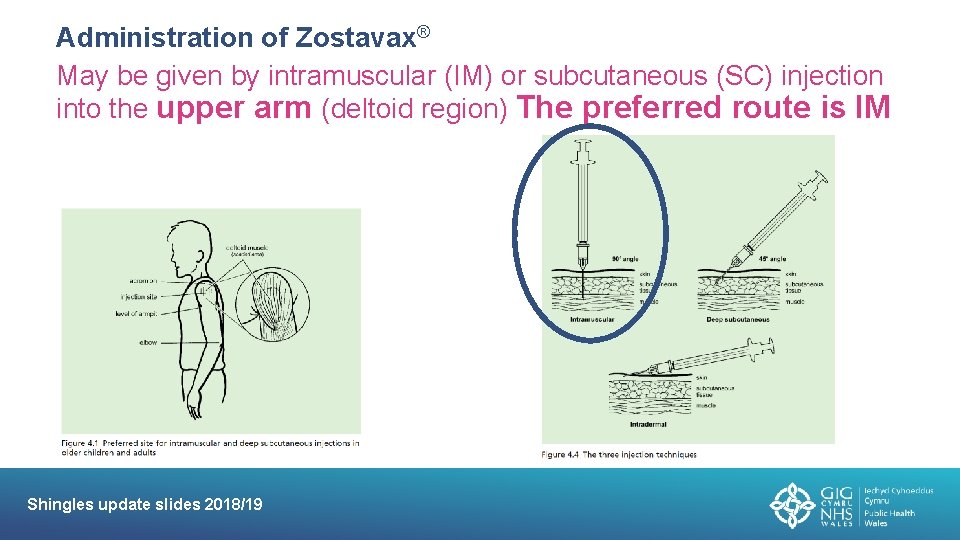
Administration of Zostavax® May be given by intramuscular (IM) or subcutaneous (SC) injection into the upper arm (deltoid region) The preferred route is IM Shingles update slides 2018/19
Giving Zostavax® at the same time as other vaccines • Zostavax® may be administered concomitantly with other vaccines including 23 -valent pneumococcal polysaccharide (PPV), influenza and live vaccines • Zostavax® should ideally be given at the same time as other live vaccines • A four week interval is recommended between MMR and Zostavax ® Shingles update slides 2018/19
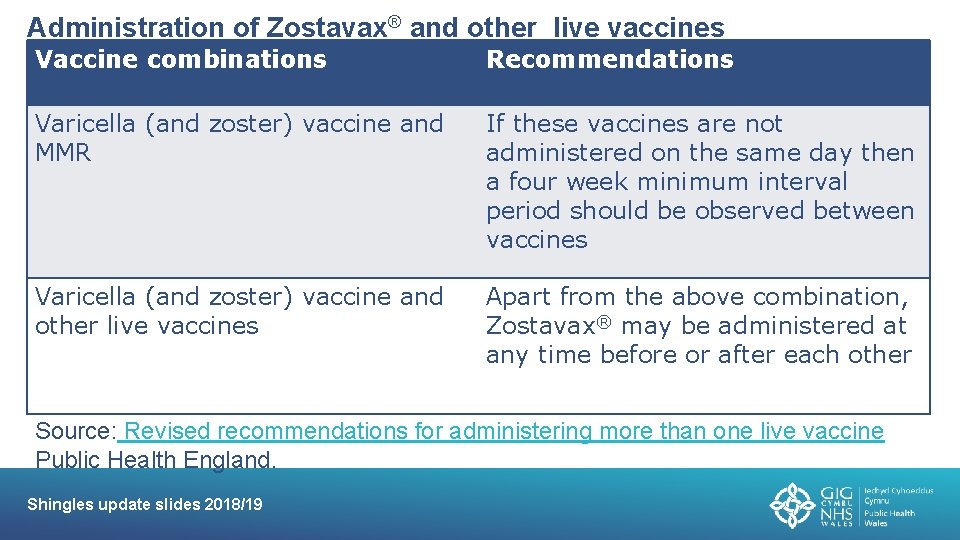
Administration of Zostavax® and other live vaccines Vaccine combinations Recommendations Varicella (and zoster) vaccine and MMR If these vaccines are not administered on the same day then a four week minimum interval period should be observed between vaccines Varicella (and zoster) vaccine and other live vaccines Apart from the above combination, Zostavax® may be administered at any time before or after each other Source: Revised recommendations for administering more than one live vaccine Public Health England. Shingles update slides 2018/19
Possible adverse reactions to Zostavax®* • Most commonly reported side effects are at the injection site and can include redness, pain, swelling and pruritus • Less common injection site reactions include haematoma, induration and warmth • Other common side effects include headache, and pain in arm or leg • Less common side effects include nausea, joint/muscle pain, fever swollen glands, shingles, rash • Chicken pox is a very rare side effect, < than 1 in 10, 000 people Shingles update slides 2018/19 *SPC contains more detail around precautions and contraindications https: //www. medicines. org. uk/emc/
Vaccine efficacy and length of protection • For those vaccinated but who later developed shingles, the vaccine reduced the incidence of PHN by 66% (Oxman et al. , 2005; Oxman et al. , 2008) • The need for a second dose is currently unknown • The latest data suggests the vaccine confers protection for at least 5 years (Schmader et al. , 2010) Shingles update slides 2018/19
New shingles vaccine licenced Shingrix® – herpes zoster vaccine (inactivated, recombinant adjuvanted vaccine) • Shingrix® was licenced in March 2018 by the European Medicines Agency • JCVI are currently considering information that will inform the potential for the use of Shingrix® in the wider UK programme • It is anticipated that Shingrix® could be recommended for individuals contraindicated to live Zostavax® vaccine due to immunocompromising conditions or treatment More information is available in the JCVI minutes - March 2018 Shingles update slides 2018/19
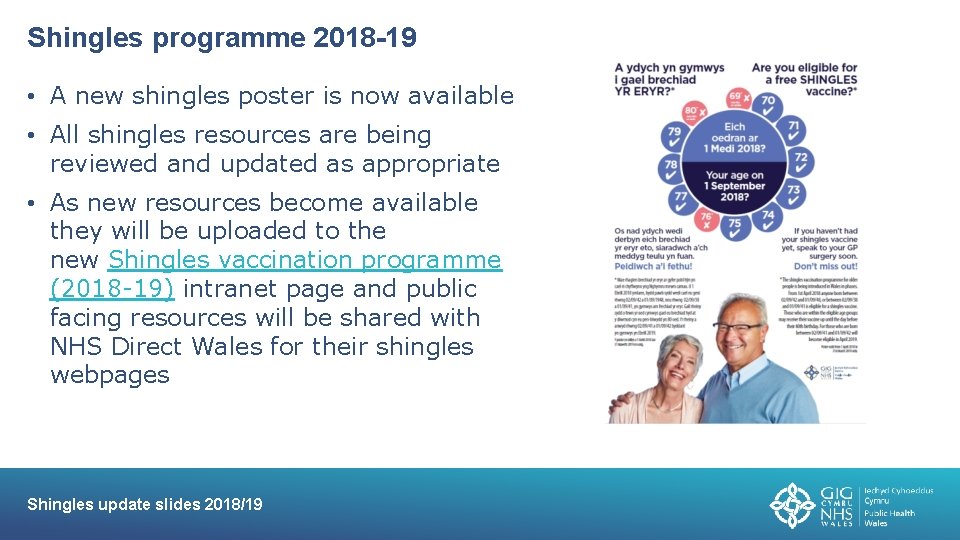
Shingles programme 2018 -19 • A new shingles poster is now available • All shingles resources are being reviewed and updated as appropriate • As new resources become available they will be uploaded to the new Shingles vaccination programme (2018 -19) intranet page and public facing resources will be shared with NHS Direct Wales for their shingles webpages Shingles update slides 2018/19
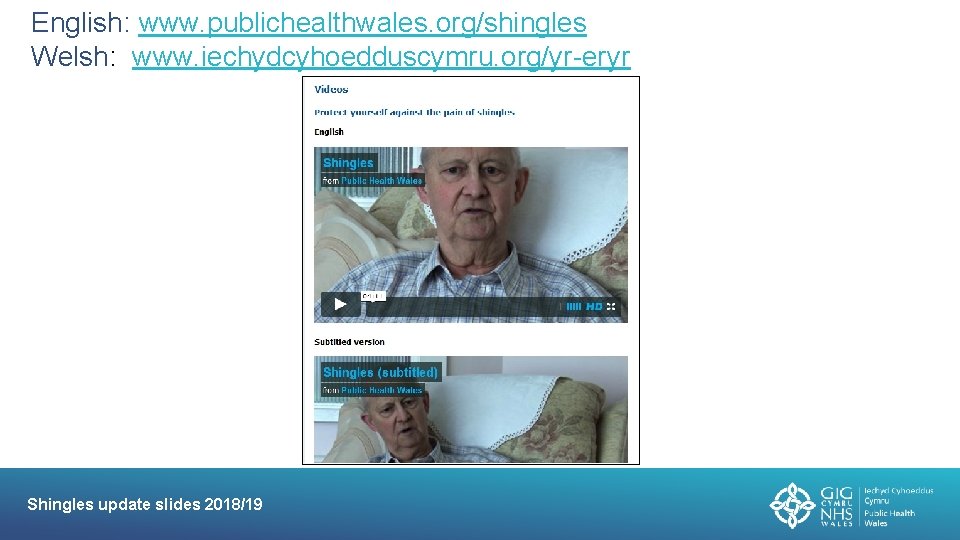
English: www. publichealthwales. org/shingles Welsh: www. iechydcyhoedduscymru. org/yr-eryr Shingles update slides 2018/19
Resources • Welsh Health Circular WHC (2017)17. Changes to the Shingles immunisation programme [link] • Green Book, chapter 28 a [link] • Public Health Wales Vaccine Preventable Disease Programme NHS Wales Shingles intranet pages [link] (NHS Wales intranet only) • Public Health Wales Vaccine Preventable Disease Programme NHS Wales Shingles vaccination programme (2018 -19) intranet pages [link] (NHS Wales intranet only) • Frequently Asked Questions: Varicella (chickenpox and shingles) (Public Health Wales) [link] (NHS Wales intranet only) • Health of Wales Information Service (HOWIS) Immunisation and vaccine clinical forum [link] (NHS Wales intranet only) • NHS Direct Wales Shingles information and eligibility checker [link] • Shingles Support Society [link] Shingles update slides 2018/19
Acknowledgment • This resource was prepared by the Vaccine Preventable Disease Programme, Public Health Wales as a national training template to support the shingles vaccination programme Shingles update slides 2018/19
- Slides: 33