
Shifts Demand Supply Increase Demand With Supply Constant
- Slides: 48
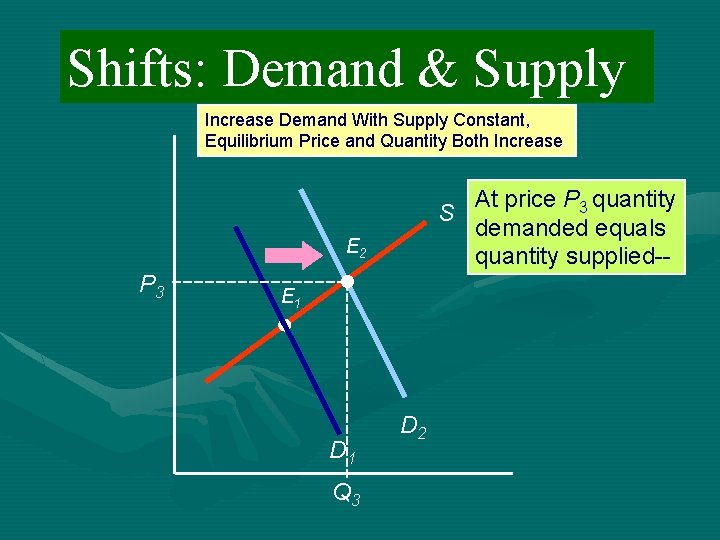
Shifts: Demand & Supply Increase Demand With Supply Constant, Equilibrium Price and Quantity Both Increase. At price P 3 quantity S demanded equals quantity supplied-- E 2 P 3 E 1 D 1 Q 3 D 2
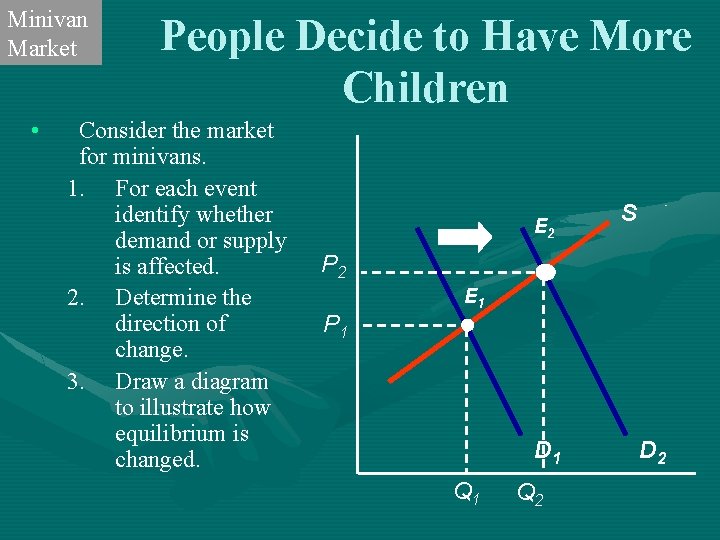
Minivan Market • People Decide to Have More Children Consider the market for minivans. 1. For each event identify whether demand or supply is affected. 2. Determine the direction of change. 3. Draw a diagram to illustrate how equilibrium is changed. E 2 S P 2 P 1 E 1 D 1 Q 2 D 2
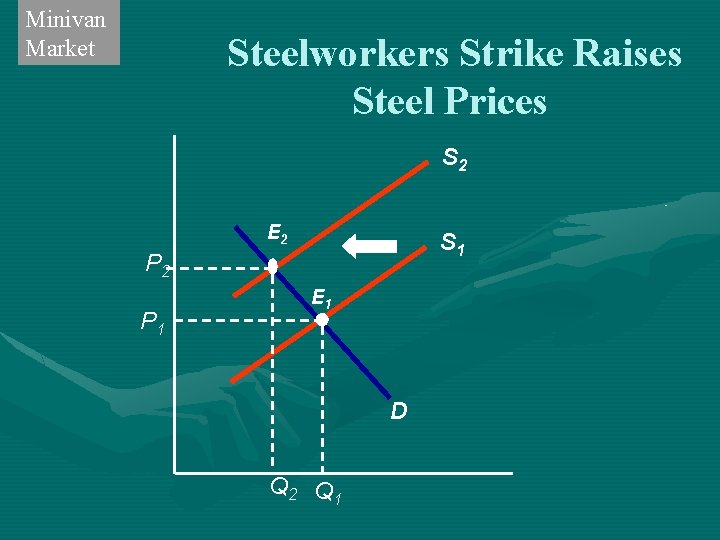
Minivan Market Steelworkers Strike Raises Steel Prices S 2 E 2 S 1 P 2 P 1 E 1 D Q 2 Q 1
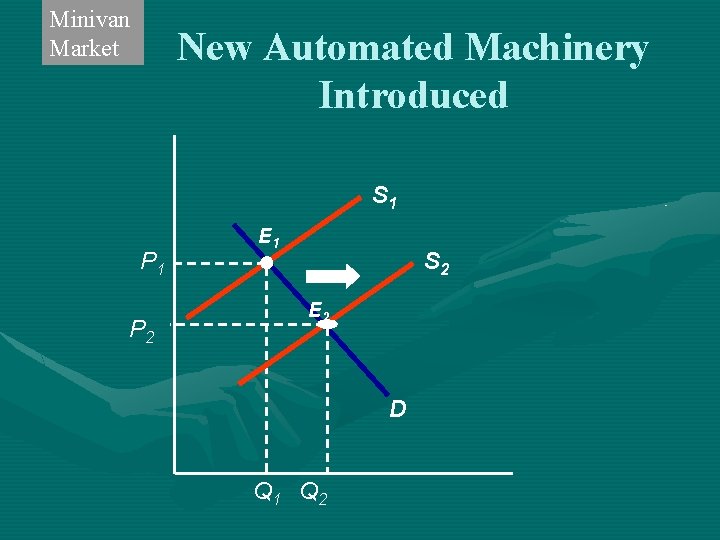
Minivan Market New Automated Machinery Introduced S 1 P 2 E 1 S 2 E 2 D Q 1 Q 2
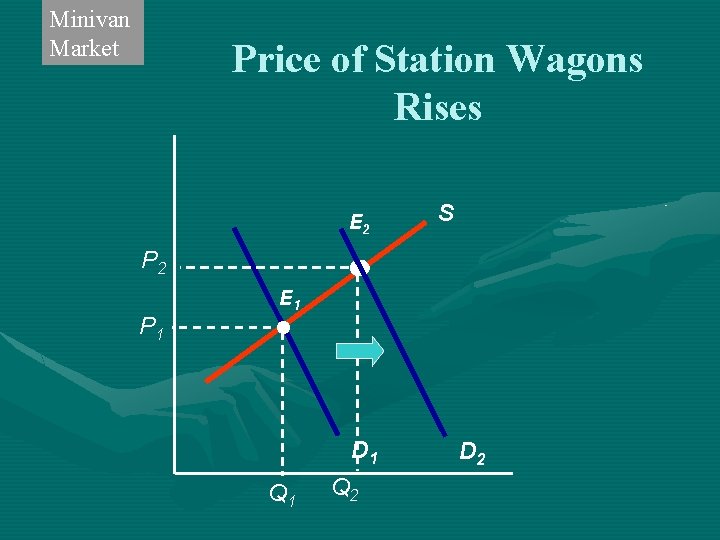
Minivan Market Price of Station Wagons Rises E 2 S P 2 P 1 E 1 D 1 Q 2 D 2
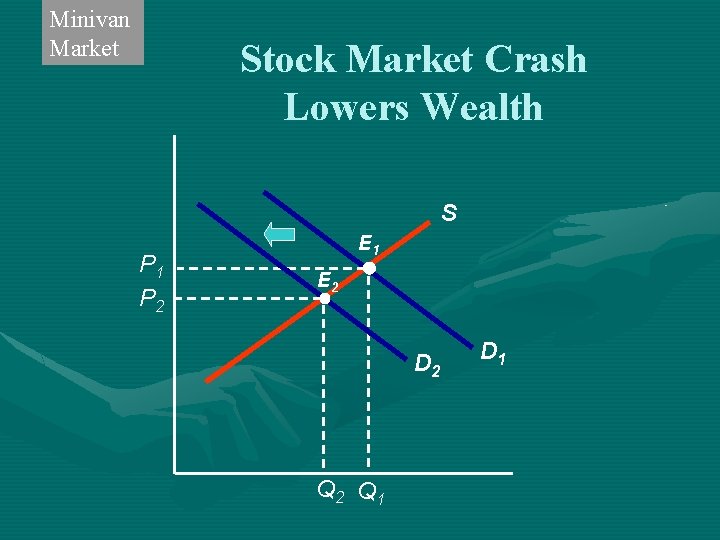
Minivan Market Stock Market Crash Lowers Wealth S P 1 P 2 E 1 E 2 D 2 Q 1 D 1
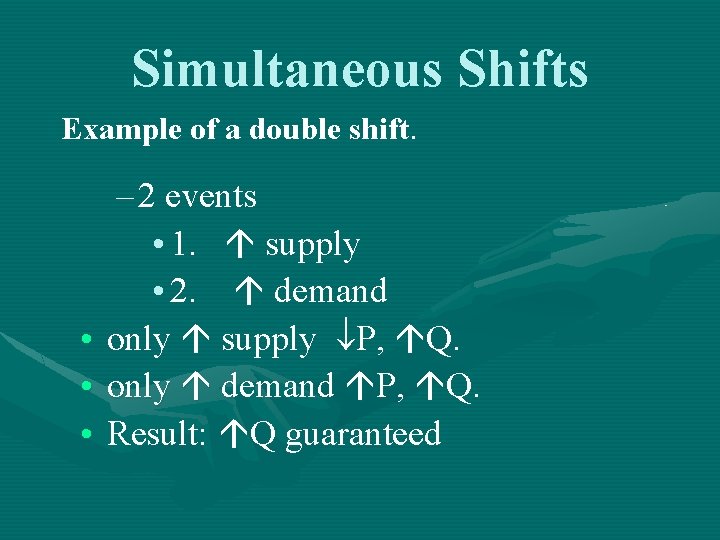
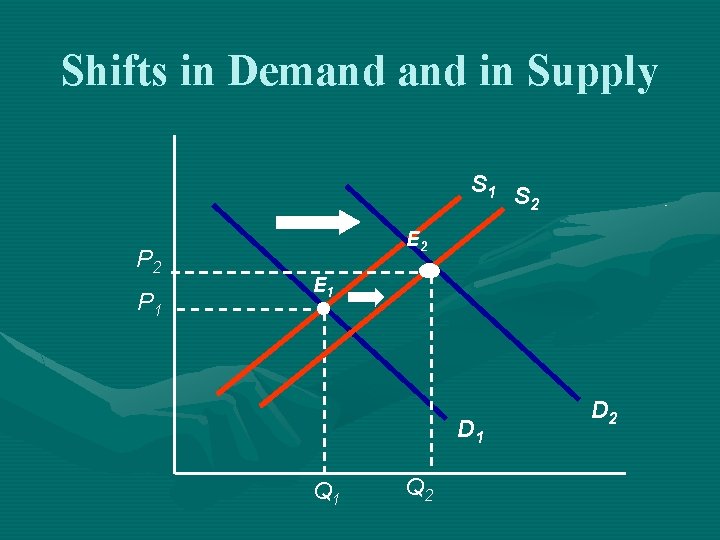
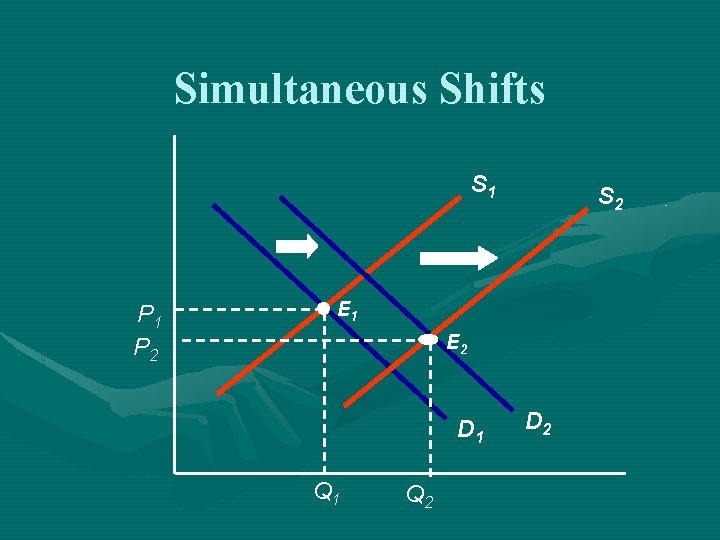
Simultaneous Shifts Example of a double shift. – 2 events • 1. supply • 2. demand • only supply P, Q. • only demand P, Q. • Result: Q guaranteed
Shifts in Demand in Supply S 1 S 2 P 1 E 2 E 1 D 1 Q 2 D 2
Simultaneous Shifts S 1 P 2 S 2 E 1 E 2 D 1 Q 2 D 2
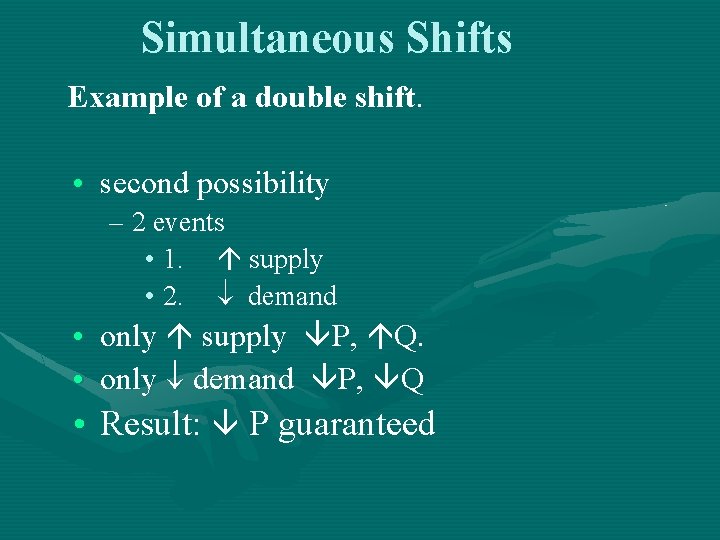
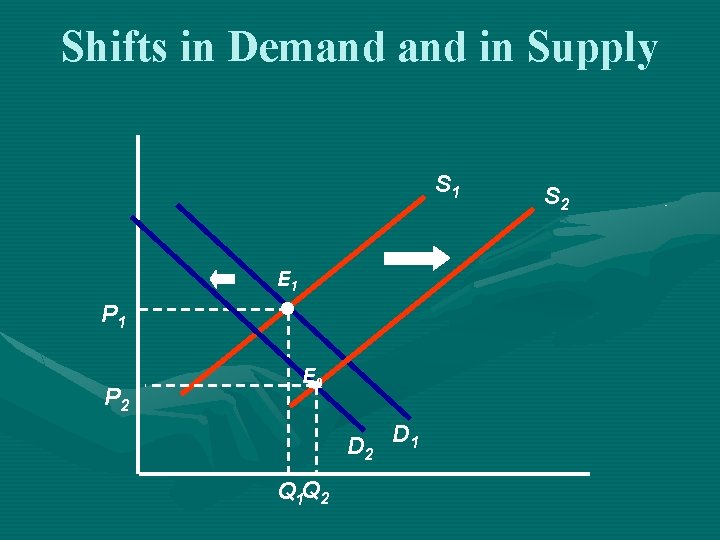
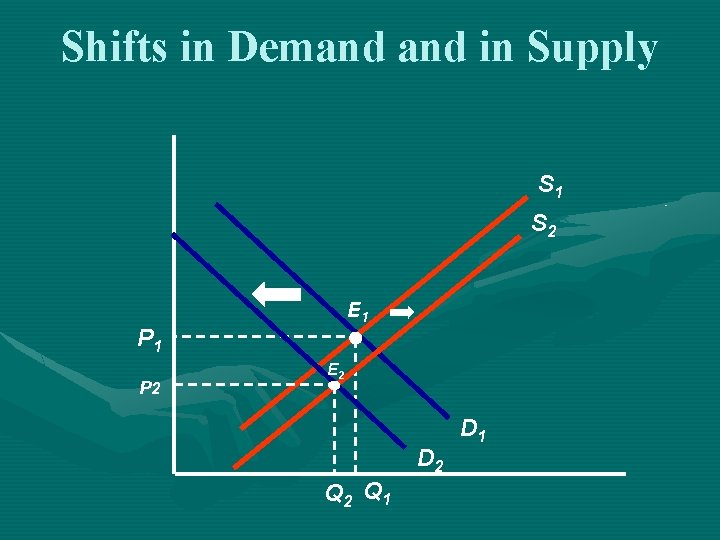
Simultaneous Shifts Example of a double shift. • second possibility – 2 events • 1. supply • 2. demand • only supply P, Q. • only demand P, Q • Result: P guaranteed
Shifts in Demand in Supply S 1 E 1 P 2 E 2 D 1 Q 1 Q 2 S 2
Shifts in Demand in Supply S 1 S 2 E 1 P 2 E 2 D 2 Q 1 D 1
Markets and Government Policy • Supply and demand together determine the prices of the economy’s many different goods & services. • Prices guide the use of resources and the allocation of final goods and services.
Price Controls Price fixing is based on debatable reasoning: • 1) Belief that one side of the market is to “blame” for “undesirable” price changes. • 2) Belief that governments can repeal the laws of supply and demand. • If you prevent prices from changing, you effectively suspend the mechanism for economic coordination.
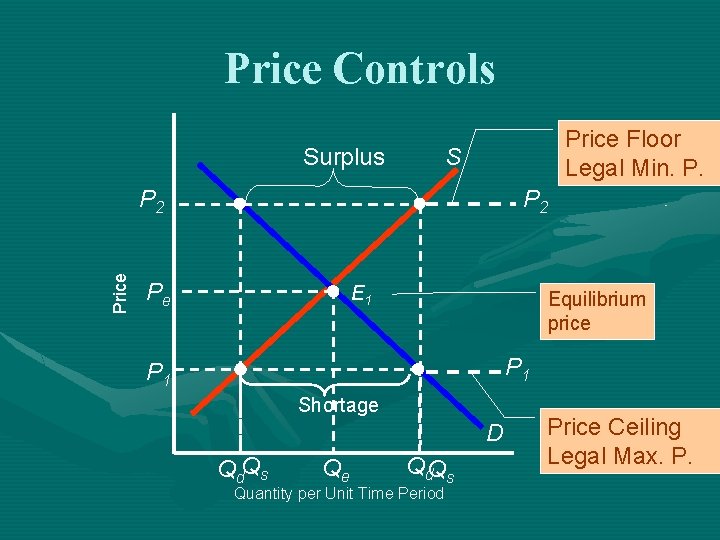
Price Controls Surplus Price Floor Legal Min. P. S Price P 2 Pe E 1 Equilibrium price P 1 Shortage D Qd. Qs Qe Qd. Qs Quantity per Unit Time Period Price Ceiling Legal Max. P.
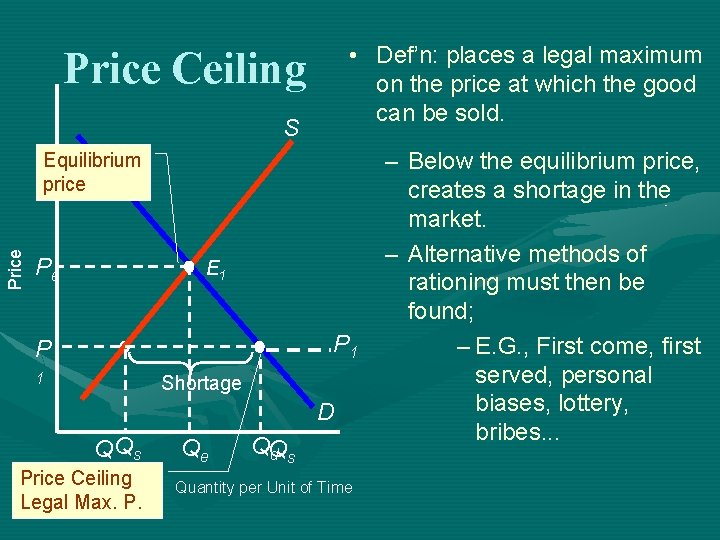
• Def’n: places a legal maximum on the price at which the good can be sold. Price Ceiling S Price Equilibrium price Pe E 1 P 1 Shortage D Q Qs d Price Ceiling Legal Max. P. Qe QQ d s Quantity per Unit of Time – Below the equilibrium price, creates a shortage in the market. – Alternative methods of rationing must then be found; – E. G. , First come, first served, personal biases, lottery, bribes. . .
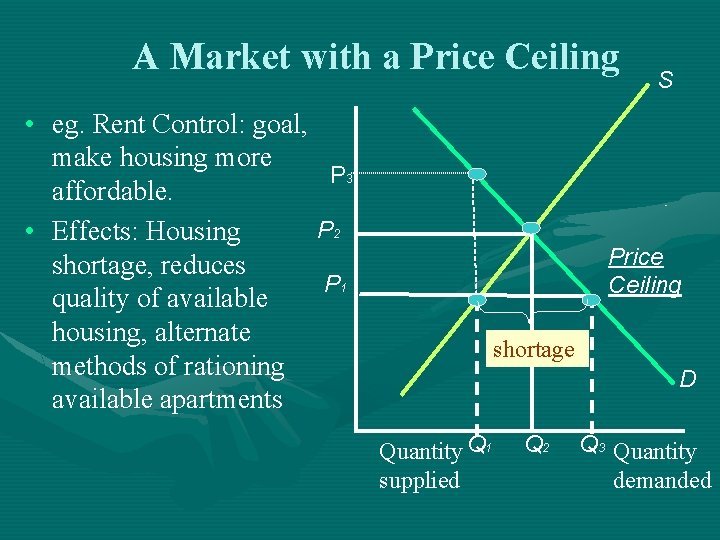
A Market with a Price Ceiling • eg. Rent Control: goal, make housing more P 3 affordable. P 2 • Effects: Housing shortage, reduces P 1 quality of available housing, alternate methods of rationing available apartments S Price Ceiling shortage D Quantity Q 1 supplied Q 2 Q 3 Quantity demanded
Market for Organs • The Canadian government has essentially placed a price ceiling of $0 on organs – to sell human organs in this country is illegal. • At the end of 2003, more than 3, 700 Canadians were waiting for an organ transplant and 147 died in 2003 waiting.
Market for Organs • All of us have two kidneys, but can survive (in fact live a normal life) with just one. • It is therefore possible for anyone to decide to offer one of his or her own kidneys, if the proper incentive exists. • For some this incentive would be a financial one, and some people desperate for a kidney would be willing to pay ® Black Market in Kidneys
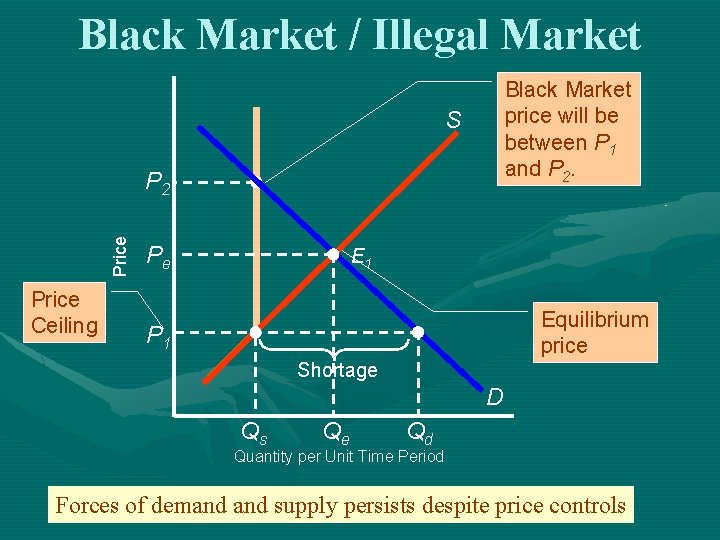
Black Market / Illegal Market Black Market price will be between P 1 and P 2. S Price P 2 Price Ceiling Pe E 1 Equilibrium price P 1 Shortage D Qs Qe Qd Quantity per Unit Time Period Forces of demand supply persists despite price controls
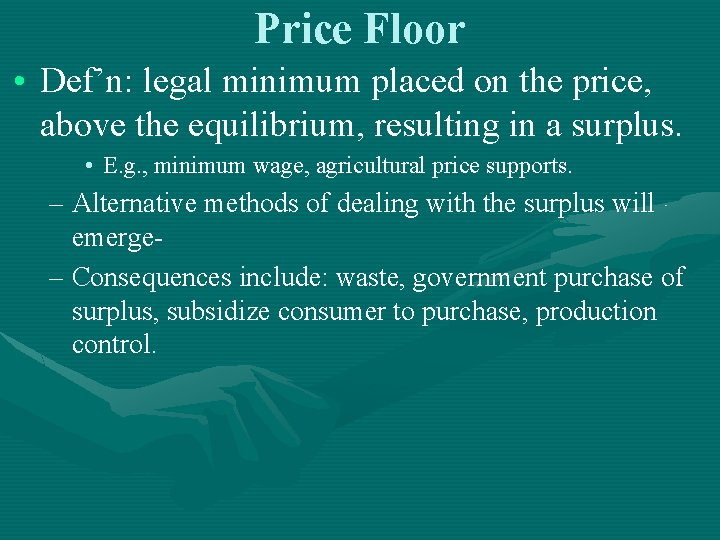
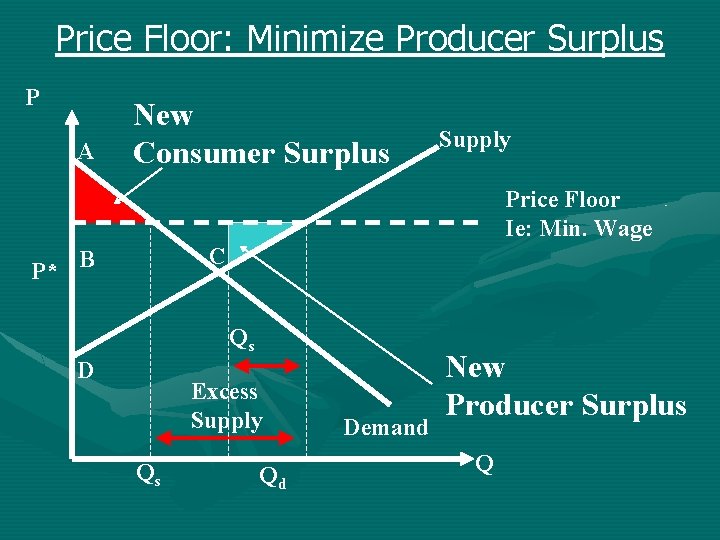
Price Floor • Def’n: legal minimum placed on the price, above the equilibrium, resulting in a surplus. • E. g. , minimum wage, agricultural price supports. – Alternative methods of dealing with the surplus will emerge– Consequences include: waste, government purchase of surplus, subsidize consumer to purchase, production control.
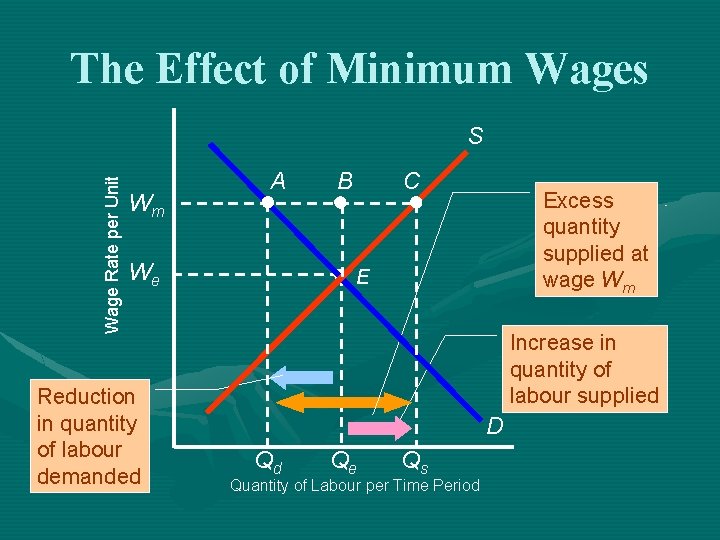
The Effect of Minimum Wages Wage Rate per Unit S Wm A We Reduction in quantity of labour demanded B C Excess quantity supplied at wage Wm E Increase in quantity of labour supplied D Qd Qe Qs Quantity of Labour per Time Period
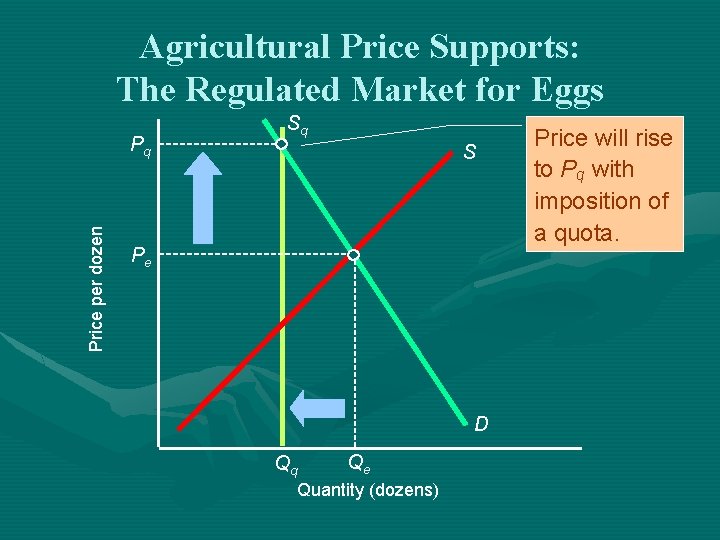
Agricultural Price Supports: The Regulated Market for Eggs Price per dozen Pq Sq S Pe D Qq Qe Quantity (dozens) Price will rise to Pq with imposition of a quota.
Price Controls • Economists usually oppose price controls for everyday kinds of commodities because – They obscure the signals given by market prices that normally guide the allocation of society’s scarce resources. Markets are prevented from performing their coordinating and rationing activities. • However, if all things are not equal, and a market is not operating properly, price controls can be useful – Ie: controls placed upon a monopoly
· The individual’s demand curve can be seen as the individual’s willingness to pay curve. · On the other hand, the individual must only actually pay the market price for (all) the units consumed. · For example, you may be willing to pay $40 for a haircut, but upon arriving at the stylist, discover that the price is only $20 · The difference between willingness to pay and the amount you pay is the Consumer Surplus
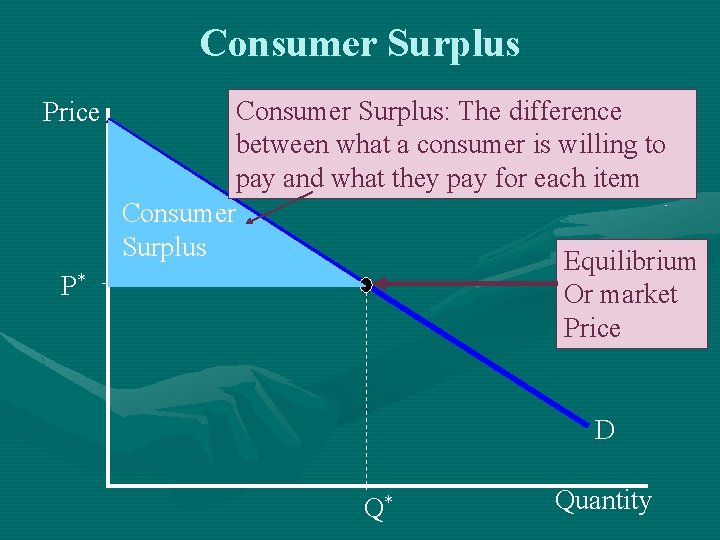
Definition: The net economic benefit to the consumer due to a purchase (i. e. the willingness to pay of the consumer net of the actual expenditure on the good) is called consumer surplus. The area under an ordinary demand curve and above the market price provides a measure of consumer surplus. Note that a consumer will receive more surplus from the first good than from the last good.
Consumer Surplus Price P* Consumer Surplus: The difference between what a consumer is willing to pay and what they pay for each item Consumer Surplus Equilibrium Or market Price D Q* Quantity
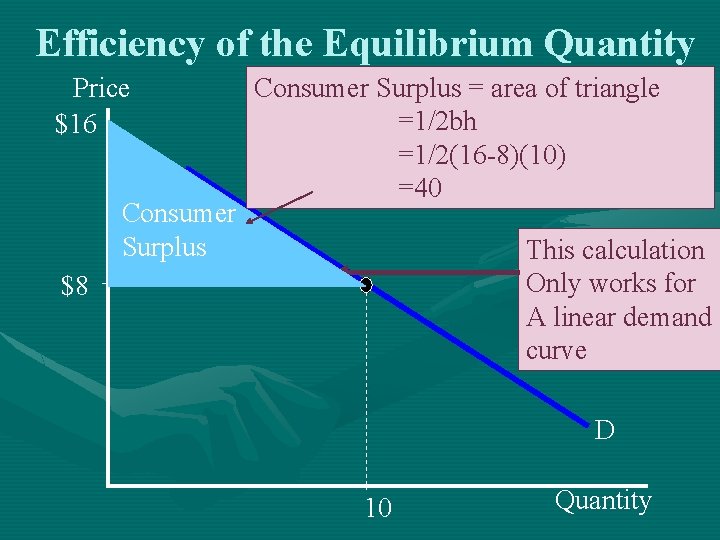
Efficiency of the Equilibrium Quantity Price $16 Consumer Surplus = area of triangle =1/2 bh =1/2(16 -8)(10) =40 This calculation Only works for A linear demand curve $8 D 10 Quantity
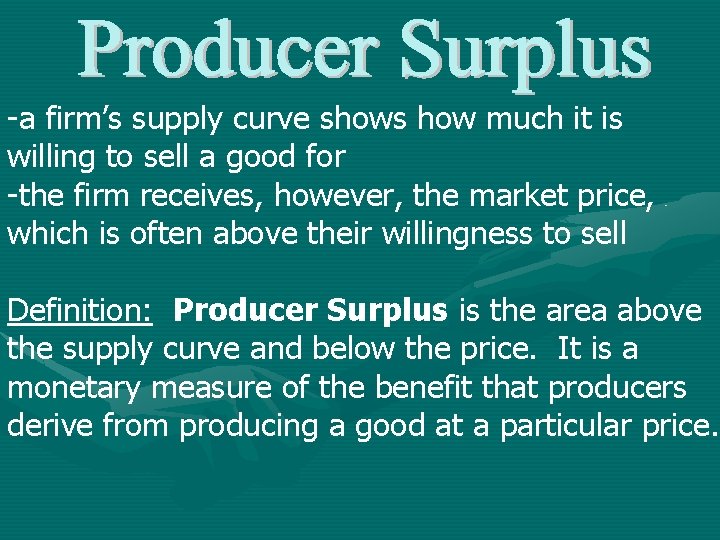
-a firm’s supply curve shows how much it is willing to sell a good for -the firm receives, however, the market price, which is often above their willingness to sell Definition: Producer Surplus is the area above the supply curve and below the price. It is a monetary measure of the benefit that producers derive from producing a good at a particular price.
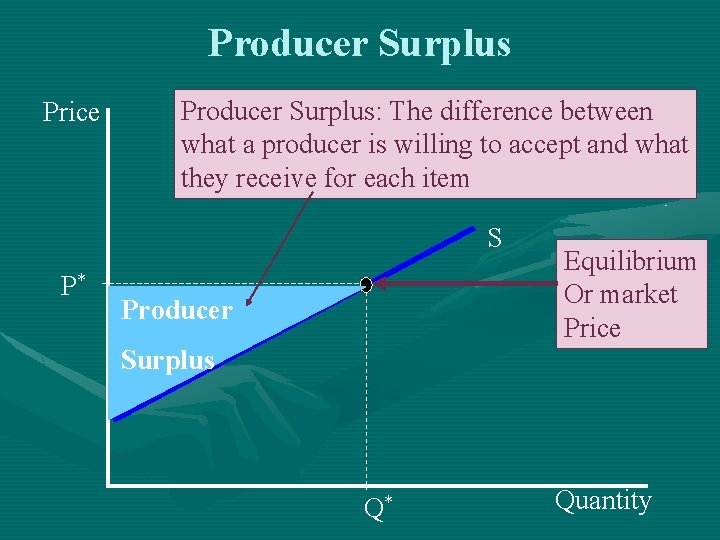
Producer Surplus Price Producer Surplus: The difference between what a producer is willing to accept and what they receive for each item S P* Producer Equilibrium Or market Price Surplus Q* Quantity
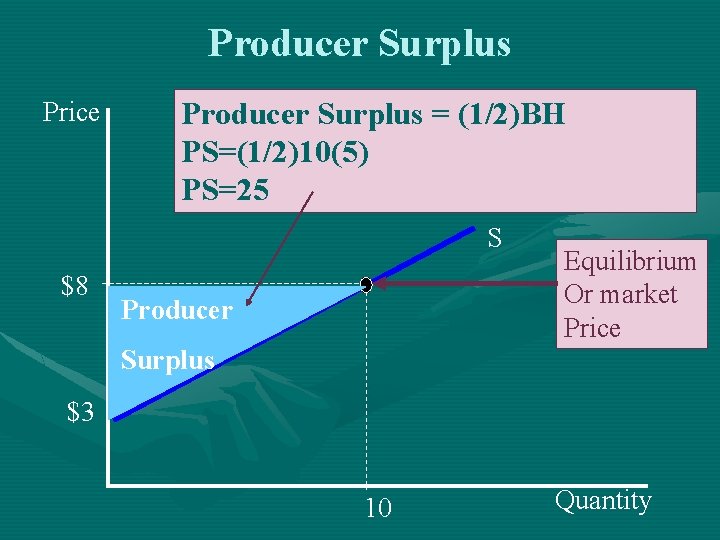
Producer Surplus Price Producer Surplus = (1/2)BH PS=(1/2)10(5) PS=25 S $8 Producer Equilibrium Or market Price Surplus $3 10 Quantity
· When the government (or other agency, such as a union) imposes price floors and price ceilings, consumer and producer surplus is generally decreased (except in very rare and unique cases) ·Generally, the consumers with the greatest willingness to pay or the producers with the greatest efficiency will consume and provide the good ·The alternate situation is provided graphically for interest sake only
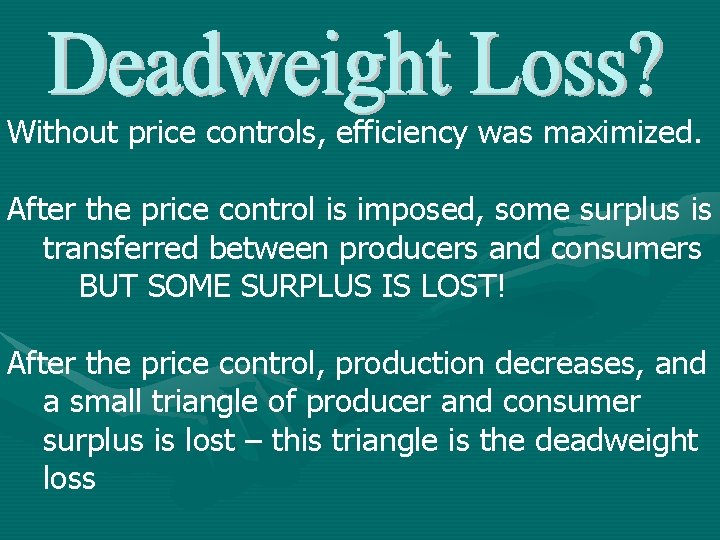
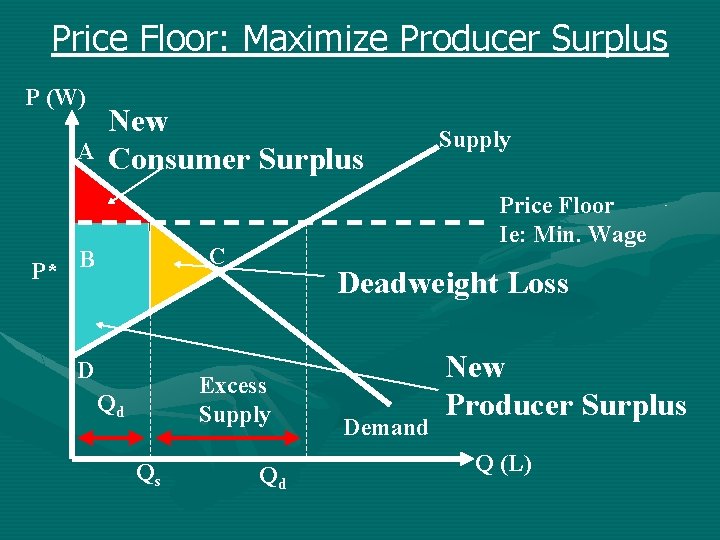
Without price controls, efficiency was maximized. After the price control is imposed, some surplus is transferred between producers and consumers BUT SOME SURPLUS IS LOST! After the price control, production decreases, and a small triangle of producer and consumer surplus is lost – this triangle is the deadweight loss
Deadweight loss – reduction in net economic benefit due to inefficient allocation of resources Price controls create inefficiencies!!
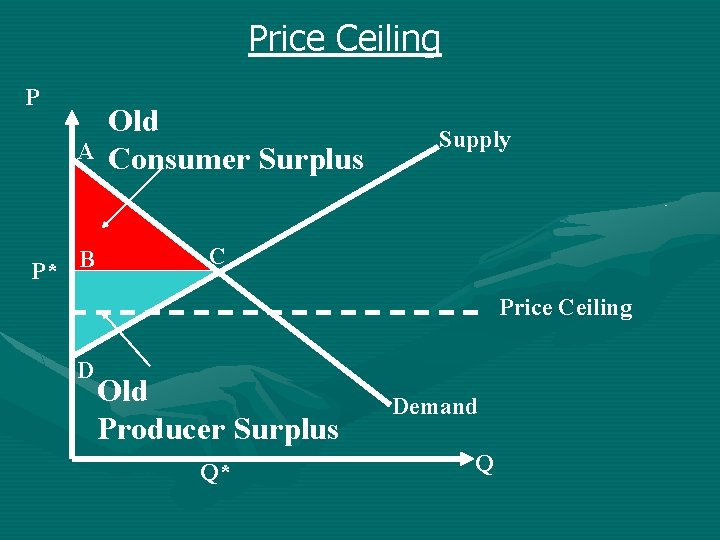
Price Ceiling P A P* B Old Consumer Surplus Supply C Price Ceiling D Old Producer Surplus Q* Demand Q
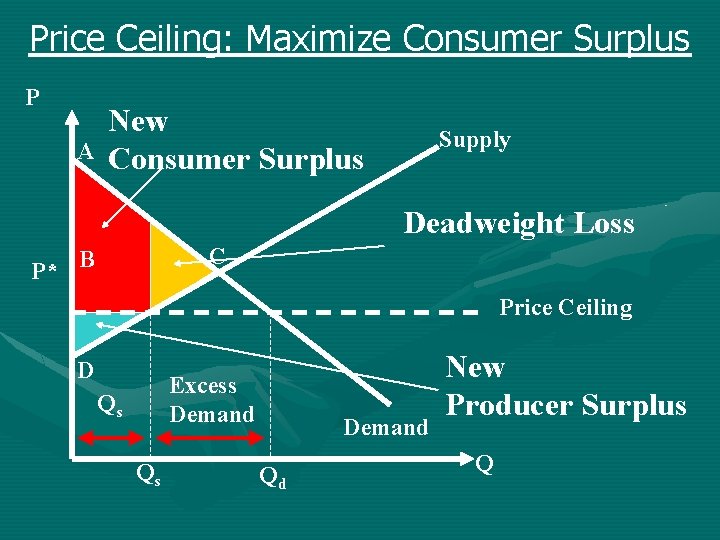
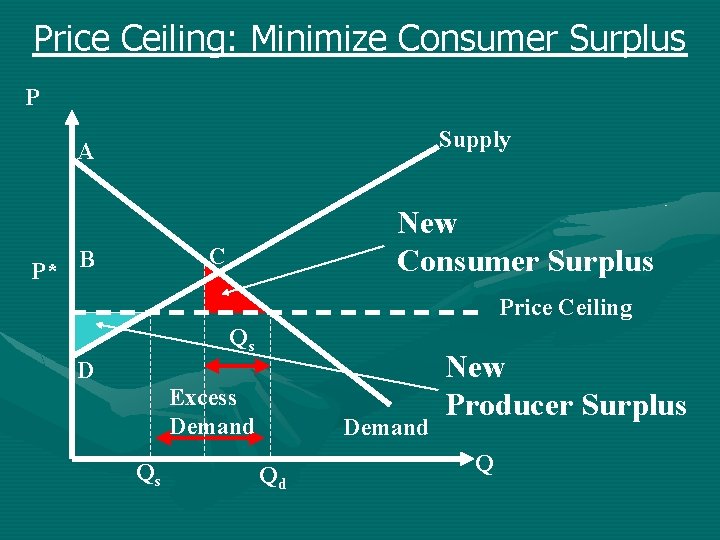
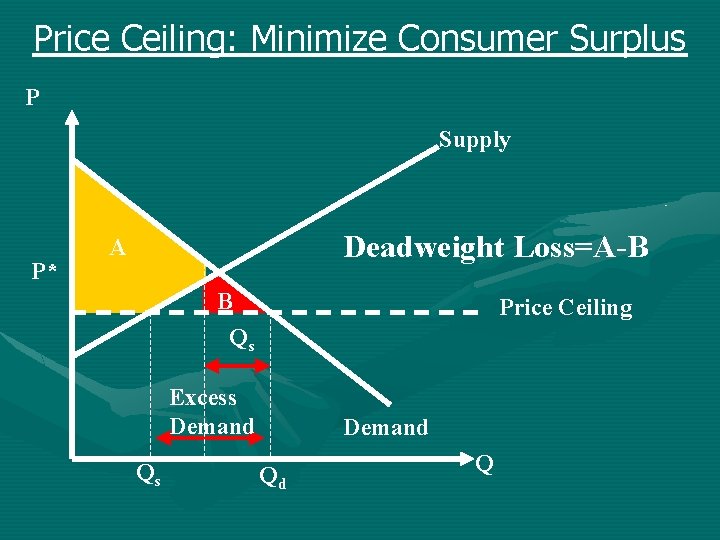
The impact of a price ceiling depends on which consumer receive the available good. We will examine the 2 extreme cases: • Consumers with greatest willingness to pay receive good (maximize consumer surplus) • Consumers with least willingness to pay receive good (minimize consumer surplus)
Price Ceiling: Maximize Consumer Surplus P A New Consumer Surplus Supply Deadweight Loss C P* B Price Ceiling D Excess Demand Qs Qs Demand Qd New Producer Surplus Q
Price Ceiling: Minimize Consumer Surplus P Supply A New Consumer Surplus C P* B Price Ceiling Qs D Excess Demand Qd New Producer Surplus Q
Price Ceiling: Minimize Consumer Surplus P Supply P* Deadweight Loss=A-B A B Qs Price Ceiling Excess Demand Qd Q
• It is generally assumed that the consumers with the greatest willingness to pay receive the good, but this does not always occur • Price ceilings are only effective if resale (black market) is prevented • Price ceilings can also cause a reliance on imports to meet excess demand
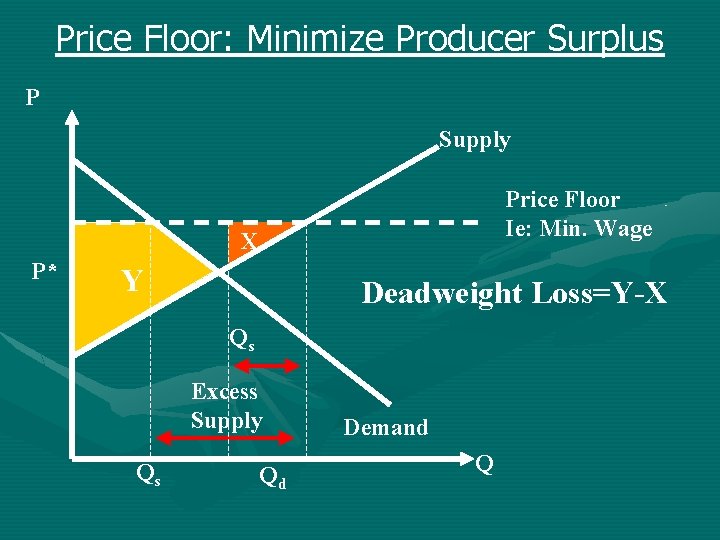
A • • price floor always has the following effects: Excess supply will exist The market will underconsume Consumer surplus will decrease Some consumer surplus is transferred to the producer • Producer surplus may increase or decrease • There will be a deadweight loss
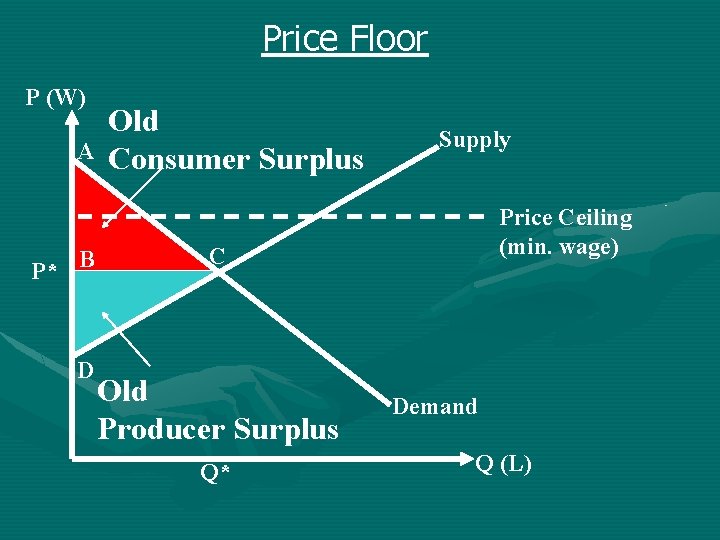
Price Floor P (W) A P* B D Old Consumer Surplus Supply Price Ceiling (min. wage) C Old Producer Surplus Q* Demand Q (L)
The impact of a price floor depends on which producer will sell the good (which worker works). We will examine the 2 extreme cases: • Producers with greatest efficiency supply good (maximize producer surplus) • Producers with least efficiency supply good (minimize producer surplus)
Price Floor: Maximize Producer Surplus P (W) A New Consumer Surplus Price Floor Ie: Min. Wage C P* B D Deadweight Loss Excess Supply Qd Qs Supply Qd Demand New Producer Surplus Q (L)
Price Floor: Minimize Producer Surplus P A New Consumer Surplus Supply Price Floor Ie: Min. Wage C P* B Qs D Excess Supply Qs Qd Demand New Producer Surplus Q
Price Floor: Minimize Producer Surplus P Supply Price Floor Ie: Min. Wage X P* Y Deadweight Loss=Y-X Qs Excess Supply Qs Qd Demand Q
• Therefore the attempt of a union to increase wages (create a price floor) has two effects: 1) Some workers receive a higher wage 2) Some workers lose their jobs • Note that there is a difference between negotiating a higher wage (a union’s publicized goal) and ensuring wages keep up with inflation (often a union’s achieved goal)
Midterm 1 • • 1 hour 50 multiple choice questions Includes all material previously covered Some questions will be quickly answered, others may take time • Students should average 1 min per question • Feel free to skip over troublesome questions until later