
Shifting Equilibrium Applications Involving the Equilibrium Constant The
Shifting Equilibrium
Applications Involving the Equilibrium Constant • The Meaning of K – K > 1 the equilibrium position is far to the right – K < 1 the equilibrium position is far to the left
• The value of K for a system can be calculated from a known set of equilibrium concentrations. • Unknown equilibrium concentrations can be calculated if the value of K and the remaining equilibrium concentrations are known.
Le Chatelier’s Principle • A reaction at equilibrium will proceed in a direction that relieves the stress put on it. • The equilibrium position changes, but the equilibrium constant (K) does not change unless temperature changes
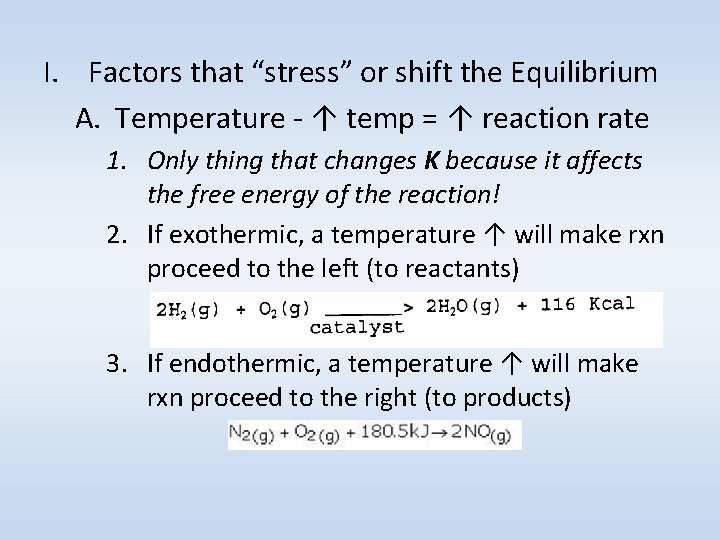
I. Factors that “stress” or shift the Equilibrium A. Temperature - ↑ temp = ↑ reaction rate 1. Only thing that changes K because it affects the free energy of the reaction! 2. If exothermic, a temperature ↑ will make rxn proceed to the left (to reactants) 3. If endothermic, a temperature ↑ will make rxn proceed to the right (to products)
B. Volume 1. Look at the number of moles of gas • ↓ the volume ↑ the pressure, & will cause the reaction to proceed towards the side with fewer moles of gas • ↓ volume ↑ reaction rate for both the forward & reverse reactions. • The side with more moles of gas has an advantage since there are more collision per unit of time 2. Changing volume does not change K
C. Pressure 1. Look at the number of moles of gas 2. Pressure can be changed 2 ways • Changing volume (see previous slide); changing pressure this was does change reaction rate • Adding an inert gas; changing pressure this was does NOT change reaction rate 3. Changing pressure does not change K
D. Concentration 1. Look at the reactants & products • If reactant’s concentration ↑, reaction shifts towards products • If product’s concentration ↑, reaction shifts towards reactants
2. Can change concentration by: • Adding reactant or product • Removing reactant or product • Adding something that complete (or almost completely) reacts with the reactant or products • If you add something that forms a precipitate with one the reactants or products, you are effectively removing that reactant or product
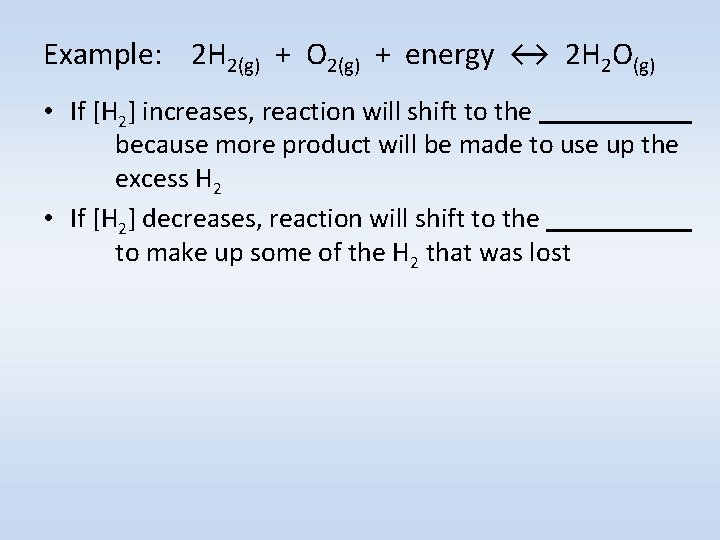
Example: 2 H 2(g) + O 2(g) + energy ↔ 2 H 2 O(g) • If [H 2] increases, reaction will shift to the because more product will be made to use up the excess H 2 • If [H 2] decreases, reaction will shift to the to make up some of the H 2 that was lost
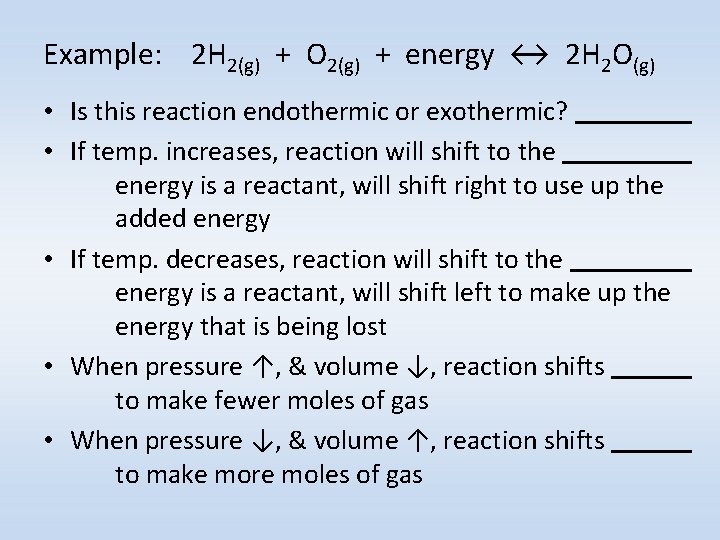
Example: 2 H 2(g) + O 2(g) + energy ↔ 2 H 2 O(g) • Is this reaction endothermic or exothermic? • If temp. increases, reaction will shift to the energy is a reactant, will shift right to use up the added energy • If temp. decreases, reaction will shift to the energy is a reactant, will shift left to make up the energy that is being lost • When pressure ↑, & volume ↓, reaction shifts to make fewer moles of gas • When pressure ↓, & volume ↑, reaction shifts to make more moles of gas
- Slides: 11