
SHIFT HAPPENS Three Powerful Ways to Create Change

![The Four Signals Wounded/Cursed/ Disrepected [Dissed]](https://slidetodoc.com/presentation_image_h/e179c27dd56322b70ec2d858044da98d/image-37.jpg "The Four Signals Wounded/Cursed/ Disrepected [Dissed]")

- Slides: 50
SHIFT HAPPENS: Three Powerful Ways to Create Change Bill O’Hanlon
Shift Happens For a free copy of these Power. Point slides, visit: http: //www. billohanlon. com ü Click on FREE STUFF ü Then click on SLIDES ü Wait about a week for the slides to show up; meanwhile there are others up there you can have while you are waiting. üOn that page is a link to sign up for my free monthly newsletter, filled with interesting research, cool and moving videos and free handouts 2
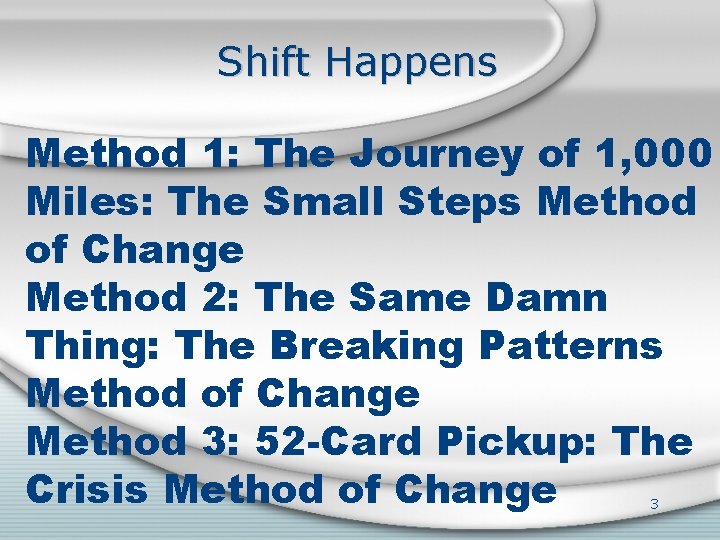
Shift Happens Method 1: The Journey of 1, 000 Miles: The Small Steps Method of Change Method 2: The Same Damn Thing: The Breaking Patterns Method of Change Method 3: 52 -Card Pickup: The Crisis Method of Change 3
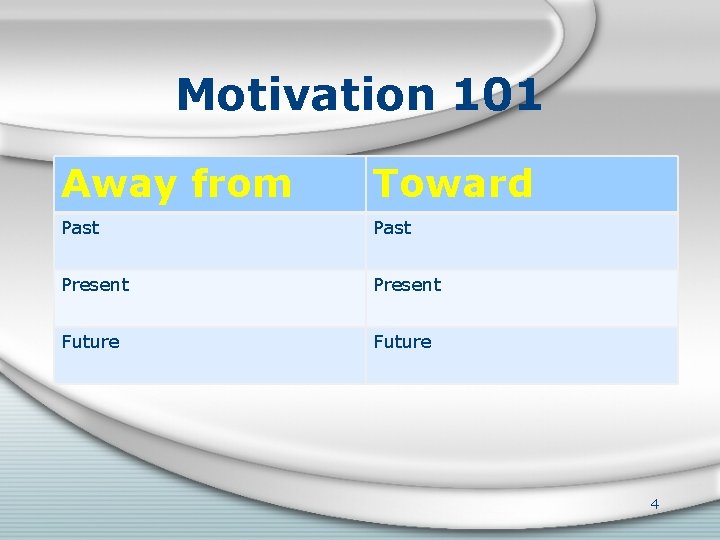
Motivation 101 Away from Toward Past Present Future 4
Method 1 Small Steps 5
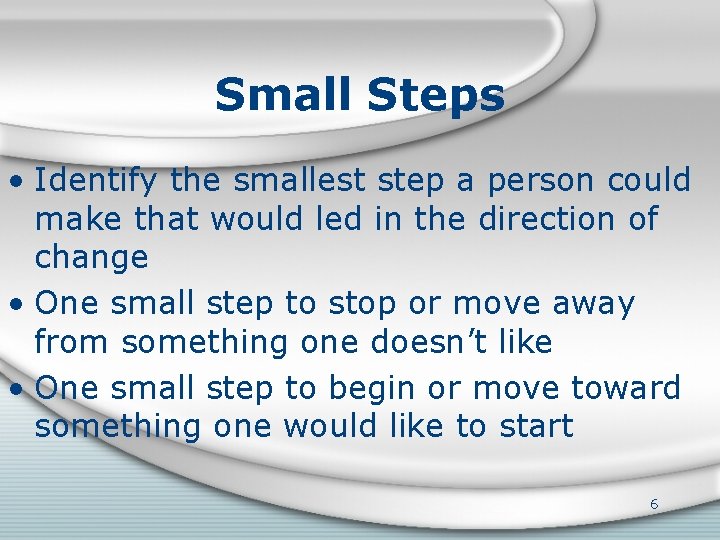
Small Steps • Identify the smallest step a person could make that would led in the direction of change • One small step to stop or move away from something one doesn’t like • One small step to begin or move toward something one would like to start 6
Method 2 Change Patterns 7
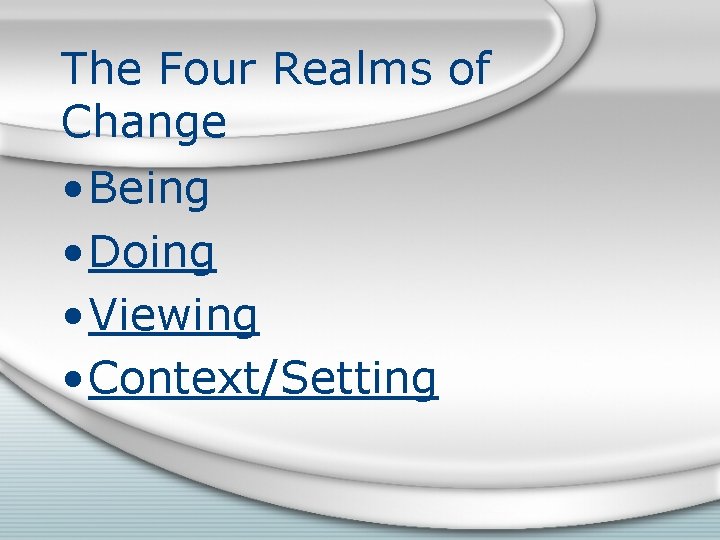
The Four Realms of Change • Being • Doing • Viewing • Context/Setting
VALUING/VALIDATION BEING
Accept and acknowledge the person, not all their actions
CHANGE THE DOING
Change: Actions Interactions Speaking
CHANGE THE VIEWING
Maya Angelou Change the viewing
Change: Focus of attention Meanings
Change views • Discover what the person is attending to typically in the problem situation • Find out what meanings they attribute in the problem situation – – What causes it? intentions others have? it means about them and their future will solve it? • Suggest other possibilities for focusing attention and alternate meanings • Tell stories to help shift views
CHANGE THE CONTEXT
Change: Locations Timing/time Associations Biochemistry Neurology Physiology
Discovering the “doing” of the problem • Investigate how the person “does” anything related to the problem (Action/interaction/speaking/location/timing aspects) • How could the person make the problem better or worse? • If they could teach you or someone else to experience or create this problem, how would they do that?
Identify and change patterns • Discover what recurs again and again in the problem situation • Find out what parts of that the person or others around them can change • Suggest small changes to disrupt or change the pattern • Tell stories to seed the possibility of change and to enhance motivation and positive expectation
Method 3 The Crisis/Breakdown Method 21
Crisis/Breakdown When you discover you are riding a dead horse, the best strategy is to dismount. -Dakota Tribal saying
Crisis/Breakdown Method Sometimes we climb the ladder all the way to the top, only to discover that we have placed it against the wrong wall. Joseph Campbell
Resilience From Post-Traumatic Stress to Post-Traumatic Success
Trauma and our ideas about it “Resilience is often the most commonly observed outcome trajectory following exposure to a potentially traumatic event. ” [G. A. Bonnano, C. Rennicke and S. Dekel, (2005) “Selfenhancement among high-exposure survivors of the September 11 th Terrorist Attack: Resilience or Social Maladjustment? ” Journal of Personality and Social Psychology, 88: 984 -988. ]
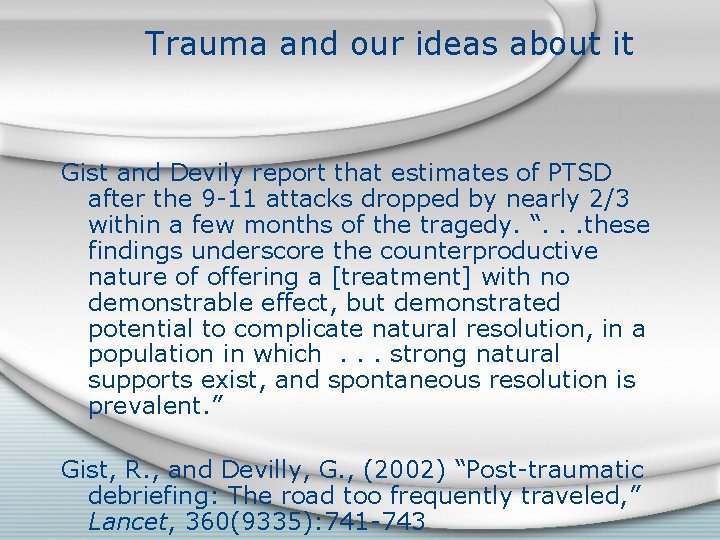
Trauma and our ideas about it Gist and Devily report that estimates of PTSD after the 9 -11 attacks dropped by nearly 2/3 within a few months of the tragedy. “. . . these findings underscore the counterproductive nature of offering a [treatment] with no demonstrable effect, but demonstrated potential to complicate natural resolution, in a population in which. . . strong natural supports exist, and spontaneous resolution is prevalent. ” Gist, R. , and Devilly, G. , (2002) “Post-traumatic debriefing: The road too frequently traveled, ” Lancet, 360(9335): 741 -743
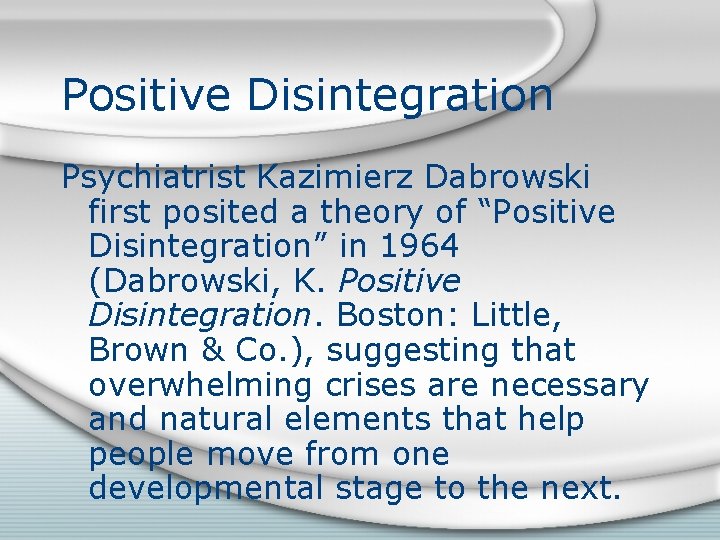
Positive Disintegration Psychiatrist Kazimierz Dabrowski first posited a theory of “Positive Disintegration” in 1964 (Dabrowski, K. Positive Disintegration. Boston: Little, Brown & Co. ), suggesting that overwhelming crises are necessary and natural elements that help people move from one developmental stage to the next.
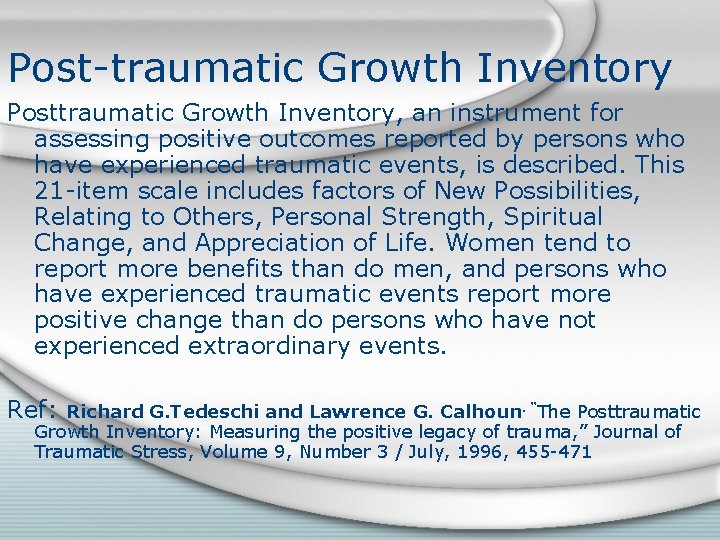
Post-traumatic Growth Inventory Posttraumatic Growth Inventory, an instrument for assessing positive outcomes reported by persons who have experienced traumatic events, is described. This 21 -item scale includes factors of New Possibilities, Relating to Others, Personal Strength, Spiritual Change, and Appreciation of Life. Women tend to report more benefits than do men, and persons who have experienced traumatic events report more positive change than do persons who have not experienced extraordinary events. Ref: Richard G. Tedeschi and Lawrence G. Calhoun. “The Posttraumatic Growth Inventory: Measuring the positive legacy of trauma, ” Journal of Traumatic Stress, Volume 9, Number 3 / July, 1996, 455 -471
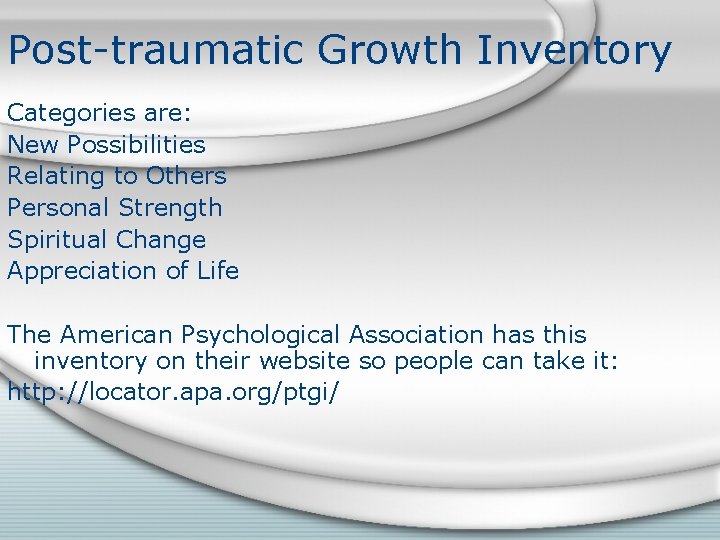
Post-traumatic Growth Inventory Categories are: New Possibilities Relating to Others Personal Strength Spiritual Change Appreciation of Life The American Psychological Association has this inventory on their website so people can take it: http: //locator. apa. org/ptgi/
Post-traumatic Growth Inventory Sample statements; rate on a scale of 1 -5 how much the trauma or crisis led to this: I established a new path for my life. I know better that I can handle difficulties. I changed my priorities about what is important in life. New opportunities are available which wouldn't have been otherwise. I have more compassion for others. I discovered that I'm stronger than I thought I was. I have a greater sense of closeness with others.
Positive consequences of traumatic experiences New perceptions of oneself Feeling stronger and more self-assured Increased self-reliance Gains in recognizing and appreciating one’s own vulnerability Change in relationships with others Closer family ties Greater appreciation of significant others Greater self-disclosure and emotional expressiveness Changed philosophy of life Taking things easier Knowing what is truly important Greater spirituality
The 3 crucial elements of posttraumatic success • Connection • Compassion • Contribution
Initial disconnection is normal • But if it persists, then PTSD often ensues • Discover natural places or ways of connection • Help people reconnect or connect in places or ways they haven’t before
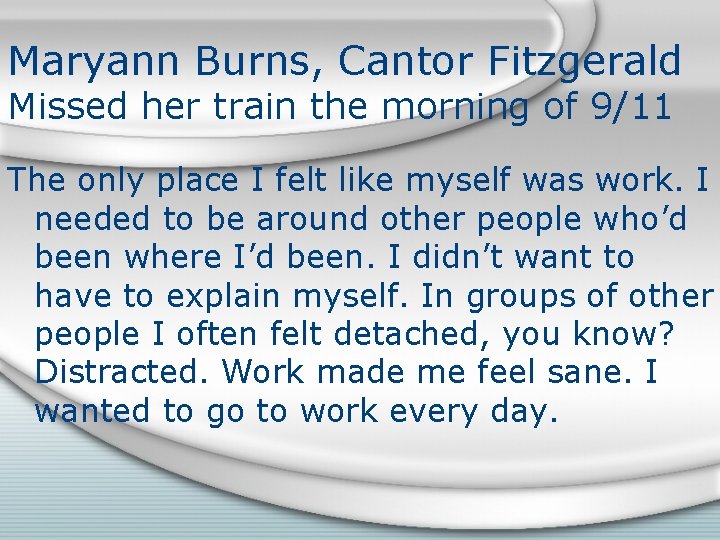
Maryann Burns, Cantor Fitzgerald Missed her train the morning of 9/11 The only place I felt like myself was work. I needed to be around other people who’d been where I’d been. I didn’t want to have to explain myself. In groups of other people I often felt detached, you know? Distracted. Work made me feel sane. I wanted to go to work every day.
Connecting with self and transforming trauma There is a way to turn tragedy, wounds, hurts and disrespect into life/career direction and good in the world 35
The Four Soul Signals Blissed/Blessed Or Dissed/Pissed
The Four Signals Wounded/Cursed/ Disrepected [Dissed]
Dissed Patsy Rodenberg Voice coach for actors and public speakers
Dissed Ken Tucker Rock and Movie Critic
Dissed and Pissed Sidney Poitier Actor
Wounded Leonard Cohen: There’s a crack in everything. That’s how the light gets in.
Ann Rice Daughter who died of leukemia at 5. Rice wrote a novel that featured a 5 -year-old who could never die. (Interview with a Vampire)
The Key Transforming the “negative” energy of anger and hurts into positive energy
Wounded/Disrespected We all leave childhood with wounds. In time we may transform our liabilities into gifts. The faults that pockmark the psyche may become the source of a man or a woman’s beauty. The injuries we have suffered invite us to assume the most human of all vocations—to heal ourselves and others. –Sam Keen
Andrew Vachss 45
Pissed Righteous indignation/dissatisfaction • What would you talk about if given an hour of prime television to influence the nation or the world? • What pisses you off that you would like to correct in the world or other people? • What can’t you sit still for?
Wounded/Cursed/Indignation to Life/Career Direction • Where were you (or someone else) pissed on that pissed you off? • Where have you been wounded? • Where or about what have you been cursed? • How can you turn this wound or disrespect or curse into a blessing or contribution?
Permission to use This Powerpoint presentation was created by Bill O’Hanlon © 2011. You have my permission to use it for non-commercial purposes (like sharing it with your colleagues or studying it yourself). If you want to use it in any commercial (money-making) activities, please contact me for permission and discussion.
Bill O’Hanlon’s info Websites: http: //www. billohanlon. com http: //www. Publishinga. Book. com http: //www. Paid. Public. Speaker. com Email: Possi. Bill@aol. com 49
Contact information Bill O’Hanlon, M. S. , LMFT Possibilities 223 N. Guadalupe #278 Santa Fe, NM 87501 USA Possi. Bill@aol. com www. billohanlon. com