
Shielding Design for the Electron Beam Dump for
Shielding Design for the Electron Beam Dump for TARLA Linac Using FLUKA Dr. Haris Ðapo Ankara University Institute of Accelerator Technologies, TARLA
Outline Beam dump design Collimator design Bremsstrahlung targets design Questions and future Feb 28, 2020 H. Ðapo, Nuclear Physics @ TARLA 2

Electron Beam Dump position Basic Parameters: ● The available space has a rectangular shape with dimensions of: 200 cm L x 120 cm W x 200 cm H ● Beam energy range: 4 - 45 Me. V (for simulation 50 Me. V was used) ●Beam current is 1. 6 m. A ●Delivered Power max 80 k. W ● Two type of simulation: 1. with e-beam falling on bremsstrahlung target and than being bent towards the beam dump or 2. with an e-beam pointed directly onto the target with 100 mrad opening ● For simulation 1 month of continuous beam was used Questions: ● material to be used (the BD should not melt) ● equivalent dose distribution ● how to shield the BD
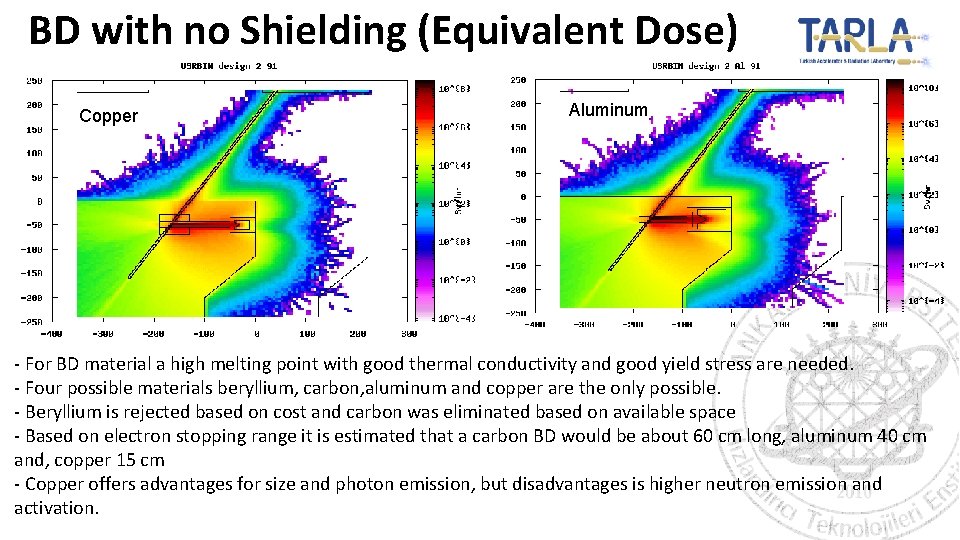
BD with no Shielding (Equivalent Dose) Copper Aluminum - For BD material a high melting point with good thermal conductivity and good yield stress are needed. - Four possible materials beryllium, carbon, aluminum and copper are the only possible. - Beryllium is rejected based on cost and carbon was eliminated based on available space - Based on electron stopping range it is estimated that a carbon BD would be about 60 cm long, aluminum 40 cm and, copper 15 cm - Copper offers advantages for size and photon emission, but disadvantages is higher neutron emission and activation.
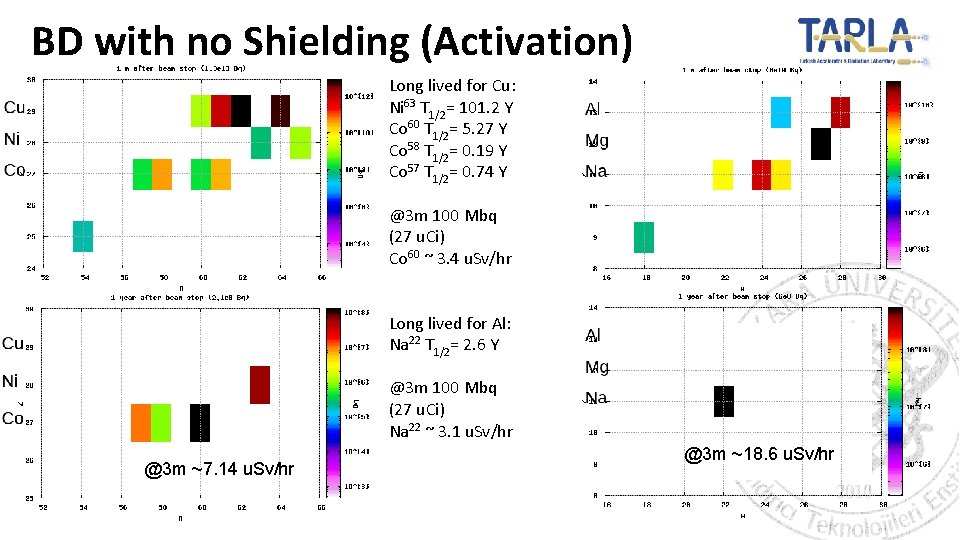
BD with no Shielding (Activation) Long lived for Cu: Ni 63 T 1/2= 101. 2 Y Co 60 T 1/2= 5. 27 Y Co 58 T 1/2= 0. 19 Y Co 57 T 1/2= 0. 74 Y @3 m 100 Mbq (27 u. Ci) Co 60 ~ 3. 4 u. Sv/hr Long lived for Al: Na 22 T 1/2= 2. 6 Y @3 m 100 Mbq (27 u. Ci) Na 22 ~ 3. 1 u. Sv/hr @3 m ~7. 14 u. Sv/hr @3 m ~18. 6 u. Sv/hr
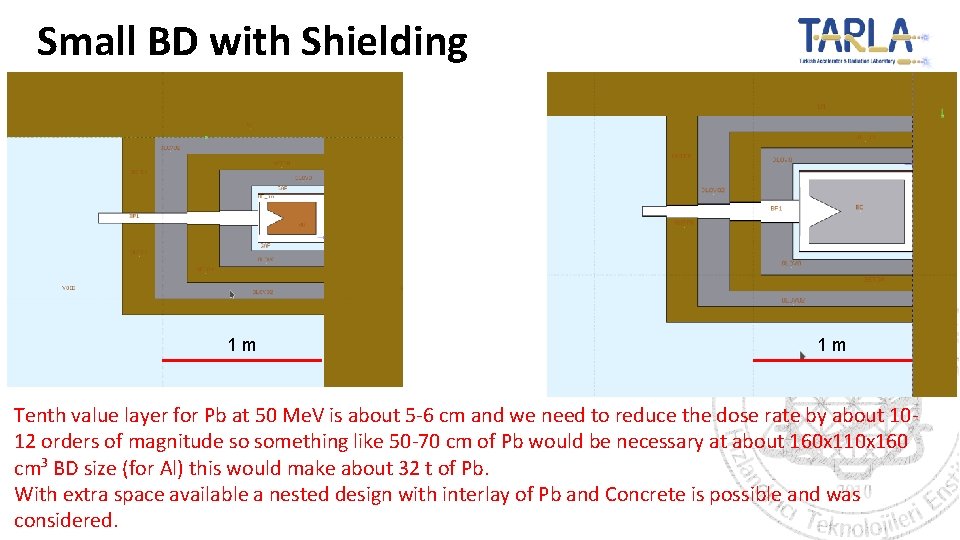
Small BD with Shielding 1 m 1 m Tenth value layer for Pb at 50 Me. V is about 5 -6 cm and we need to reduce the dose rate by about 1012 orders of magnitude so something like 50 -70 cm of Pb would be necessary at about 160 x 110 x 160 cm 3 BD size (for Al) this would make about 32 t of Pb. With extra space available a nested design with interlay of Pb and Concrete is possible and was considered.
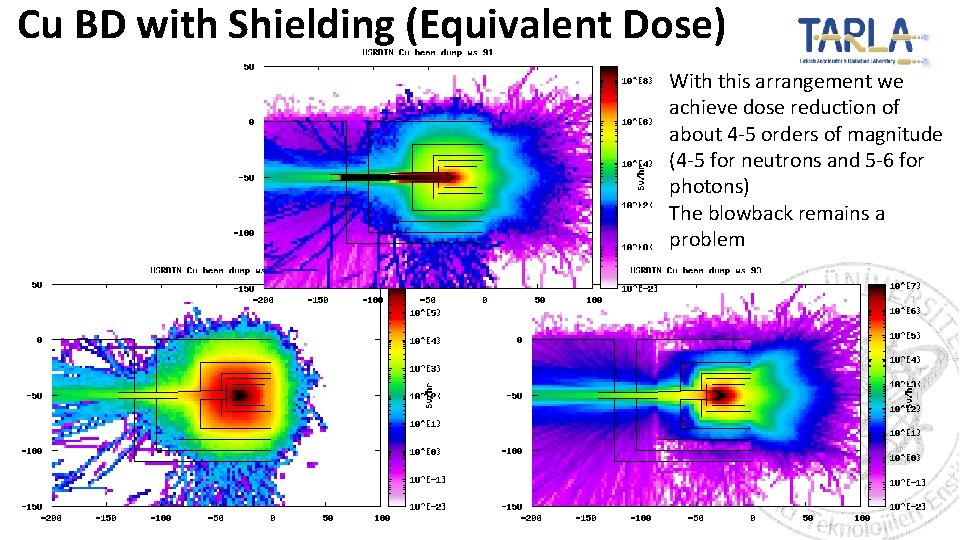
Cu BD with Shielding (Equivalent Dose) With this arrangement we achieve dose reduction of about 4 -5 orders of magnitude (4 -5 for neutrons and 5 -6 for photons) The blowback remains a problem
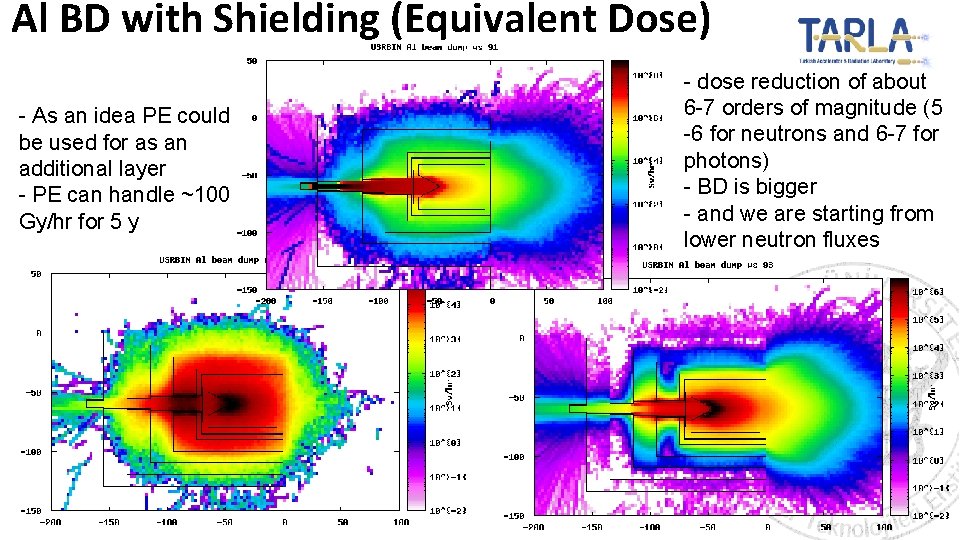
Al BD with Shielding (Equivalent Dose) - As an idea PE could be used for as an additional layer - PE can handle ~100 Gy/hr for 5 y - dose reduction of about 6 -7 orders of magnitude (5 -6 for neutrons and 6 -7 for photons) - BD is bigger - and we are starting from lower neutron fluxes
Conclusions - Both Cu and Al are viable choices for the e-BD - Both Cu and Al e-BD would fit in the available space - Al has slightly better neutron performance and produces shorter lived radio-nucleides - Cu is smaller and has better photon performance - Thermal properties are crucial for final decision (also cost) - Preliminary thermal simulations indicate that Al can be cooled (Worst case scenario: 80 k. W of power with σ=75 mm was all deposited on the surface of BD. ) - Cu thermal simulation was not done due to issue as to where to place the cooling (i. e. the height and width would be larger than depth making the side cooling less practical)
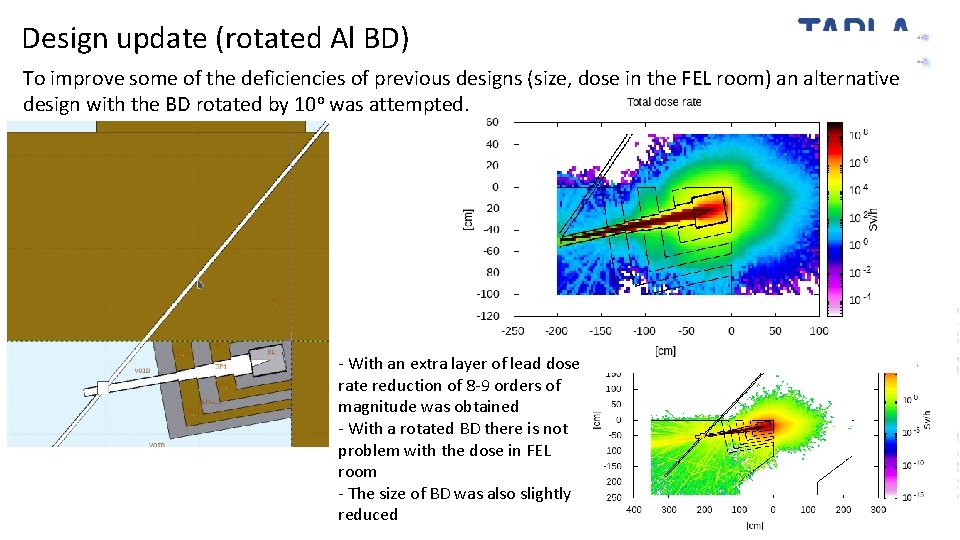
Design update (rotated Al BD) To improve some of the deficiencies of previous designs (size, dose in the FEL room) an alternative design with the BD rotated by 10 o was attempted. - With an extra layer of lead dose rate reduction of 8 -9 orders of magnitude was obtained - With a rotated BD there is not problem with the dose in FEL room - The size of BD was also slightly reduced
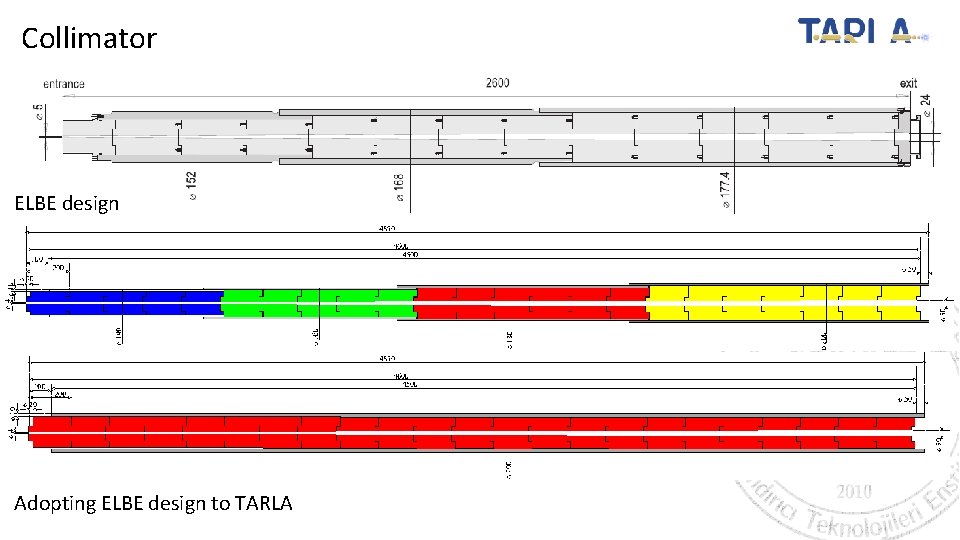
Collimator ELBE design Adopting ELBE design to TARLA
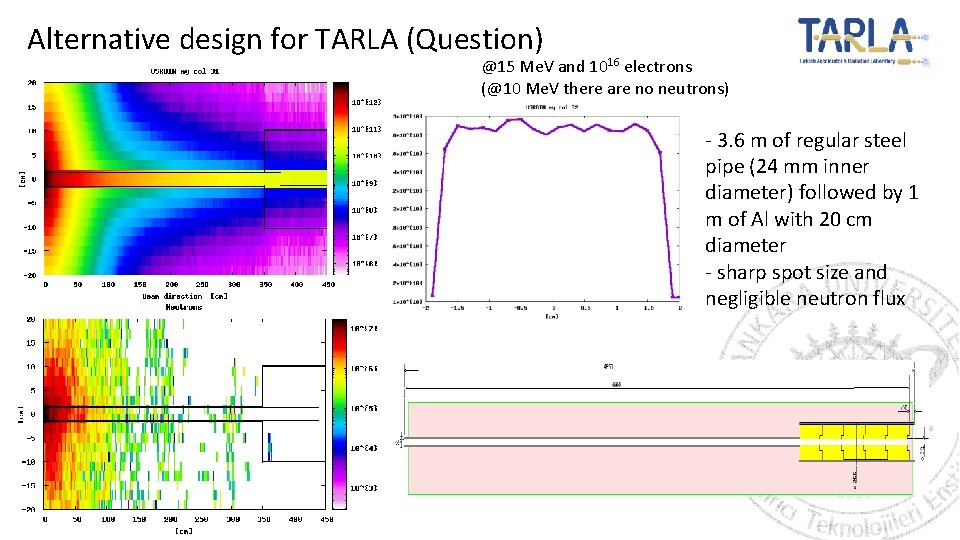
Alternative design for TARLA (Question) @15 Me. V and 1016 electrons (@10 Me. V there are no neutrons) - 3. 6 m of regular steel pipe (24 mm inner diameter) followed by 1 m of Al with 20 cm diameter - sharp spot size and negligible neutron flux
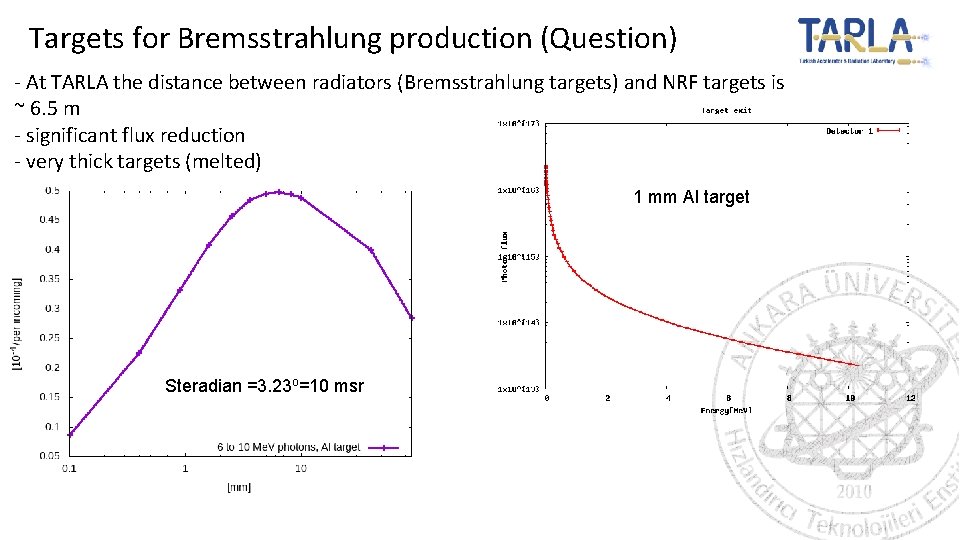
Targets for Bremsstrahlung production (Question) - At TARLA the distance between radiators (Bremsstrahlung targets) and NRF targets is ~ 6. 5 m - significant flux reduction - very thick targets (melted) 1 mm Al target Steradian =3. 23 o=10 msr
- Slides: 13