
Shield simulation for 10 kg detector Felice Dipace



- Slides: 29
Shield simulation for 10 kg detector Felice Dipace, Valerio Gentile, Giuliana Galati NEWSdm Collaboration Meeting, LNGS, 14/02/2018 1
Summary • Aim • External background characterization • Neutron shielding • Simulation set up • One material simulations • Two materials simulations 2
Aim of this work • Aim: to design neutron shield to minimize the neutroninduced track in the NIT that can simulate a WIMP signal. • In particular we are studing the shield size parameters and the effects of different materials to build a shield that let’s to have less than (1 bkg track)/(10 kg*y). • To make this study we use Geant 4 simulation program. • Physics list used to simulate neutrons interaction: QGSP_BIC_HP. • Optimization performed on muon-induced neutron because of their harder spectrum. 3
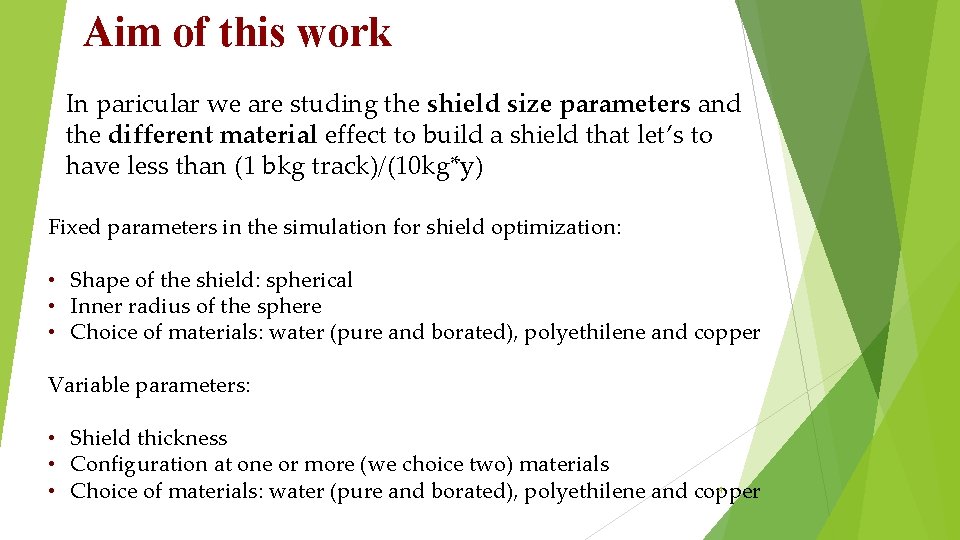
Aim of this work In paricular we are studing the shield size parameters and the different material effect to build a shield that let’s to have less than (1 bkg track)/(10 kg*y) Fixed parameters in the simulation for shield optimization: • Shape of the shield: spherical • Inner radius of the sphere • Choice of materials: water (pure and borated), polyethilene and copper Variable parameters: • Shield thickness • Configuration at one or more (we choice two) materials • Choice of materials: water (pure and borated), polyethilene and copper 4
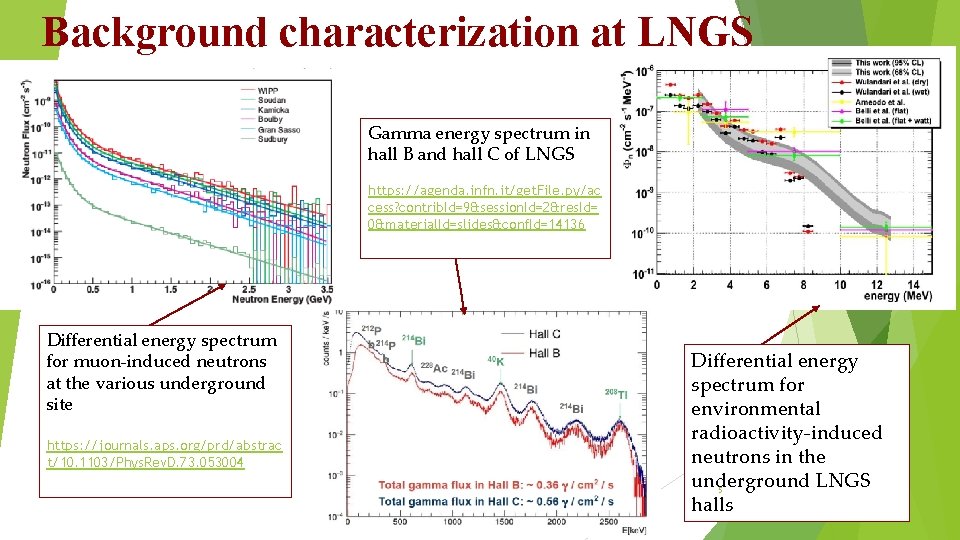
Background characterization at LNGS Gamma energy spectrum in hall B and hall C of LNGS https: //agenda. infn. it/get. File. py/ac cess? contrib. Id=9&session. Id=2&res. Id= 0&material. Id=slides&conf. Id=14136 Differential energy spectrum for muon-induced neutrons at the various underground site https: //journals. aps. org/prd/abstrac t/10. 1103/Phys. Rev. D. 73. 053004 Differential energy spectrum for environmental radioactivity-induced neutrons in the underground LNGS 5 halls
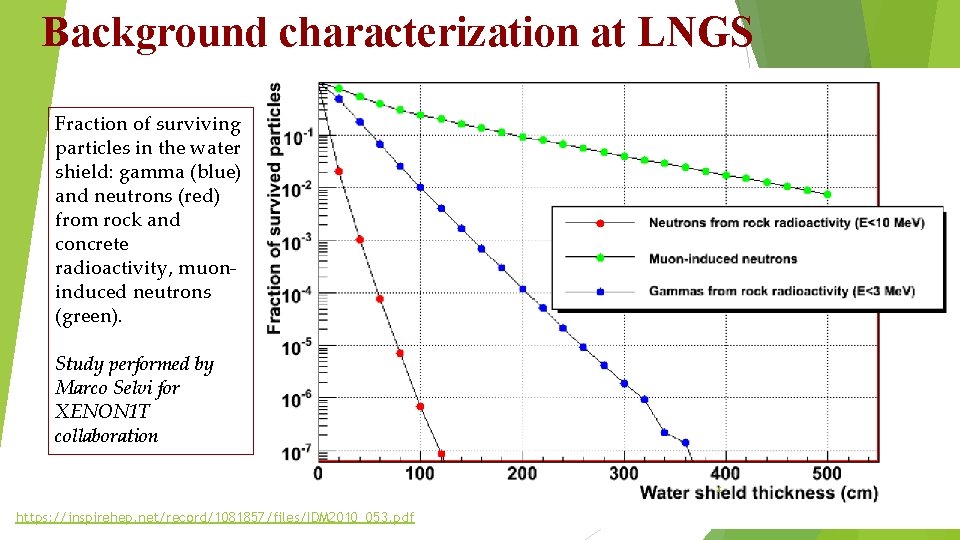
Background characterization at LNGS Fraction of surviving particles in the water shield: gamma (blue) and neutrons (red) from rock and concrete radioactivity, muoninduced neutrons (green). Study performed by Marco Selvi for XENON 1 T collaboration 6 https: //inspirehep. net/record/1081857/files/IDM 2010_053. pdf
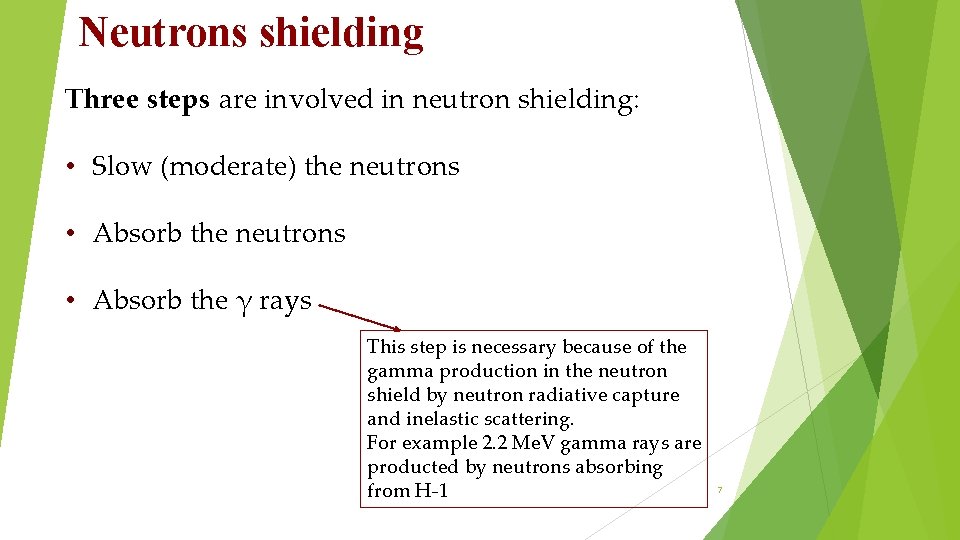
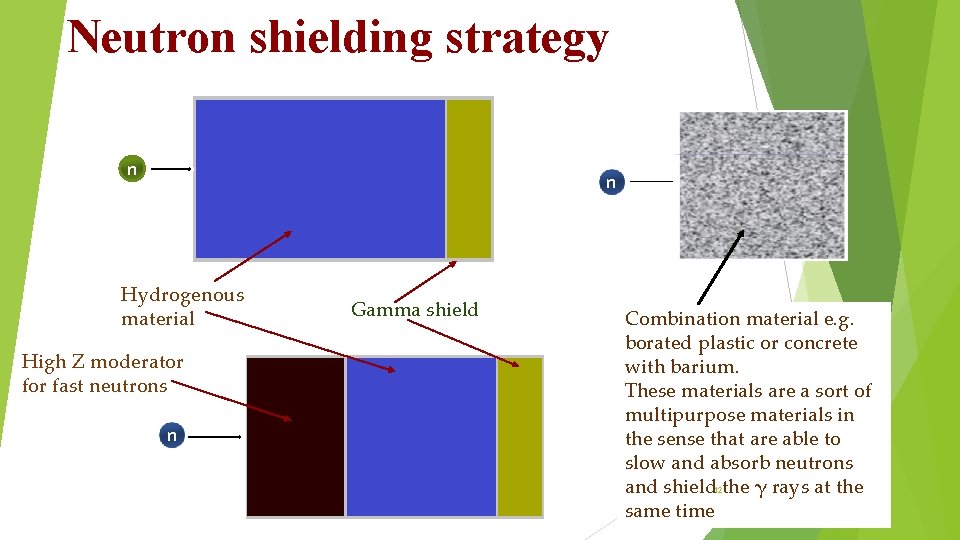
Neutrons shielding Three steps are involved in neutron shielding: • Slow (moderate) the neutrons • Absorb the γ rays This step is necessary because of the gamma production in the neutron shield by neutron radiative capture and inelastic scattering. For example 2. 2 Me. V gamma rays are producted by neutrons absorbing from H-1 7
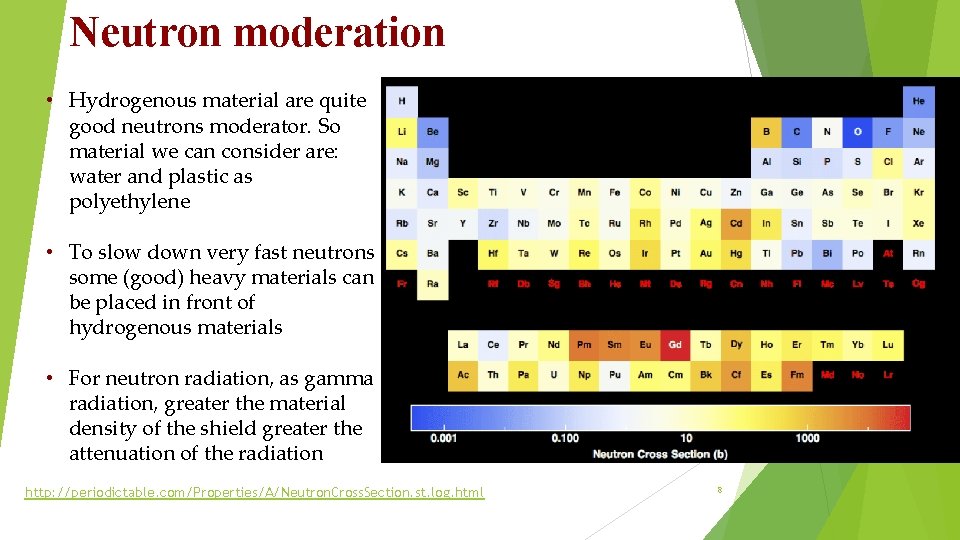
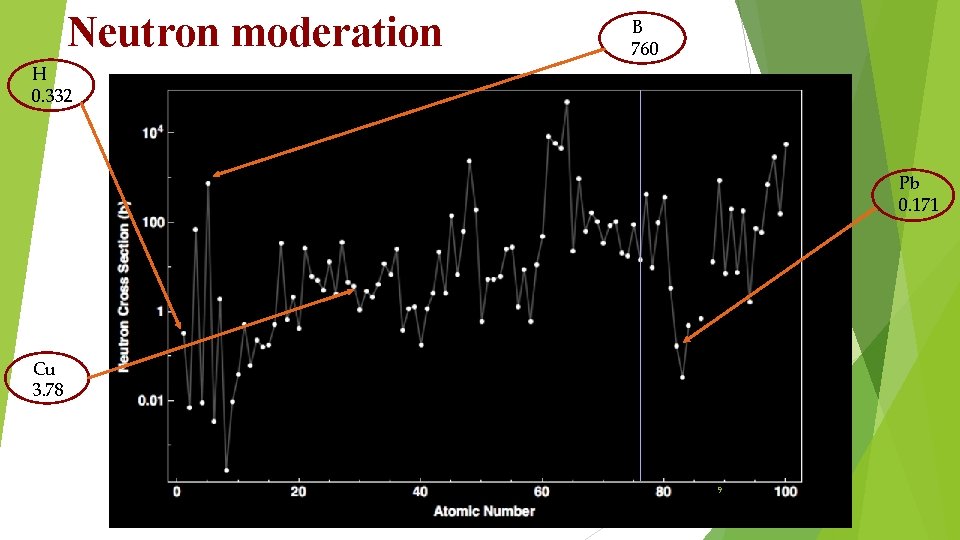
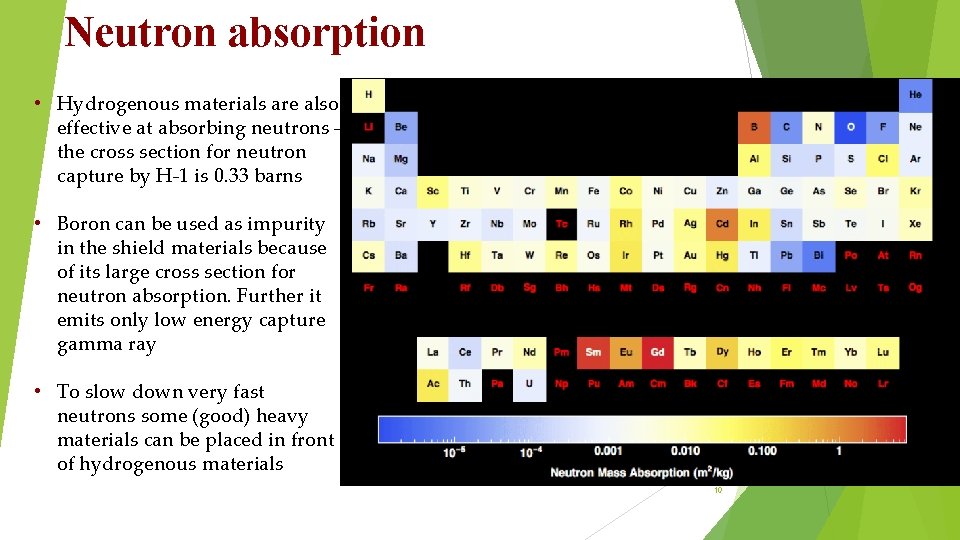
Neutron moderation • Hydrogenous material are quite good neutrons moderator. So material we can consider are: water and plastic as polyethylene • To slow down very fast neutrons some (good) heavy materials can be placed in front of hydrogenous materials • For neutron radiation, as gamma radiation, greater the material density of the shield greater the attenuation of the radiation http: //periodictable. com/Properties/A/Neutron. Cross. Section. st. log. html 8
Neutron moderation B 760 H 0. 332 Pb 0. 171 Cu 3. 78 9
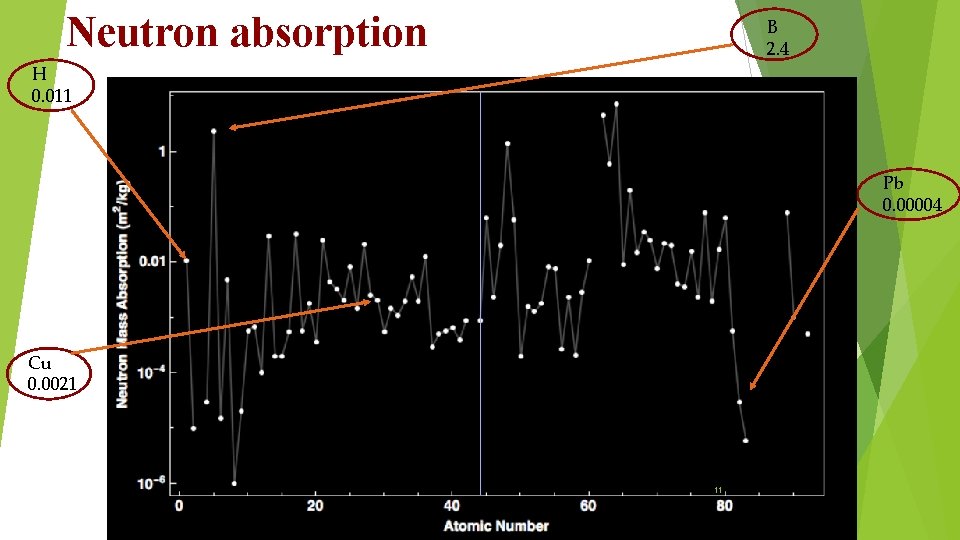
Neutron absorption • Hydrogenous materials are also effective at absorbing neutrons the cross section for neutron capture by H-1 is 0. 33 barns • Boron can be used as impurity in the shield materials because of its large cross section for neutron absorption. Further it emits only low energy capture gamma ray • To slow down very fast neutrons some (good) heavy materials can be placed in front of hydrogenous materials 10
Neutron absorption B 2. 4 H 0. 011 Pb 0. 00004 Cu 0. 0021 11
Neutron shielding strategy n n Hydrogenous material High Z moderator fast neutrons n Gamma shield Combination material e. g. borated plastic or concrete with barium. These materials are a sort of multipurpose materials in the sense that are able to slow and absorb neutrons and shield 12 the γ rays at the same time
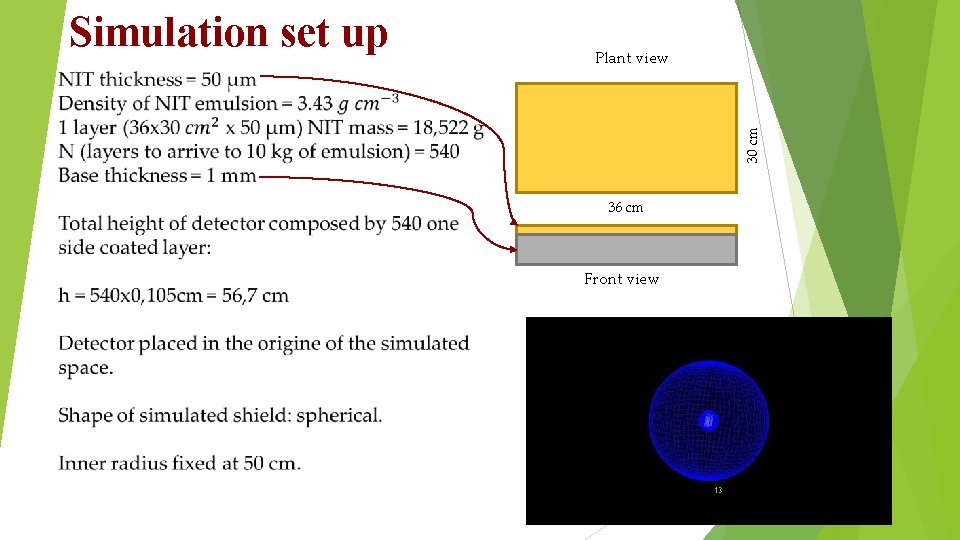
Plant view 30 cm Simulation set up 36 cm Front view 13
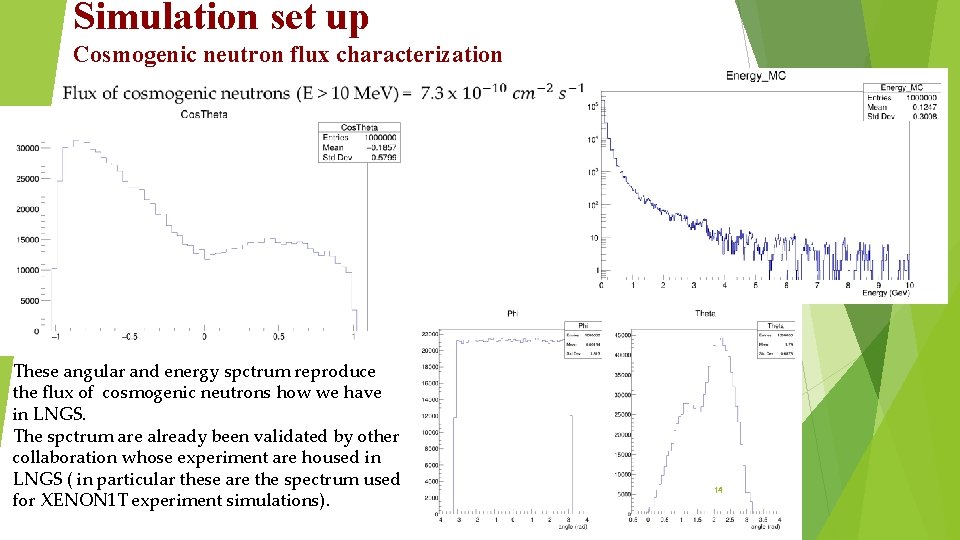
Simulation set up Cosmogenic neutron flux characterization These angular and energy spctrum reproduce the flux of cosmogenic neutrons how we have in LNGS. The spctrum are already been validated by other collaboration whose experiment are housed in LNGS ( in particular these are the spectrum used for XENON 1 T experiment simulations). 14
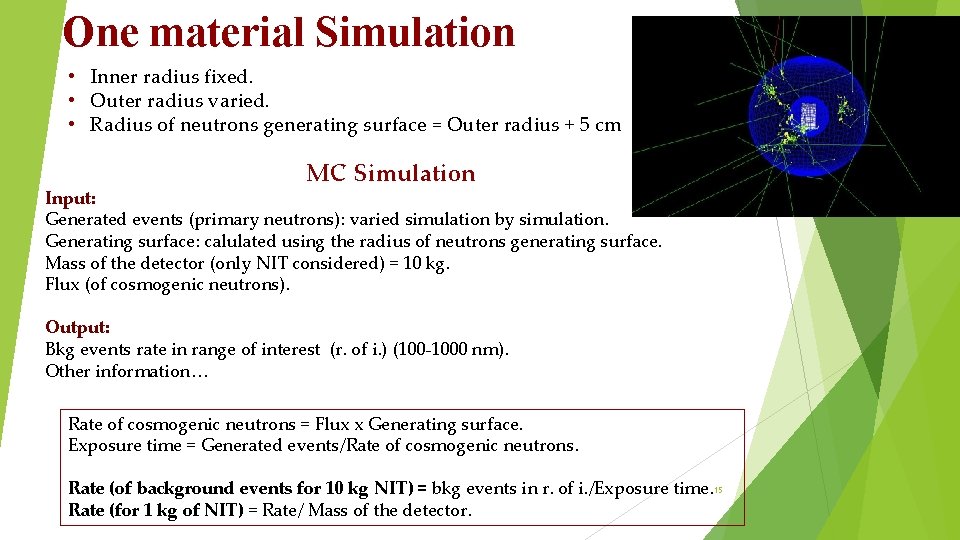
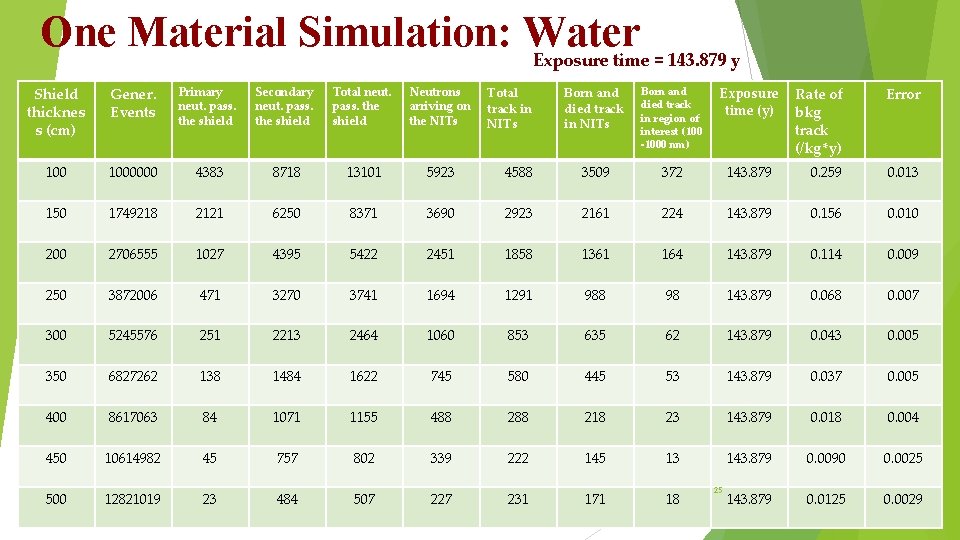
One material Simulation • Inner radius fixed. • Outer radius varied. • Radius of neutrons generating surface = Outer radius + 5 cm MC Simulation Input: Generated events (primary neutrons): varied simulation by simulation. Generating surface: calulated using the radius of neutrons generating surface. Mass of the detector (only NIT considered) = 10 kg. Flux (of cosmogenic neutrons). Output: Bkg events rate in range of interest (r. of i. ) (100 -1000 nm). Other information… Rate of cosmogenic neutrons = Flux x Generating surface. Exposure time = Generated events/Rate of cosmogenic neutrons. Rate (of background events for 10 kg NIT) = bkg events in r. of i. /Exposure time. 15 Rate (for 1 kg of NIT) = Rate/ Mass of the detector.
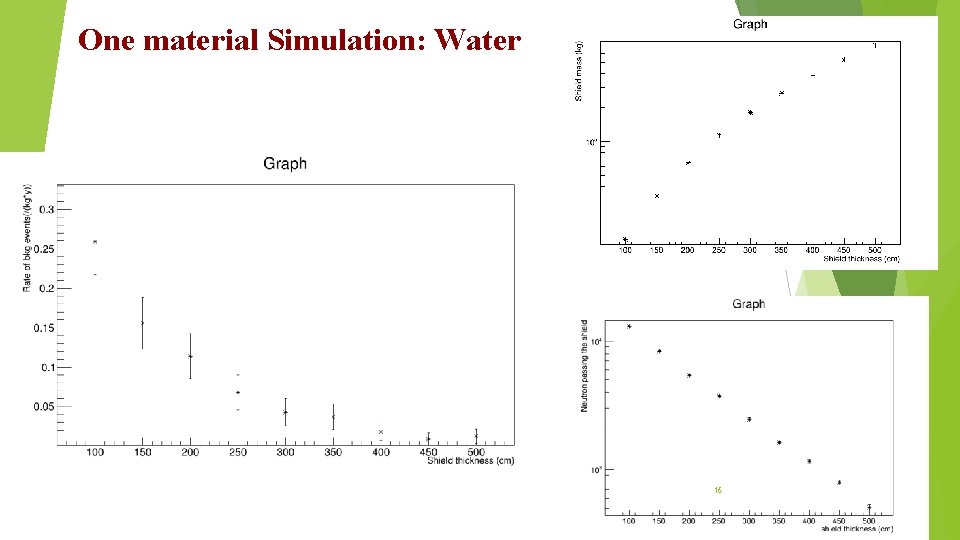
One material Simulation: Water 16
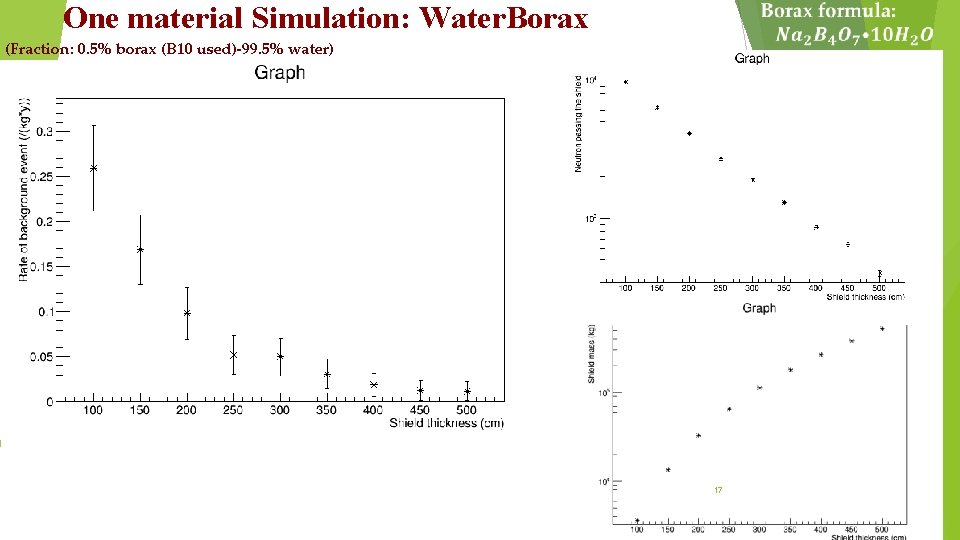
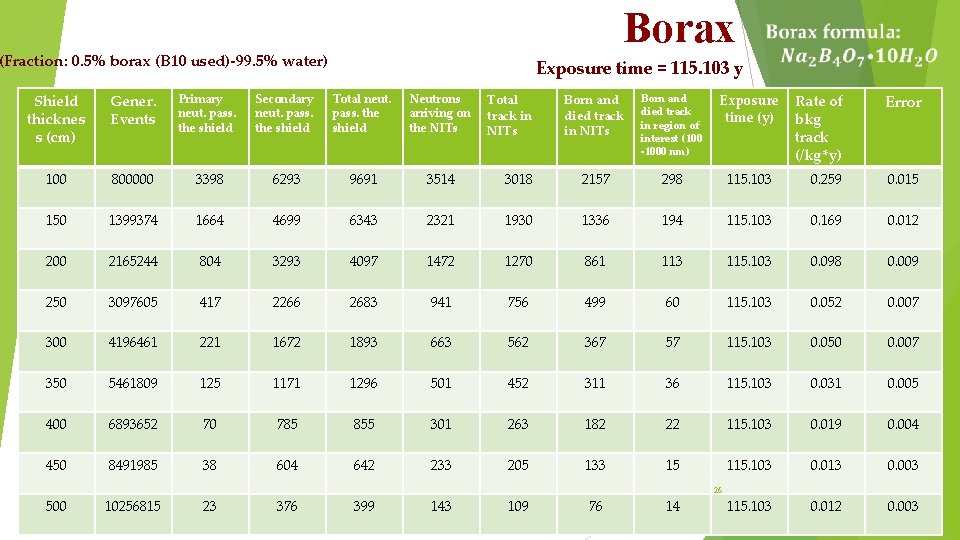
One material Simulation: Water. Borax (Fraction: 0. 5% borax (B 10 used)-99. 5% water) 17
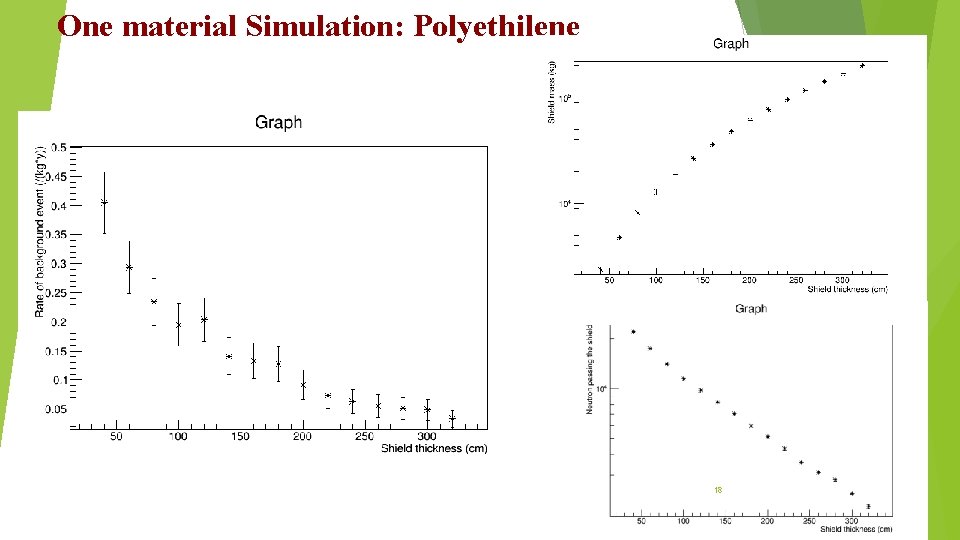
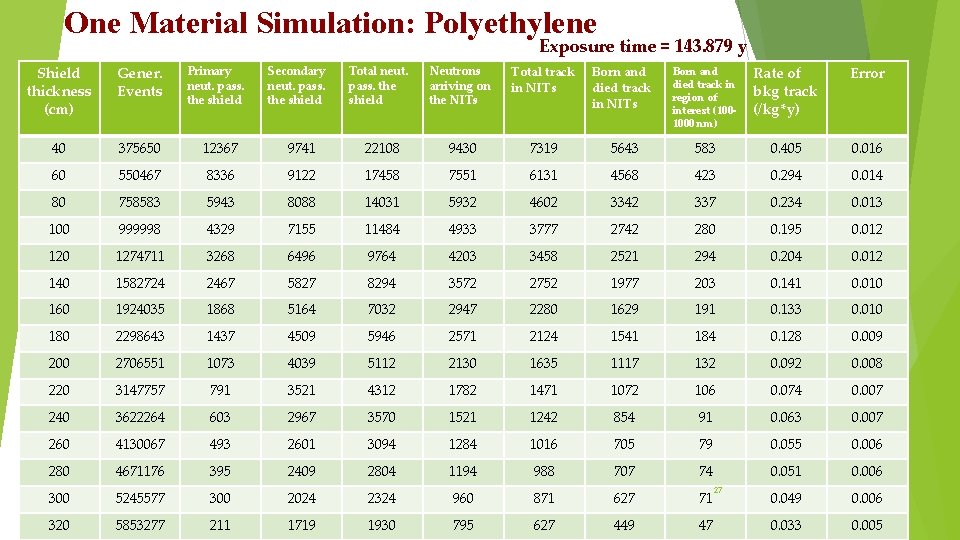
One material Simulation: Polyethilene 18
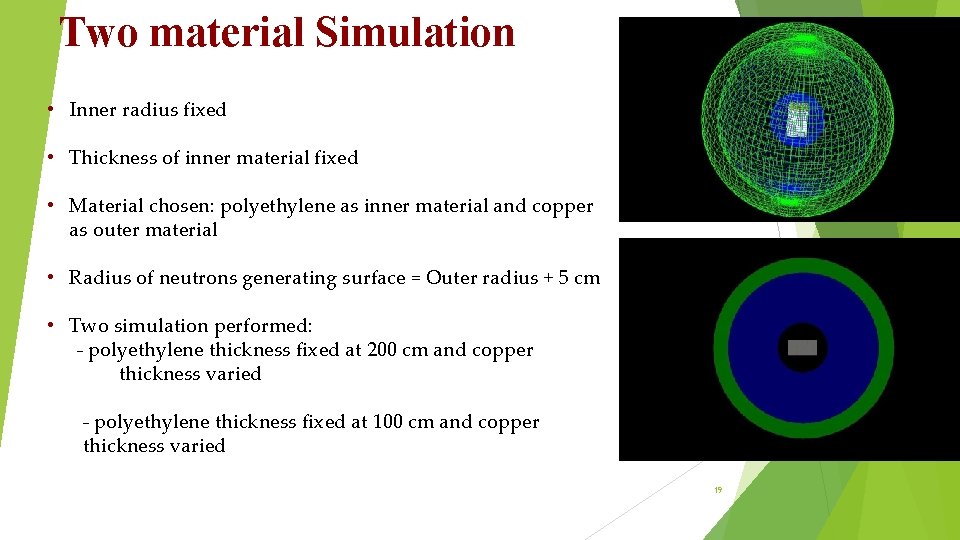
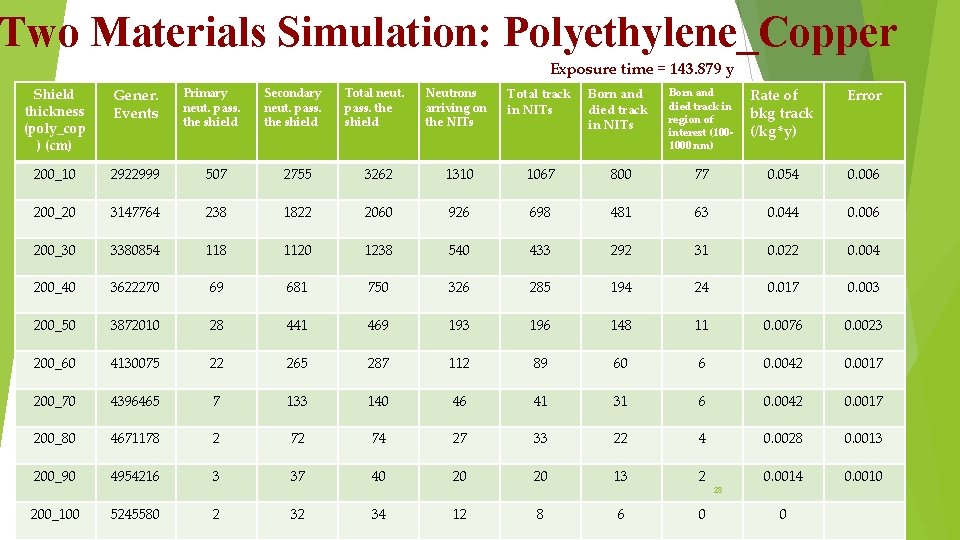
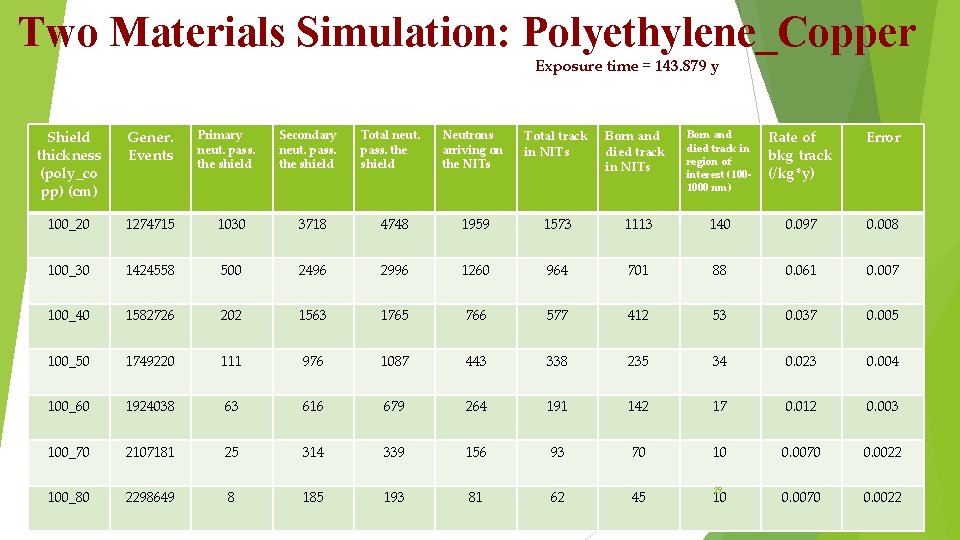
Two material Simulation • Inner radius fixed • Thickness of inner material fixed • Material chosen: polyethylene as inner material and copper as outer material • Radius of neutrons generating surface = Outer radius + 5 cm • Two simulation performed: - polyethylene thickness fixed at 200 cm and copper thickness varied - polyethylene thickness fixed at 100 cm and copper thickness varied 19
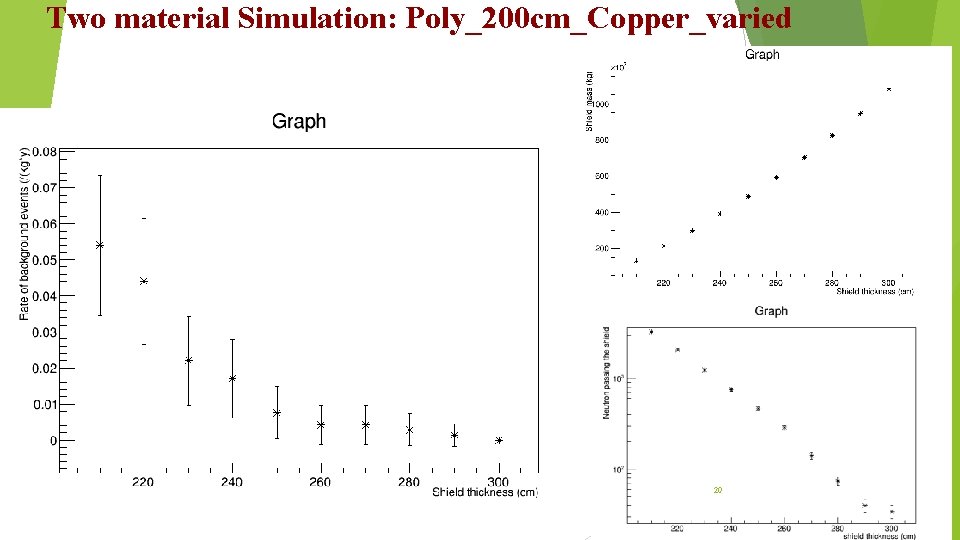
Two material Simulation: Poly_200 cm_Copper_varied 20
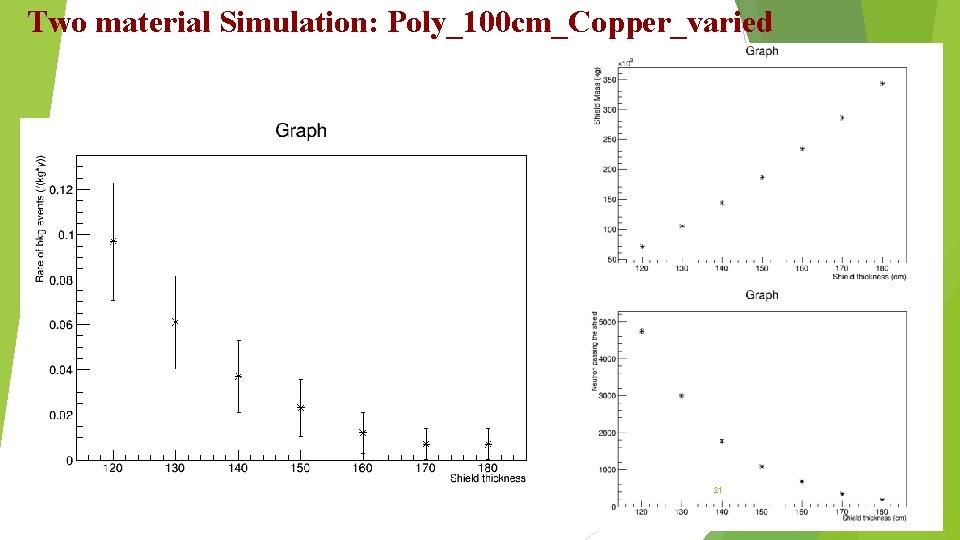
Two material Simulation: Poly_100 cm_Copper_varied 21
Future Work • Cross-checks on gamma rays produced by absorbed neutrons • Cross-checks on environmental radioactivity-induced gamma and neutrons • Cross-checks on muon-induced neutrons in the shield 22
Thank you 23
Back-up Tables 24
One Material Simulation: Water Exposure time = 143. 879 y Shield thicknes s (cm) Gener. Events Primary neut. pass. the shield Secondary neut. pass. the shield Total neut. pass. the shield Neutrons arriving on the NITs Rate of bkg track (/kg*y) Error 1000000 4383 8718 13101 5923 143. 879 0. 259 0. 013 150 1749218 2121 6250 8371 224 143. 879 0. 156 0. 010 200 2706555 1027 4395 1361 164 143. 879 0. 114 0. 009 250 3872006 471 1291 988 98 143. 879 0. 068 0. 007 300 5245576 1060 853 635 62 143. 879 0. 043 0. 005 350 1622 745 580 445 53 143. 879 0. 037 0. 005 1071 1155 488 218 23 143. 879 0. 018 0. 004 45 757 802 339 222 145 13 143. 879 0. 0090 0. 0025 23 484 507 227 231 171 18 143. 879 0. 0125 0. 0029 Born and died track in NITs Born and died track in region of interest (100 -1000 nm) Exposure time (y) 4588 3509 372 3690 2923 2161 5422 2451 1858 3270 3741 1694 251 2213 2464 6827262 138 1484 400 8617063 84 450 10614982 500 12821019 Total track in NITs 25
Borax (Fraction: 0. 5% borax (B 10 used)-99. 5% water) Exposure time = 115. 103 y Rate of bkg track (/kg*y) Error 115. 103 0. 259 0. 015 194 115. 103 0. 169 0. 012 861 113 115. 103 0. 098 0. 009 756 499 60 115. 103 0. 052 0. 007 663 562 367 57 115. 103 0. 050 0. 007 1296 501 452 311 36 115. 103 0. 031 0. 005 785 855 301 263 182 22 115. 103 0. 019 0. 004 642 233 205 133 15 115. 103 0. 013 0. 003 115. 103 0. 012 0. 003 Shield thicknes s (cm) Gener. Events Primary neut. pass. the shield Secondary neut. pass. the shield Total neut. pass. the shield Neutrons arriving on the NITs 100 800000 3398 6293 9691 3514 150 1399374 1664 4699 6343 200 2165244 804 3293 250 3097605 417 300 4196461 350 Born and died track in NITs Born and died track in region of interest (100 -1000 nm) Exposure time (y) 3018 2157 298 2321 1930 1336 4097 1472 1270 2266 2683 941 221 1672 1893 5461809 125 1171 400 6893652 70 450 8491985 38 Total track in NITs 26 500 10256815 23 376 399 143 109 76 14
One Material Simulation: Polyethylene Exposure time = 143. 879 y Shield thickness (cm) Gener. Events Born and died track in region of interest (1001000 nm) Rate of bkg track (/kg*y) Error 40 375650 12367 5643 583 0. 405 0. 016 60 550467 6131 4568 423 0. 294 0. 014 80 5932 4602 3342 337 0. 234 0. 013 11484 4933 3777 2742 280 0. 195 0. 012 6496 9764 4203 3458 2521 294 0. 204 0. 012 2467 5827 8294 3572 2752 1977 203 0. 141 0. 010 1924035 1868 5164 7032 2947 2280 1629 191 0. 133 0. 010 180 2298643 1437 4509 5946 2571 2124 1541 184 0. 128 0. 009 200 2706551 1073 4039 5112 2130 1635 1117 132 0. 092 0. 008 220 3147757 791 3521 4312 1782 1471 1072 106 0. 074 0. 007 240 3622264 603 2967 3570 1521 1242 854 91 0. 063 0. 007 260 4130067 493 2601 3094 1284 1016 705 79 0. 055 0. 006 280 4671176 395 2409 2804 1194 988 707 74 0. 051 0. 006 300 5245577 300 2024 2324 960 871 627 71 0. 049 0. 006 320 5853277 211 1719 1930 795 627 449 47 0. 033 0. 005 Total neut. pass. the shield Neutrons arriving on the NITs Total track in NITs Born and died track in NITs 9741 22108 9430 7319 8336 9122 17458 7551 758583 5943 8088 14031 100 999998 4329 7155 120 1274711 3268 140 1582724 160 Primary neut. pass. the shield Secondary neut. pass. the shield 27
Two Materials Simulation: Polyethylene_Copper Exposure time = 143. 879 y Shield thickness (poly_cop ) (cm) Gener. Events Born and died track in region of interest (1001000 nm) Rate of bkg track (/kg*y) Error 200_10 2922999 507 2755 800 77 0. 054 0. 006 200_20 3147764 238 698 481 63 0. 044 0. 006 200_30 3380854 540 433 292 31 0. 022 0. 004 200_40 750 326 285 194 24 0. 017 0. 003 441 469 193 196 148 11 0. 0076 0. 0023 22 265 287 112 89 60 6 0. 0042 0. 0017 4396465 7 133 140 46 41 31 6 0. 0042 0. 0017 200_80 4671178 2 72 74 27 33 22 4 0. 0028 0. 0013 200_90 4954216 3 37 40 20 20 13 2 0. 0014 0. 0010 200_100 5245580 2 32 34 12 8 6 0 Neutrons arriving on the NITs Total track in NITs Born and died track in NITs 3262 1310 1067 1822 2060 926 118 1120 1238 3622270 69 681 200_50 3872010 28 200_60 4130075 200_70 Primary neut. pass. the shield Secondary neut. pass. the shield Total neut. pass. the shield 28 0
Two Materials Simulation: Polyethylene_Copper Exposure time = 143. 879 y Shield thickness (poly_co pp) (cm) Gener. Events Born and died track in region of interest (1001000 nm) Rate of bkg track (/kg*y) Error 100_20 1274715 1030 3718 1113 140 0. 097 0. 008 100_30 1424558 500 964 701 88 0. 061 0. 007 100_40 1582726 766 577 412 53 0. 037 0. 005 100_50 1087 443 338 235 34 0. 023 0. 004 616 679 264 191 142 17 0. 012 0. 003 25 314 339 156 93 70 10 0. 0070 0. 0022 8 185 193 81 62 45 10 29 0. 0070 0. 0022 Neutrons arriving on the NITs Total track in NITs Born and died track in NITs 4748 1959 1573 2496 2996 1260 202 1563 1765 1749220 111 976 100_60 1924038 63 100_70 2107181 100_80 2298649 Primary neut. pass. the shield Secondary neut. pass. the shield Total neut. pass. the shield