
Sherri Mc Laughlin School Counselor Class of 2018




- Slides: 24
Sherri Mc. Laughlin School Counselor, Class of 2018 Thursday October 5, 2017
§ Some colleges will have deadlines as early as this month. These would include rolling admission, priority, early decision, and early action deadlines. § If you cannot afford the application fees that many colleges charge, ask your counselor to help you request a fee waiver if you qualify. § Finalize your college essay. Many schools will require that you submit at least one essay with your application. § Request personal recommendations from teachers, school counselors, or employers. Follow the process required by your high school or provide a stamped, addressed envelope, the appropriate college forms, and an outline of your academic record and extracurricular activities to each person writing you a recommendation. § Research possibilities of scholarships. Ask your counselor, your colleges, and your religious and civic groups about scholarship opportunities. You should never pay for scholarship information. § The FAFSA will be open October 1 st. Be prepared to file the FAFSA as soon as possible. www. fafsa. ed. gov
§ Finalize and send any early decision or early action applications due this month. Have a parent, teacher, counselor, or other adult review the application before it is submitted. § Most colleges will require a copy of your transcript from your high school. Follow your school’s procedure for sending transcripts. § Make sure testing companies have sent your scores directly to the colleges to which you are applying. § Submit personal statement, essay, and letters of recommendation if required or recommended.
§ Keep track of and observe deadlines for sending in all required fees and paperwork. § If necessary, register for the February ACT/SAT (some colleges will be able consider it). § While most of your applications will be complete and you are waiting to receive admission decisions, don’t slack in the classroom. The college that you do attend will want to see your second semester transcript. No Senioritis! § Acceptance letters and financial aid offers will start to arrive. Review your acceptances, compare financial aid packages, and visit your final choices, especially if you haven’t already.
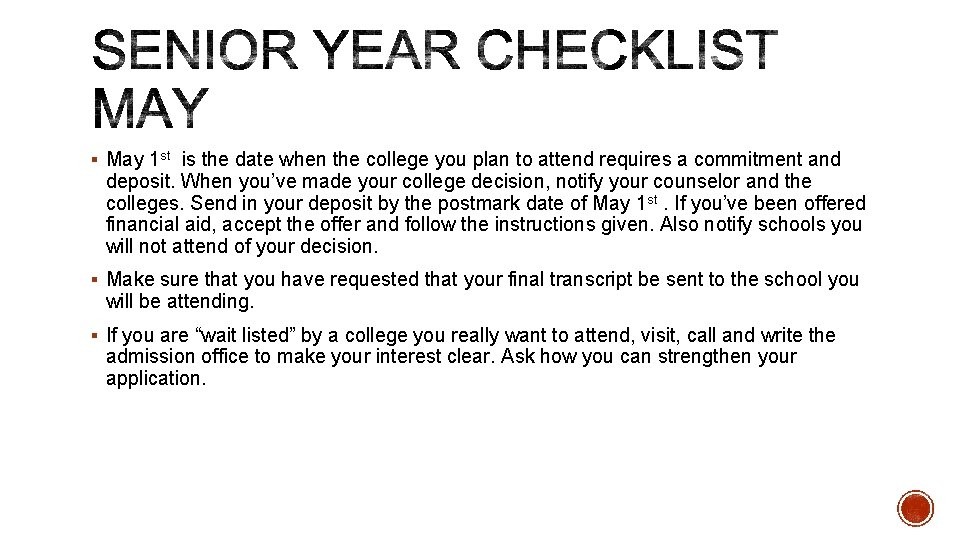
§ May 1 st is the date when the college you plan to attend requires a commitment and deposit. When you’ve made your college decision, notify your counselor and the colleges. Send in your deposit by the postmark date of May 1 st. If you’ve been offered financial aid, accept the offer and follow the instructions given. Also notify schools you will not attend of your decision. § Make sure that you have requested that your final transcript be sent to the school you will be attending. § If you are “wait listed” by a college you really want to attend, visit, call and write the admission office to make your interest clear. Ask how you can strengthen your application.
§ Senior year is an exciting time, however, it is not a time to “take it easy” § Colleges will look at the courses you’ve taken during your senior year. § Colleges will look at the transcript you sent at the time of application as well as at the end of the senior year. It is important to keep pushing yourself and maintain your grades and GPA.
October is College Application Month! All students planning on attending college are encouraged to apply during the month of October to meet priority deadlines which for many colleges and universities is November 1 st. § Mrs. Mc. Laughlin hosts application workshops after school in room 606 (Oct. 12, 17, 19, 24, 26). Students can receive assistance on college searches, application completion, college essay writing, scholarship searches and any post-secondary needs!!!
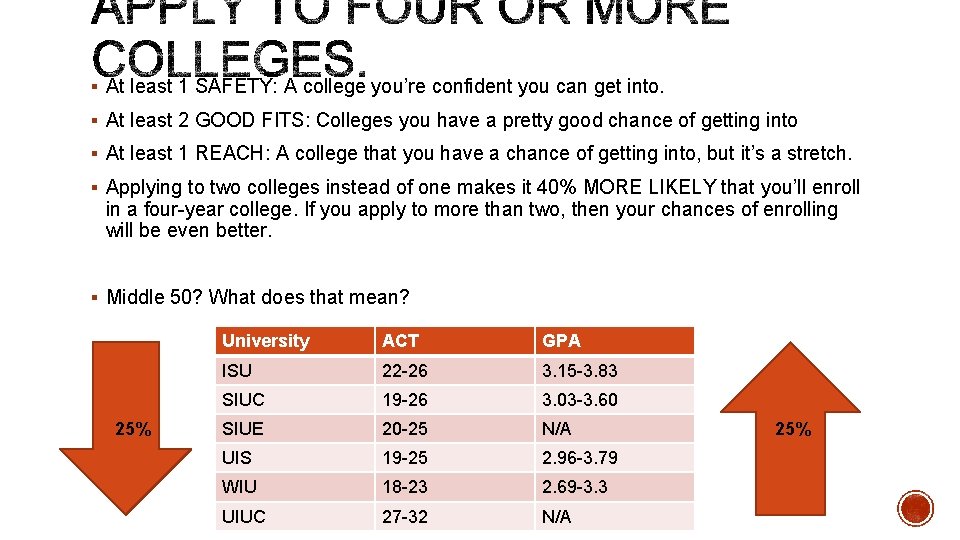
§ At least 1 SAFETY: A college you’re confident you can get into. § At least 2 GOOD FITS: Colleges you have a pretty good chance of getting into § At least 1 REACH: A college that you have a chance of getting into, but it’s a stretch. § Applying to two colleges instead of one makes it 40% MORE LIKELY that you’ll enroll in a four-year college. If you apply to more than two, then your chances of enrolling will be even better. § Middle 50? What does that mean? 25% University ACT GPA ISU 22 -26 3. 15 -3. 83 SIUC 19 -26 3. 03 -3. 60 SIUE 20 -25 N/A UIS 19 -25 2. 96 -3. 79 WIU 18 -23 2. 69 -3. 3 UIUC 27 -32 N/A 25%
You may want to reconsider taking the ACT. You can do this by going to the website www. actstudent. org. The cost is $46 for the ACT without writing or $62. 50 for the exam with writing. All students planning on studying education are encouraged to take the writing portion. Upcoming test dates: December 9 th (Nov 3 rd registration deadline) February 10 th (January 12 th registration deadline) On the www. actstudent. org website there is free test prep.
§ The SAT is another college entrance exam through the College Board § The SAT is the official State of Illinois exam given to juniors in April. § Register at sat. org/register § Cost: $46 or $60 with essay § Dates: § December 2 nd (November 2 nd registration deadline) § March 10 th (February 9 th registration deadline)
Want to play a sport in college? § When you start applying to colleges, you'll also need to register with and be certified by the NCAA Eligibility Center (formerly known as the NCAA Initial-Eligibility Clearinghouse) if you are applying to Division I and II schools. § This can be done at http: //www. ncaa. org/student-atheletes/future/how- register § The purpose of the Eligibility Center is to determine if you meet academic eligibility requirements. This does NOT mean that the schools you've applied to have accepted you. Registering with the center is a separate process -- you still have to apply to each of your target schools through the normal application procedures. § With NCAA eligibility requirements, if you don't meet them, you won't be making the team. Every athlete must meet minimum standardized-test scores and core curriculum requirements -- and continue to meet academic requirements each year. In other words, excelling at a sport won't keep you in sports college if you don't meet both the NCAA's and the school's academic requirements.
§ Location § Cost § Facilities § Size § Available majors § Reputation § Early in the college selection process, have a frank discussion with your child regarding financial expectations. Make sure they are taking advantage of state and federal sources of financial aid and scholarship opportunities.
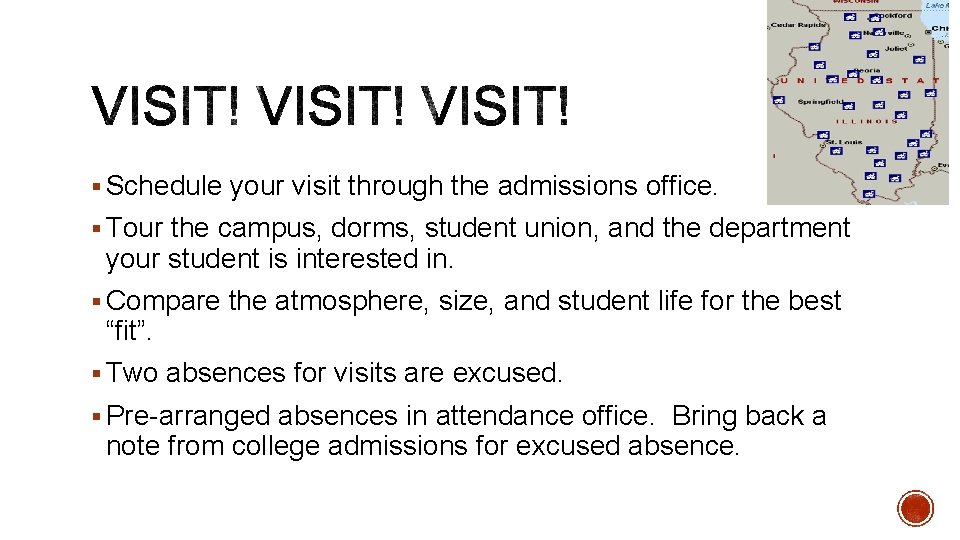
§ Schedule your visit through the admissions office. § Tour the campus, dorms, student union, and the department your student is interested in. § Compare the atmosphere, size, and student life for the best “fit”. § Two absences for visits are excused. § Pre-arranged absences in attendance office. Bring back a note from college admissions for excused absence.
§ The FAFSA window opened on October 1 st. You may complete you FAFSA by going to www. fafsa. gov § ASAP to be eligible for certain grants. § FAFSA Completion Night will be hosted at JHS on Oct. 11 th at 6: 00 p. m. in the JHS Media Center § Questions about FAFSA? Contact our ISAC rep Greg Tranpier § 708 -274 -0251 § Greg. Tranpier@isac. Illinois. gov
§Merit based- Based on academic achievement §Need based- looks at EFC and monetary need §www. fastweb. com § www. careercruising. com §www. collegezone. com §www. collegegreenlight. com
§ A loan is a type of “self-help” aid that lets you borrow money from the government, banks or other lending institutions. Since it’s “self-help” aid, it must be paid back with added interest § Differences Between Subsidized Loans and Unsubsidized Loans: The primary difference between these two ways to pay for college is that subsidized loans are based on financial need, while unsubsidized loans are not. Also, for subsidized loans, the lender pays the interest while the college student is enrolled in school.
§Work directly with school’s financial aid office for more aid opportunities §Accept the schools award package through school’s website. §Apply for housing. §Meet Deadlines!
§ Scholarship information is updated every month on the JHS web page. § Go to www. jhs. jsd 117. org § Go to Students § Then go to Student Services § Next, go to Scholarships § Information about eligibility, deadlines and where to obtain the application is available under each month that the scholarship deadline applies. § Make sure to meet the deadline or the scholarship will not be accepted. § Allow plenty of time to complete essays, ask for letters of recommendation, and get it postdated according to the deadline. § Use Career Cruising under the portfolio section to complete clubs, organizations, community service, sports, leadership, and other pertinent information. This can be used over and does not have to be recreated every time.
§ Take the ASVAB (given at JHS Dec. 7, 2017) § Review military entrance requirements. § Check on pre-qualifications. § Go through the screening process. § Go through military entrance processing station. MEPS in St. Louis, Missouri. § Meet with all branches to ensure you are getting the best possible package.
§ Vocational schools offer a more streamlined education. The curriculum focuses on developing the skills and knowledge needed to prepare your for a career as in your area of interest. § To get into a trade school, the first thing that an individual needs is a diploma. If they have not earned a high school diploma, a General Education Diploma will also be accepted for admission into a trade school. Depending on the specific trade school program, a high school graduate might also be required to have achieved a 2. 0 or higher grade point average for trade school admission. § Most trade schools require that you visit in order to make application to the program.
§Create a portfolio and resume with references on Career Cruising at: www. careercrusing. com §Complete job application §Practice interviewing skills §Try to match job with career interests
Thanks for attending Senior Information Night! Sherri Mc. Laughlin smclaughlin@jsd 117. org 217 -243 -4384 ext. 2242