
Sherlock Diagnosing Problems in the Enterprise Srikanth Kandula
Sherlock – Diagnosing Problems in the Enterprise Srikanth Kandula Victor Bahl, Ranveer Chandra, Albert Greenberg, David Maltz, Ming Zhang
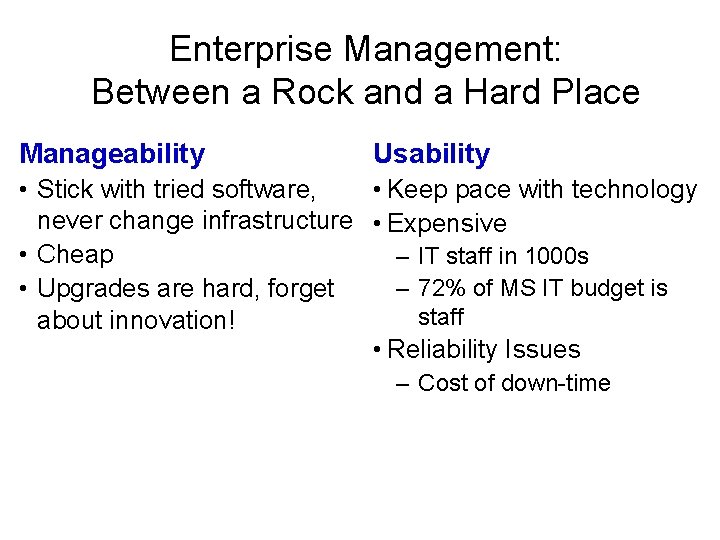
Enterprise Management: Between a Rock and a Hard Place Manageability Usability • Stick with tried software, • Keep pace with technology never change infrastructure • Expensive • Cheap – IT staff in 1000 s – 72% of MS IT budget is • Upgrades are hard, forget staff about innovation! • Reliability Issues – Cost of down-time
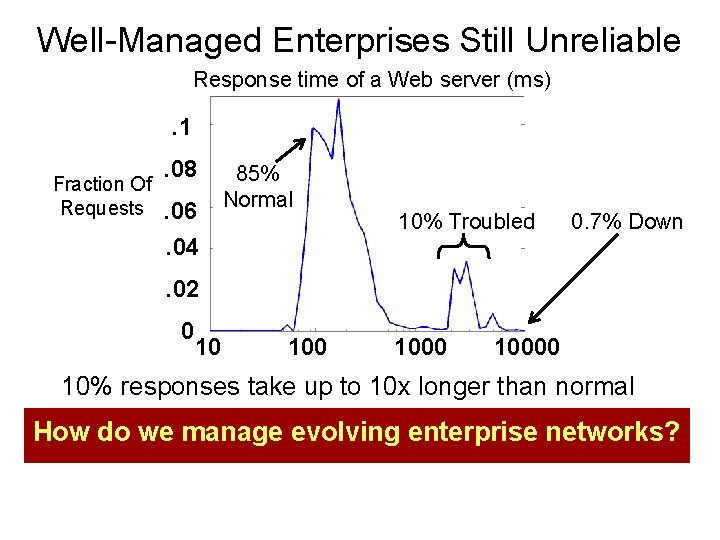
Well-Managed Enterprises Still Unreliable Response time of a Web server (ms) . 1 Fraction Of Requests . 08. 06. 04 85% Normal 10% Troubled 0. 7% Down . 02 0 10 10000 10% responses take up to 10 x longer than normal How do we manage evolving enterprise networks?
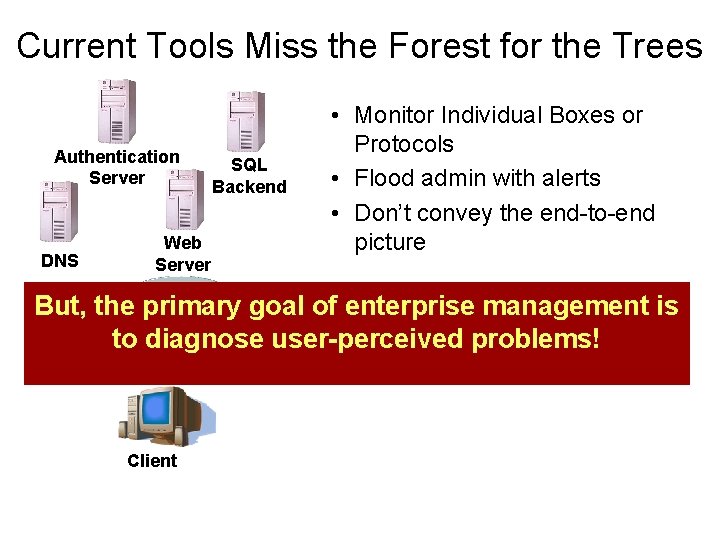
Current Tools Miss the Forest for the Trees Authentication Server DNS Web Server SQL Backend • Monitor Individual Boxes or Protocols • Flood admin with alerts • Don’t convey the end-to-end picture But, the primary goal of enterprise management is to diagnose user-perceived problems! Client
Sherlock Instead of looking at the nitty-gritty of individual components, use an end-to-end approach that focuses on user problems
Challenges for the End-to-End Approach • Don’t know what user’s performance depends on
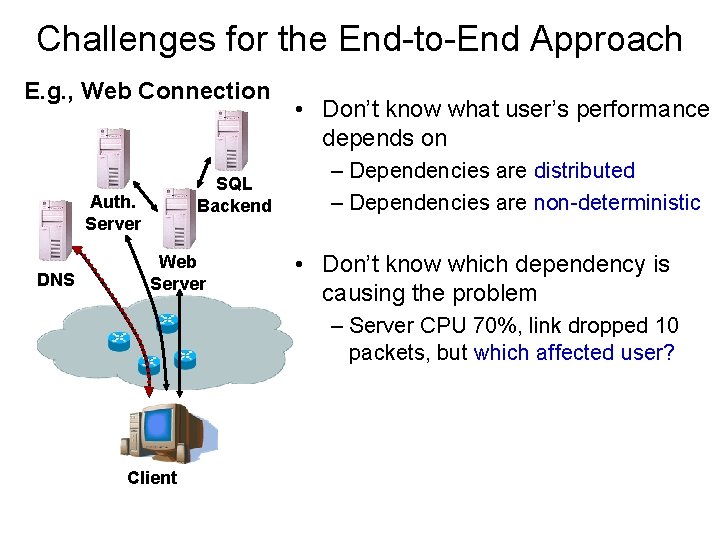
Challenges for the End-to-End Approach E. g. , Web Connection SQL Backend Auth. Server DNS Web Server • Don’t know what user’s performance depends on – Dependencies are distributed – Dependencies are non-deterministic • Don’t know which dependency is causing the problem – Server CPU 70%, link dropped 10 packets, but which affected user? Client
Sherlock’s Contributions • Passively infers dependencies from logs • Builds a unified dependency graph incorporating network, server and application dependencies • Diagnoses user problems in the enterprise • Deployed in a part of the Microsoft Enterprise
Sherlock’s Architecture
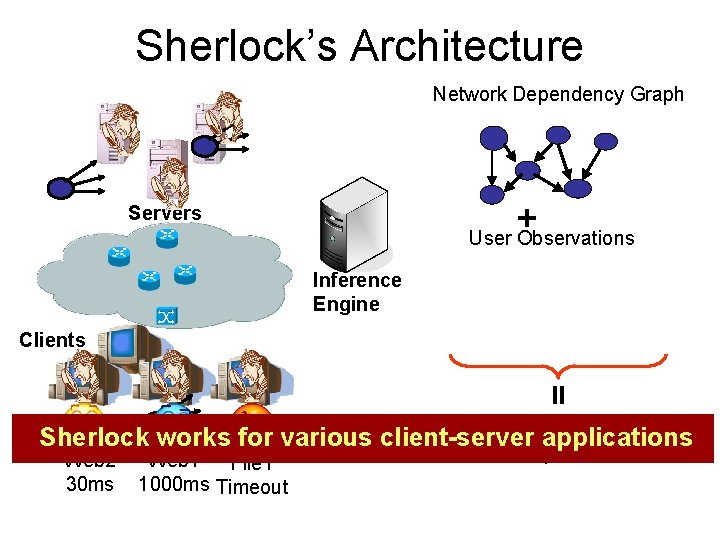
Sherlock’s Architecture Network Dependency Graph + User Observations Servers Inference Engine Clients = List Troubled Sherlock works for various client-server applications Web 2 30 ms Web 1 File 1 1000 ms Timeout Components
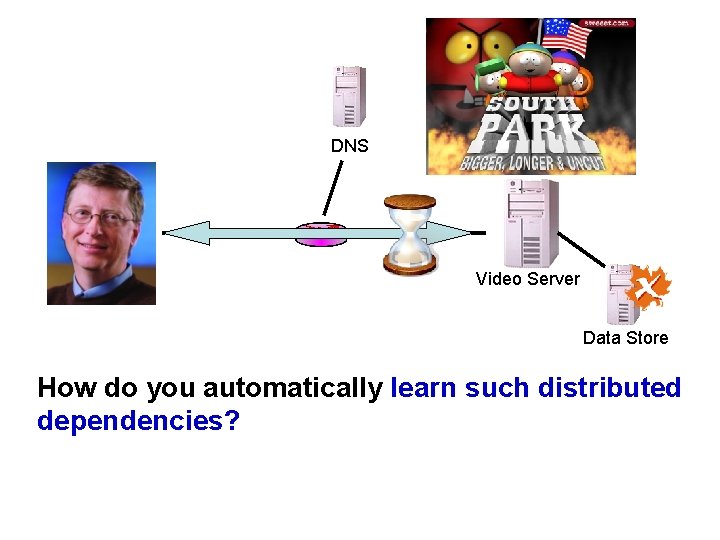
DNS Video Server Data Store How do you automatically learn such distributed dependencies?
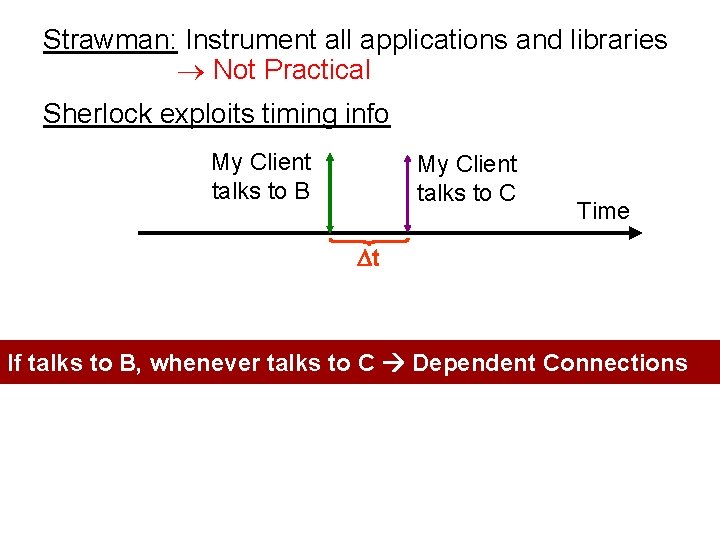
Strawman: Instrument all applications and libraries Not Practical Sherlock exploits timing info My Client talks to B My Client talks to C Time t If talks to B, whenever talks to C Dependent Connections
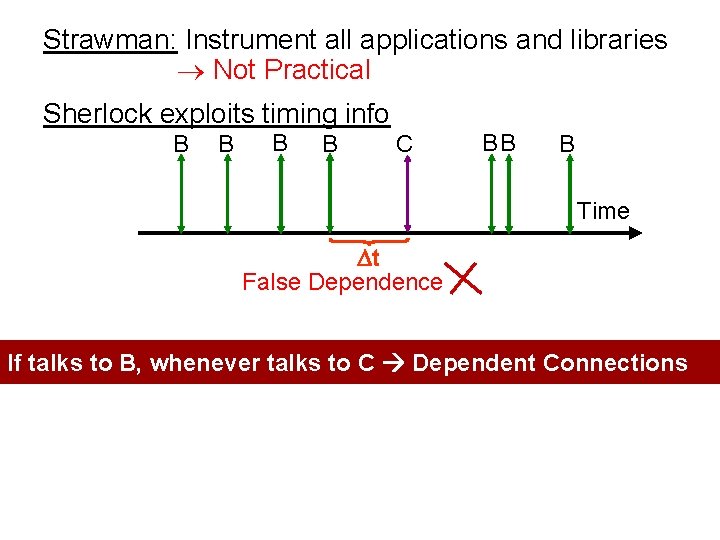
Strawman: Instrument all applications and libraries Not Practical Sherlock exploits timing info B B C BB B Time t False Dependence If talks to B, whenever talks to C Dependent Connections
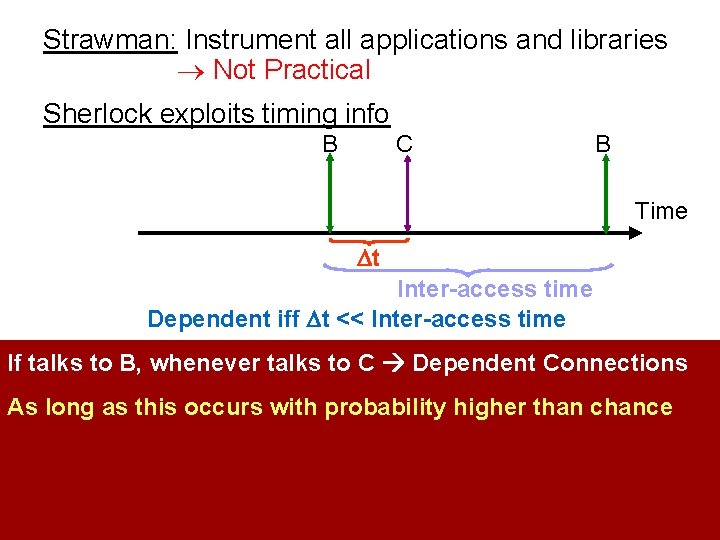
Strawman: Instrument all applications and libraries Not Practical Sherlock exploits timing info B C B Time t Inter-access time Dependent iff t << Inter-access time If talks to B, whenever talks to C Dependent Connections As long as this occurs with probability higher than chance
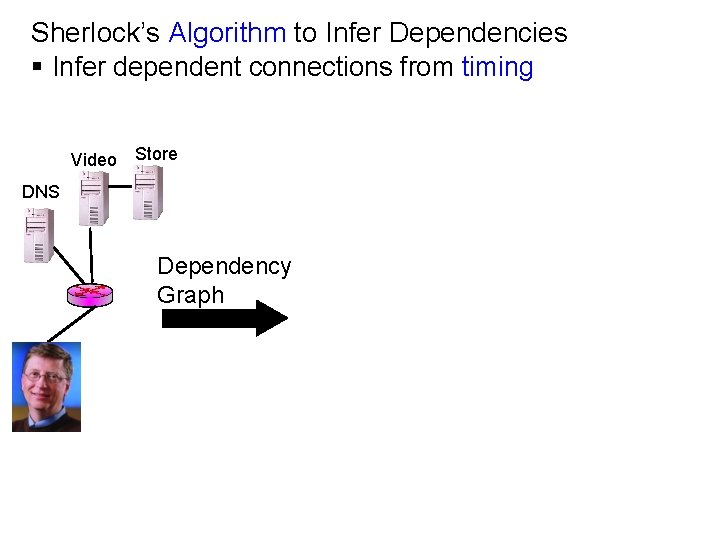
Sherlock’s Algorithm to Infer Dependencies § Infer dependent connections from timing Video Store DNS Dependency Graph
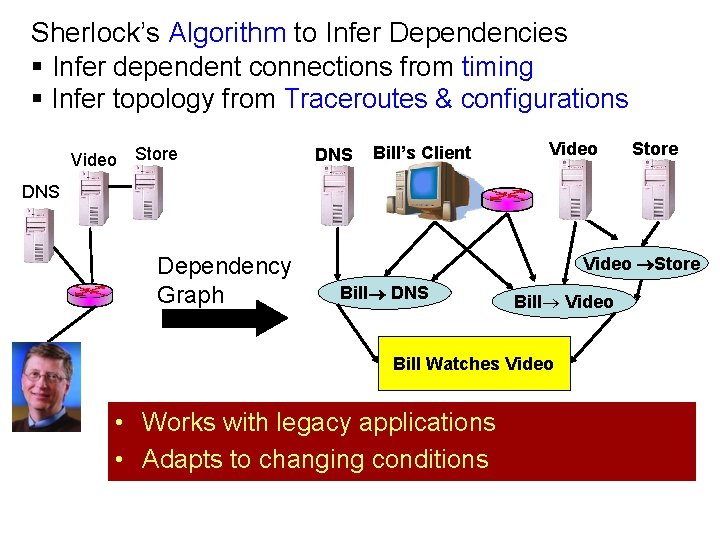
Sherlock’s Algorithm to Infer Dependencies § Infer dependent connections from timing § Infer topology from Traceroutes & configurations Video Store DNS Bill’s Client Video Store DNS Dependency Graph Video Store Bill DNS Bill Video Bill Watches Video • Works with legacy applications • Adapts to changing conditions
But hard dependencies are not enough…
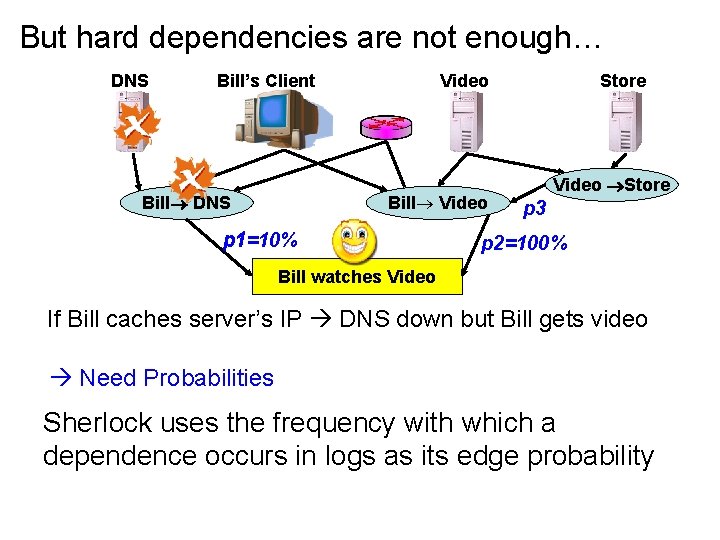
But hard dependencies are not enough… DNS Bill’s Client Bill DNS Video Bill Video p 1=10% Store Video Store p 3 p 2=100% Bill watches Video If Bill caches server’s IP DNS down but Bill gets video Need Probabilities Sherlock uses the frequency with which a dependence occurs in logs as its edge probability
How do we use the dependency graph to diagnose user problems?
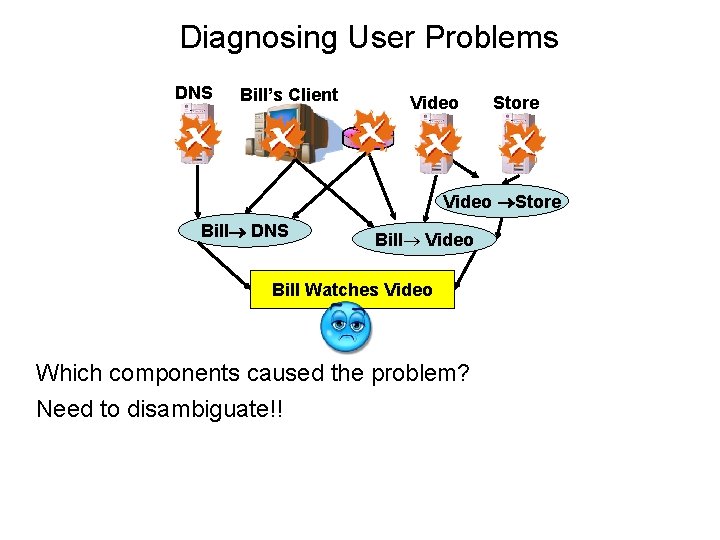
Diagnosing User Problems DNS Bill’s Client Video Store Bill DNS Bill Video Bill Watches Video Which components caused the problem? Need to disambiguate!!
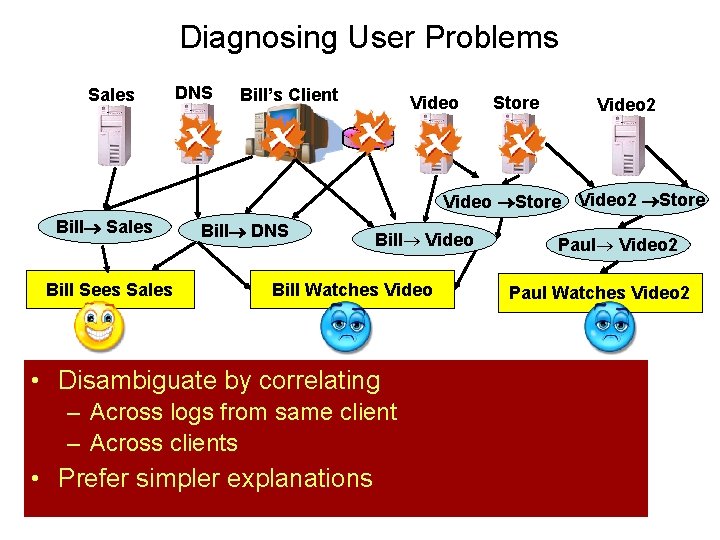
Diagnosing User Problems Sales DNS Bill’s Client Video Store Video 2 Store Bill Sales Bill Sees Sales Bill DNS Bill Video Bill Watches Video components the problem? • Which Disambiguate bycaused correlating Use– correlation disambiguate!! Across logstofrom same client – Across clients • Prefer simpler explanations Paul Video 2 Paul Watches Video 2
Will Correlation Scale?
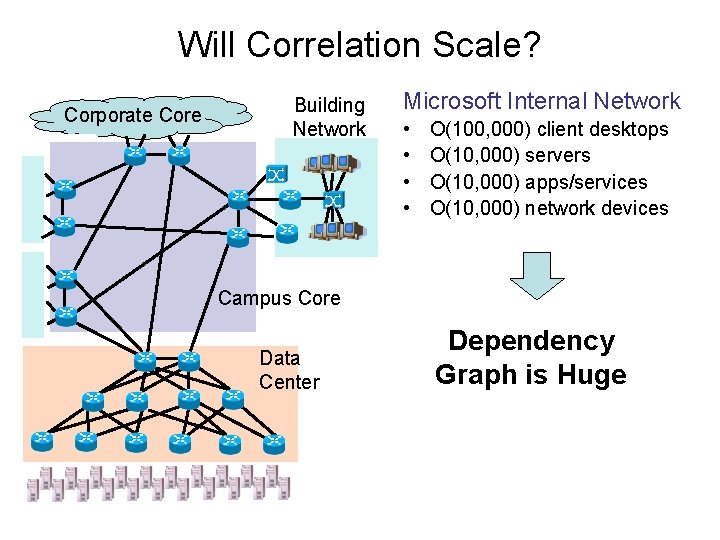
Will Correlation Scale? Corporate Core Building Network Microsoft Internal Network • • O(100, 000) client desktops O(10, 000) servers O(10, 000) apps/services O(10, 000) network devices Campus Core Data Center Dependency Graph is Huge
Will Correlation Scale? Can we evaluate all combinations of component failures? The number of fault combinations is exponential! Impossible to compute!
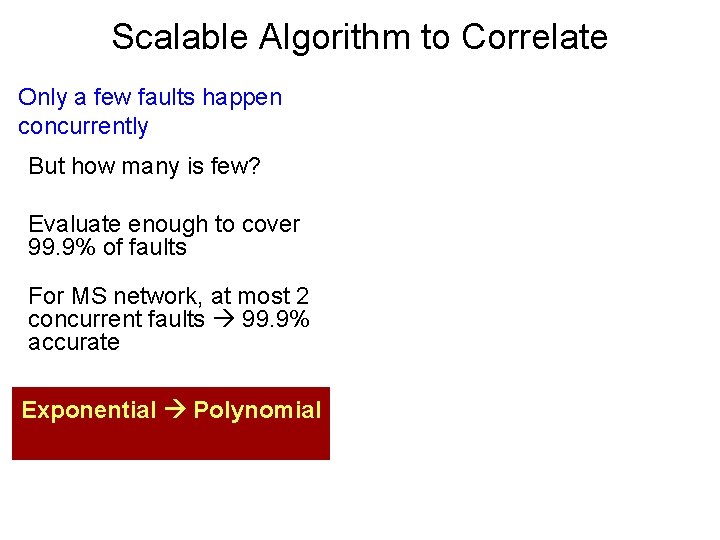
Scalable Algorithm to Correlate Only a few faults happen concurrently But how many is few? Evaluate enough to cover 99. 9% of faults For MS network, at most 2 concurrent faults 99. 9% accurate Exponential Polynomial
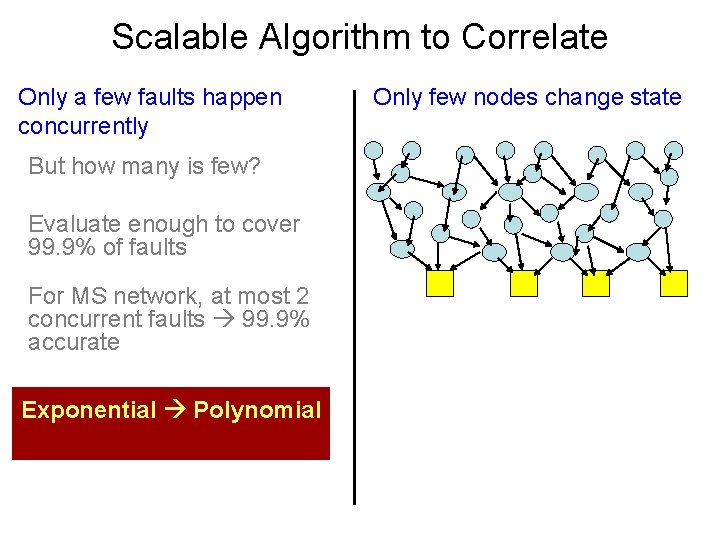
Scalable Algorithm to Correlate Only a few faults happen concurrently But how many is few? Evaluate enough to cover 99. 9% of faults For MS network, at most 2 concurrent faults 99. 9% accurate Exponential Polynomial Only few nodes change state
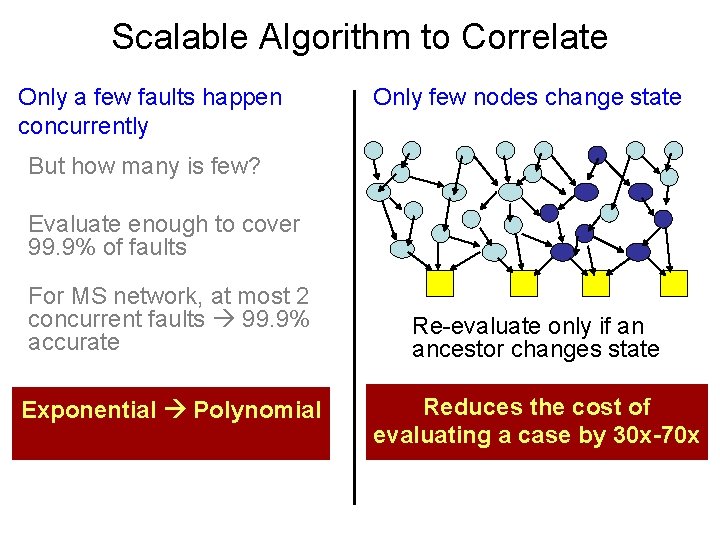
Scalable Algorithm to Correlate Only a few faults happen concurrently Only few nodes change state But how many is few? Evaluate enough to cover 99. 9% of faults For MS network, at most 2 concurrent faults 99. 9% accurate Exponential Polynomial Re-evaluate only if an ancestor changes state Reduces the cost of evaluating a case by 30 x-70 x
Results
Experimental Setup • Evaluated on the Microsoft enterprise network • Monitored 23 clients, 40 production servers for 3 weeks – Clients are at MSR Redmond – Extra host on server’s Ethernet logs packets • Busy, operational network – Main Intranet Web site and software distribution file server – Load-balancing front-ends – Many paths to the data-center
What Do Web Dependencies in the MS Enterprise Look Like?
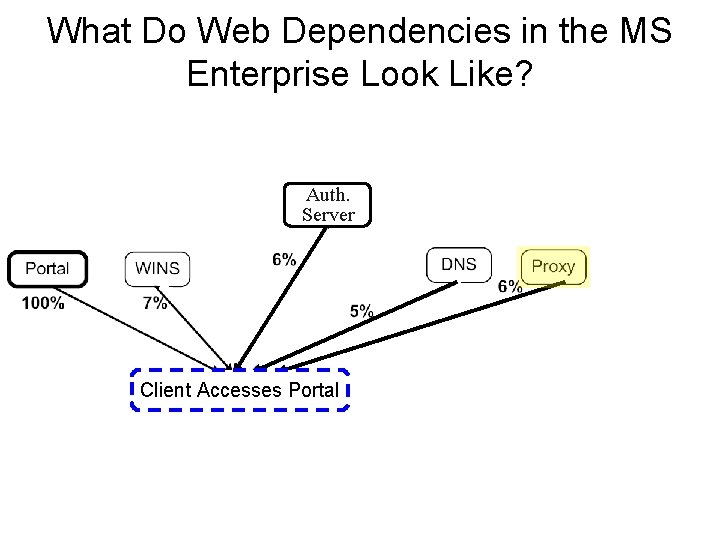
What Do Web Dependencies in the MS Enterprise Look Like? Auth. Server Client Accesses Portal
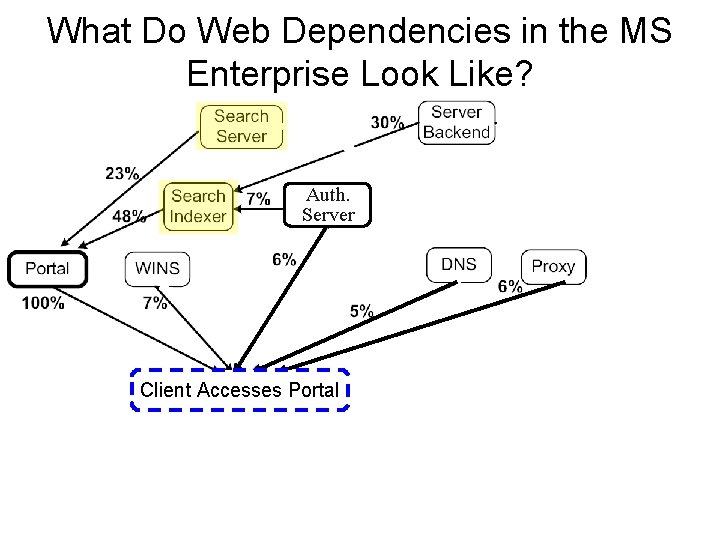
What Do Web Dependencies in the MS Enterprise Look Like? Auth. Server Client Accesses Portal
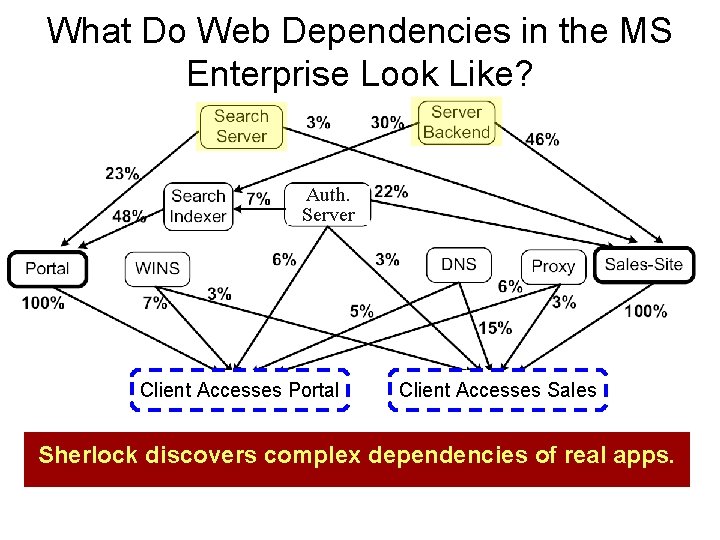
What Do Web Dependencies in the MS Enterprise Look Like? Auth. Server Client Accesses Portal Client Accesses Sales Sherlock discovers complex dependencies of real apps.
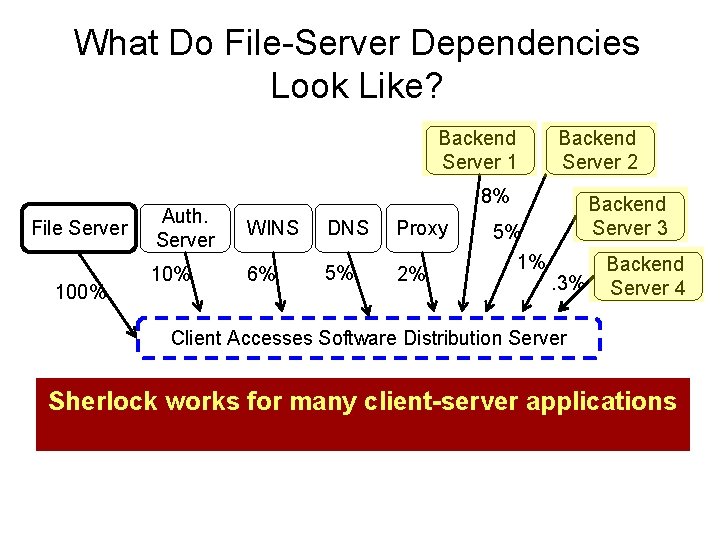
What Do File-Server Dependencies Look Like? Backend Server 1 File Server 100% Backend Server 2 8% Auth. Server WINS DNS Proxy 10% 6% 5% 2% 5% 1% Backend Server 3. 3% Backend Server 4 Client Accesses Software Distribution Server Sherlock works for many client-server applications
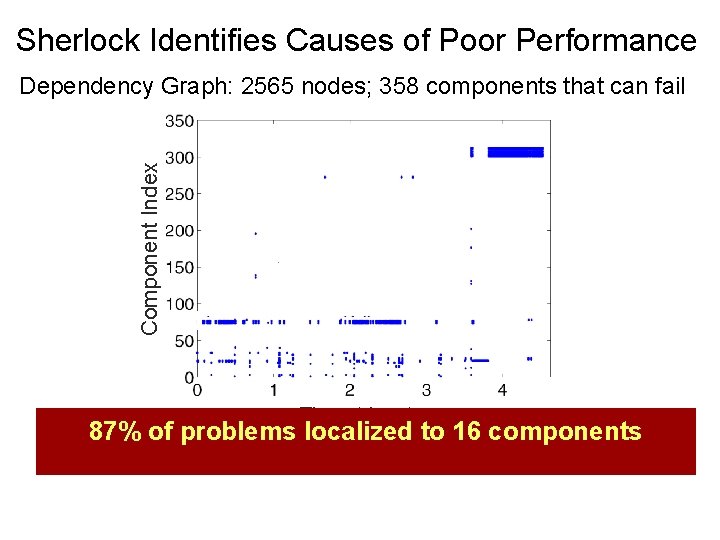
Sherlock Identifies Causes of Poor Performance Component Index Dependency Graph: 2565 nodes; 358 components that can fail Time (days) 87% of problems localized to 16 components
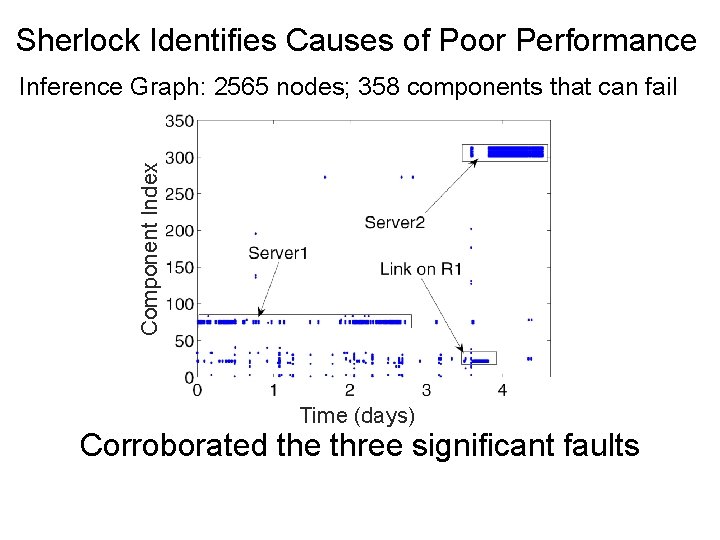
Sherlock Identifies Causes of Poor Performance Component Index Inference Graph: 2565 nodes; 358 components that can fail Time (days) Corroborated the three significant faults
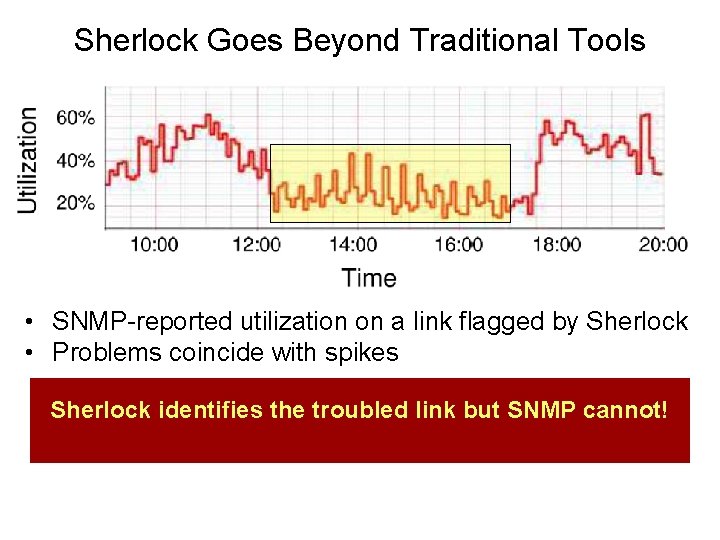
Sherlock Goes Beyond Traditional Tools • SNMP-reported utilization on a link flagged by Sherlock • Problems coincide with spikes Sherlock identifies the troubled link but SNMP cannot!
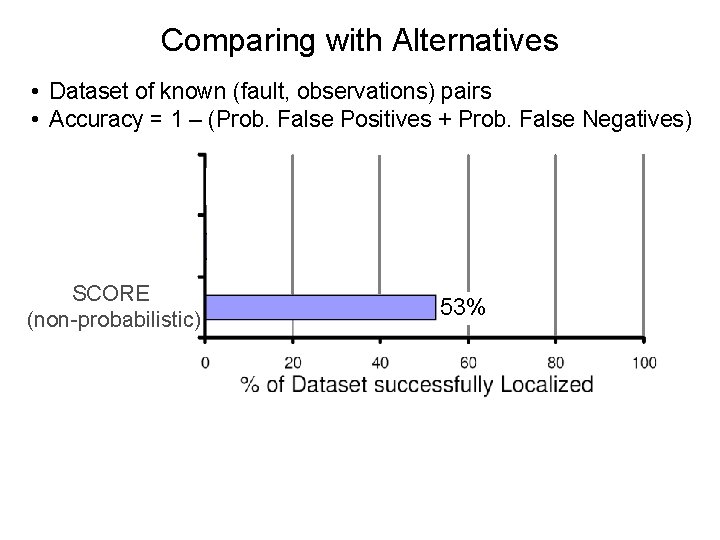
Comparing with Alternatives • Dataset of known (fault, observations) pairs • Accuracy = 1 – (Prob. False Positives + Prob. False Negatives) SCORE (non-probabilistic) 53%
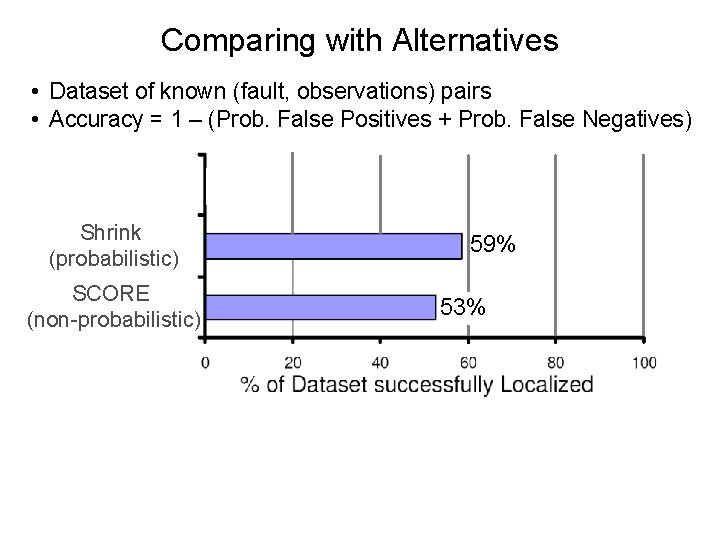
Comparing with Alternatives • Dataset of known (fault, observations) pairs • Accuracy = 1 – (Prob. False Positives + Prob. False Negatives) Shrink (probabilistic) SCORE (non-probabilistic) 59% 53%
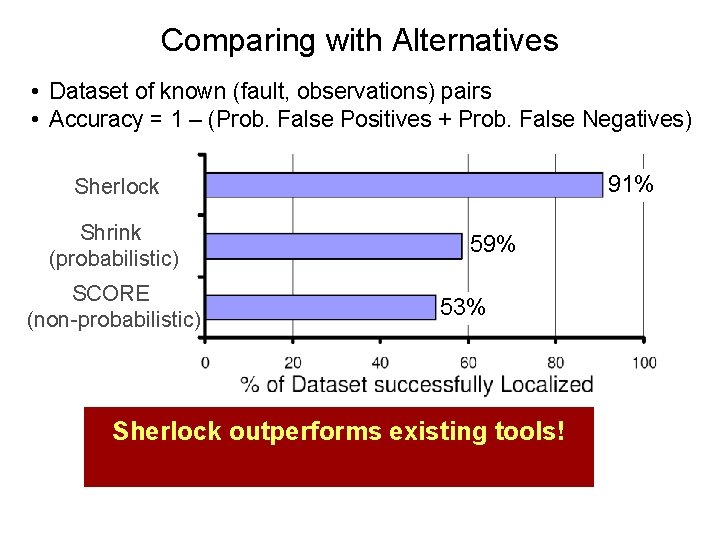
Comparing with Alternatives • Dataset of known (fault, observations) pairs • Accuracy = 1 – (Prob. False Positives + Prob. False Negatives) 91% Sherlock Shrink (probabilistic) SCORE (non-probabilistic) 59% 53% Sherlock outperforms existing tools!
Conclusions • Sherlock passively infers network-wide dependencies from logs and traceroutes • It diagnoses faults by correlating user observations • It works at scale! • Experiments in Microsoft’s Network show – Finds faults missed by existing tools like SNMP – Is more accurate than prior techniques • Steps towards a Microsoft product
- Slides: 41