
Sheltered Instruction Observation Protocol Model SIOP Lucia Buttaro
Sheltered Instruction Observation Protocol Model SIOP Lucia Buttaro, Ph. D.
OBJECTIVES • • Overview of the SIOP Model Unpacking 4 components • • Comprehensible Input Interaction Practice and application Lesson Delivery
Components of the SIOP Model • • Preparation Building Background Comprehensible Input Strategies Interaction Practice/Application Lesson Delivery Review/Assessment
Comprehensible Input • Speech appropriate for students’ proficiency levels (slower rate, enunciation and simple sentence structure for beginners) • Clear explanation of academic tasks • A variety of techniques used to make concepts clearer (e. g. , modeling, visuals, hands-on activities, demonstrations, gestures, body language)
Interaction Component • What is interaction? • Contact and discussion between teacher/student and student to student about lesson concepts to encourage deeper thought and more language use. • Uses group configuration among students • Provides for sufficient wait time for student responses • Gives opportunities for students to clarify key concepts in their native language as needed (this is a unique feature of SIOP)
Making Content Comprehensible • http: //vidego. multicastmedia. com/playe r. php? p=da 46 imyr

Making Content Comprehensible: Interaction http: //vidego. multicastmedia. com/player. php ? p=d 7 y 4 u 441
Opportunities for Interaction • • Encourage more elaborate responses Vary group configurations (random, voluntary, assigned) Whole group, flexible small groups, partners, triads Homogenous/heterogeneous (gender, language proficiency, ability, etc. ) • Allow adequate wait time • Clarify concepts in L 1 if needed-teacher or peers clarify concepts or use native text, dictionaries or other tools
Practice and Application • Hands on materials and/or manipulatives provided for students to practice using new content knowledge • Activities provided for students to apply content and language knowledge in the classroom. • Activities integrate all language skills (listening, speaking, reading and writing)

Focus on key vocabulary • • • Contextualize key vocabulary Personal dictionaries Content word wall Cloze sentences Vocabulary through songs
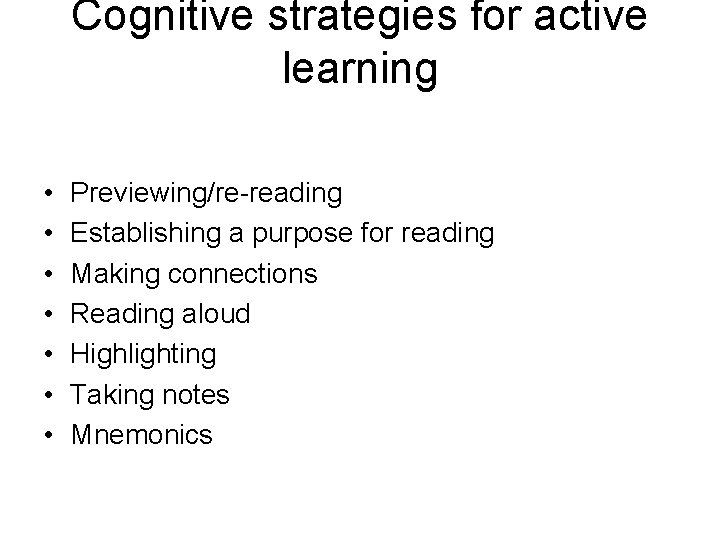
Cognitive strategies for active learning • • Previewing/re-reading Establishing a purpose for reading Making connections Reading aloud Highlighting Taking notes Mnemonics
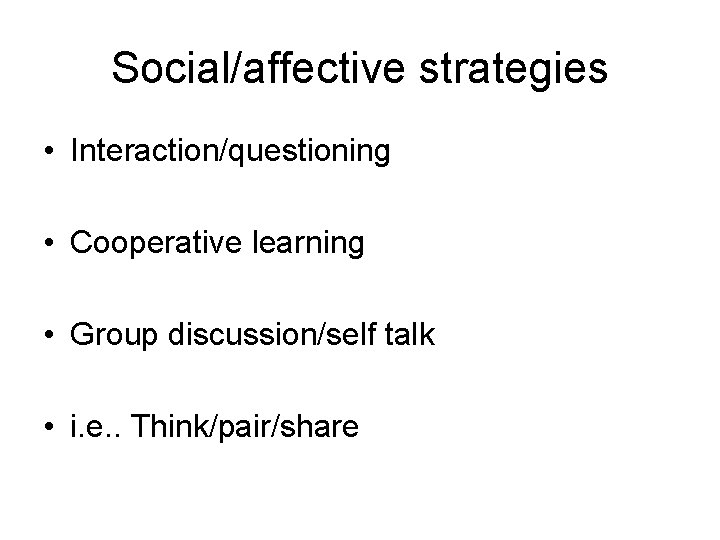
Social/affective strategies • Interaction/questioning • Cooperative learning • Group discussion/self talk • i. e. . Think/pair/share
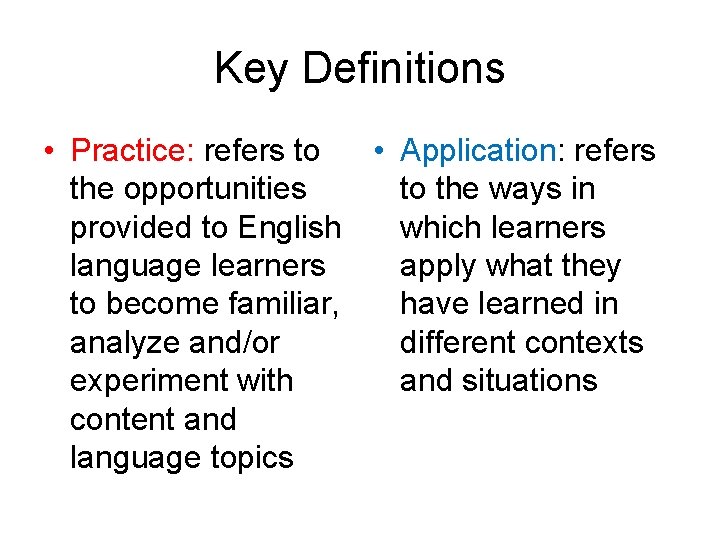
Key Definitions • Practice: refers to • Application: refers the opportunities to the ways in provided to English which learners language learners apply what they to become familiar, have learned in analyze and/or different contexts experiment with and situations content and language topics
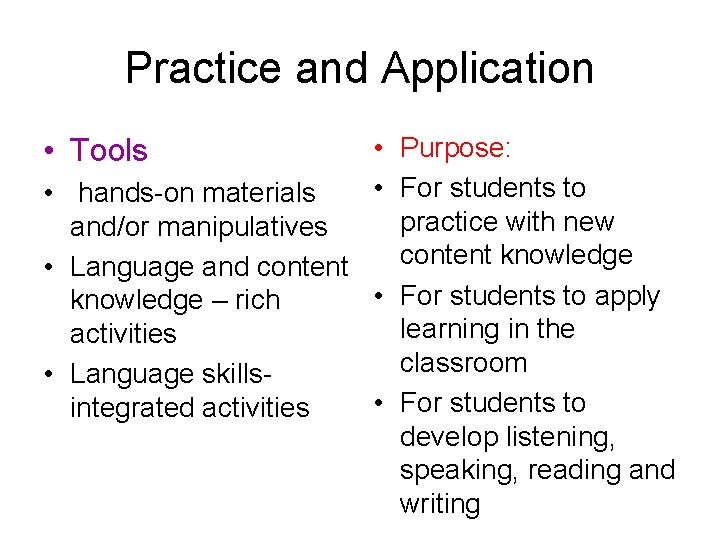
Practice and Application • Purpose: • For students to • hands-on materials practice with new and/or manipulatives content knowledge • Language and content • For students to apply knowledge – rich learning in the activities classroom • Language skills • For students to integrated activities develop listening, speaking, reading and writing • Tools
Lesson Delivery • Content Objectives clearly supported by lesson delivery • Language objectives clearly supported by lesson delivery • Students engaged approximately 90% to 100% of the period • Pacing of the lesson appropriate to students’ ability level
Lesson Delivery Features • Content Objectives should be clearly supported by the lesson delivery (stated orally – written on board for all to see) • Language objectives should be clearly supported by the lesson delivery (stated orally and written on board for all to see)
Lesson Delivery Features * Class time needs to be planned efficiently – all aspects of student engagement should be considered: • Well planned lessons • Clear explanations of academic tasks or instructions • Appropriate amount of time to spend on academic task • Strong classroom management • Opportunities for students to apply learning in meaningful ways • Active student involvement • Lesson design that meets the language and learning needs of the students

More on Lesson Delivery Features • Students should be engaged approximately 90 -100% of the time during the lesson (engagement minimizes boredom and off-task behaviors) • Pacing of the lesson should be appropriate to the students’ ability level brisk enough to maintain students’ interests, but not too quick to lose their understanding)
SIOP Summary • Review Key Features of SIOP • Provide Time for “Works/Quirks/Questions” • Evaluation Handout which will include: S – Something I learned… I – I will use… O – One question I have… P – Please clarify this…
English Language Learners • “If the child is not learning the way you are teaching, then you must teach the way the child learns” – Rita Dunn
Bibliography Echevarria, J. , Vogt, M. & Short, D. (2007). Making Content Comprehensible for English language learners: The SIOP Model (3 rd ed. ). Needham Heights, MA. Allyn and Bacon. Flynn, K. &Hill, J. (2005). English Language Learners: A Growing Population. Mid-Continent Research for Education and Learning Policy brief. National Center for Education Statistics. (2002 a). Schools and staffing survey: 1999 -2000. Retrieved November 19, 2011 from http: //nces. ed. gov/pubs 2002/2002313. pdf). Thomas, W. P. , & Collier, V. (1997). School effectiveness for language minority students. Washington, D. C. : National Center for Bilingual Education. Additional Websites: ahonigsfeld@molloy. edu http: //www. siopinstitute. net/
- Slides: 21