
ShellModel Approach and Structure of Exotic Nuclei Nadya
![Superdeformation in 36 Ar E. Caurier et al, PRL 95, 042502 (2005) [sd]16[pf]0 -](https://slidetodoc.com/presentation_image_h/05f9ed7644b82d8aaa0f22672e68af09/image-12.jpg "Superdeformation in 36 Ar E. Caurier et al, PRL 95, 042502 (2005) [sd]16[pf]0 -")
- Slides: 28
Shell-Model Approach and Structure of Exotic Nuclei Nadya Smirnova Centre d’Etudes Nucléaires de Bordeaux Gradignan France EURISOL Town Meeting, November 27 -28, 2006
Shell-Model Approach and Structure of Exotic Nuclei I. Physics case: structure of nuclei far from the valley of stability II. The nuclear shell model: formalism, advantages and modern capabilities III. Some frontier developments and applications: • Deformation and shape coexistence • Evolution of the shell structure far from stability • Drip-line systems and effects of the continuum • No-core shell model • Astrophysics applications • Precision measurements and weak-interaction physics IV. Perspectives
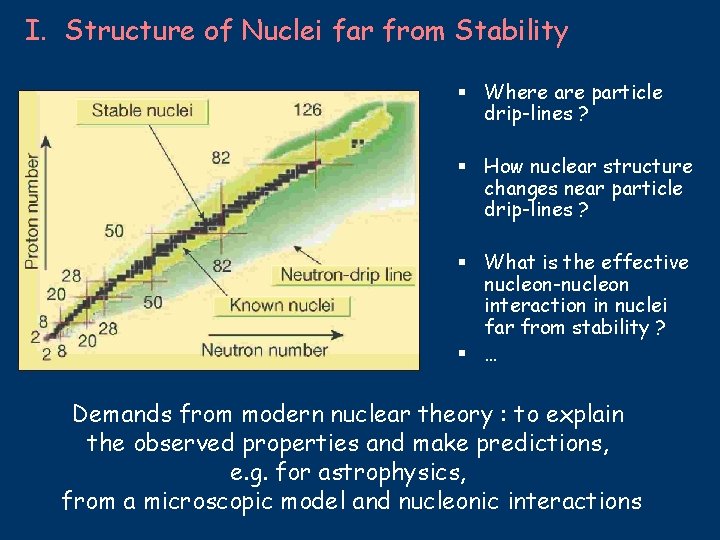
I. Structure of Nuclei far from Stability § Where are particle drip-lines ? § How nuclear structure changes near particle drip-lines ? § What is the effective nucleon-nucleon interaction in nuclei far from stability ? § … Demands from modern nuclear theory : to explain the observed properties and make predictions, e. g. for astrophysics, from a microscopic model and nucleonic interactions
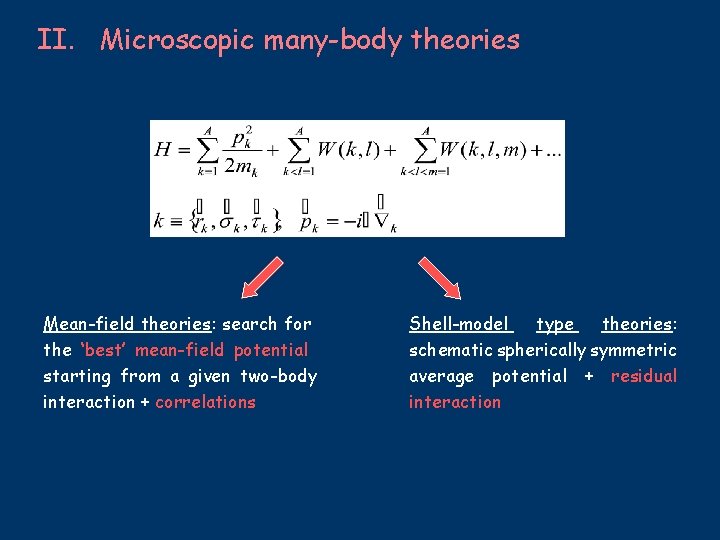
II. Microscopic many-body theories Mean-field theories: search for the ‘best’ mean-field potential starting from a given two-body interaction + correlations Shell-model type theories: schematic spherically symmetric average potential + residual interaction
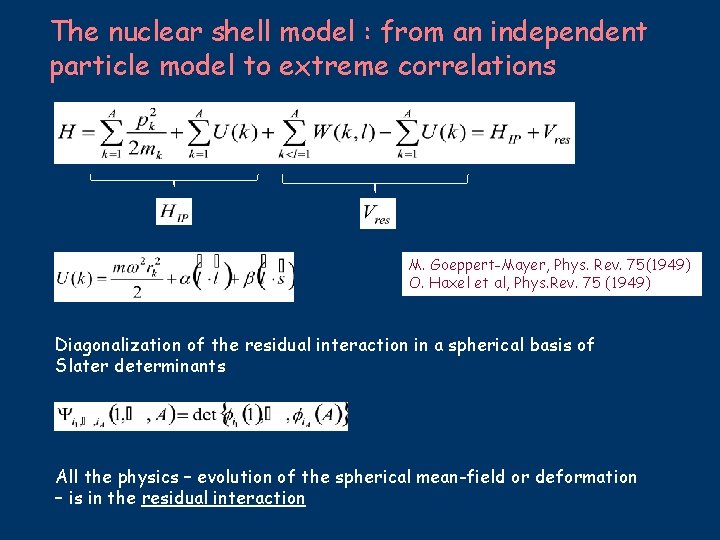
The nuclear shell model : from an independent particle model to extreme correlations M. Goeppert-Mayer, Phys. Rev. 75(1949) O. Haxel et al, Phys. Rev. 75 (1949) Diagonalization of the residual interaction in a spherical basis of Slater determinants All the physics – evolution of the spherical mean-field or deformation – is in the residual interaction
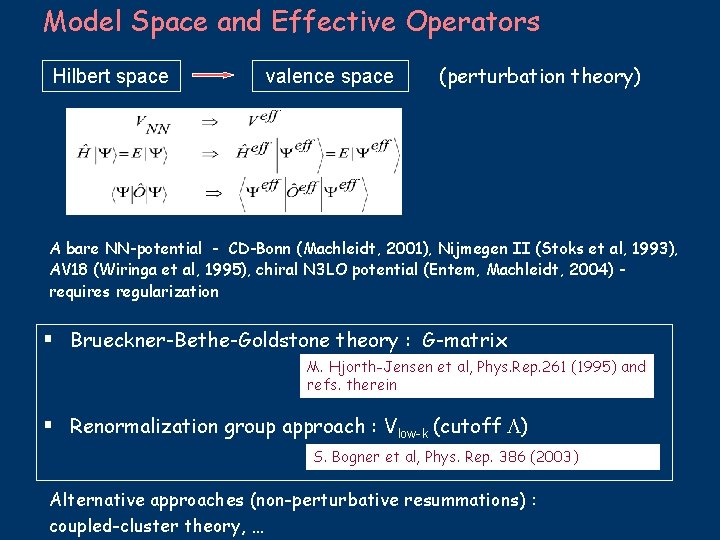
Model Space and Effective Operators Hilbert space valence space (perturbation theory) A bare NN-potential - CD-Bonn (Machleidt, 2001), Nijmegen II (Stoks et al, 1993), AV 18 (Wiringa et al, 1995), chiral N 3 LO potential (Entem, Machleidt, 2004) requires regularization § Brueckner-Bethe-Goldstone theory : G-matrix M. Hjorth-Jensen et al, Phys. Rep. 261 (1995) and refs. therein § Renormalization group approach : Vlow-k (cutoff ) S. Bogner et al, Phys. Rep. 386 (2003) Alternative approaches (non-perturbative resummations) : coupled-cluster theory, …
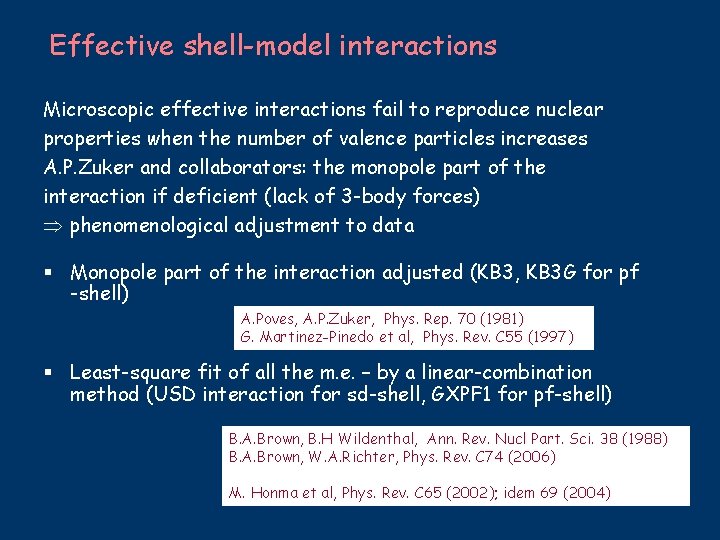
Effective shell-model interactions Microscopic effective interactions fail to reproduce nuclear properties when the number of valence particles increases A. P. Zuker and collaborators: the monopole part of the interaction if deficient (lack of 3 -body forces) phenomenological adjustment to data § Monopole part of the interaction adjusted (KB 3, KB 3 G for pf -shell) A. Poves, A. P. Zuker, Phys. Rep. 70 (1981) G. Martinez-Pinedo et al, Phys. Rev. C 55 (1997) § Least-square fit of all the m. e. – by a linear-combination method (USD interaction for sd-shell, GXPF 1 for pf-shell) B. A. Brown, B. H Wildenthal, Ann. Rev. Nucl Part. Sci. 38 (1988) B. A. Brown, W. A. Richter, Phys. Rev. C 74 (2006) M. Honma et al, Phys. Rev. C 65 (2002); idem 69 (2004)
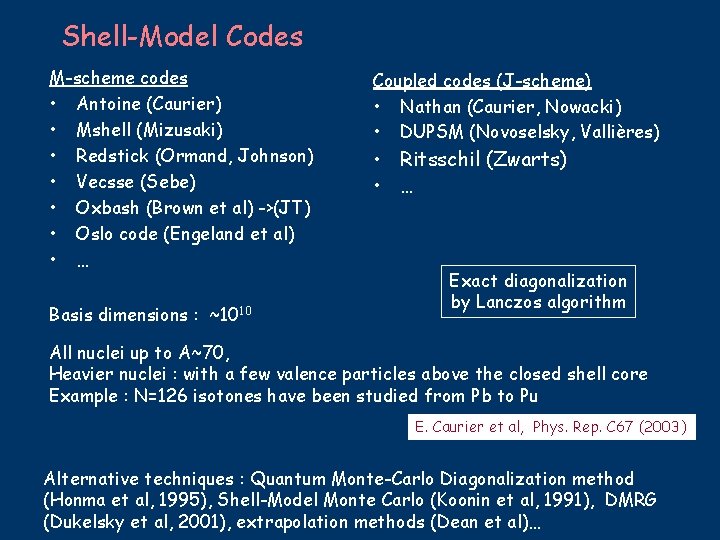
Shell-Model Codes M-scheme codes • Antoine (Caurier) • Mshell (Mizusaki) • Redstick (Ormand, Johnson) • Vecsse (Sebe) • Oxbash (Brown et al) ->(JT) • Oslo code (Engeland et al) • … Basis dimensions : ~1010 Coupled codes (J-scheme) • Nathan (Caurier, Nowacki) • DUPSM (Novoselsky, Vallières) • Ritsschil (Zwarts) • … Exact diagonalization by Lanczos algorithm All nuclei up to A~70, Heavier nuclei : with a few valence particles above the closed shell core Example : N=126 isotones have been studied from Pb to Pu E. Caurier et al, Phys. Rep. C 67 (2003) Alternative techniques : Quantum Monte-Carlo Diagonalization method (Honma et al, 1995), Shell-Model Monte Carlo (Koonin et al, 1991), DMRG (Dukelsky et al, 2001), extrapolation methods (Dean et al)…
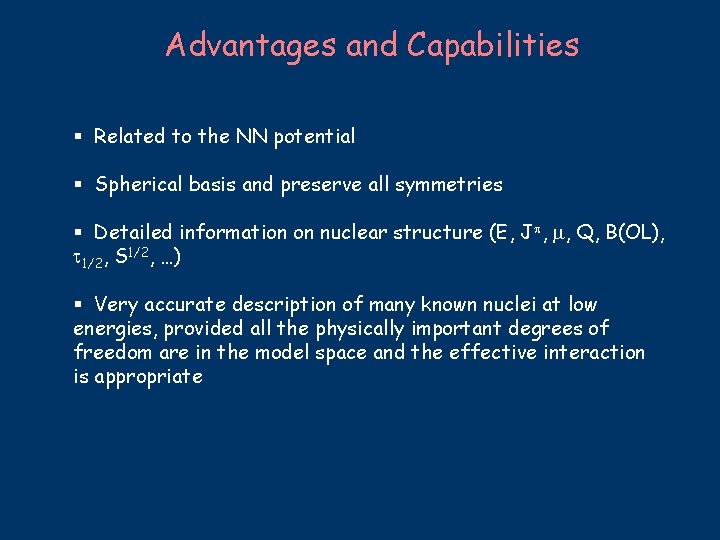
Advantages and Capabilities § Related to the NN potential § Spherical basis and preserve all symmetries § Detailed information on nuclear structure (E, J , , Q, B(OL), 1/2, S 1/2, …) § Very accurate description of many known nuclei at low energies, provided all the physically important degrees of freedom are in the model space and the effective interaction is appropriate
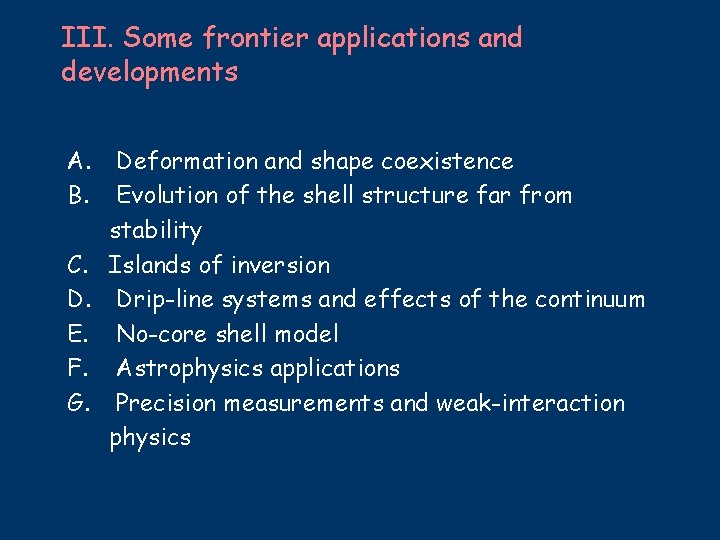
III. Some frontier applications and developments A. B. C. D. E. F. G. Deformation and shape coexistence Evolution of the shell structure far from stability Islands of inversion Drip-line systems and effects of the continuum No-core shell model Astrophysics applications Precision measurements and weak-interaction physics
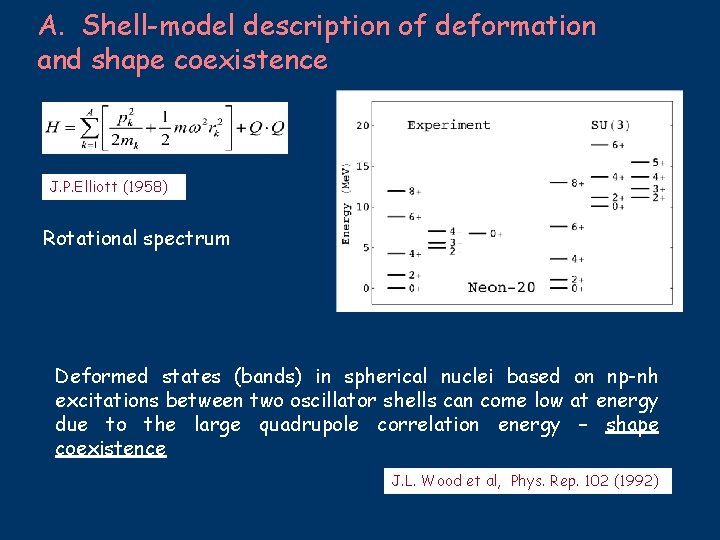
A. Shell-model description of deformation and shape coexistence J. P. Elliott (1958) Rotational spectrum Deformed states (bands) in spherical nuclei based on np-nh excitations between two oscillator shells can come low at energy due to the large quadrupole correlation energy – shape coexistence J. L. Wood et al, Phys. Rep. 102 (1992)
Superdeformation in 36 Ar E. Caurier et al, PRL 95, 042502 (2005) [sd]16[pf]0 - 0 p 0 h – spherical configuration [sd]12[pf]4 - 4 p 4 h – deformed configuration
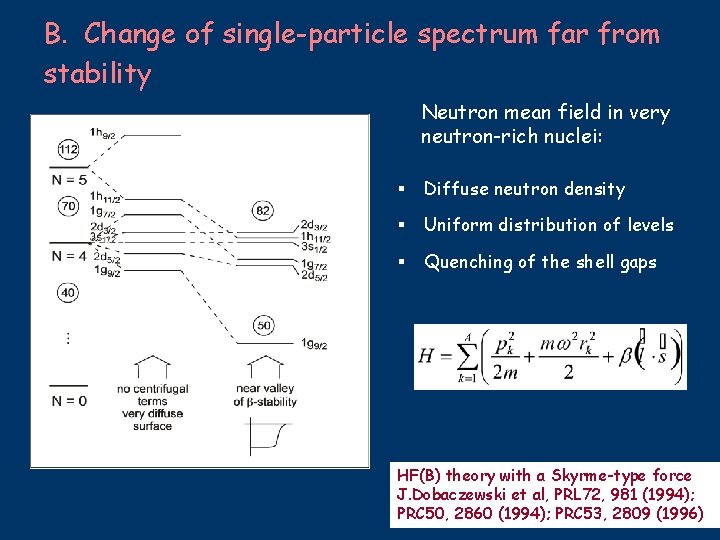
B. Change of single-particle spectrum far from stability Neutron mean field in very neutron-rich nuclei: § Diffuse neutron density § Uniform distribution of levels § Quenching of the shell gaps HF(B) theory with a Skyrme-type force J. Dobaczewski et al, PRL 72, 981 (1994); PRC 50, 2860 (1994); PRC 53, 2809 (1996)
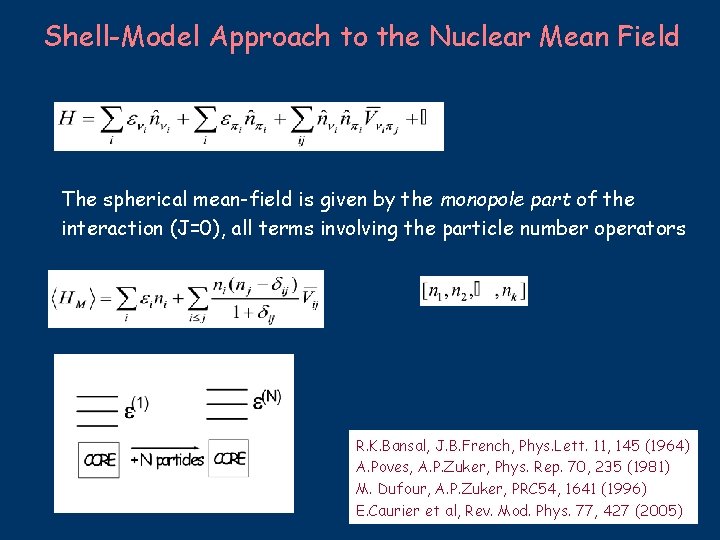
Shell-Model Approach to the Nuclear Mean Field The spherical mean-field is given by the monopole part of the interaction (J=0), all terms involving the particle number operators R. K. Bansal, J. B. French, Phys. Lett. 11, 145 (1964) A. Poves, A. P. Zuker, Phys. Rep. 70, 235 (1981) M. Dufour, A. P. Zuker, PRC 54, 1641 (1996) E. Caurier et al, Rev. Mod. Phys. 77, 427 (2005)
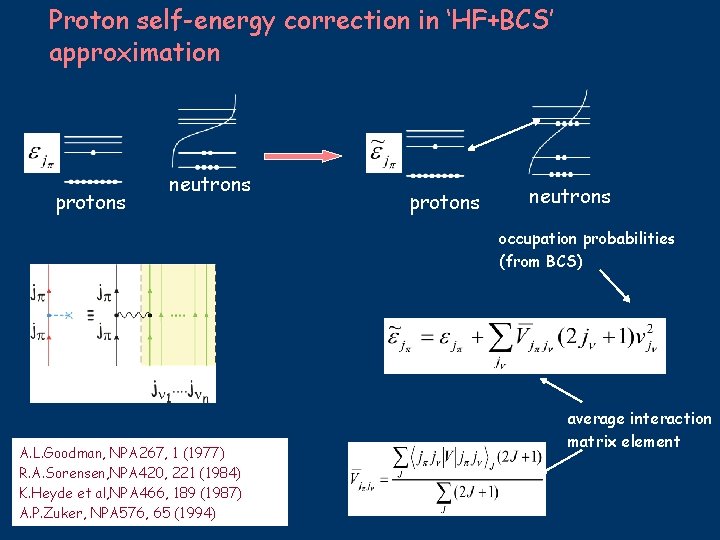
Proton self-energy correction in ‘HF+BCS’ approximation protons neutrons occupation probabilities (from BCS) A. L. Goodman, NPA 267, 1 (1977) R. A. Sorensen, NPA 420, 221 (1984) K. Heyde et al, NPA 466, 189 (1987) A. P. Zuker, NPA 576, 65 (1994) average interaction matrix element
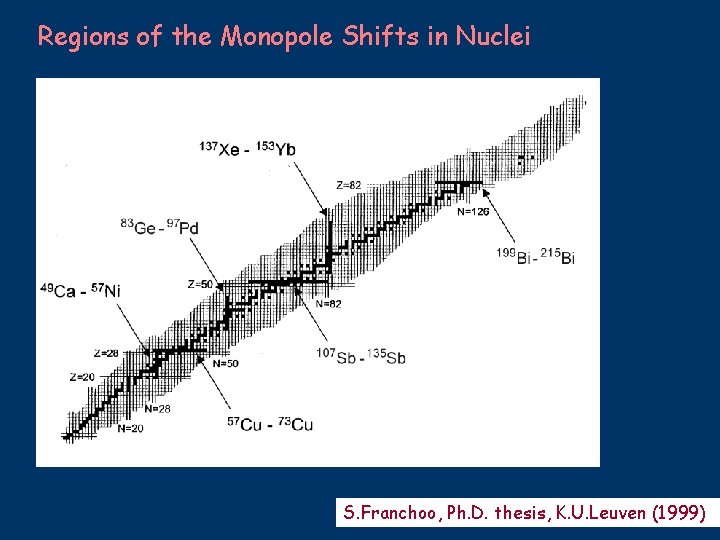
Regions of the Monopole Shifts in Nuclei S. Franchoo, Ph. D. thesis, K. U. Leuven (1999)
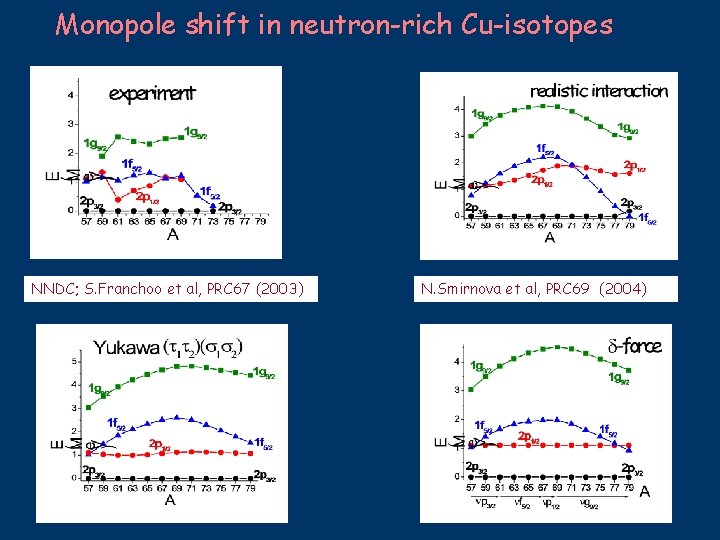
Monopole shift in neutron-rich Cu-isotopes NNDC; S. Franchoo et al, PRC 67 (2003) N. Smirnova et al, PRC 69 (2004)
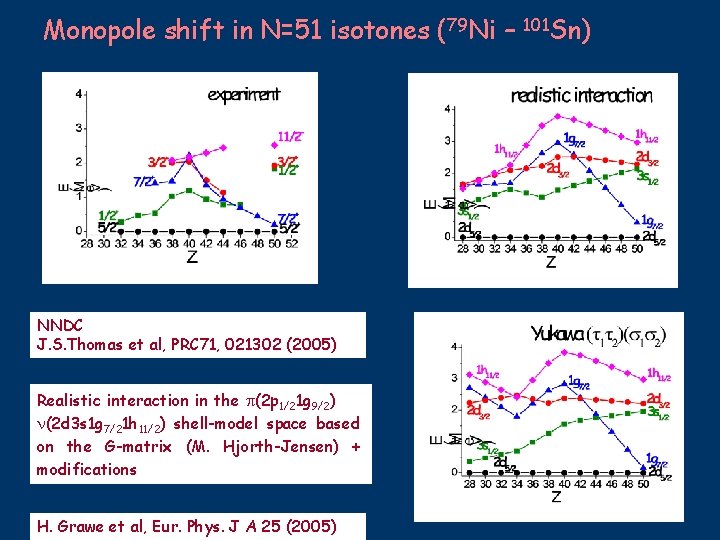
Monopole shift in N=51 isotones (79 Ni – NNDC J. S. Thomas et al, PRC 71, 021302 (2005) Realistic interaction in the (2 p 1/21 g 9/2) (2 d 3 s 1 g 7/21 h 11/2) shell-model space based on the G-matrix (M. Hjorth-Jensen) + modifications H. Grawe et al, Eur. Phys. J A 25 (2005) 101 Sn)
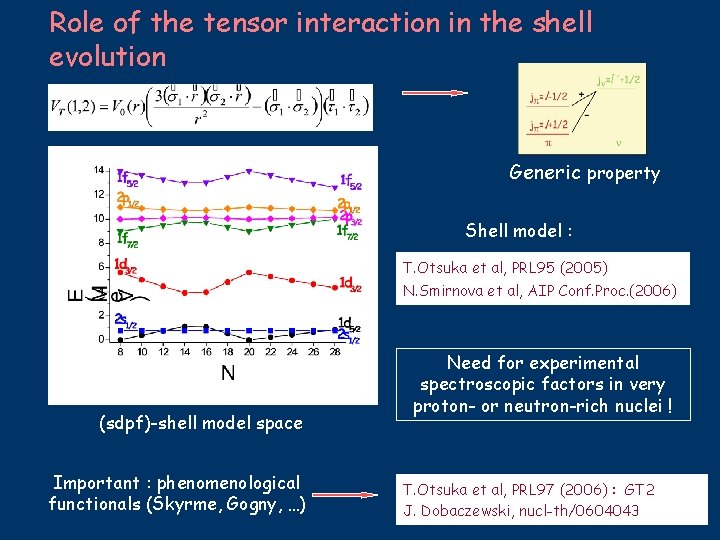
Role of the tensor interaction in the shell evolution Generic property Shell model : T. Otsuka et al, PRL 95 (2005) N. Smirnova et al, AIP Conf. Proc. (2006) (sdpf)-shell model space Important : phenomenological functionals (Skyrme, Gogny, …) Need for experimental spectroscopic factors in very proton- or neutron-rich nuclei ! T. Otsuka et al, PRL 97 (2006) : GT 2 J. Dobaczewski, nucl-th/0604043
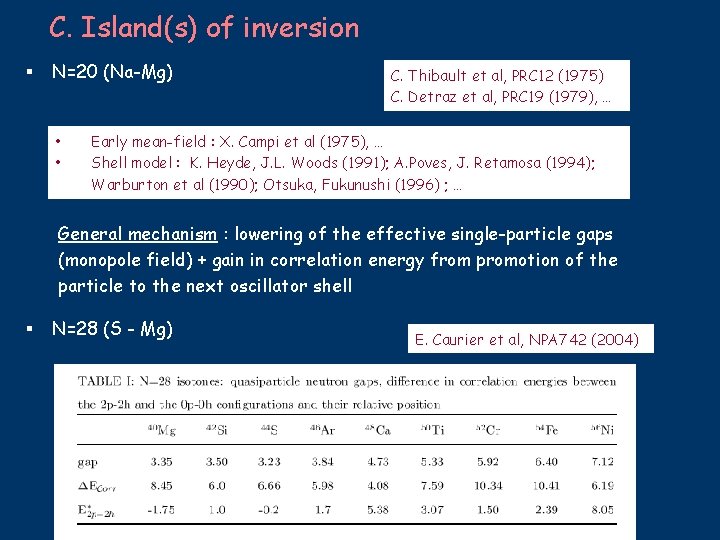
C. Island(s) of inversion § N=20 (Na-Mg) • • C. Thibault et al, PRC 12 (1975) C. Detraz et al, PRC 19 (1979), … Early mean-field : X. Campi et al (1975), … Shell model : K. Heyde, J. L. Woods (1991); A. Poves, J. Retamosa (1994); Warburton et al (1990); Otsuka, Fukunushi (1996) ; … General mechanism : lowering of the effective single-particle gaps (monopole field) + gain in correlation energy from promotion of the particle to the next oscillator shell § N=28 (S - Mg) E. Caurier et al, NPA 742 (2004)
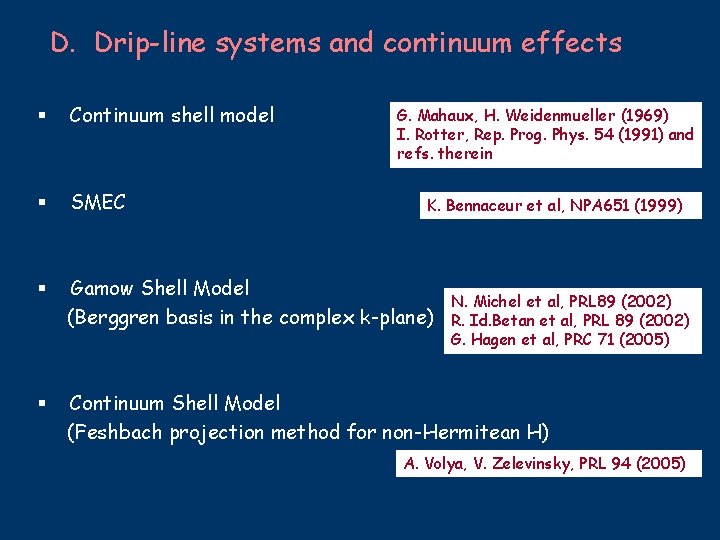
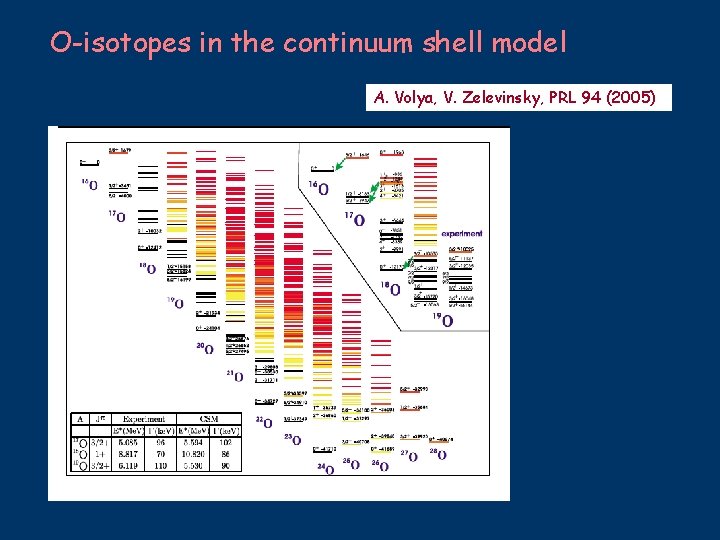
D. Drip-line systems and continuum effects § Continuum shell model § SMEC § Gamow Shell Model (Berggren basis in the complex k-plane) § Continuum Shell Model (Feshbach projection method for non-Hermitean H) G. Mahaux, H. Weidenmueller (1969) I. Rotter, Rep. Prog. Phys. 54 (1991) and refs. therein K. Bennaceur et al, NPA 651 (1999) N. Michel et al, PRL 89 (2002) R. Id. Betan et al, PRL 89 (2002) G. Hagen et al, PRC 71 (2005) A. Volya, V. Zelevinsky, PRL 94 (2005)
O-isotopes in the continuum shell model A. Volya, V. Zelevinsky, PRL 94 (2005)
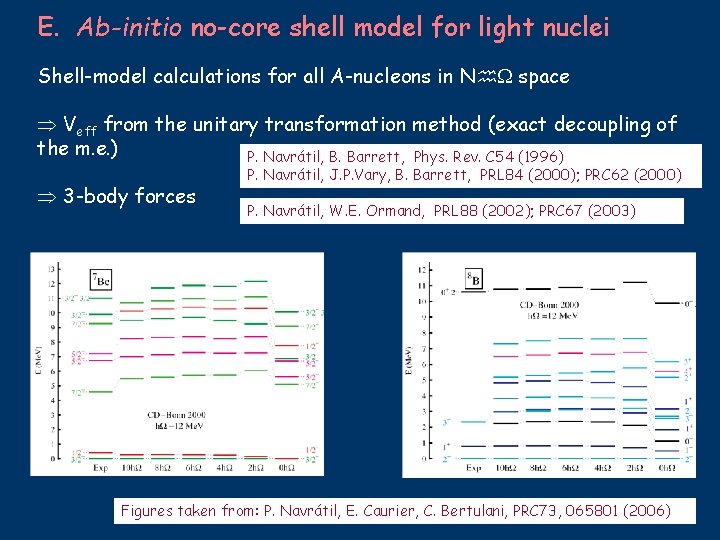
E. Ab-initio no-core shell model for light nuclei Shell-model calculations for all A-nucleons in N space Veff from the unitary transformation method (exact decoupling of the m. e. ) P. Navrátil, B. Barrett, Phys. Rev. C 54 (1996) 3 -body forces P. Navrátil, J. P. Vary, B. Barrett, PRL 84 (2000); PRC 62 (2000) P. Navrátil, W. E. Ormand, PRL 88 (2002); PRC 67 (2003) Figures taken from: P. Navrátil, E. Caurier, C. Bertulani, PRC 73, 065801 (2006)
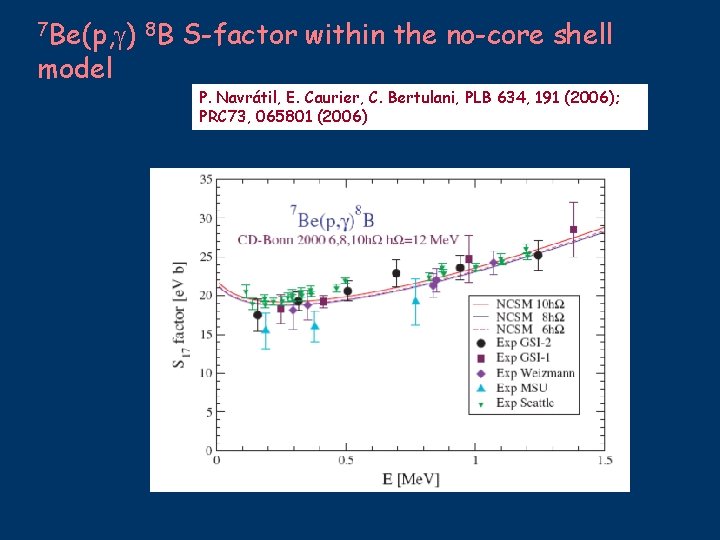
7 Be(p, ) 8 B model S-factor within the no-core shell P. Navrátil, E. Caurier, C. Bertulani, PLB 634, 191 (2006); PRC 73, 065801 (2006)
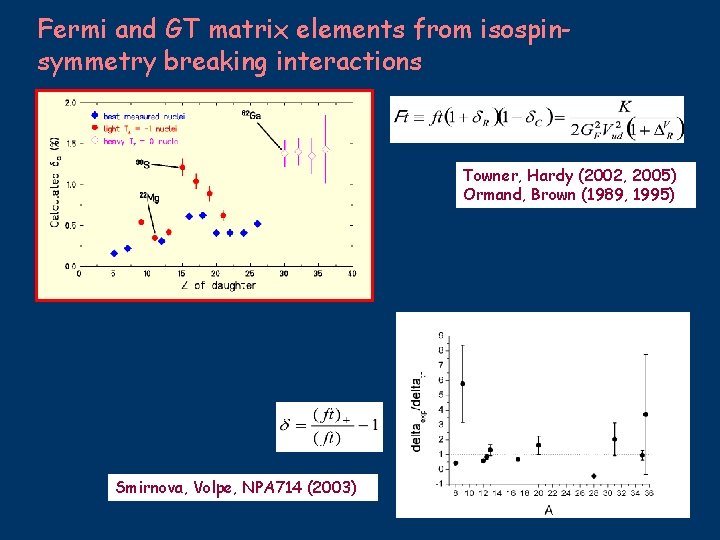
G. Nucleus as a laboratory to study weak interactions § Superallowed 0+ transitions and unitarity of CKM matrix § Search for G-parity violating terms in the axial-vector weak current (mirror transitions, correlation experiments) § First-forbidden decay and structure of the weak interaction beyond V-A hypothesis § … All this requires accurate description of the nuclear states, including isospin-symmetry breaking • • • Displacement of energy levels in mirror nuclei Isospin-forbidden proton or neutron emission Isospin-forbidden Fermi -decay Electromagentic transitions violating isospin symmetry (E 1 in N=Z nuclei) -delayed two proton emission, …
Fermi and GT matrix elements from isospinsymmetry breaking interactions Towner, Hardy (2002, 2005) Ormand, Brown (1989, 1995) Smirnova, Volpe, NPA 714 (2003)
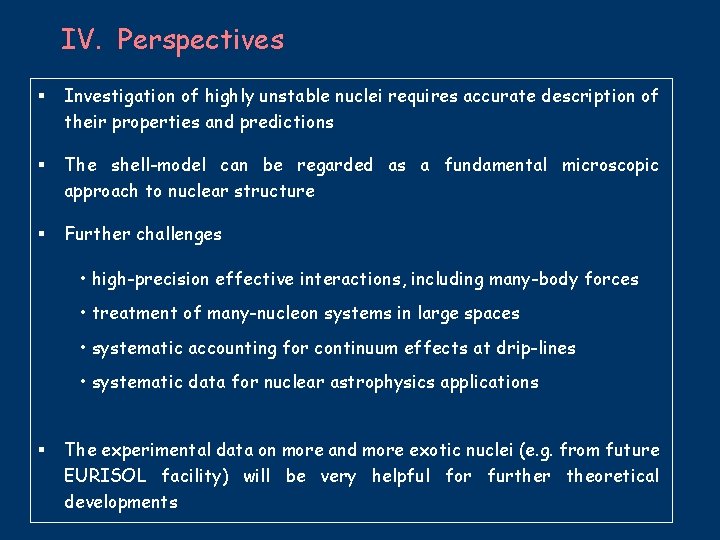
IV. Perspectives § Investigation of highly unstable nuclei requires accurate description of their properties and predictions § The shell-model can be regarded as a fundamental microscopic approach to nuclear structure § Further challenges • high-precision effective interactions, including many-body forces • treatment of many-nucleon systems in large spaces • systematic accounting for continuum effects at drip-lines • systematic data for nuclear astrophysics applications § The experimental data on more and more exotic nuclei (e. g. from future EURISOL facility) will be very helpful for further theoretical developments
Acknowledgements Theory : K. Heyde (University of Ghent, Belgium) E. Caurier, F. Nowacki (IRe. S, Strasbourg) C. Volpe (IPN, Orsay) P. Van Isacker (GANIL) Experiment : G. Neyens, P. Van Duppen, M. Huyse (University of Leuven) B. Blank (CENBG) A. Andreyev (TRIUMF, Vancouver) G. Georgiev (CSNSM, Orsay) F. De Oliveira, J. -Ch. Thomas (GANIL) J. L. Wood (GT, Atlanta)