
Shellfish Restoration Planning in Connecticut Shellfish Gathering Update



- Slides: 18
Shellfish Restoration Planning in Connecticut Shellfish Gathering Update 1/10/2020
Background and context • Bivalve shellfish are part of a healthy Long Island Sound and play a role in improving impaired estuarine waters of Connecticut. • Natural shellfish beds, especially oyster and mussel reefs, provide numerous ecosystem services e. g. habitat and food provision for aquatic organisms, water filtration and erosion control. • Shellfish production provides jobs and recreation. Aquaculture is valued at over $30 million dollars in the state and sales of recreational shellfishing permits are in excess of $100, 000 annually (with a multiplier effect of millions of dollars)
The problem • Shellfish populations and the environment have historically been impacted by pollution, development, severe storms and overfishing. • Changing environmental conditions may further affect shellfish populations. • Many of these habitats are not optimal condition to support ecosystem services, fisheries and aquaculture. • Concerns exist about how restoration can occur and be compatible with existing uses, and how funding is best spent. • No plan is in place to guide the development of projects.
What is “shellfish restoration” 1. Conservation: protecting existing shellfish beds from human and environmental threats; 2. Management: rehabilitating historic shellfish beds for fisheries and aquaculture purposes; 3. Restoration: creating or enhancing shellfish beds for ecosystems services such as providing habitat, improving water quality, stabilizing shorelines against erosion Goal: to develop a plan that addresses barriers and recommendations for high priority restoration projects and practices for Connecticut.
Goals and Objectives Objective 1. Conduct analysis environmental conditions and human use maps/data to inform the process of identifying potential sites and practices for shellfish restoration in Connecticut; Objective 2. Engage key players to review GIS analysis, and refine by identifying priority sites, practices, restoration resources and funding; Objective 3. Conduct site visits to at least three high priority potential restoration sites and create a GIS data layer containing descriptive physical, biological, regulatory and logistical characteristics of the areas; Objective 4. Share draft plan with key players and solicit input; Objective 5. Develop a guidance document on the state/federal regulatory requirements for restoration; and Objective 6. Submit final shellfish restoration plan to USDA NRCS.
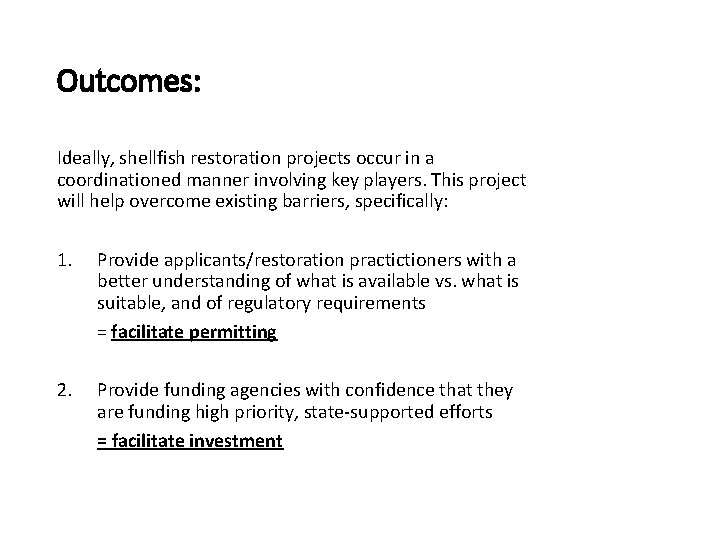
Outcomes: Ideally, shellfish restoration projects occur in a coordinationed manner involving key players. This project will help overcome existing barriers, specifically: 1. Provide applicants/restoration practictioners with a better understanding of what is available vs. what is suitable, and of regulatory requirements = facilitate permitting 2. Provide funding agencies with confidence that they are funding high priority, state-supported efforts = facilitate investment
Who’s involved? • Facilitation: • Connecticut Sea Grant • Connecticut Department of Agriculture • Connecticut Department of Environmental Protection • Key players (includes but not limited to): • • • Shellfish industry Shellfish / harbor management commissions State/Federal regulators Coastal engineers Environmental groups Restoration practictioners
Timeline Project Task Obj. 1. GIS analysis Q 4 2018 Q 1 2019 x x Obj. 2. Engage partners Q 2 2019 Q 3 2019 x x Q 4 2019 Q 1 2019 Q 2 2020 Q 3 2020 Obj. 3. Engage stakeholders x Obj. 4. Site Visits x x x Obj. 6. Regulatory guidance x x x Obj. 7. Restoration plan x x x Obj. 5. Outreach x x
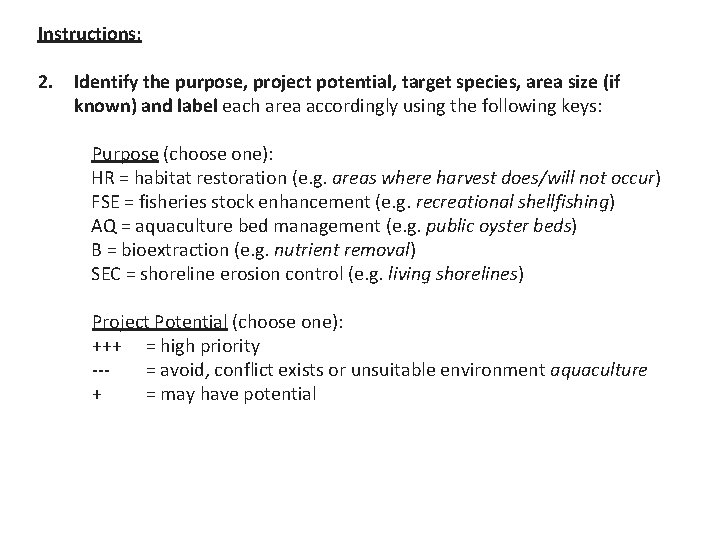
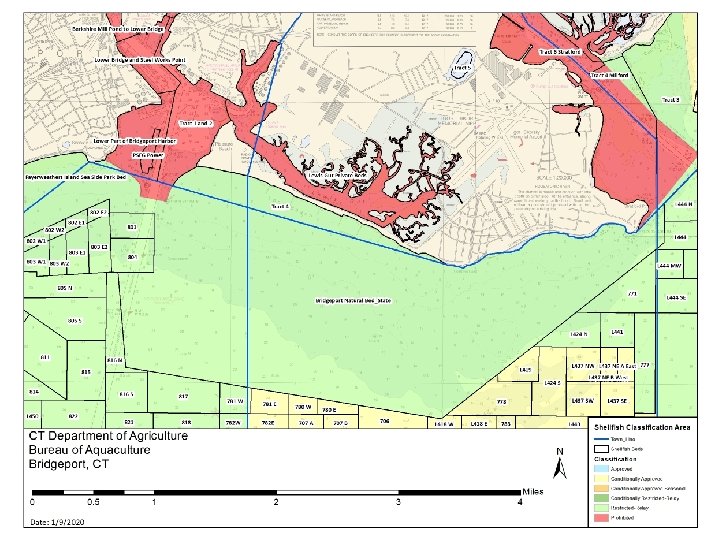
Instructions: 2. Identify the purpose, project potential, target species, area size (if known) and label each area accordingly using the following keys: Purpose (choose one): HR = habitat restoration (e. g. areas where harvest does/will not occur) FSE = fisheries stock enhancement (e. g. recreational shellfishing) AQ = aquaculture bed management (e. g. public oyster beds) B = bioextraction (e. g. nutrient removal) SEC = shoreline erosion control (e. g. living shorelines) Project Potential (choose one): +++ = high priority --= avoid, conflict exists or unsuitable environment aquaculture + = may have potential
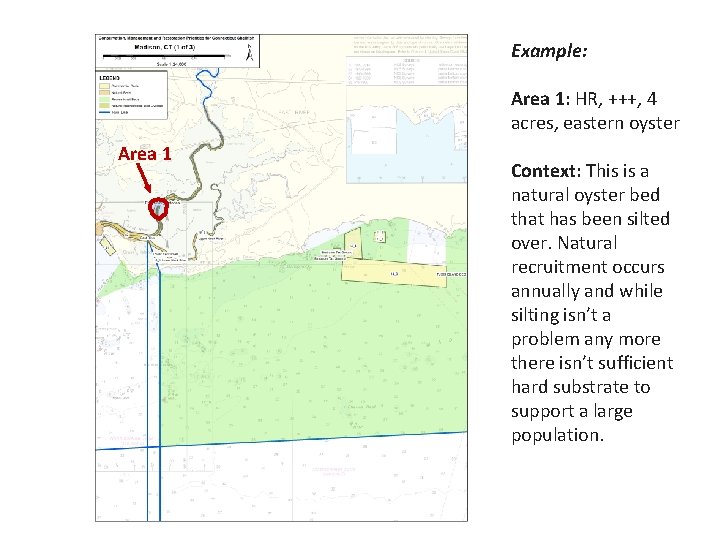
Example: Area 1: HR, +++, 4 acres, eastern oyster Area 1 Context: This is a natural oyster bed that has been silted over. Natural recruitment occurs annually and while silting isn’t a problem any more there isn’t sufficient hard substrate to support a large population.
CONSERVATION, MANAGEMENT AND RESTORATION PRIORITIES AND PRACTICES FOR CONNECTICUT SHELLFISH Purpose of Project: The goal of this project is to develop, through a transparent, collaborative process, a comprehensive shellfish conservation, management and restoration plan that addresses barriers and recommendations for high priority projects and practices for Connecticut. Purpose of Shellfish Restoration Steering Committee: Partner organizations representing local, state and federal planning and regulatory agencies, environmental organizations, restoration practitioners, academia, and the aquaculture sector, will be engaged in the review and refining of the results of a GIS analysis* and will also provide input and feedback on a plan for shellfish restoration priorities and practices in Connecticut. Steering committee members will assist in the identification of priority sites, practices and municipal restoration resources and potential funding sources. *GIS analysis will inform the process of identifying potential sites and practices for shellfish restoration in Connecticut.
Shellfish Restoration Steering Committee: Bell’s Shellfish - David Hopp 203 -515 -2631 bells. coastal@gmail. com CT Billion Oyster Project - Katie Mosher kmoshersmith@nyharbor. org And Peter Malinowski pmalinowski@nyharbor. org CT DA/BA - Kristin De. Rosia-Banick Kristin. De. Rosia-Banick@ct. gov CT DA/BA - David Carey David. carey@ct. gov CTSG – Tessa Getchis tessa. getchis@uconn. edu CT DEEP - Harry Yamalis harry. yamalis@ct. gov CT DEEP - Krista Romero krista. romero@ct. gov CT DEEP – Christopher Bellucci christopher. bellucci@ct. gov (or designee) (NEFSC holding interviews for new shellfish biologist; ask Lisa Milke in January) NRCS CT - Debbie Surabian debbie. surabian@usda. gov Save the Sound - Gwen Mac. Donald gmacdonald@savethesound. org TNC – Nathan Frohling nfrohling@tnc. org UConn Extension - Mike O’Neill mp. oneill@uconn. edu USFWS – Suzanne Paton suzanne_paton@fws. gov NOAA - Jim Turek James. Turek@noaa. gov NOAA – Elizabeth Hayes Elizabeth. hayes@noaa. gov ACOE – Cori Rose Cori. M. Rose@usace. army. mil NMFS - Alison Verkade alison. verkade@noaa. gov The Sound School - Peter Solomon peter. solomon@new-haven. k 12. ct. us Fairfield Shellfish Commission - John C. Short, Jr. shellfishcommission@fairfieldct. org Cornell Cooperative Extension – Chris Pickerell cp 26@cornell. edu (or designee) ? ? Pew Charitable Trust - Aaron Kornbluth akornbluth@pewtrusts. org Stakeholder Group: Long Island Soundkeeper - Bill Lucey Harbor Watch – S. Crosby (or designee) blucey@savethesound. org s. crosby@earthplace. org
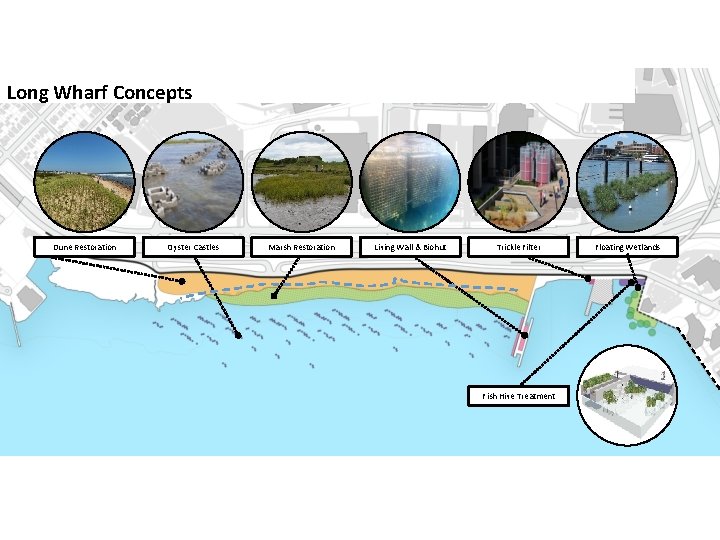
Long Wharf Concepts Proposed Road + Wall Dune Restoration Oyster Castles Marsh Restoration Living Wall & Biohut Trickle Filter Fish Hive Treatment Floating Wetlands