
Shellbased Support Structures for Nb 3 Sn Accelerator
Shell-based Support Structures for Nb 3 Sn Accelerator Quadrupole Magnets Paolo Ferracin Workshop on Accelerator Magnet, Superconductor, Design and Optimization CERN May 19 – 23, 2008 Paolo Ferracin 05/23/08
Outline • • • Introduction: shell based support structures Principles of operation Overview of LARP shell-base structures Assembly, cool-down effect and excitation Axial support Length scale-up • Shell axial strain • Flexural rigidity and LHe containment • Alignment • Conclusions Paolo Ferracin 05/23/08 2
Introduction Shell based support structure • Shell-based structures • Aluminum segmented shell (solid tube) • 4 -piece yoke with open gaps during operation • Assembly through two sub-assemblies • Pre-loading with water pressurized bladders • Maximum stress reached after cool-down • Axial coil support by end-plate and axial rods • The concept has been adopted to cope with the requirements of high field (high forces) Nb 3 Sn (brittle conductor) magnets • Capability of providing large forces • Precise control of coil pre-load • Through LARP Magnet R&D accelerator quality features Paolo Ferracin 05/23/08 3
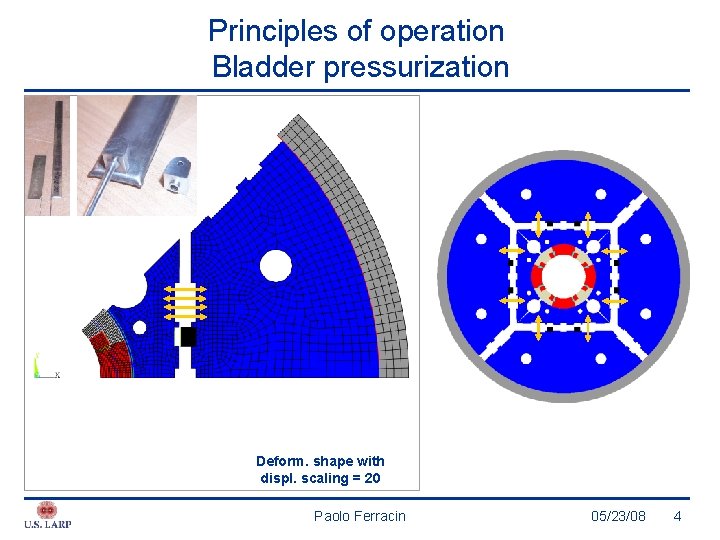
Principles of operation Bladder pressurization Deform. shape with displ. scaling = 20 Paolo Ferracin 05/23/08 4

Principles of operation Key insertion and bladder deflation Deform. shape with displ. scaling = 20 Paolo Ferracin 05/23/08 5
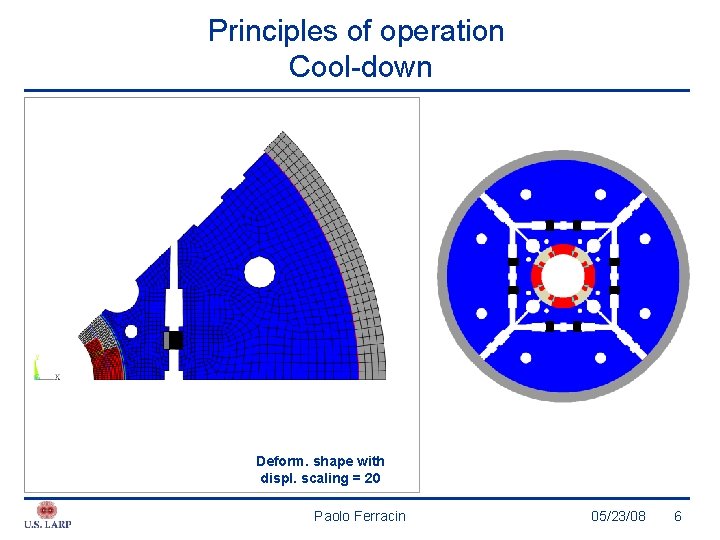
Principles of operation Cool-down Deform. shape with displ. scaling = 20 Paolo Ferracin 05/23/08 6
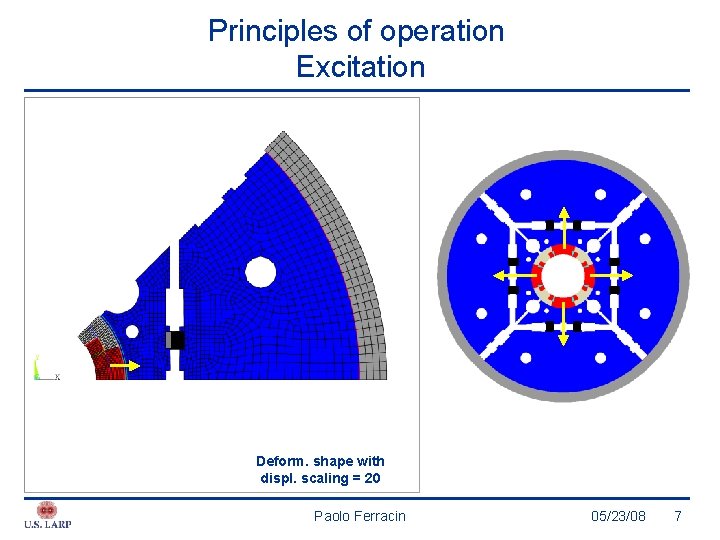
Principles of operation Excitation Deform. shape with displ. scaling = 20 Paolo Ferracin 05/23/08 7
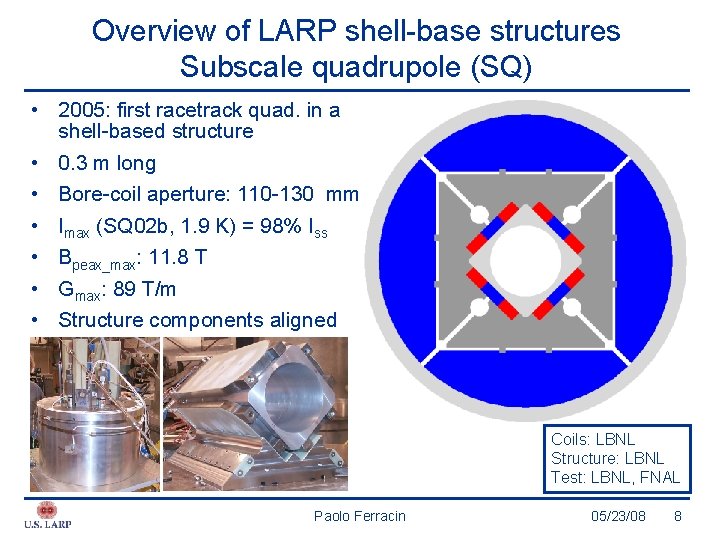
Overview of LARP shell-base structures Subscale quadrupole (SQ) • 2005: first racetrack quad. in a shell-based structure • 0. 3 m long • Bore-coil aperture: 110 -130 mm • Imax (SQ 02 b, 1. 9 K) = 98% Iss • Bpeax_max: 11. 8 T • Gmax: 89 T/m • Structure components aligned Coils: LBNL Structure: LBNL Test: LBNL, FNAL Paolo Ferracin 05/23/08 8
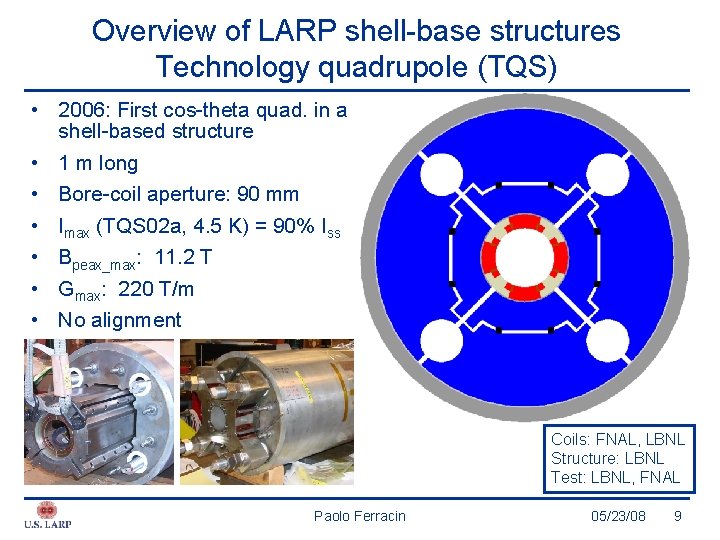
Overview of LARP shell-base structures Technology quadrupole (TQS) • 2006: First cos-theta quad. in a shell-based structure • 1 m long • Bore-coil aperture: 90 mm • Imax (TQS 02 a, 4. 5 K) = 90% Iss • Bpeax_max: 11. 2 T • Gmax: 220 T/m • No alignment Coils: FNAL, LBNL Structure: LBNL Test: LBNL, FNAL Paolo Ferracin 05/23/08 9
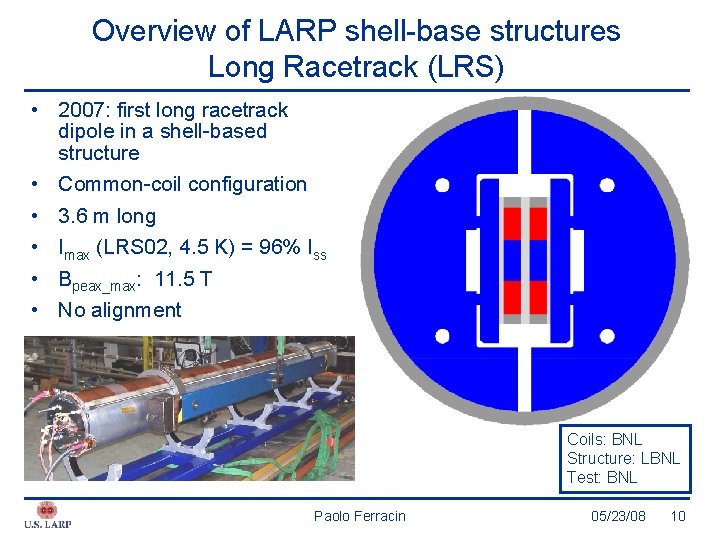
Overview of LARP shell-base structures Long Racetrack (LRS) • 2007: first long racetrack dipole in a shell-based structure • Common-coil configuration • 3. 6 m long • Imax (LRS 02, 4. 5 K) = 96% Iss • Bpeax_max: 11. 5 T • No alignment Coils: BNL Structure: LBNL Test: BNL Paolo Ferracin 05/23/08 10
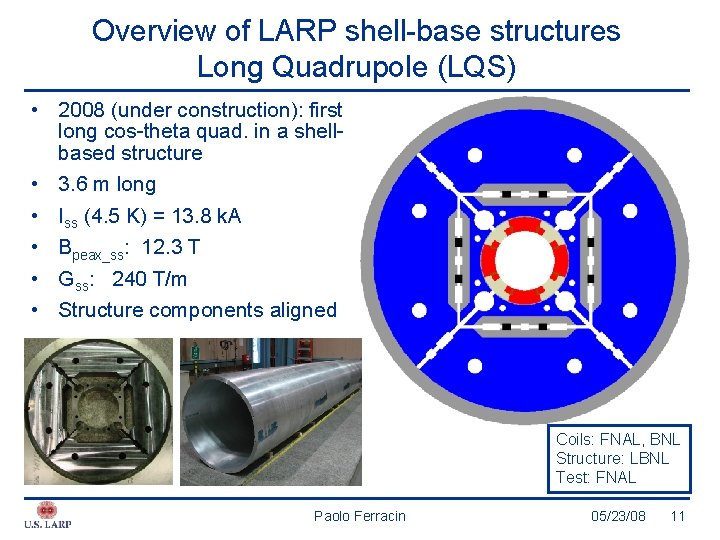
Overview of LARP shell-base structures Long Quadrupole (LQS) • 2008 (under construction): first long cos-theta quad. in a shellbased structure • 3. 6 m long • Iss (4. 5 K) = 13. 8 k. A • Bpeax_ss: 12. 3 T • Gss: 240 T/m • Structure components aligned Coils: FNAL, BNL Structure: LBNL Test: FNAL Paolo Ferracin 05/23/08 11
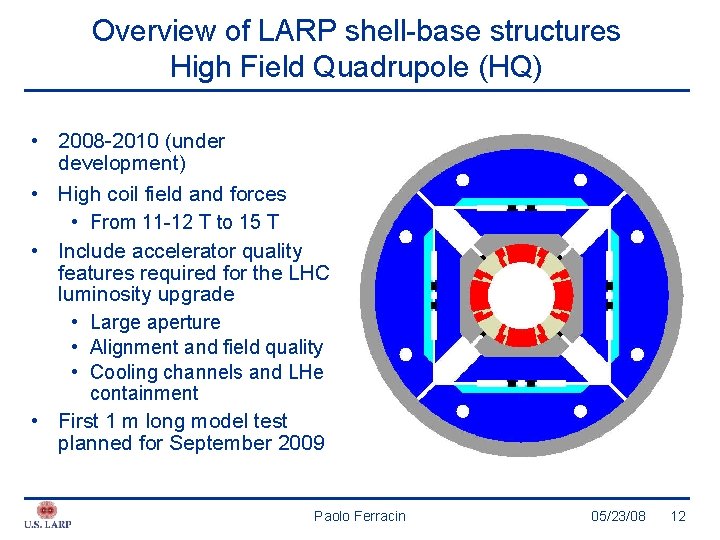
Overview of LARP shell-base structures High Field Quadrupole (HQ) • 2008 -2010 (under development) • High coil field and forces • From 11 -12 T to 15 T • Include accelerator quality features required for the LHC luminosity upgrade • Large aperture • Alignment and field quality • Cooling channels and LHe containment • First 1 m long model test planned for September 2009 Paolo Ferracin 05/23/08 12
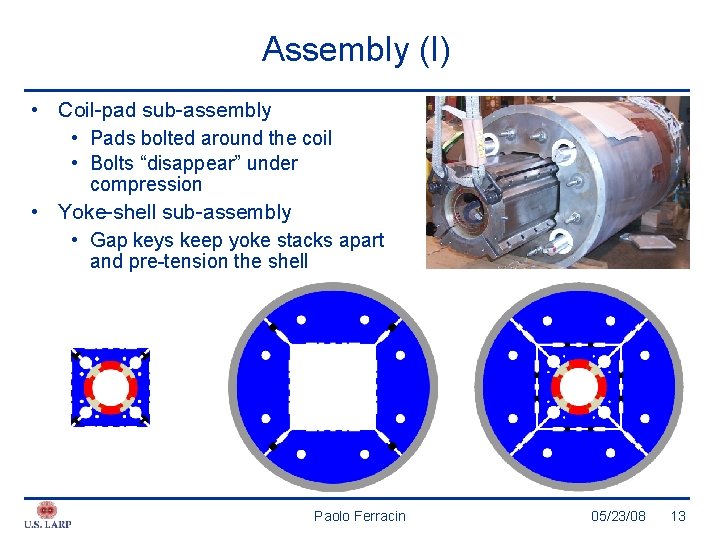
Assembly (I) • Coil-pad sub-assembly • Pads bolted around the coil • Bolts “disappear” under compression • Yoke-shell sub-assembly • Gap keys keep yoke stacks apart and pre-tension the shell Paolo Ferracin 05/23/08 13
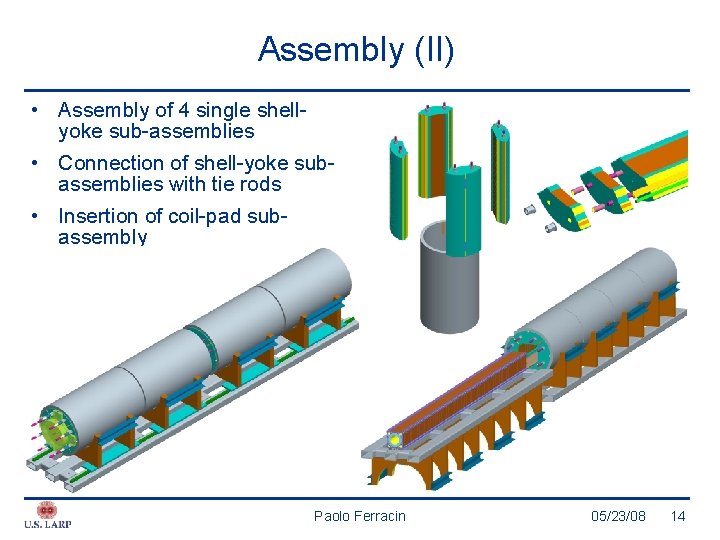
Assembly (II) • Assembly of 4 single shellyoke sub-assemblies • Connection of shell-yoke subassemblies with tie rods • Insertion of coil-pad subassembly Paolo Ferracin 05/23/08 14
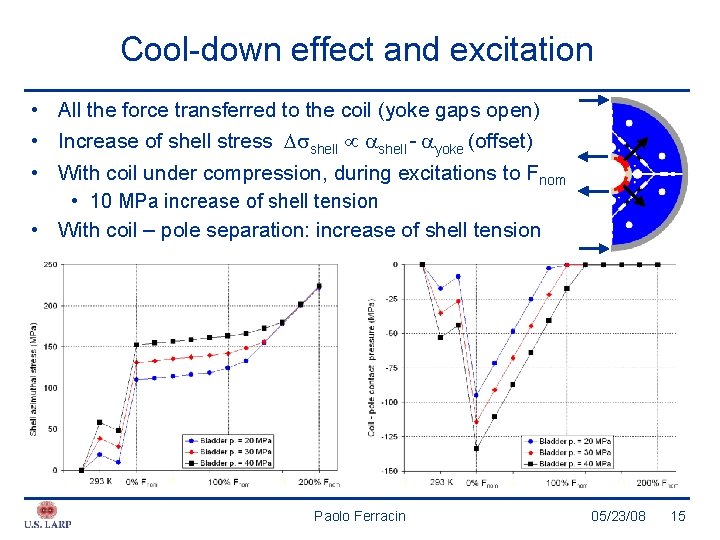
Cool-down effect and excitation • All the force transferred to the coil (yoke gaps open) • Increase of shell stress shell - yoke (offset) • With coil under compression, during excitations to Fnom • 10 MPa increase of shell tension • With coil – pole separation: increase of shell tension Paolo Ferracin 05/23/08 15
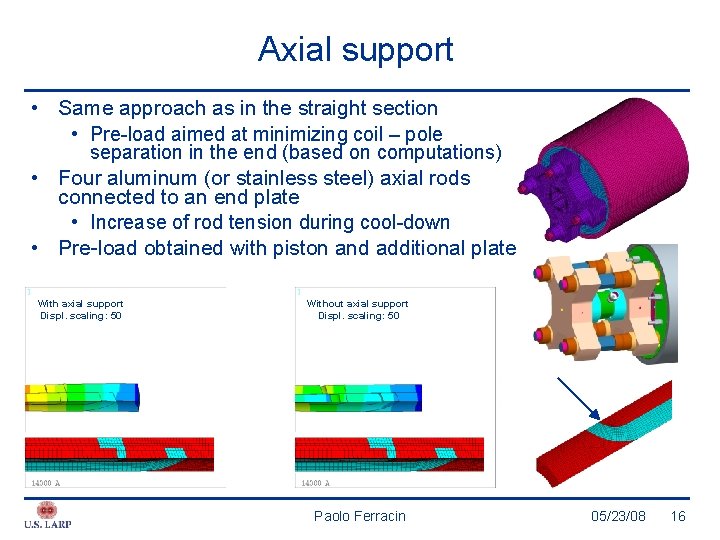
Axial support • Same approach as in the straight section • Pre-load aimed at minimizing coil – pole separation in the end (based on computations) • Four aluminum (or stainless steel) axial rods connected to an end plate • Increase of rod tension during cool-down • Pre-load obtained with piston and additional plate With axial support Displ. scaling: 50 Without axial support Displ. scaling: 50 Paolo Ferracin 05/23/08 16
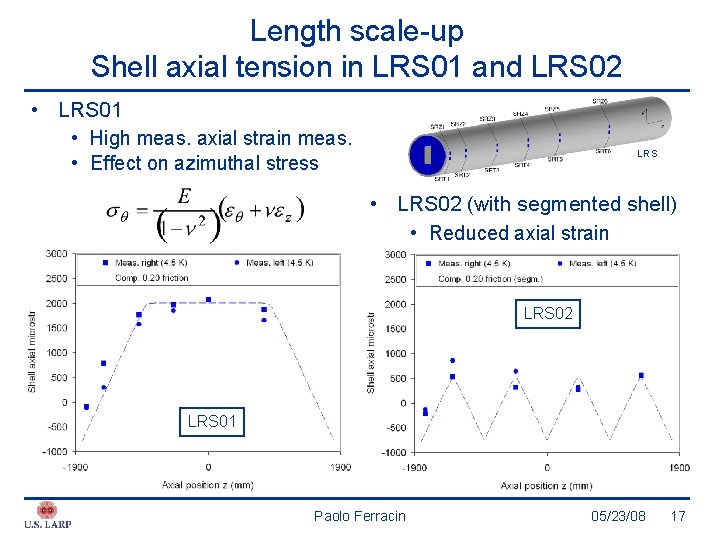
Length scale-up Shell axial tension in LRS 01 and LRS 02 • LRS 01 • High meas. axial strain meas. • Effect on azimuthal stress LRS • LRS 02 (with segmented shell) • Reduced axial strain LQS LRS 02 LRS 01 Paolo Ferracin 05/23/08 17
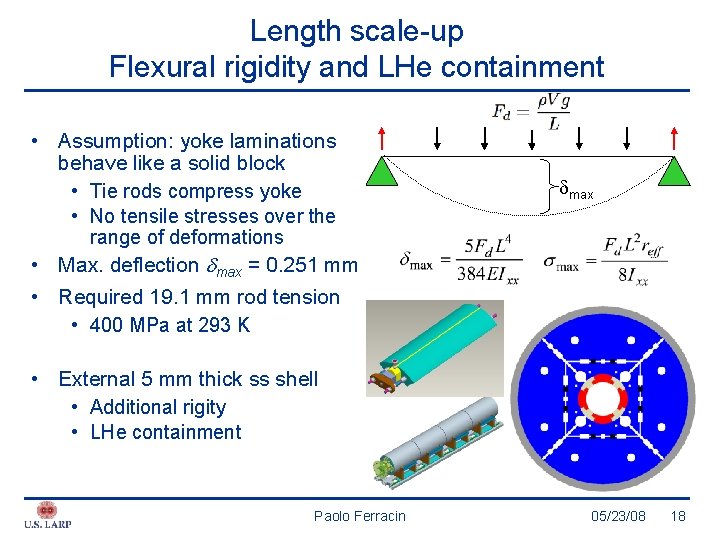
Length scale-up Flexural rigidity and LHe containment • Assumption: yoke laminations behave like a solid block • Tie rods compress yoke • No tensile stresses over the max range of deformations • Max. deflection max = 0. 251 mm • Required 19. 1 mm rod tension • 400 MPa at 293 K • External 5 mm thick ss shell • Additional rigity • LHe containment Paolo Ferracin 05/23/08 18
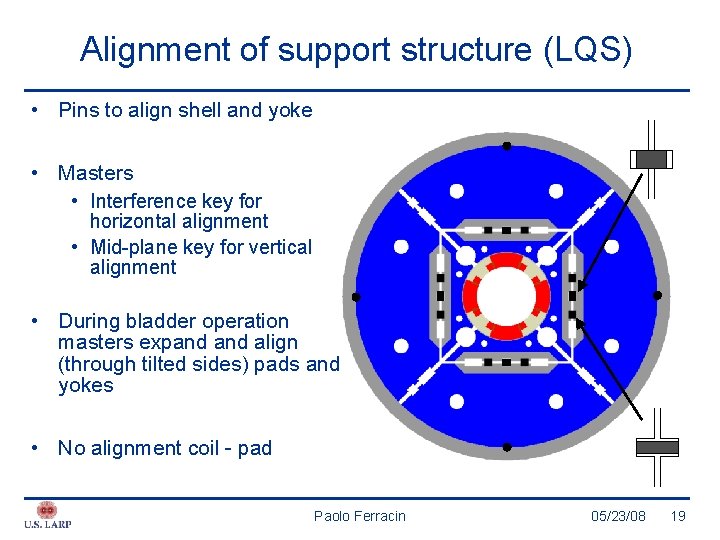
Alignment of support structure (LQS) • Pins to align shell and yoke • Masters • Interference key for horizontal alignment • Mid-plane key for vertical alignment • During bladder operation masters expand align (through tilted sides) pads and yokes • No alignment coil - pad Paolo Ferracin 05/23/08 19
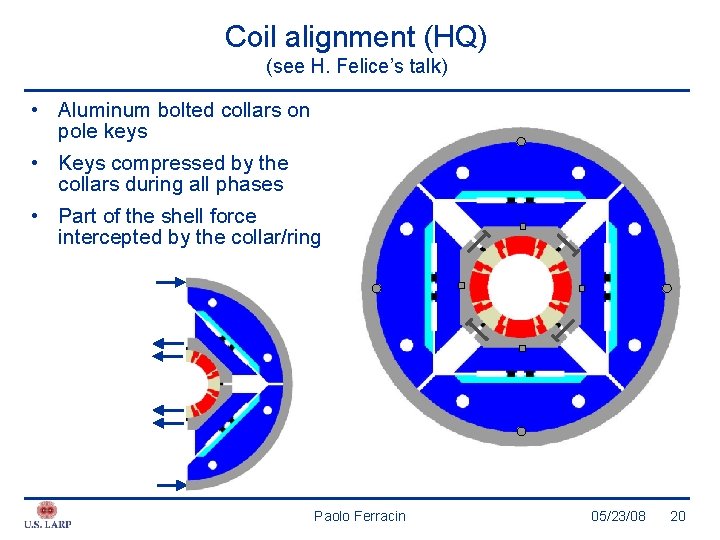
Coil alignment (HQ) (see H. Felice’s talk) • Aluminum bolted collars on pole keys • Keys compressed by the collars during all phases • Part of the shell force intercepted by the collar/ring Paolo Ferracin 05/23/08 20
Conclusions • Shell-based structures have been proven to provide • Accurate control and safe assembly pre-load level • Reduce risks of degrading brittle Nb 3 Sn superconductor • Large pre-load force • Capability of supporting coils in very high field • Accelerator quality features are being introduced in the structure design through the LARP Program • Assembly and load of cos-theta coils: TQ • Alignment of the support structure: SQ, LQS • Assembly, load, rigidity of long magnets: LRS, LQS • High field and coil alignment : HQ Paolo Ferracin 05/23/08 21
Appendix Paolo Ferracin 05/23/08 22
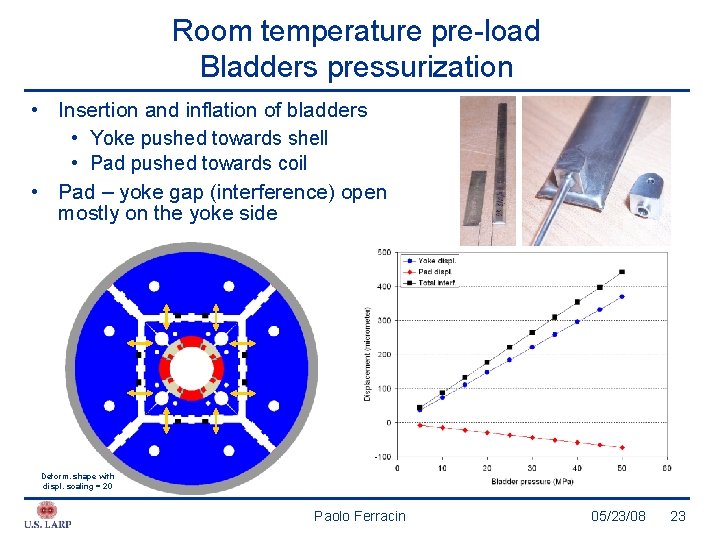
Room temperature pre-load Bladders pressurization • Insertion and inflation of bladders • Yoke pushed towards shell • Pad pushed towards coil • Pad – yoke gap (interference) open mostly on the yoke side Deform. shape with displ. scaling = 20 Displ. scaling: 20 Paolo Ferracin 05/23/08 23
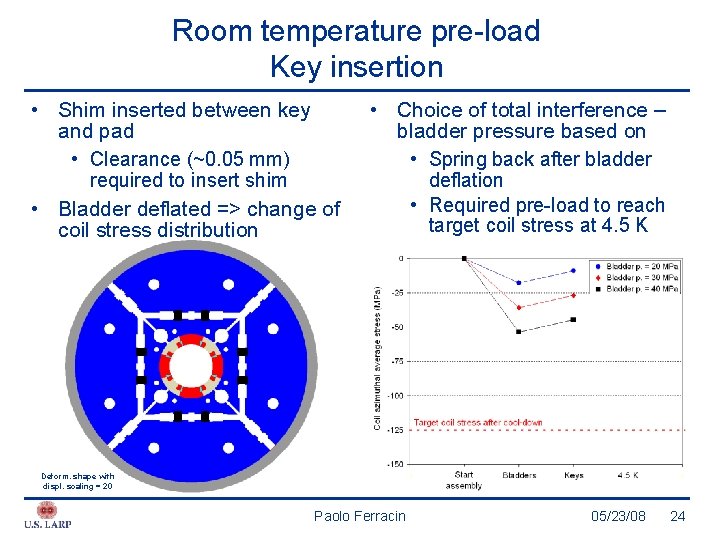
Room temperature pre-load Key insertion • Shim inserted between key and pad • Clearance (~0. 05 mm) • Choice of total interference – bladder pressure based on • Spring back after bladder required to insert shim • Bladder deflated => change of coil stress distribution deflation • Required pre-load to reach target coil stress at 4. 5 K Deform. shape with displ. scaling = 20 Paolo Ferracin 05/23/08 24
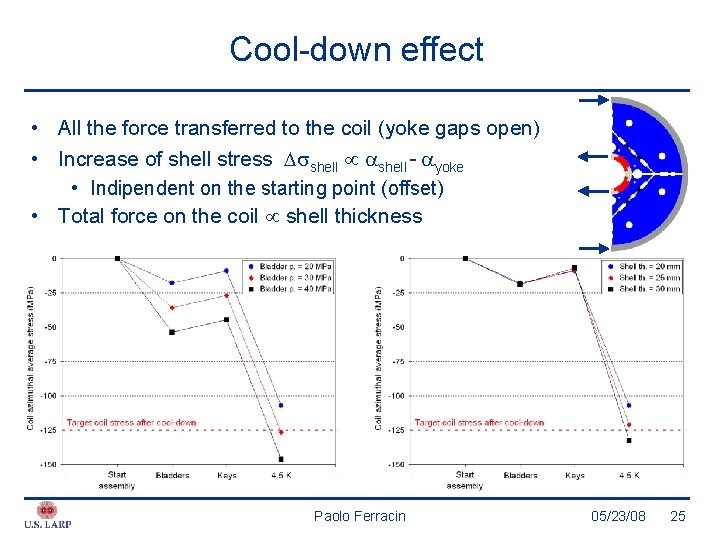
Cool-down effect • All the force transferred to the coil (yoke gaps open) • Increase of shell stress shell - yoke • Indipendent on the starting point (offset) • Total force on the coil shell thickness Paolo Ferracin 05/23/08 25
- Slides: 25