
SHELL Integrated Gas Roger Bounds Global Head of
SHELL Integrated Gas Roger Bounds Global Head of Shell LNG, Shell Integrated Gas Copyright Shell Eastern Petroleum Pte Ltd November 2014 1
DEFINITIONS AND CAUTIONARY NOTE Reserves: Our use of the term “reserves” in this presentation means SEC proved oil and gas reserves. Resources: Our use of the term “resources” in this presentation includes quantities of oil and gas not yet classified as SEC proved oil and gas reserves. Resources are consistent with the Society of Petroleum Engineers 2 P and 2 C definitions. Organic: Our use of the term Organic includes SEC proved oil and gas reserves excluding changes resulting from acquisitions, divestments and year-average pricing impact. Resources plays: our use of the term ‘resources plays’ refers to tight, shale and coal bed methane oil and gas acreage. The companies in which Royal Dutch Shell plc directly and indirectly owns investments are separate entities. In this presentation “Shell”, “Shell group” and “Royal Dutch Shell” are sometimes used for convenience where references are made to Royal Dutch Shell plc and its subsidiaries in general. Likewise, the words “we”, “us” and “our” are also used to refer to subsidiaries in general or to those who work for them. These expressions are also used where no useful purpose is served by identifying the particular company or companies. ‘‘Subsidiaries’’, “Shell subsidiaries” and “Shell companies” as used in this presentation refer to companies in which Royal Dutch Shell either directly or indirectly has control, by having either a majority of the voting rights or the right to exercise a controlling influence. The companies in which Shell has significant influence but not control are referred to as “associated companies” or “associates” and companies in which Shell has joint control are referred to as “jointly controlled entities”. In this presentation, associates and jointly controlled entities are also referred to as “equity-accounted investments”. The term “Shell interest” is used for convenience to indicate the direct and/or indirect ownership interest held by Shell in a venture, partnership or company, after exclusion of all third-party interest. This presentation contains forward-looking statements concerning the financial condition, results of operations and businesses of Royal Dutch Shell. All statements other than statements of historical fact are, or may be deemed to be, forward-looking statements. Forward-looking statements are statements of future expectations that are based on management’s current expectations and assumptions and involve known and unknown risks and uncertainties that could cause actual results, performance or events to differ materially from those expressed or implied in these statements. Forward-looking statements include, among other things, statements concerning the potential exposure of Royal Dutch Shell to market risks and statements expressing management’s expectations, beliefs, estimates, forecasts, projections and assumptions. These forward-looking statements are identified by their use of terms and phrases such as ‘‘anticipate’’, ‘‘believe’’, ‘‘could’’, ‘‘estimate’’, ‘‘expect’’, ‘‘intend’’, ‘‘may’’, ‘‘plan’’, ‘‘objectives’’, ‘‘outlook’’, ‘‘probably’’, ‘‘project’’, ‘‘will’’, ‘‘seek’’, ‘‘target’’, ‘‘risks’’, ‘‘goals’’, ‘‘should’’ and similar terms and phrases. There a number of factors that could affect the future operations of Royal Dutch Shell and could cause those results to differ materially from those expressed in the forwardlooking statements included in this presentation, including (without limitation): (a) price fluctuations in crude oil and natural gas; (b) changes in demand for Shell’s products; (c) currency fluctuations; (d) drilling and production results; (e) reserves estimates; (f) loss of market share and industry competition; (g) environmental and physical risks; (h) risks associated with the identification of suitable potential acquisition properties and targets, and successful negotiation and completion of such transactions; (i) the risk of doing business in developing countries and countries subject to international sanctions; (j) legislative, fiscal and regulatory developments including potential litigation and regulatory measures as a result of climate changes; (k) economic and financial market conditions in various countries and regions; (l) political risks, including the risks of expropriation and renegotiation of the terms of contracts with governmental entities, delays or advancements in the approval of projects and delays in the reimbursement for shared costs; and (m) changes in trading conditions. All forward-looking statements contained in this presentation are expressly qualified in their entirety by the cautionary statements contained or referred to in this section. Readers should not place undue reliance on forward-looking statements. Additional factors that may affect future results are contained in Royal Dutch Shell’s 20 -F for the year ended 31 December, 2013 (available at www. shell. com/investor and www. sec. gov ). These factors also should be considered by the reader. Each forward-looking statement speaks only as of the date of this presentation, 6 November 2014. Neither Royal Dutch Shell nor any of its subsidiaries undertake any obligation to publicly update or revise any forward-looking statement as a result of new information, future events or other information. In light of these risks, results could differ materially from those stated, implied or inferred from the forward-looking statements contained in this presentation. There can be no assurance that dividend payments will match or exceed those set out in this presentation in the future, or that they will be made at all. We use certain terms in this presentation, such as discovery potential, that the United States Securities and Exchange Commission (SEC) guidelines strictly prohibit us from including in filings Copyright Shell. Investors Eastern Petroleum Pte Ltd 2 with the SEC. U. S. are urged to consider closely the disclosure in our Form 20 -F, File No 1 -32575, available on the SEC website www. sec. gov. You. October can also 2014 obtain this form from August 2013 Copyright of Shell Exploration & Production Co. 2 the SEC by calling 1 -800 -SEC-0330.
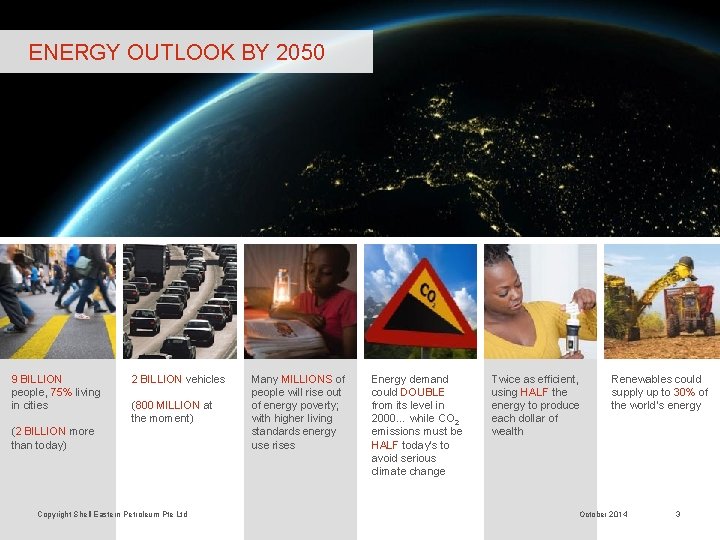
ENERGY OUTLOOK BY 2050 9 BILLION people, 75% living in cities 2 BILLION vehicles (800 MILLION at the moment) (2 BILLION more than today) Copyright Shell Eastern Petroleum Pte Ltd Many MILLIONS of people will rise out of energy poverty; with higher living standards energy use rises Energy demand could DOUBLE from its level in 2000… while CO 2 emissions must be HALF today’s to avoid serious climate change Twice as efficient, using HALF the energy to produce each dollar of wealth Renewables could supply up to 30% of the world’s energy October 2014 3

BENEFITS OF GAS AIR QUALITY SMARTER PLANNING Copyright of Shell COMPANY Eastern Petroleum NAME Pte Ltd LOWER CO 2 JOBS FEWER EMISSIONS October 2014 4
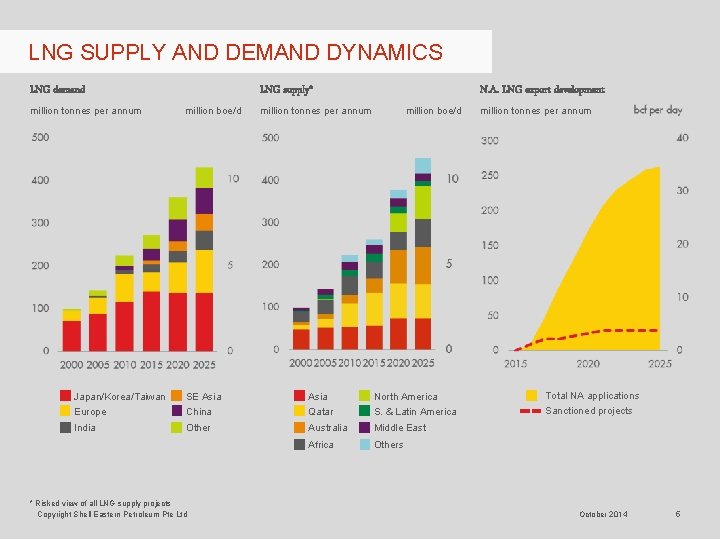
LNG SUPPLY AND DEMAND DYNAMICS LNG demand million tonnes per annum LNG supply* million boe/d N. A. LNG export development million tonnes per annum million boe/d Japan/Korea/Taiwan Europe SE Asia China Asia Qatar North America India Other Australia Middle East Africa Others * Risked view of all LNG supply projects Copyright Shell Eastern Petroleum Pte Ltd S. & Latin America million tonnes per annum Total NA applications Sanctioned projects October 2014 5
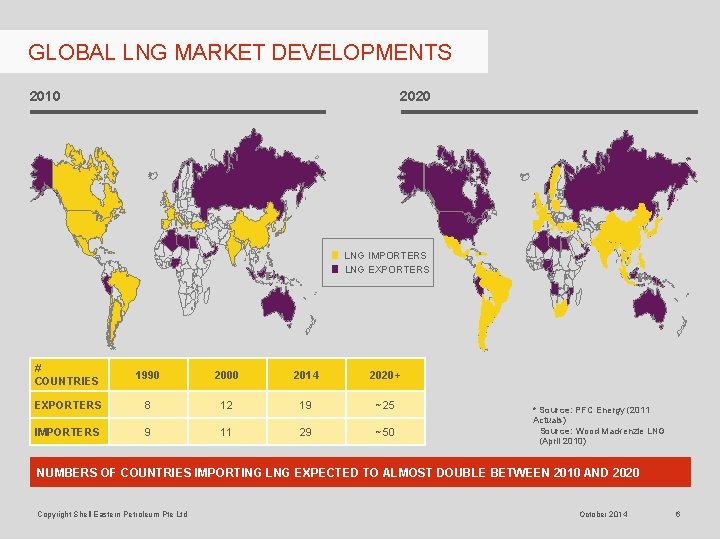
GLOBAL LNG MARKET DEVELOPMENTS 2020 2010 LNG IMPORTERS LNG EXPORTERS # COUNTRIES 1990 2000 2014 2020+ EXPORTERS 8 12 19 ~25 IMPORTERS 9 11 29 ~50 * Source: PFC Energy (2011 Actuals) Source: Wood Mackenzie LNG (April 2010) NUMBERS OF COUNTRIES IMPORTING LNG EXPECTED TO ALMOST DOUBLE BETWEEN 2010 AND 2020 Copyright of Shell COMPANY Eastern Petroleum NAME Pte Ltd October 2014 6
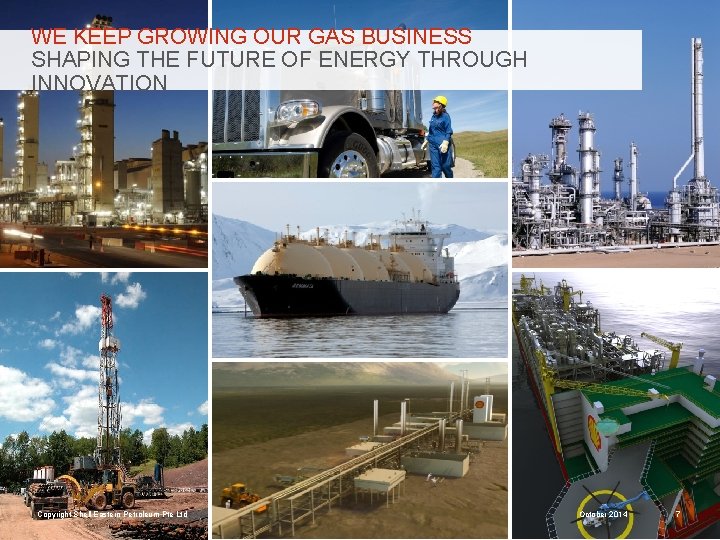
WE KEEP GROWING OUR GAS BUSINESS SHAPING THE FUTURE OF ENERGY THROUGH INNOVATION Copyright Shell Eastern Petroleum Pte Ltd October 2014 7
- Slides: 8