
Shell Exploration Production HEMP and HAZID 27022021 File
- Slides: 17
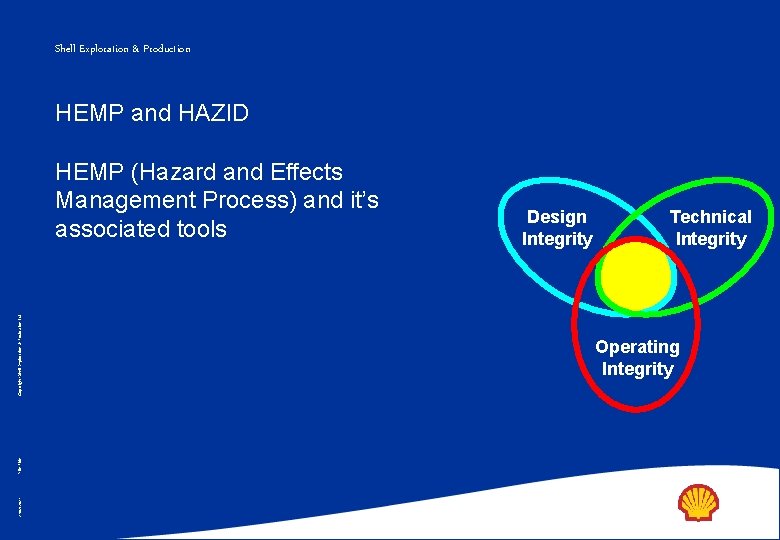
Shell Exploration & Production HEMP and HAZID 27/02/2021 File Title Copyright: Shell Exploration & Production Ltd. HEMP (Hazard and Effects Management Process) and it’s associated tools Design Integrity Technical Integrity Operating Integrity
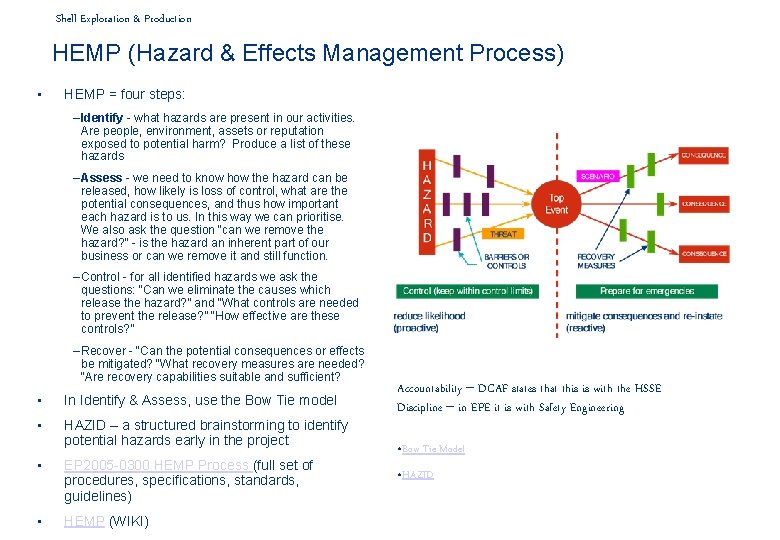
Shell Exploration & Production HEMP (Hazard & Effects Management Process) • HEMP = four steps: – Identify - what hazards are present in our activities. Are people, environment, assets or reputation exposed to potential harm? Produce a list of these hazards – Assess - we need to know how the hazard can be released, how likely is loss of control, what are the potential consequences, and thus how important each hazard is to us. In this way we can prioritise. We also ask the question “can we remove the hazard? ” - is the hazard an inherent part of our business or can we remove it and still function. – Control - for all identified hazards we ask the questions: “Can we eliminate the causes which release the hazard? ” and “What controls are needed to prevent the release? ” “How effective are these controls? ” – Recover - “Can the potential consequences or effects be mitigated? “What recovery measures are needed? “Are recovery capabilities suitable and sufficient? • In Identify & Assess, use the Bow Tie model • HAZID – a structured brainstorming to identify potential hazards early in the project • EP 2005 -0300 HEMP Process (full set of procedures, specifications, standards, guidelines) • HEMP (WIKI) Accountability – DCAF states that this is with the HSSE Discipline – in EPE it is with Safety Engineering • Bow Tie Model • HAZID
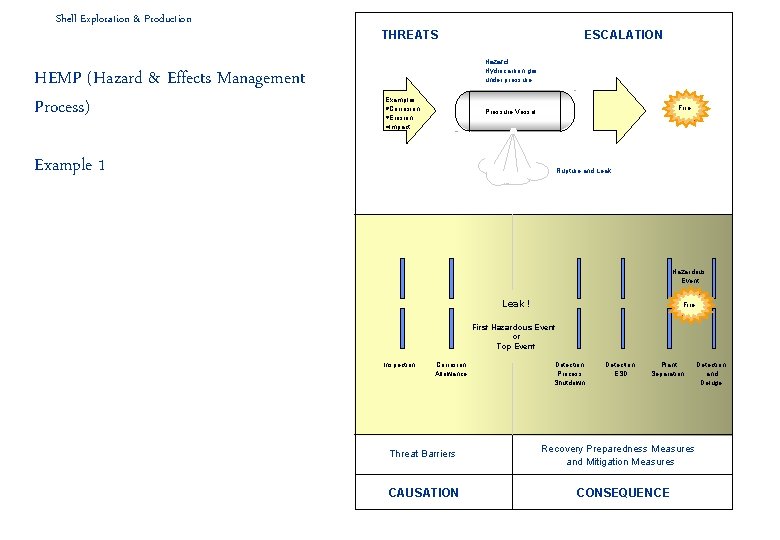
Shell Exploration & Production HEMP (Hazard & Effects Management Process) THREATS ESCALATION Hazard : Hydrocarbon gas under pressure Examples: Corrosion Erosion Impact Fire Pressure Vessel Example 1 Rupture and Leak Hazardous Event Leak ! Fire First Hazardous Event or Top Event Inspection Corrosion Allowance Threat Barriers CAUSATION Detection Process Shutdown Detection ESD Plant Separation Recovery Preparedness Measures and Mitigation Measures CONSEQUENCE Detection and Deluge
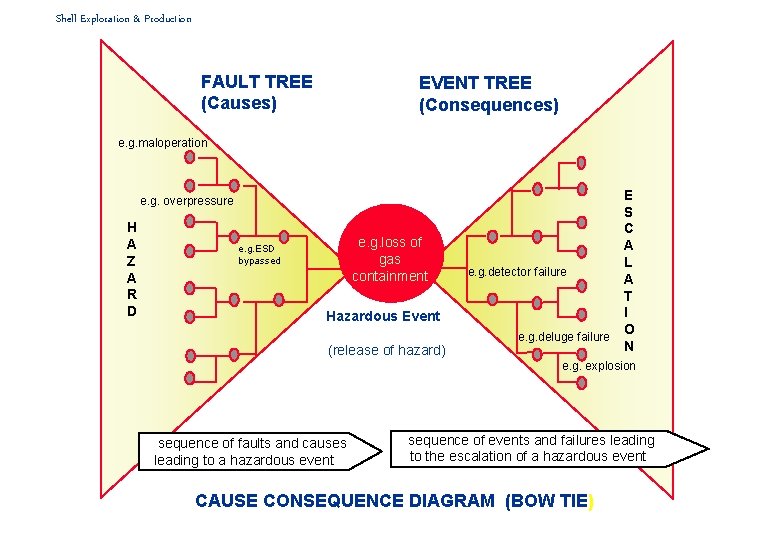
Shell Exploration & Production FAULT TREE (Causes) EVENT TREE (Consequences) e. g. maloperation e. g. overpressure H A Z A R D e. g. loss of gas containment e. g. ESD bypassed Hazardous Event (release of hazard) E S C A L e. g. detector failure A T I O e. g. deluge failure N e. g. explosion sequence of faults and causes leading to a hazardous event sequence of events and failures leading to the escalation of a hazardous event CAUSE CONSEQUENCE DIAGRAM (BOW TIE)
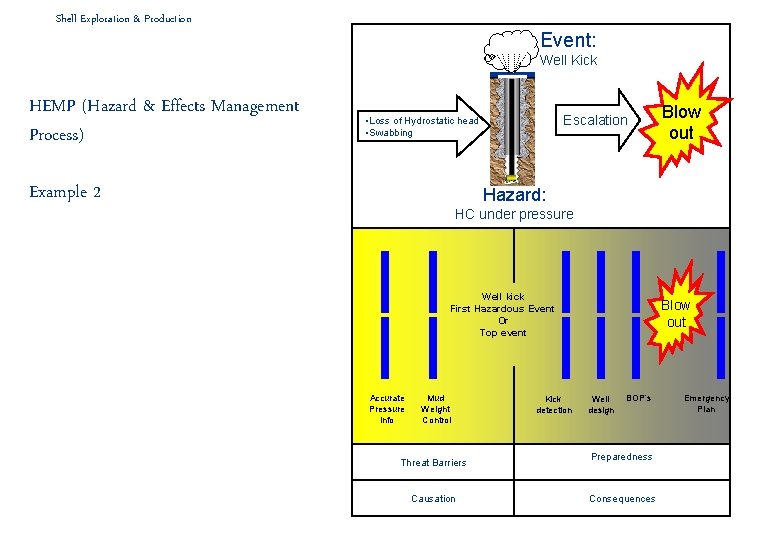
Shell Exploration & Production Event: Well Kick HEMP (Hazard & Effects Management Process) Threats Escalation • Loss of Hydrostatic head • Swabbing Example 2 Blow out Hazard: HC under pressure Well kick First Hazardous Event Or Top event Accurate Pressure info Mud Weight Control Kick detection Blow out Well design BOP’s Emergency Plan Threat Barriers Recovery Preparedness Measures And Mitigation Measures Causation Consequences
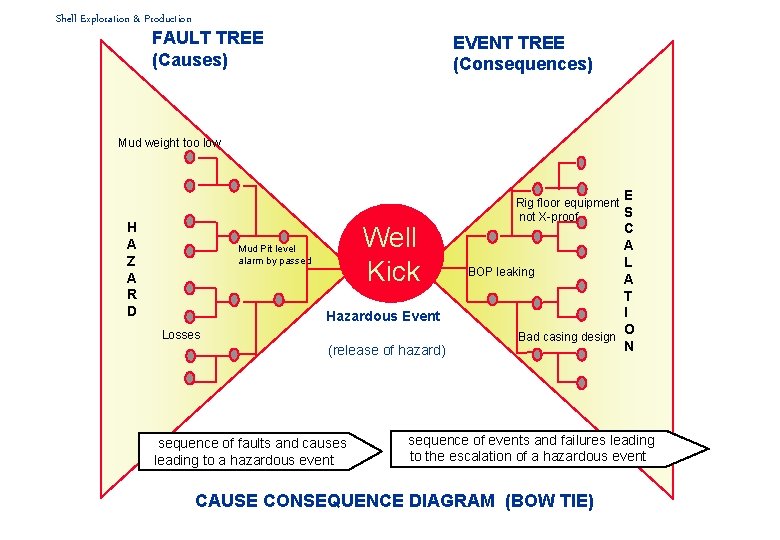
Shell Exploration & Production FAULT TREE (Causes) EVENT TREE (Consequences) Mud weight too low E H A Z A R D Well Kick Mud Pit level alarm by passed Hazardous Event Losses (release of hazard) sequence of faults and causes leading to a hazardous event Rig floor equipment S not X-proof C A L BOP leaking A T I O Bad casing design N sequence of events and failures leading to the escalation of a hazardous event CAUSE CONSEQUENCE DIAGRAM (BOW TIE)
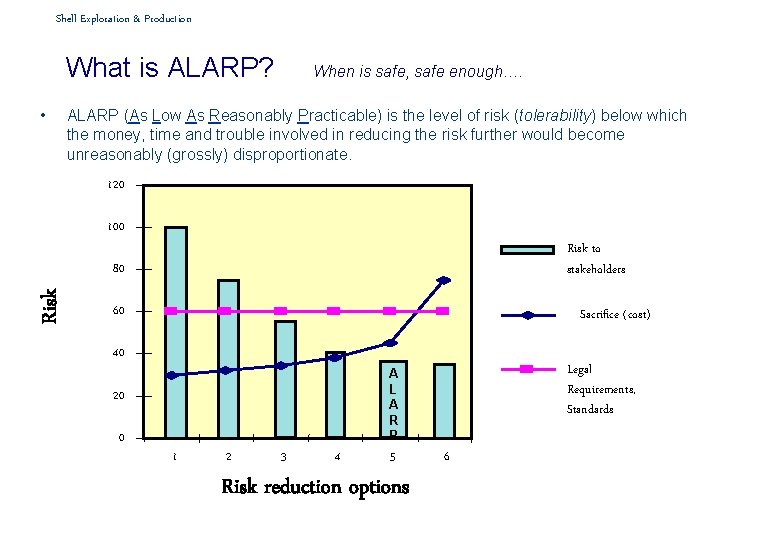
Shell Exploration & Production What is ALARP? • When is safe, safe enough…. ALARP (As Low As Reasonably Practicable) is the level of risk (tolerability) below which the money, time and trouble involved in reducing the risk further would become unreasonably (grossly) disproportionate. 120 100 Risk to stakeholders Risk 80 60 Sacrifice (cost) 40 20 0 Legal Requirements, Standards A L A R P 1 2 3 4 5 Risk reduction options 6
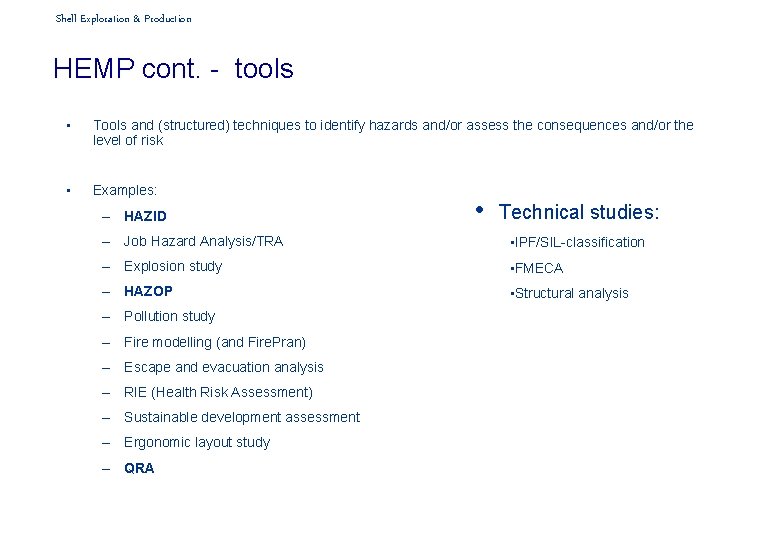
Shell Exploration & Production HEMP cont. - tools • Tools and (structured) techniques to identify hazards and/or assess the consequences and/or the level of risk • Examples: – HAZID • Technical studies: – Job Hazard Analysis/TRA • IPF/SIL-classification – Explosion study • FMECA – HAZOP • Structural analysis – Pollution study – Fire modelling (and Fire. Pran) – Escape and evacuation analysis – RIE (Health Risk Assessment) – Sustainable development assessment – Ergonomic layout study – QRA
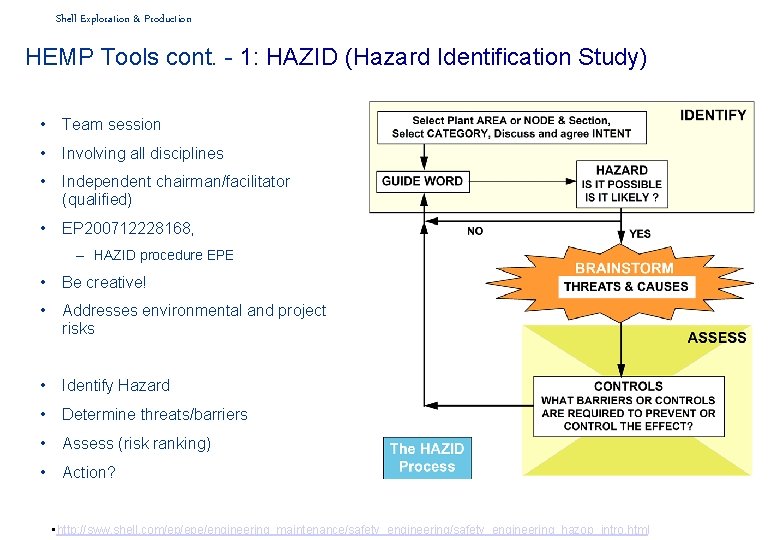
Shell Exploration & Production HEMP Tools cont. - 1: HAZID (Hazard Identification Study) • Team session • Involving all disciplines • Independent chairman/facilitator (qualified) • EP 200712228168, – HAZID procedure EPE • Be creative! • Addresses environmental and project risks • Identify Hazard • Determine threats/barriers • Assess (risk ranking) • Action? • http: //sww. shell. com/ep/epe/engineering_maintenance/safety_engineering_hazop_intro. html
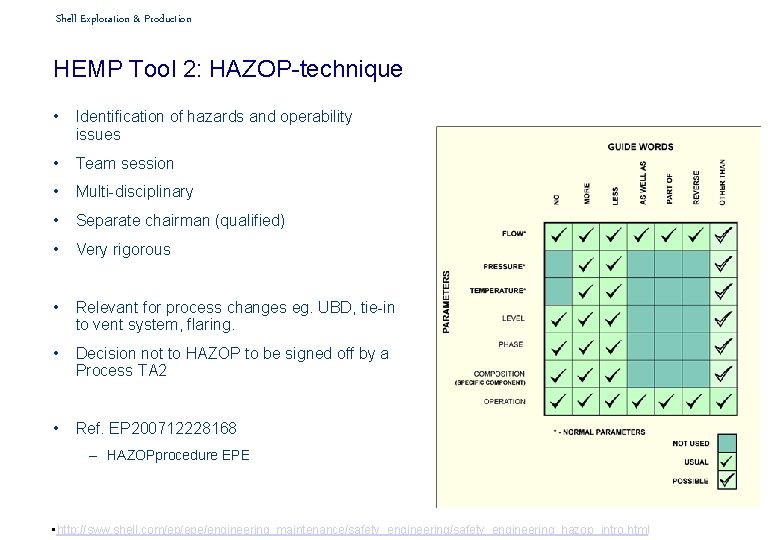
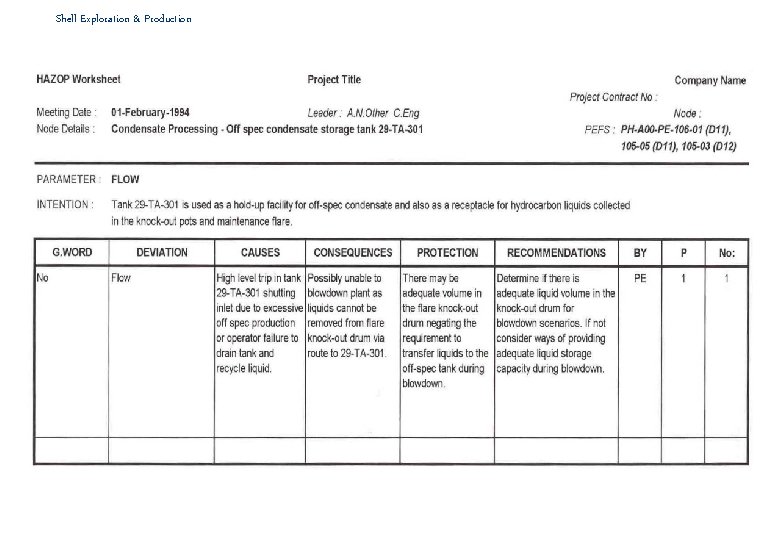
Shell Exploration & Production HEMP Tool 2: HAZOP-technique • Identification of hazards and operability issues • Team session • Multi-disciplinary • Separate chairman (qualified) • Very rigorous • Relevant for process changes eg. UBD, tie-in to vent system, flaring. • Decision not to HAZOP to be signed off by a Process TA 2 • Ref. EP 200712228168 – HAZOPprocedure EPE • http: //sww. shell. com/ep/epe/engineering_maintenance/safety_engineering_hazop_intro. html
Shell Exploration & Production
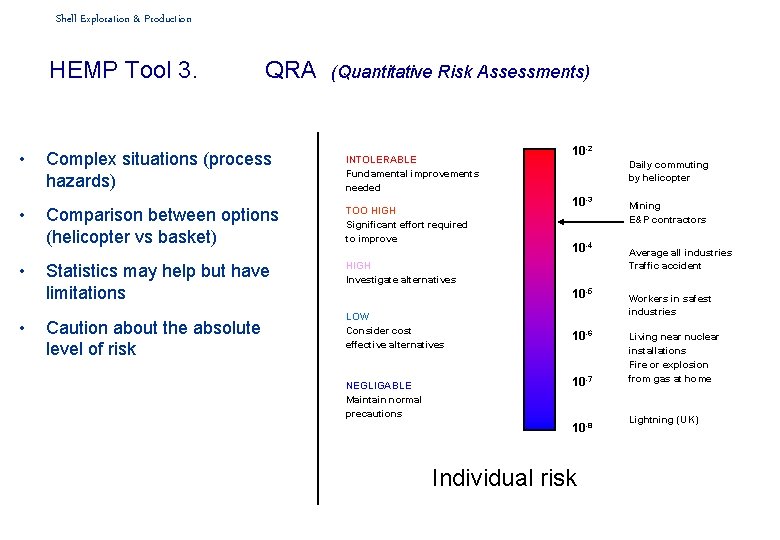
Shell Exploration & Production HEMP Tool 3. QRA (Quantitative Risk Assessments) • Complex situations (process hazards) INTOLERABLE Fundamental improvements needed • Comparison between options (helicopter vs basket) TOO HIGH Significant effort required to improve Statistics may help but have limitations HIGH Investigate alternatives • • Caution about the absolute level of risk 10 -2 Daily commuting by helicopter 10 -3 10 -4 10 -5 LOW Consider cost effective alternatives NEGLIGABLE Maintain normal precautions 10 -6 10 -7 10 -8 Individual risk Mining E&P contractors Average all industries Traffic accident Workers in safest industries Living near nuclear installations Fire or explosion from gas at home Lightning (UK)
Shell Exploration & Production
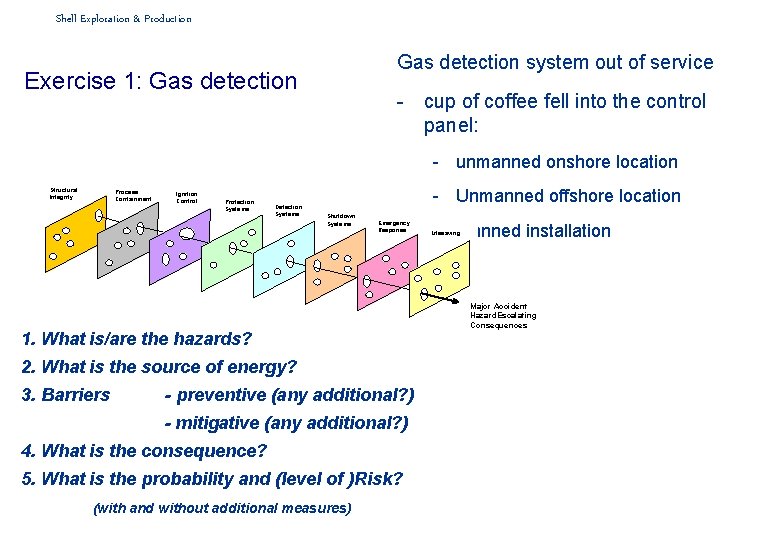
Shell Exploration & Production Gas detection system out of service Exercise 1: Gas detection - cup of coffee fell into the control panel: - unmanned onshore location Structural Integrity Process Containment Ignition Control Protection Systems Detection Systems - Unmanned offshore location Shutdown Systems Emergency Response 1. What is/are the hazards? 2. What is the source of energy? 3. Barriers - preventive (any additional? ) - mitigative (any additional? ) 4. What is the consequence? 5. What is the probability and (level of )Risk? (with and without additional measures) - manned installation Lifesaving Major Accident Hazard. Escalating Consequences
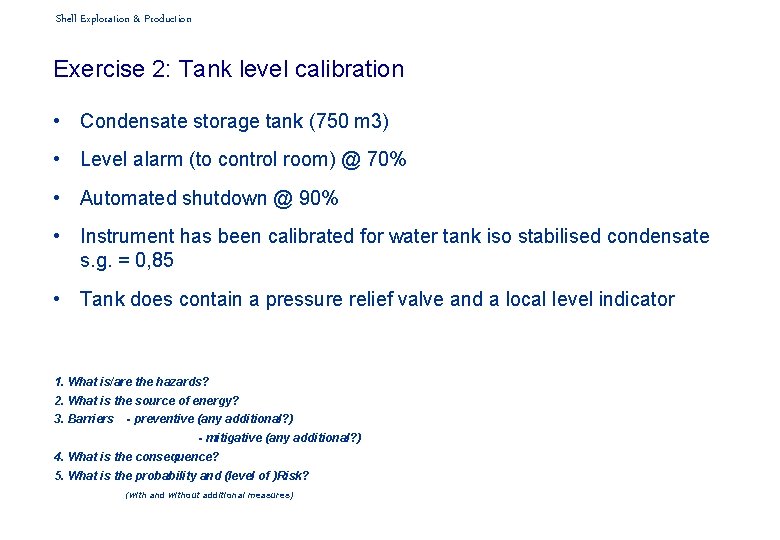
Shell Exploration & Production Exercise 2: Tank level calibration • Condensate storage tank (750 m 3) • Level alarm (to control room) @ 70% • Automated shutdown @ 90% • Instrument has been calibrated for water tank iso stabilised condensate s. g. = 0, 85 • Tank does contain a pressure relief valve and a local level indicator 1. What is/are the hazards? 2. What is the source of energy? 3. Barriers - preventive (any additional? ) - mitigative (any additional? ) 4. What is the consequence? 5. What is the probability and (level of )Risk? (with and without additional measures)
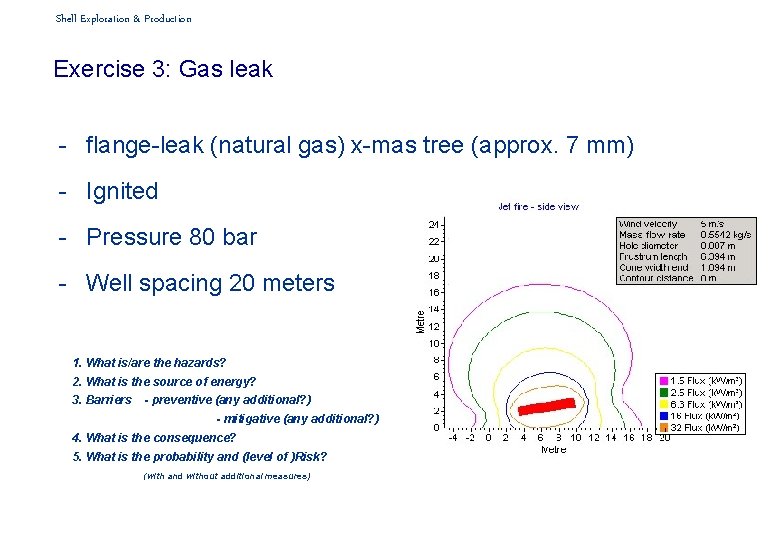
Shell Exploration & Production Exercise 3: Gas leak - flange-leak (natural gas) x-mas tree (approx. 7 mm) - Ignited - Pressure 80 bar - Well spacing 20 meters 1. What is/are the hazards? 2. What is the source of energy? 3. Barriers - preventive (any additional? ) - mitigative (any additional? ) 4. What is the consequence? 5. What is the probability and (level of )Risk? (with and without additional measures)
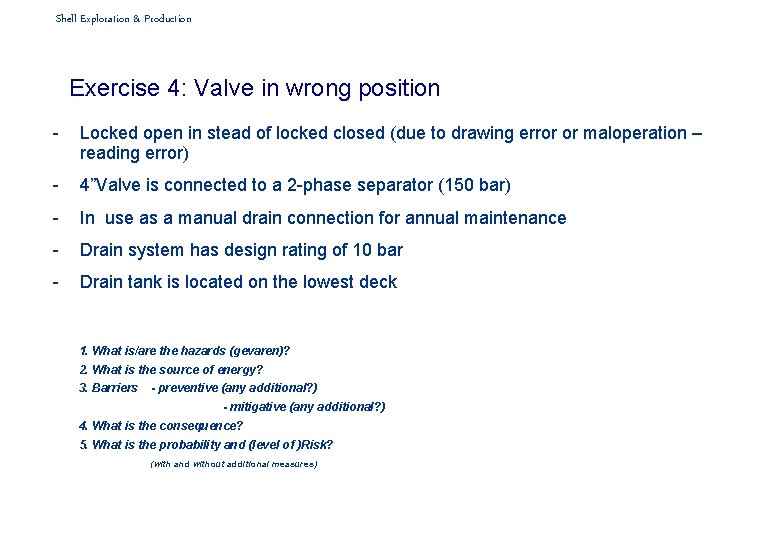
Shell Exploration & Production Exercise 4: Valve in wrong position - Locked open in stead of locked closed (due to drawing error or maloperation – reading error) - 4”Valve is connected to a 2 -phase separator (150 bar) - In use as a manual drain connection for annual maintenance - Drain system has design rating of 10 bar - Drain tank is located on the lowest deck 1. What is/are the hazards (gevaren)? 2. What is the source of energy? 3. Barriers - preventive (any additional? ) - mitigative (any additional? ) 4. What is the consequence? 5. What is the probability and (level of )Risk? (with and without additional measures)