
SHEET METALWORKING 1 Dies and Presses for Sheet

- Slides: 29
SHEET METALWORKING 1. Dies and Presses for Sheet Metal Processes 2. Sheet Metal Operations Not Performed on Presses 3. Bending of Tube Stock © 2007 John Wiley & Sons, Inc. M P Groover, Fundamentals of Modern Manufacturing 3/e
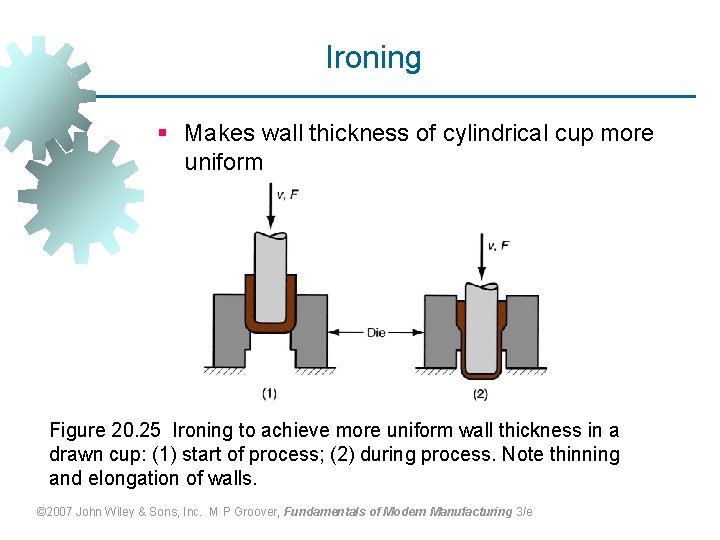
Ironing § Makes wall thickness of cylindrical cup more uniform Figure 20. 25 Ironing to achieve more uniform wall thickness in a drawn cup: (1) start of process; (2) during process. Note thinning and elongation of walls. © 2007 John Wiley & Sons, Inc. M P Groover, Fundamentals of Modern Manufacturing 3/e
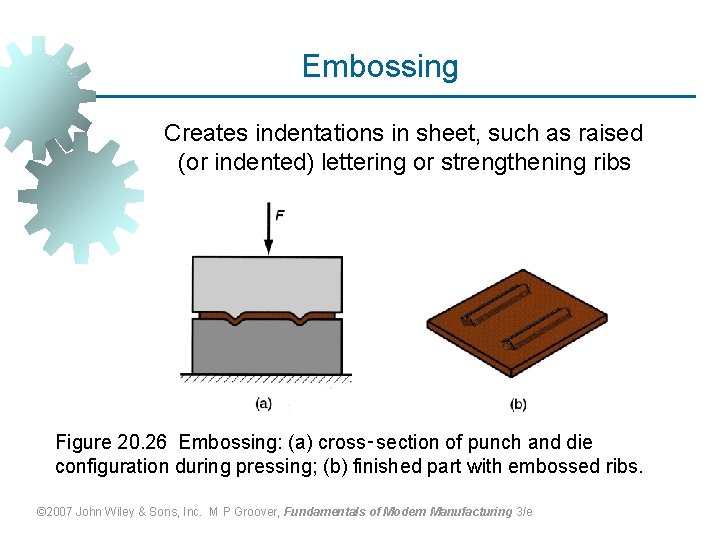
Embossing Creates indentations in sheet, such as raised (or indented) lettering or strengthening ribs Figure 20. 26 Embossing: (a) cross‑section of punch and die configuration during pressing; (b) finished part with embossed ribs. © 2007 John Wiley & Sons, Inc. M P Groover, Fundamentals of Modern Manufacturing 3/e
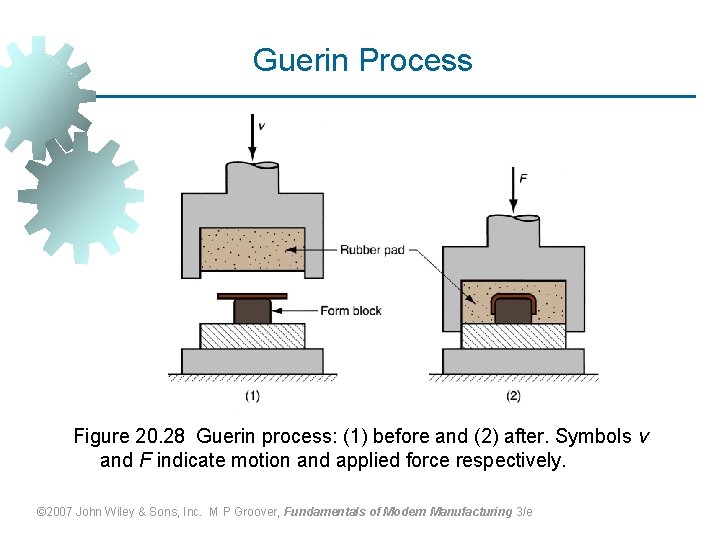
Guerin Process Figure 20. 28 Guerin process: (1) before and (2) after. Symbols v and F indicate motion and applied force respectively. © 2007 John Wiley & Sons, Inc. M P Groover, Fundamentals of Modern Manufacturing 3/e
Advantages of Guerin Process § Low tooling cost § Form block can be made of wood, plastic, or other materials that are easy to shape § Rubber pad can be used with different form blocks § Process attractive in small quantity production © 2007 John Wiley & Sons, Inc. M P Groover, Fundamentals of Modern Manufacturing 3/e
Dies for Sheet Metal Processes Most pressworking operations performed with conventional punch‑and‑die tooling § Custom‑designed for particular part § The term stamping die sometimes used for high production dies © 2007 John Wiley & Sons, Inc. M P Groover, Fundamentals of Modern Manufacturing 3/e
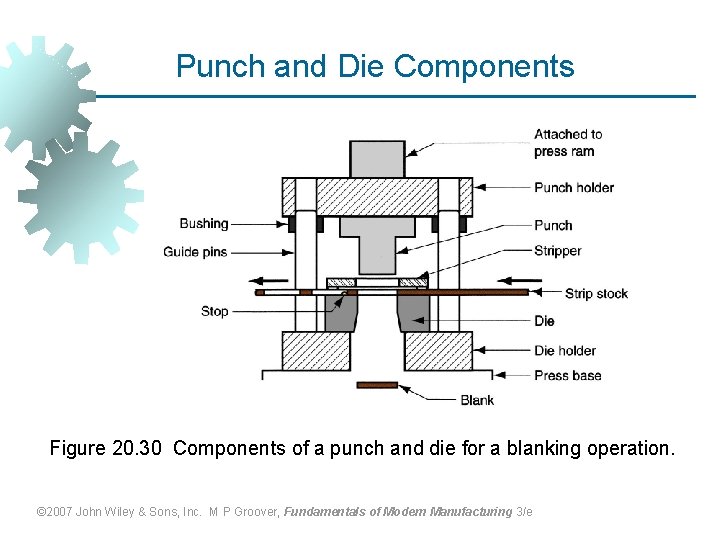
Punch and Die Components Figure 20. 30 Components of a punch and die for a blanking operation. © 2007 John Wiley & Sons, Inc. M P Groover, Fundamentals of Modern Manufacturing 3/e
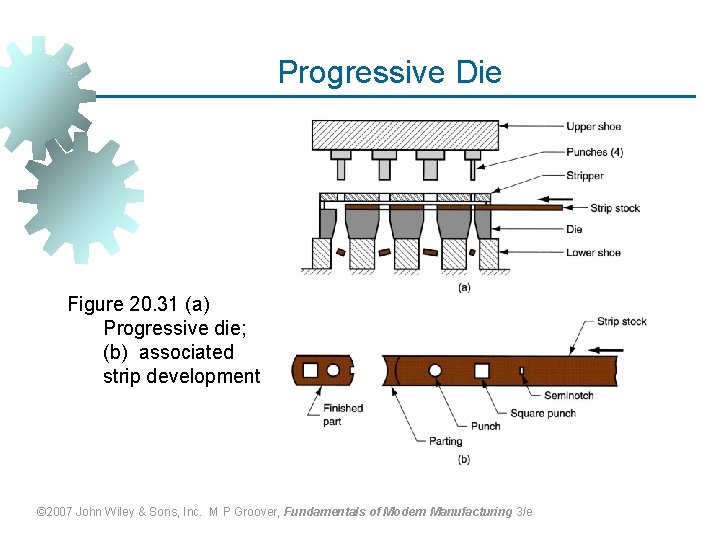
Progressive Die Figure 20. 31 (a) Progressive die; (b) associated strip development © 2007 John Wiley & Sons, Inc. M P Groover, Fundamentals of Modern Manufacturing 3/e
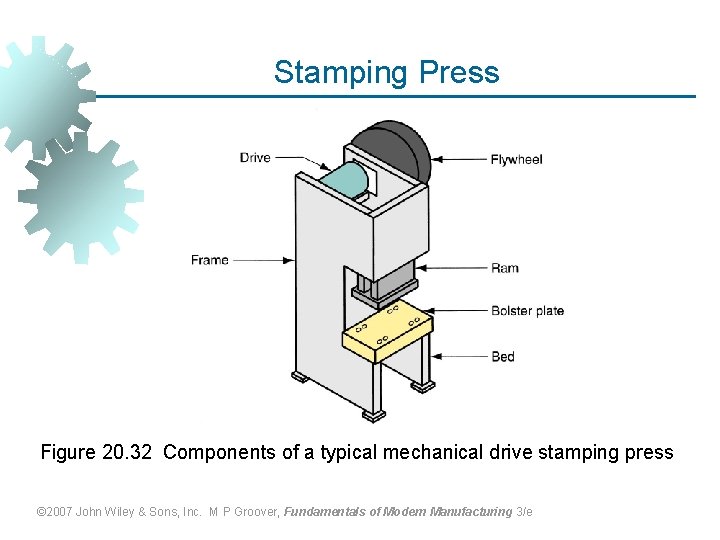
Stamping Press Figure 20. 32 Components of a typical mechanical drive stamping press © 2007 John Wiley & Sons, Inc. M P Groover, Fundamentals of Modern Manufacturing 3/e
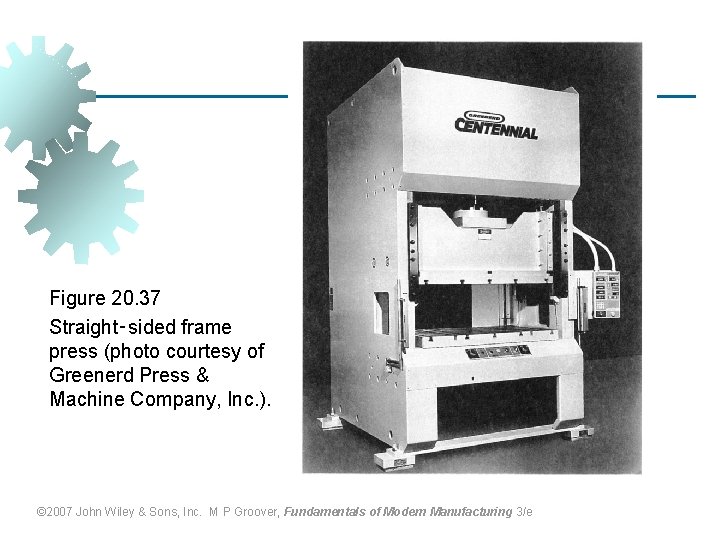
Types of Stamping Press Frame § Gap frame § Configuration of the letter C and often referred to as a C‑frame § Straight‑sided frame § Box-like construction for higher tonnage © 2007 John Wiley & Sons, Inc. M P Groover, Fundamentals of Modern Manufacturing 3/e
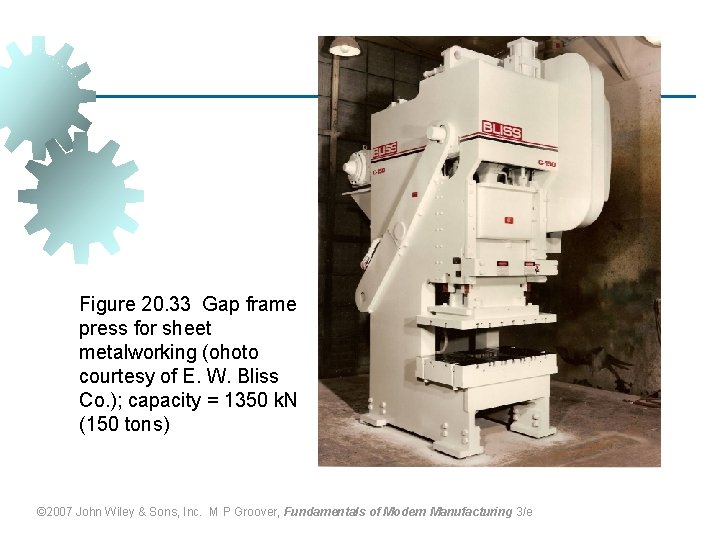
Figure 20. 33 Gap frame press for sheet metalworking (ohoto courtesy of E. W. Bliss Co. ); capacity = 1350 k. N (150 tons) © 2007 John Wiley & Sons, Inc. M P Groover, Fundamentals of Modern Manufacturing 3/e
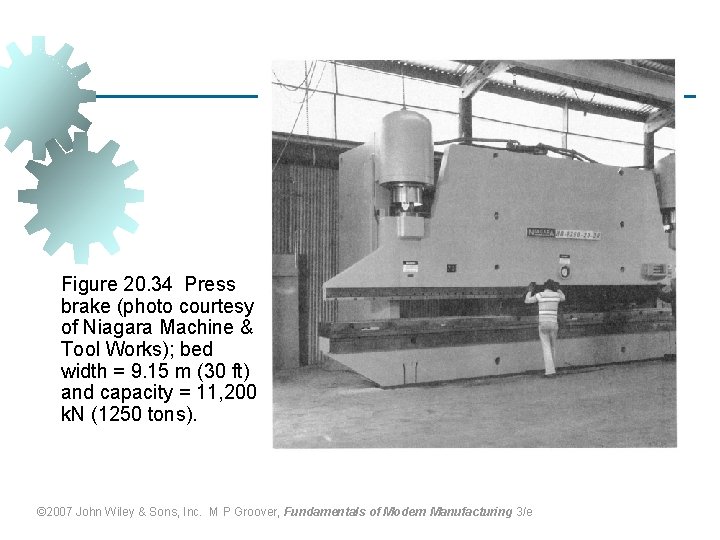
Figure 20. 34 Press brake (photo courtesy of Niagara Machine & Tool Works); bed width = 9. 15 m (30 ft) and capacity = 11, 200 k. N (1250 tons). © 2007 John Wiley & Sons, Inc. M P Groover, Fundamentals of Modern Manufacturing 3/e
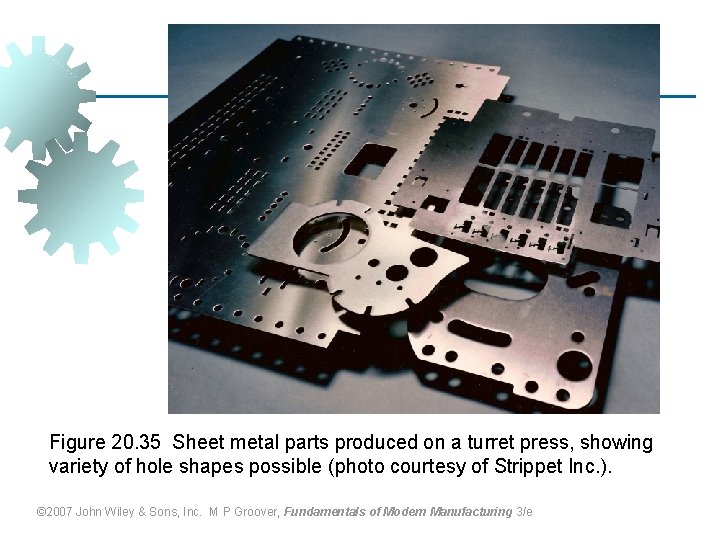
Figure 20. 35 Sheet metal parts produced on a turret press, showing variety of hole shapes possible (photo courtesy of Strippet Inc. ). © 2007 John Wiley & Sons, Inc. M P Groover, Fundamentals of Modern Manufacturing 3/e
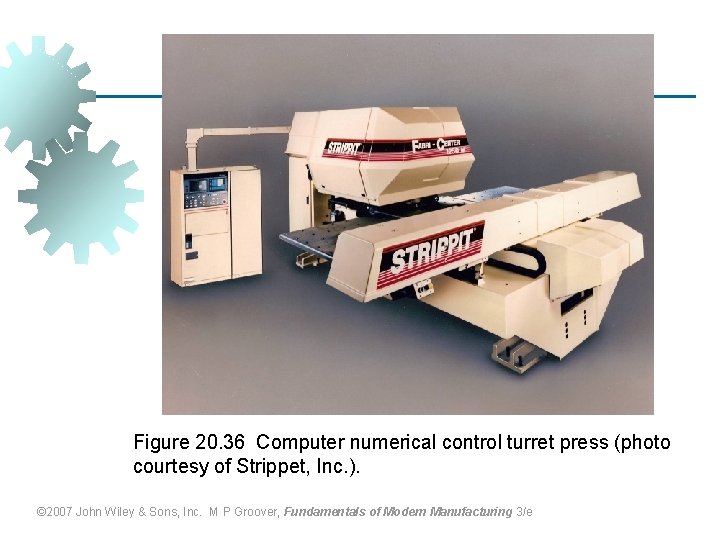
Figure 20. 36 Computer numerical control turret press (photo courtesy of Strippet, Inc. ). © 2007 John Wiley & Sons, Inc. M P Groover, Fundamentals of Modern Manufacturing 3/e
Figure 20. 37 Straight‑sided frame press (photo courtesy of Greenerd Press & Machine Company, Inc. ). © 2007 John Wiley & Sons, Inc. M P Groover, Fundamentals of Modern Manufacturing 3/e
Power and Drive Systems § Hydraulic presses - use a large piston and cylinder to drive the ram § Longer ram stroke than mechanical types § Suited to deep drawing § Slower than mechanical drives § Mechanical presses – convert rotation of motor to linear motion of ram § High forces at bottom of stroke § Suited to blanking and punching © 2007 John Wiley & Sons, Inc. M P Groover, Fundamentals of Modern Manufacturing 3/e
Operations Not Performed on Presses § § Stretch forming Roll bending and forming Spinning High‑energy‑rate forming processes. © 2007 John Wiley & Sons, Inc. M P Groover, Fundamentals of Modern Manufacturing 3/e
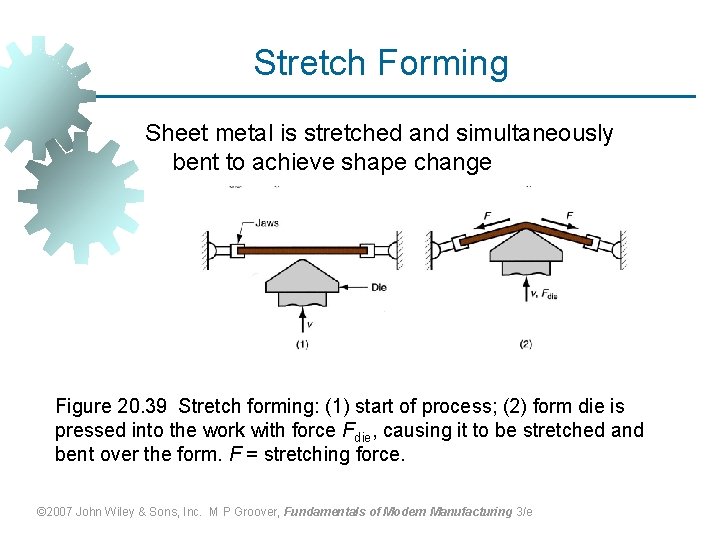
Stretch Forming Sheet metal is stretched and simultaneously bent to achieve shape change Figure 20. 39 Stretch forming: (1) start of process; (2) form die is pressed into the work with force Fdie, causing it to be stretched and bent over the form. F = stretching force. © 2007 John Wiley & Sons, Inc. M P Groover, Fundamentals of Modern Manufacturing 3/e
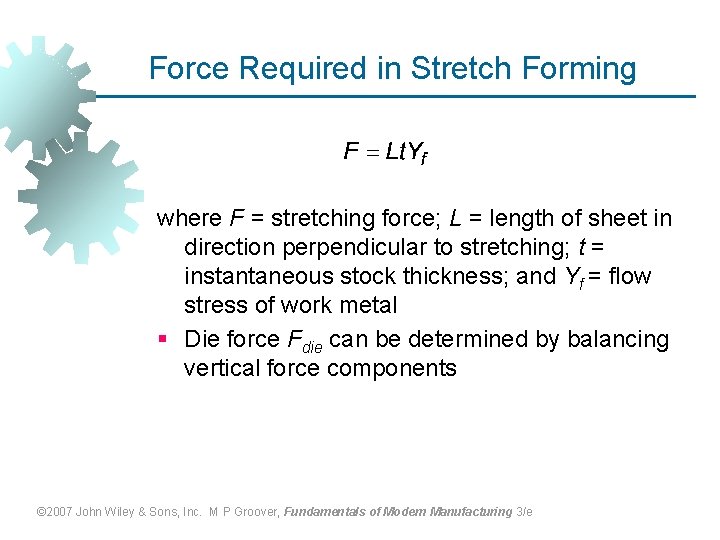
Force Required in Stretch Forming where F = stretching force; L = length of sheet in direction perpendicular to stretching; t = instantaneous stock thickness; and Yf = flow stress of work metal § Die force Fdie can be determined by balancing vertical force components © 2007 John Wiley & Sons, Inc. M P Groover, Fundamentals of Modern Manufacturing 3/e
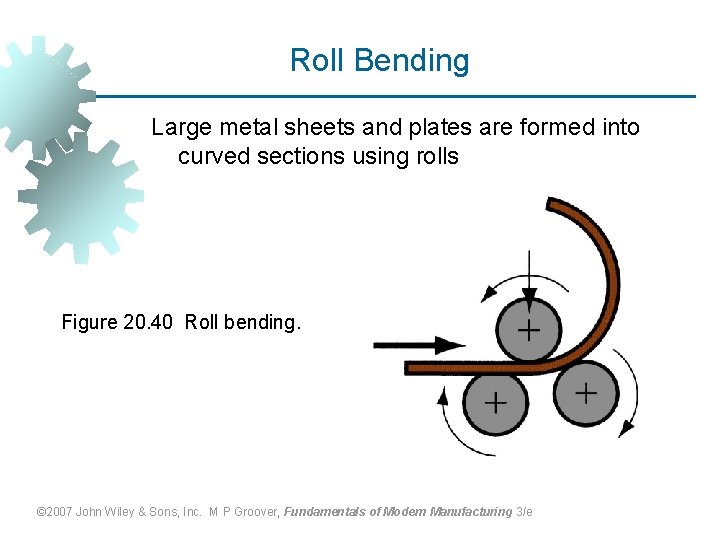
Roll Bending Large metal sheets and plates are formed into curved sections using rolls Figure 20. 40 Roll bending. © 2007 John Wiley & Sons, Inc. M P Groover, Fundamentals of Modern Manufacturing 3/e
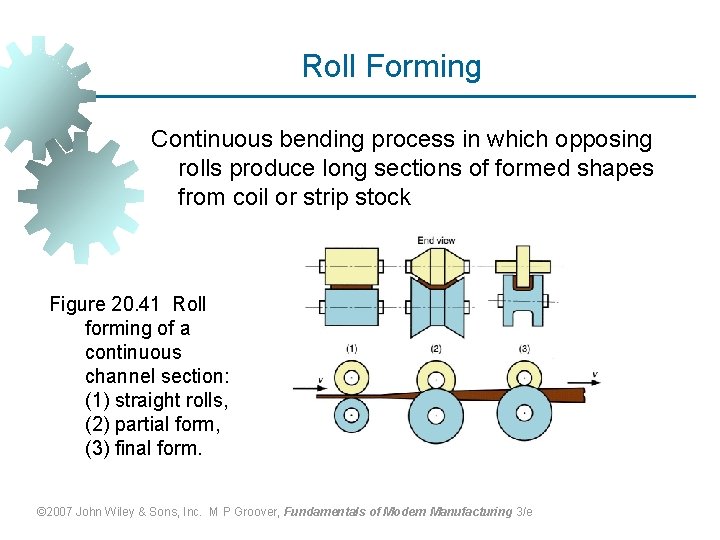
Roll Forming Continuous bending process in which opposing rolls produce long sections of formed shapes from coil or strip stock Figure 20. 41 Roll forming of a continuous channel section: (1) straight rolls, (2) partial form, (3) final form. © 2007 John Wiley & Sons, Inc. M P Groover, Fundamentals of Modern Manufacturing 3/e
Spinning Metal forming process in which an axially symmetric part is gradually shaped over a rotating mandrel using a rounded tool or roller § Three types: 1. Conventional spinning 2. Shear spinning 3. Tube spinning © 2007 John Wiley & Sons, Inc. M P Groover, Fundamentals of Modern Manufacturing 3/e
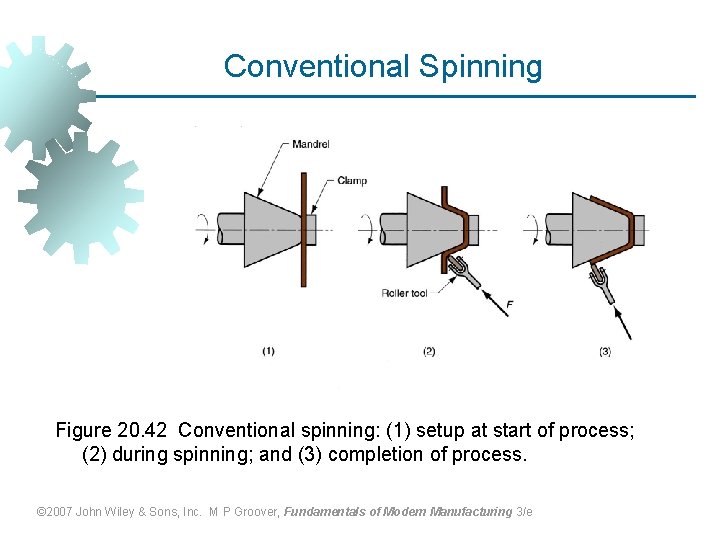
Conventional Spinning Figure 20. 42 Conventional spinning: (1) setup at start of process; (2) during spinning; and (3) completion of process. © 2007 John Wiley & Sons, Inc. M P Groover, Fundamentals of Modern Manufacturing 3/e
High‑Energy‑Rate Forming (HERF) Processes to form metals using large amounts of energy over a very short time § HERF processes include: § Explosive forming § Electrohydraulic forming § Electromagnetic forming © 2007 John Wiley & Sons, Inc. M P Groover, Fundamentals of Modern Manufacturing 3/e
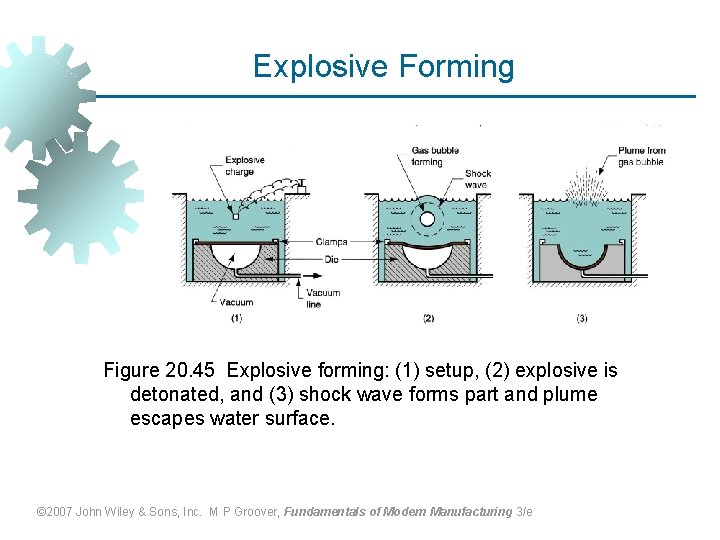
Explosive Forming Use of explosive charge to form sheet (or plate) metal into a die cavity § Explosive charge causes a shock wave whose energy is transmitted to force part into cavity § Applications: large parts, typical of aerospace industry © 2007 John Wiley & Sons, Inc. M P Groover, Fundamentals of Modern Manufacturing 3/e
Explosive Forming Figure 20. 45 Explosive forming: (1) setup, (2) explosive is detonated, and (3) shock wave forms part and plume escapes water surface. © 2007 John Wiley & Sons, Inc. M P Groover, Fundamentals of Modern Manufacturing 3/e
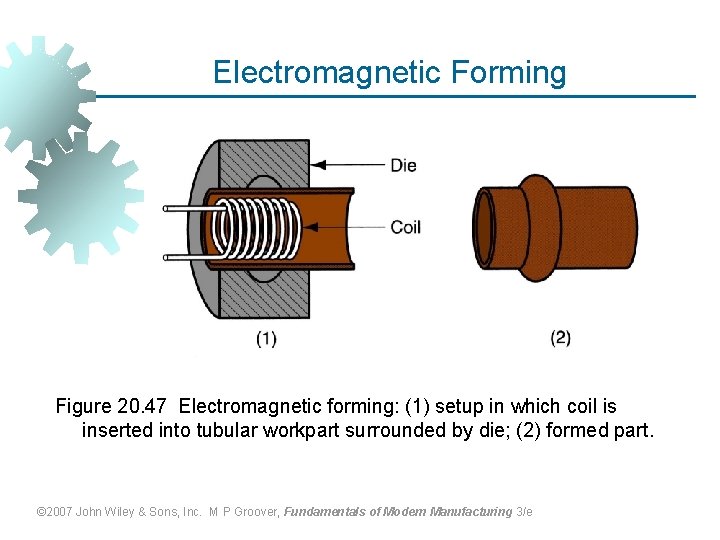
Electromagnetic Forming Sheet metal is deformed by mechanical force of an electromagnetic field induced in the workpart by an energized coil § Presently the most widely used HERF process § Applications: tubular parts © 2007 John Wiley & Sons, Inc. M P Groover, Fundamentals of Modern Manufacturing 3/e
Electromagnetic Forming Figure 20. 47 Electromagnetic forming: (1) setup in which coil is inserted into tubular workpart surrounded by die; (2) formed part. © 2007 John Wiley & Sons, Inc. M P Groover, Fundamentals of Modern Manufacturing 3/e
Thanks © 2007 John Wiley & Sons, Inc. M P Groover, Fundamentals of Modern Manufacturing 3/e