
Sheep Connect Tasmania Ovine Johnes Disease and safe











- Slides: 34
Sheep Connect Tasmania Ovine Johne’s Disease and safe vaccination – September 2011
Workshop collaborators – TIAR — Tasmanian Institute of Agricultural Research. – PASS — Proactive Agricultural Safety and Support. – DPIPWE — Department of Primary Industries Parks Water and Environment. – Tas Quality Meats, Pfizer, TP Jones, Roberts Ltd, Elders
Contents • • • Ovine Johne’s Disease (OJD) — a snapshot Effective vaccination Safe vaccinating techniques Needle stick injury (NSI) — management guidelines Contacts and further information
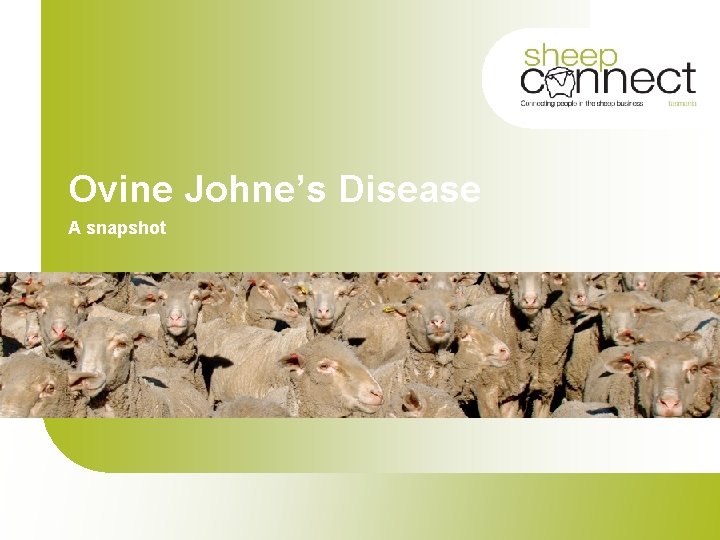
Ovine Johne’s Disease A snapshot
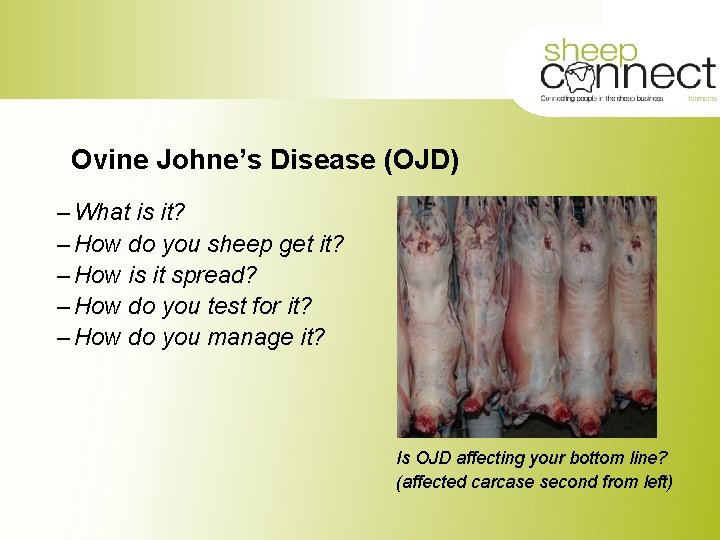
Ovine Johne’s Disease (OJD) – What is it? – How do you sheep get it? – How is it spread? – How do you test for it? – How do you manage it? Is OJD affecting your bottom line? (affected carcase second from left)
What is OJD? • • Caused by Mycobacterium paratuberculosis (Mbpt) A chronic wasting disease Intestines unable to absorb nutrients Infected sheep may take 3– 6 years to show any signs More information on disease can be found at: www. ojd. com. au
How do your sheep get OJD? The disease is spread by: 1. 2. 3. 4. faecal-oral route (contaminated pasture) contact with infected sheep other susceptible animals (deer, rabbits, goats) lots of other minor ways 12 6 -9 Infected sheep shed 10 /day but only 10 needed to infect A small contamination goes a long way
The spread of OJD in Tasmania
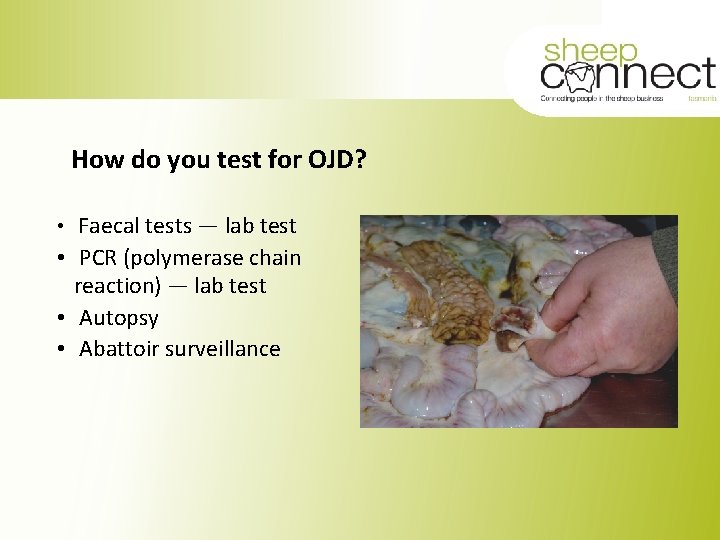
How do you test for OJD? • Faecal tests — lab test • PCR (polymerase chain reaction) — lab test • Autopsy • Abattoir surveillance
How do you manage OJD? üVaccination (Gudair) • the earlier, the better • strategic flock vaccination üBiosecurity • restrict stock movement • stringent stock hygiene üAnimal Health Statements • reduce risk by buying sheep of the same or higher point score
The impact of vaccination on flock mortality
Vaccination with Gudair — the facts ü ü ü Gudair is a KILLED vaccine in a mineral oil base (adjuvant) Gudair DOES NOT cause or spread OJD Vaccinating with Gudair WILL NOT CURE infected animals Efficacy is greatest if vaccination occurs BEFORE EXPOSURE Gudair is a one-off vaccination — 1 ml dose, NO BOOSTER Vaccination = less shedding, less impact, less deaths Vaccinating is a key management tool BUT m 100% immunity
The keys to successful vaccinating with Gudair üUse only as directed üMaintain cleanliness of vaccinating equipment üStore vaccine properly • 2– 8 o. C, do not freeze, return to fridge ASAP üCheck expiry date (valid for 12 months maximum) Read all label directions and the MSDS
Effective vaccination — marking vs weaning For disease management — the earlier the better Every sheep enterprise should work with their local Sheep MAP veterinarian to develop a tailored vaccination program for OJD • Lamb marking — the considerations üTags are already going in üGreater animal restraint is available than in a race BUT — additional pressure on operators (multiple tasks) • Weaning — the considerations ü Already vaccinating (5 in 1 booster) ü Less pressure on operators (fewer tasks) BUT — weaners can be hard to restrain in a race
Vaccination — a practical guide Equipment, techniques and safety
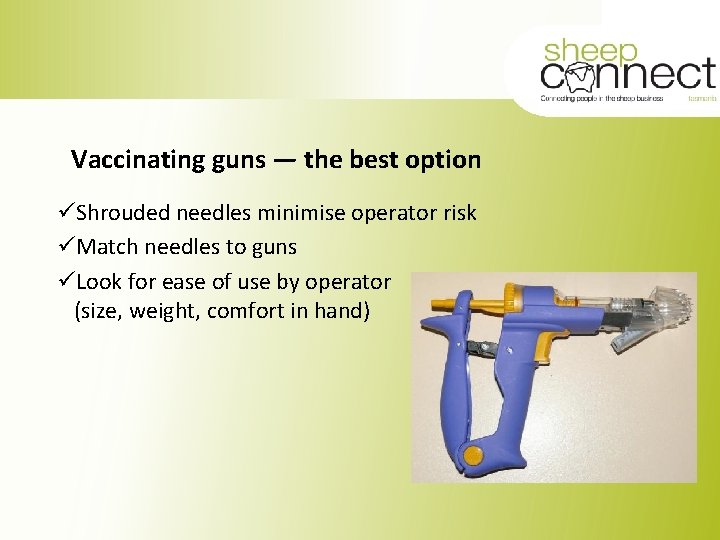
Vaccinating guns — the best option üShrouded needles minimise operator risk üMatch needles to guns üLook for ease of use by operator (size, weight, comfort in hand)
Needles — size DOES matter! Smallest gauge and length possible — Gudair is a subcutaneous injection — it is given under the skin ü 18 gauge for most injections ü 6 or 12 mm* for Gudair üBigger needles cause more tissue damage and carcase contamination *Note: shrouded guns may require a 12 mm needle as only half the needle protrudes past the shroud during injection. Match the needle to the gun and use the shortest appropriate needle.
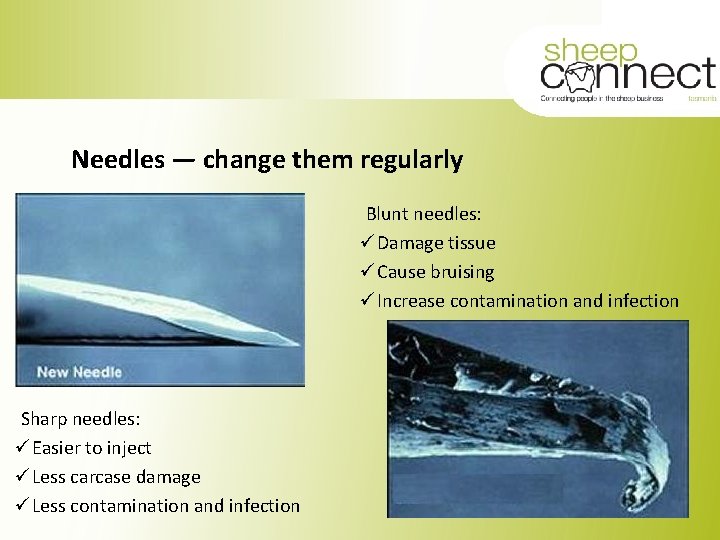
Needles — change them regularly Blunt needles: ü Damage tissue ü Cause bruising ü Increase contamination and infection Sharp needles: ü Easier to inject ü Less carcase damage ü Less contamination and infection
Subcutaneous vs intramuscular ü Subcutaneous — under the skin ü Intramuscular — into the muscle OJD is a SUBCUTANEOUS injection only (the reaction is a small lump NOT a long-term large lesion)
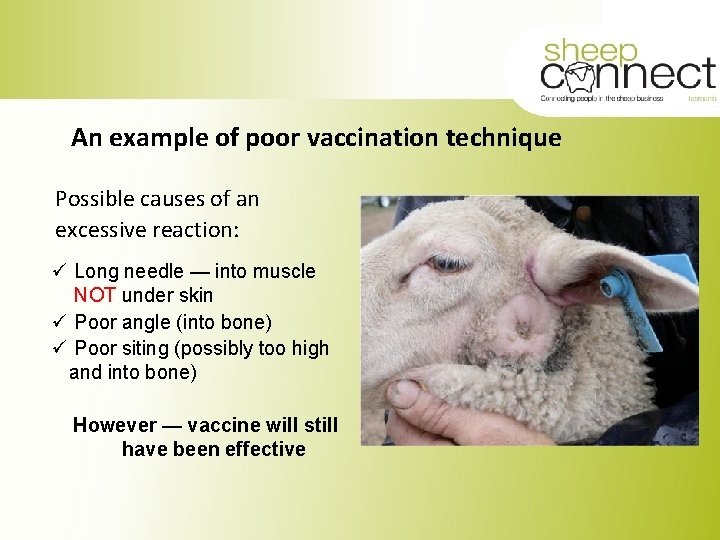
An example of poor vaccination technique Possible causes of an excessive reaction: ü Long needle — into muscle NOT under skin ü Poor angle (into bone) ü Poor siting (possibly too high and into bone) However — vaccine will still have been effective
Vaccination site — maximum efficacy, minimum damage Between jaw and ear (about 2– 4 cm below ear) AWAY from major blood vessels and bones ü Reduces potential carcase damage ü Any reactions drain down below ear — high injections tend to drain leading to: • Shoulder downgrade • Possible lameness, paralysis, neck mobility
Safe vaccination techniques One-handed technique
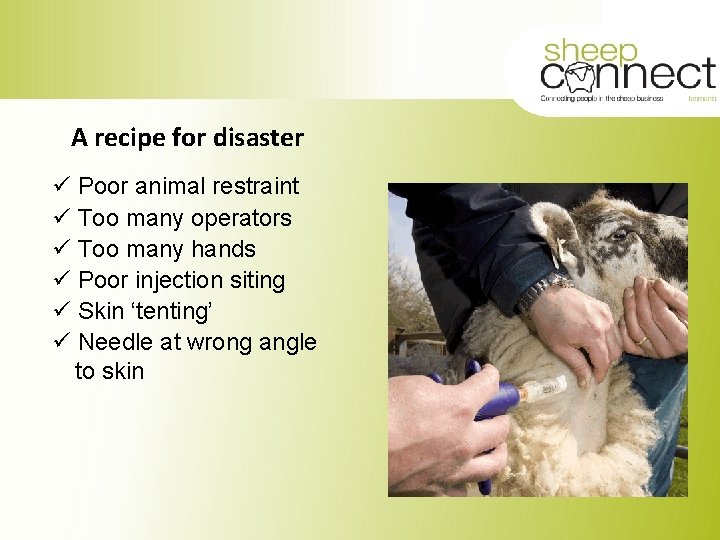
One-handed technique ü Pack race tight ü Approach from behind ü Inject between jaw and ear (2 -4 cm below the ear) ü Keep needle perpendicular to skin ü Avoid skin ‘tenting’ ü Keep other hand free for balance or support ü Keep vaccine bottle and tube away from sheep
A recipe for disaster ü Poor animal restraint ü Too many operators ü Too many hands ü Poor injection siting ü Skin ‘tenting’ ü Needle at wrong angle to skin
Vaccinating checklist Before you vaccinate run through the following checklist: ü Well maintained, calibrated equipment (1 ml dose) ü Sterilise all equipment with boiling water ü Make sure vaccine is ‘in date’ ü Have on-site storage (esky, cold packs etc) ü Consumables (guns, needles, holsters/strapping/backpacks, sharps container, spare parts— O rings/tubing, pliers for changing needles) ü First aid kit (disinfectant, detergent, eyewash, MSDS, accident procedure)
Needlestick injury (NSI) action plan If an injury occurs, act immediately: Unbroken skin: ü Wash thoroughly with soap and water Skin is broken (existing wound or needle scratch) ü Wash thoroughly with soap and water ü Apply antiseptic solution ü Seek help if the area becomes inflamed, sore, swollen or red Self injection: ü Contact doctor immediately and get to surgery/hospital ü Take vaccine package and MSDS to doctor
Gudair — MSDS Section 4
Manual handling — protecting your back and knees When picking up lambs ü Bend knees and hips ü DO NOT bend back ü Use two hands to grasp lambs ü Avoid twisting spine by picking up straight in front and moving feet to place lambs in cradle ü Look up and lunge
Local case study You. Tube clip on local needle stick incident (next slide)
Contacts and further information One-stop-shop for OJD and safe vaccination
DPIPWE veterinarians: Bruce Jackson — DPIPWE T: 0407 872 520 Rowena Bell — DPIPWE T: 0488 198 500 Sheep MAP veterinarians Kim Barrett — Kings Meadows T: 0411 242 979 Sue Van Es (Rocky Cape) E: dawsonsd@hotmail. com Eileem Wroski (Huonville) T: 6264 2328 Ron Harris (Scottsdale) T: 0419 522 996 John O’Dell (Flinders Island) T: 6359 2148 Chris Donaldson (Westbury) T: 6393 1286 Paul Nilon (Longford) T: 0419 395 867
GP and Surgeon Dr Merle Gray — GP Campbell Town T: (03) 6336 1133 Dr Gary Kode* — Plastic and reconstructive surgeon, Launceston T: (03) 6334 9313 Dr Stephen Salerno* — Plastic and reconstructive surgeon, Essendon *These surgeons have had surgical experience with Category 3 and/or 4 needlestick injuries involving Gudair
Animal welfare and vendor declarations Lyndon Iles T: 0419 569 708 E: lyndon. iles@dpipwe. tas. gov. au Tas Quality Meats (abattoir surveillance) Chris Cocker T: 0488 736 487 Pfizer Animal Health (Gudair) Phil Jarvie, Key account manager Tasmania T: 0418 557 211 E: phil. jarvie@pfizer. com. au W: www. pfizer. com. au Proactive Agricultural Support and Safety (PASS) Anne Taylor, Chair T: 0414 839 833 E: info@pass. org. au W: www. pass. org. au
Further reading www. ojd. com. au www. tiar. tas. edu. au/extensive/sheepconnect/sheep-health/ovinejohnes-disease Sheep Connect Tasmania Andrew Bailey T: 0408 129 373 E: andrew. bailey@utas. edu. au Catriona Nicholls T: 0427 571 199 E: cat. nicholls@utas. edu. au W: www. tiar. tas. edu. au/extensive/sheepconnect