
Shedding Light on Dark Energy Dr Wayne Barkhouse
Shedding Light on Dark Energy Dr. Wayne Barkhouse Department of Physics University of North Dakota

Outline • • Introduction Cosmological Framework Early Signs of Dark Energy The Discovery of Dark Energy What is Dark Energy? Probing Dark Energy Projects Summary
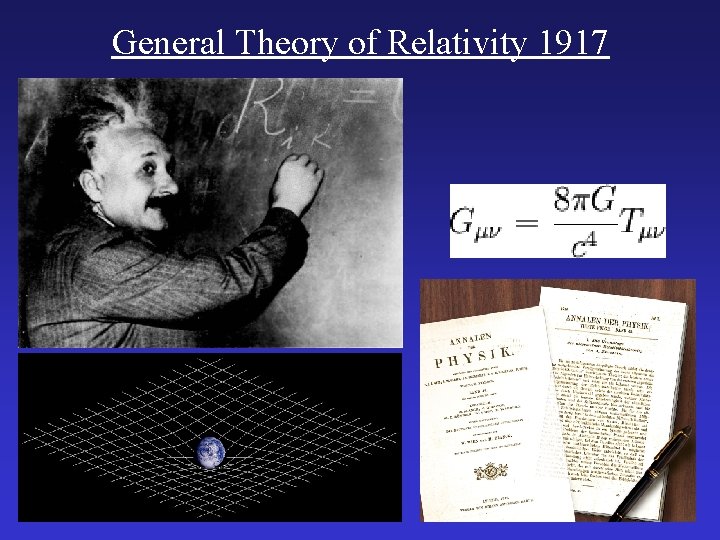
General Theory of Relativity 1917
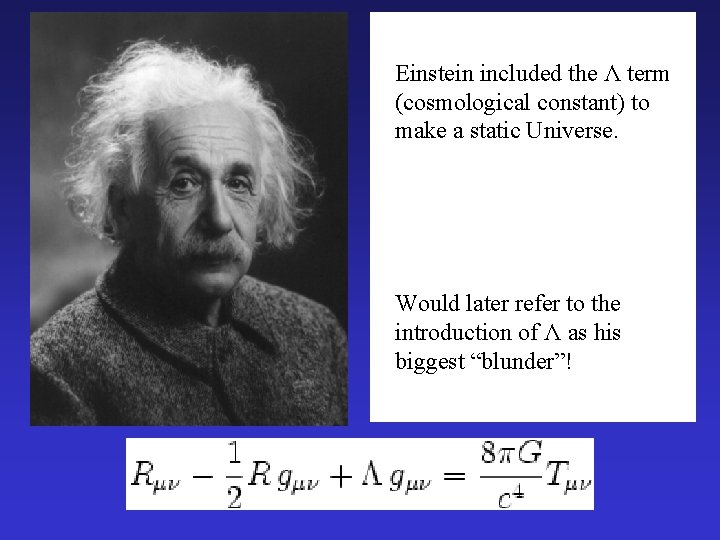
Einstein included the Λ term (cosmological constant) to make a static Universe. Would later refer to the introduction of Λ as his biggest “blunder”!
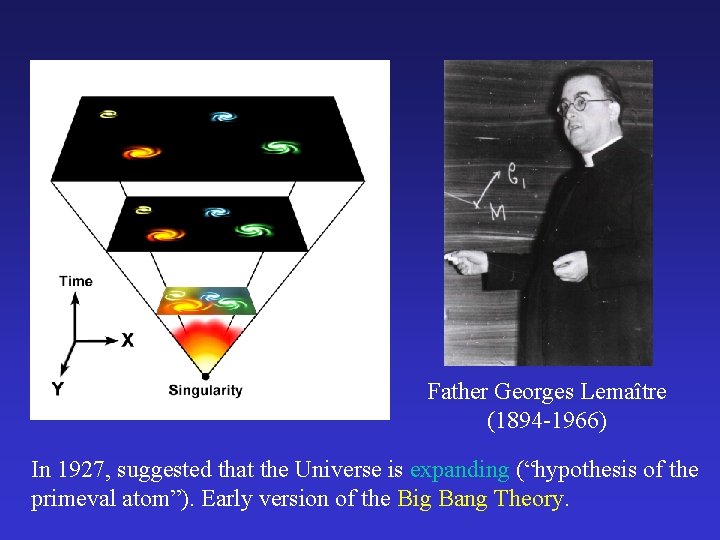
Father Georges Lemaître (1894 -1966) In 1927, suggested that the Universe is expanding (“hypothesis of the primeval atom”). Early version of the Big Bang Theory.
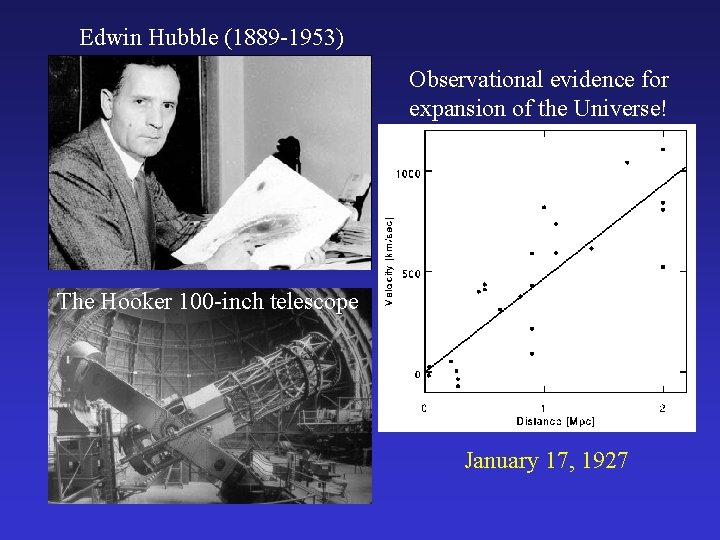
Edwin Hubble (1889 -1953) Observational evidence for expansion of the Universe! The Hooker 100 -inch telescope January 17, 1927
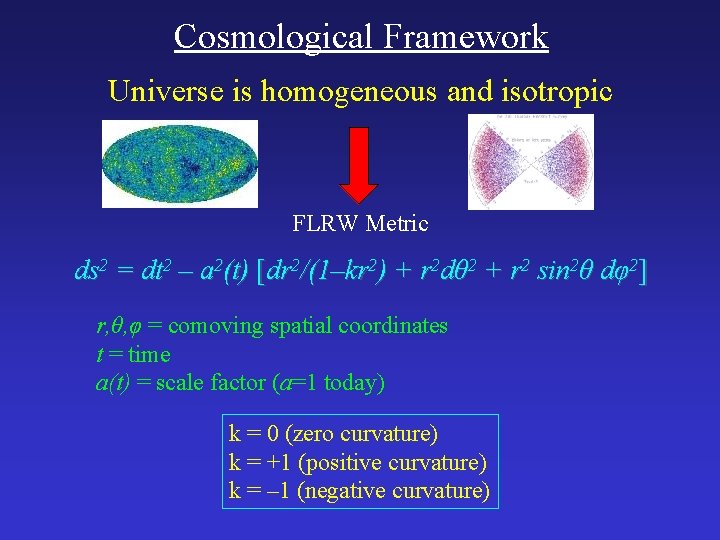
Cosmological Framework Universe is homogeneous and isotropic FLRW Metric ds 2 = dt 2 – a 2(t) [dr 2/(1–kr 2) + r 2 dθ 2 + r 2 sin 2θ dφ2] r, θ, φ = comoving spatial coordinates t = time a(t) = scale factor (a=1 today) k = 0 (zero curvature) k = +1 (positive curvature) k = – 1 (negative curvature)
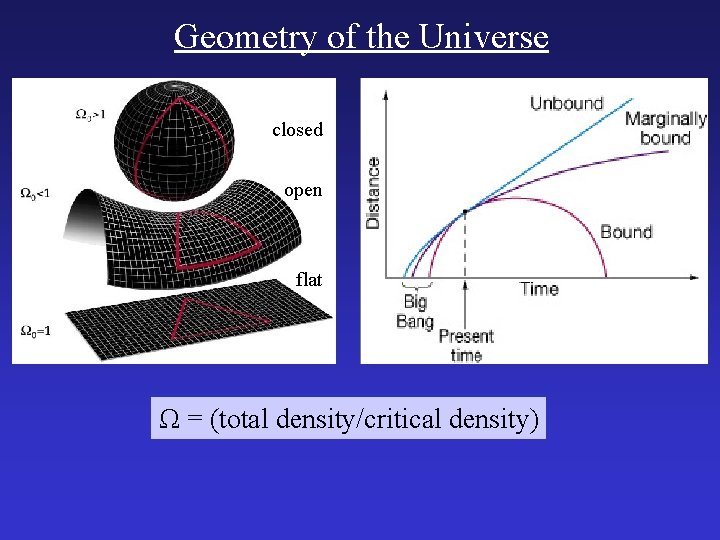
Geometry of the Universe closed open flat Ω = (total density/critical density)

Measuring the Universe Cosmology is the search of new numbers: Hubble Parameter (H 0) Deceleration parameter (q 0)
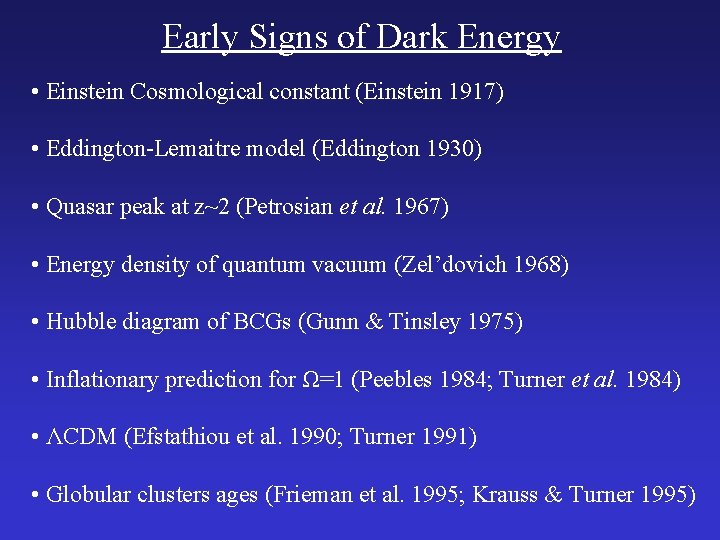
Early Signs of Dark Energy • Einstein Cosmological constant (Einstein 1917) • Eddington-Lemaitre model (Eddington 1930) • Quasar peak at z~2 (Petrosian et al. 1967) • Energy density of quantum vacuum (Zel’dovich 1968) • Hubble diagram of BCGs (Gunn & Tinsley 1975) • Inflationary prediction for Ω=1 (Peebles 1984; Turner et al. 1984) • ΛCDM (Efstathiou et al. 1990; Turner 1991) • Globular clusters ages (Frieman et al. 1995; Krauss & Turner 1995)

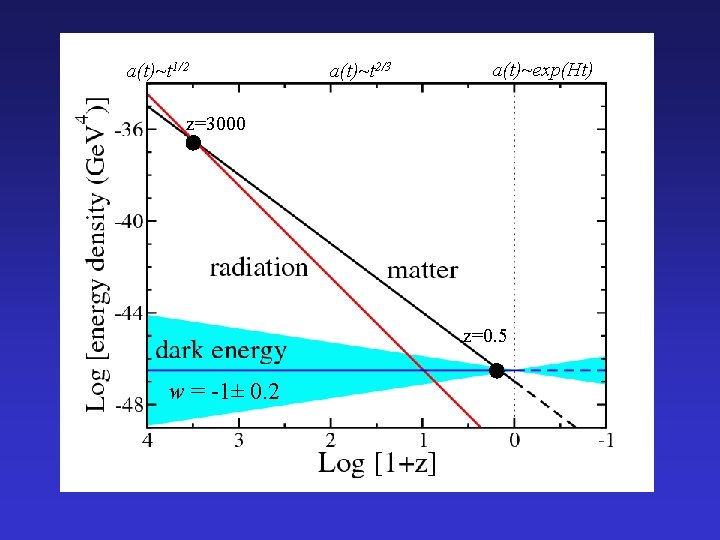
Consequence of Dark Energy Friedmann Equations: Application of GR field equations to FLRW metric Λ => pvac = –ρvac = –Λ/8πG =constant Equation of state (cosmological constant) P < -ρ/3 => w < -1/3 => d 2(a)/dt 2 > 0! w(a) = w 0 + wa(1–a) (time evolution)
a(t)~t 1/2 a(t)~t 2/3 a(t)~exp(Ht) z=3000 z=0. 5 w = -1± 0. 2
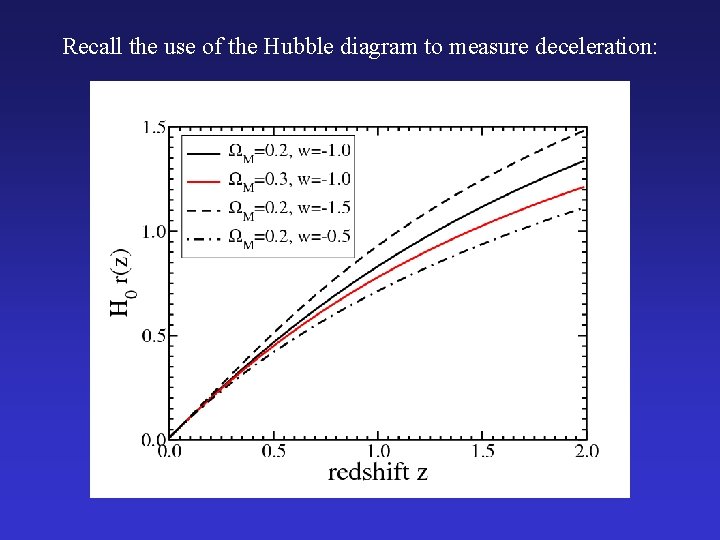
Recall the use of the Hubble diagram to measure deceleration:
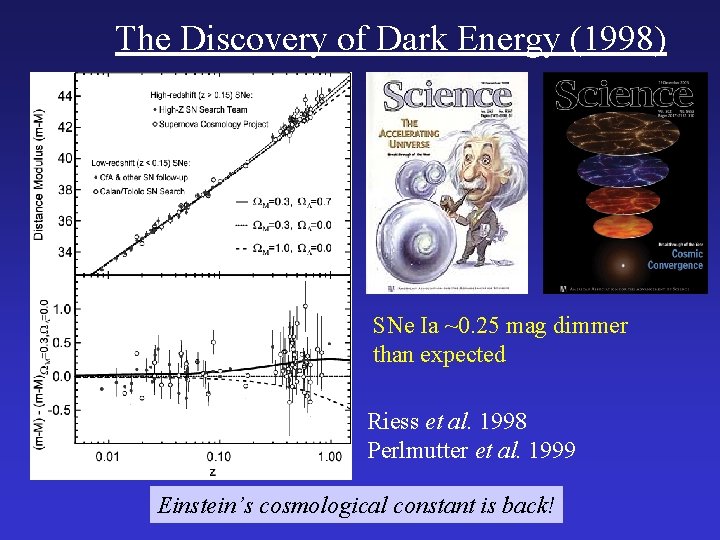
The Discovery of Dark Energy (1998) SNe Ia ~0. 25 mag dimmer than expected Riess et al. 1998 Perlmutter et al. 1999 Einstein’s cosmological constant is back!
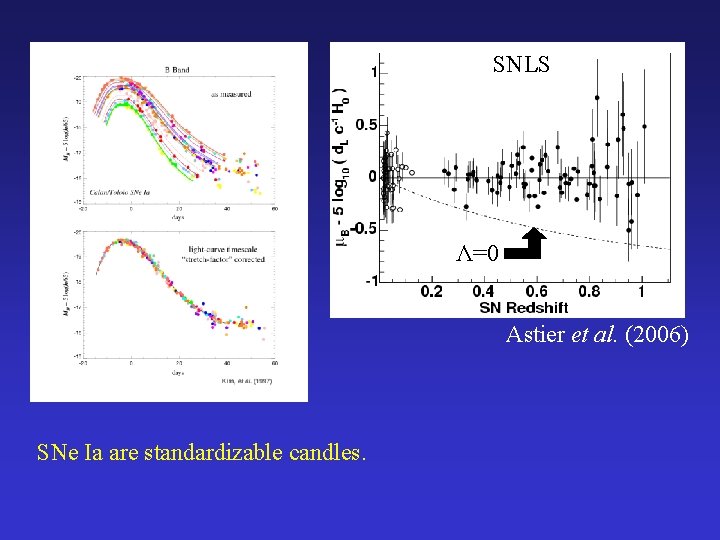
SNLS Λ=0 Astier et al. (2006) SNe Ia are standardizable candles.
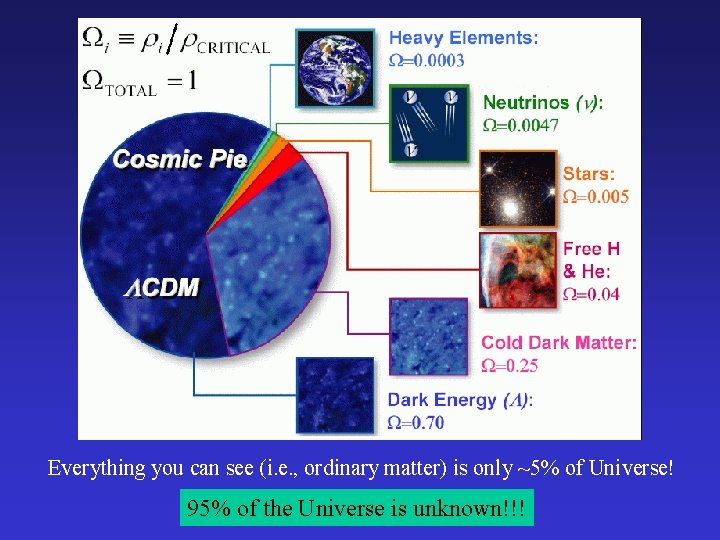
Everything you can see (i. e. , ordinary matter) is only ~5% of Universe! 95% of the Universe is unknown!!!
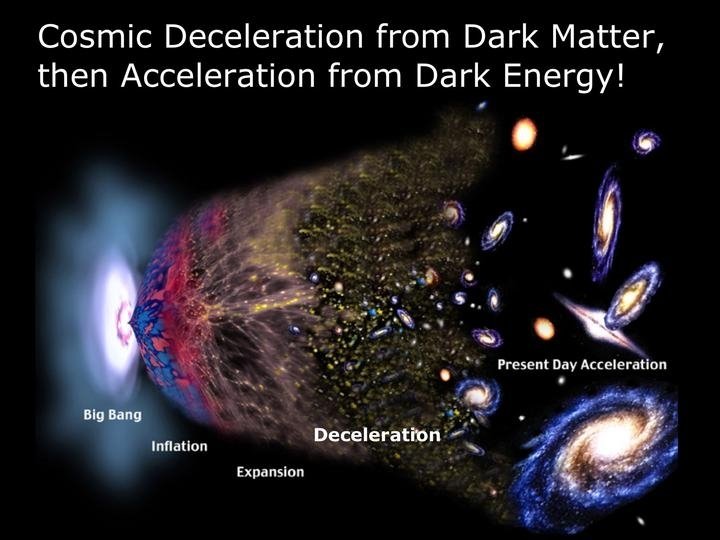
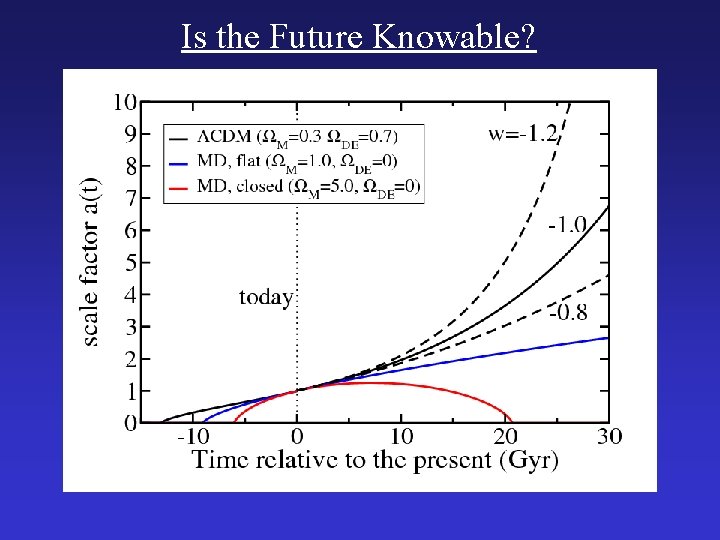
Is the Future Knowable?
What is Dark Energy? 1) Vacuum Energy: - zero point energy of the vacuum - quantum field theory yield ΩDE > 10120 ρcritical - SUSY or string theory doesn’t help (LHC may yield info) 2) Scalar Field: - additional degree of freedom (w varies between -1 and +1) - related to inflation? - vacuum energy is dynamical – why is DE just becoming important now? - may give rise to new long-range force - does not address cosmological constant problem
What is Dark Energy? 3) New Gravitational Physics: - cosmic acceleration could point towards a theory of gravity that supersedes General Relativity - no self-consistent model available 4) Old Gravitational Physics: - no compelling solution 5) String Theory: - no unique solution (invoke the anthropic principle? ) Dark energy has the potential of revolutionizing physics!
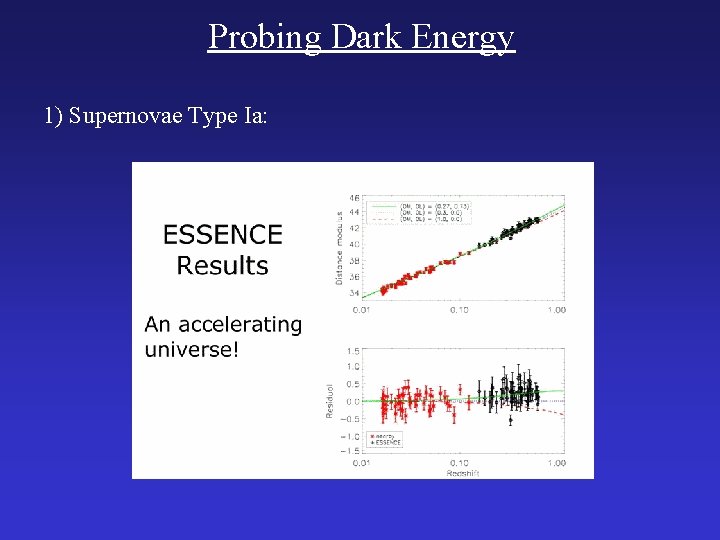
Probing Dark Energy 1) Supernovae Type Ia:
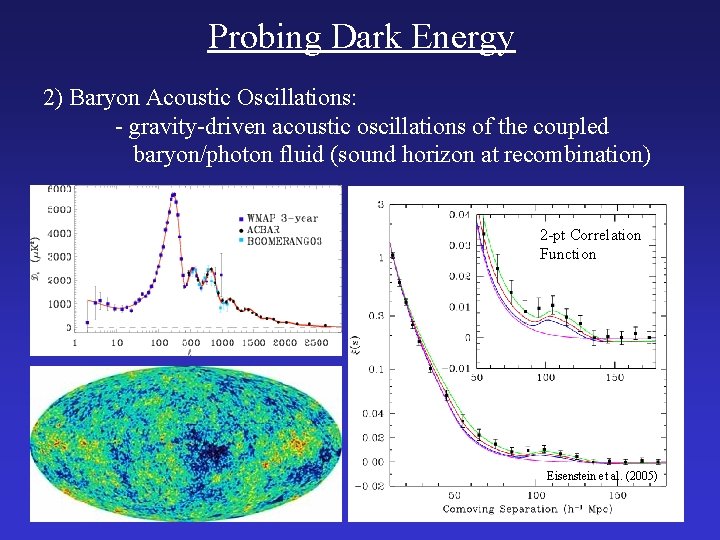
Probing Dark Energy 2) Baryon Acoustic Oscillations: - gravity-driven acoustic oscillations of the coupled baryon/photon fluid (sound horizon at recombination) 2 -pt Correlation Function Eisenstein et al. (2005)
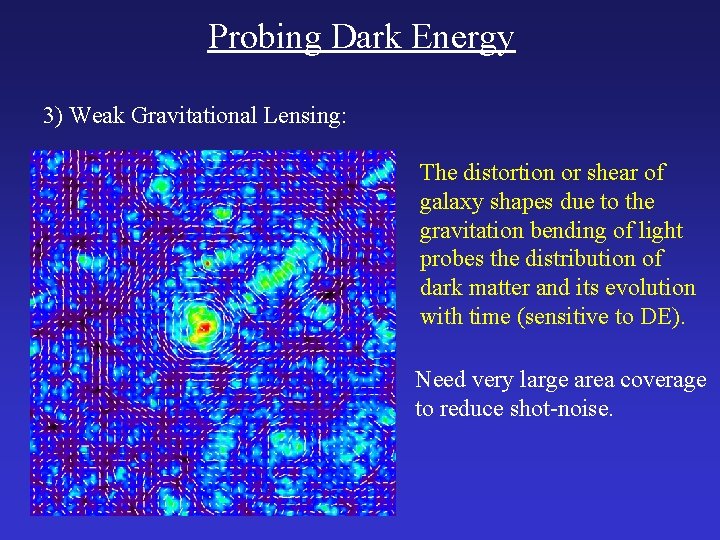
Probing Dark Energy 3) Weak Gravitational Lensing: The distortion or shear of galaxy shapes due to the gravitation bending of light probes the distribution of dark matter and its evolution with time (sensitive to DE). Need very large area coverage to reduce shot-noise.
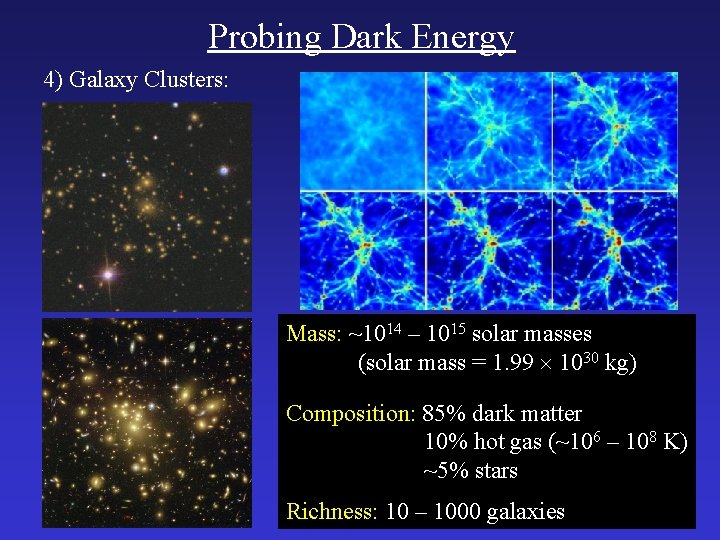
Probing Dark Energy 4) Galaxy Clusters: Mass: ~1014 – 1015 solar masses (solar mass = 1. 99 1030 kg) Composition: 85% dark matter 10% hot gas (~106 – 108 K) ~5% stars Richness: 10 – 1000 galaxies
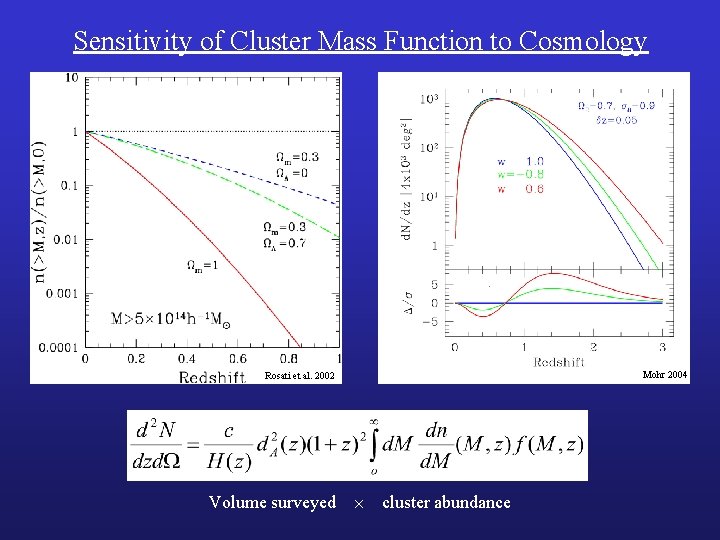
Sensitivity of Cluster Mass Function to Cosmology Mohr 2004 Rosati et al. 2002 Volume surveyed cluster abundance
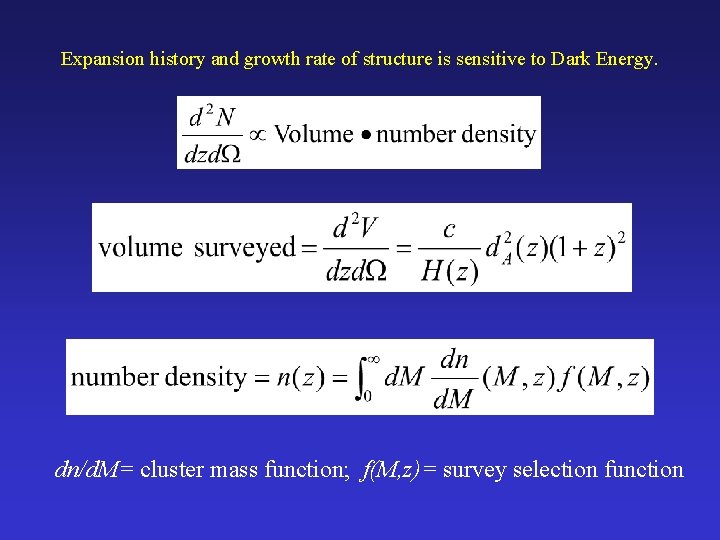
Expansion history and growth rate of structure is sensitive to Dark Energy. dn/d. M= cluster mass function; f(M, z)= survey selection function
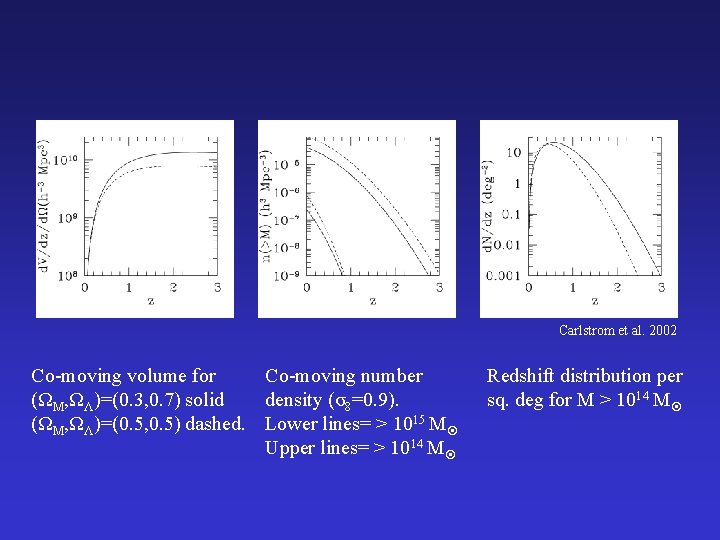
Carlstrom et al. 2002 Co-moving volume for Co-moving number (ΩM, ΩΛ)=(0. 3, 0. 7) solid density (σ8=0. 9). (ΩM, ΩΛ)=(0. 5, 0. 5) dashed. Lower lines= > 1015 M Upper lines= > 1014 M Redshift distribution per sq. deg for M > 1014 M
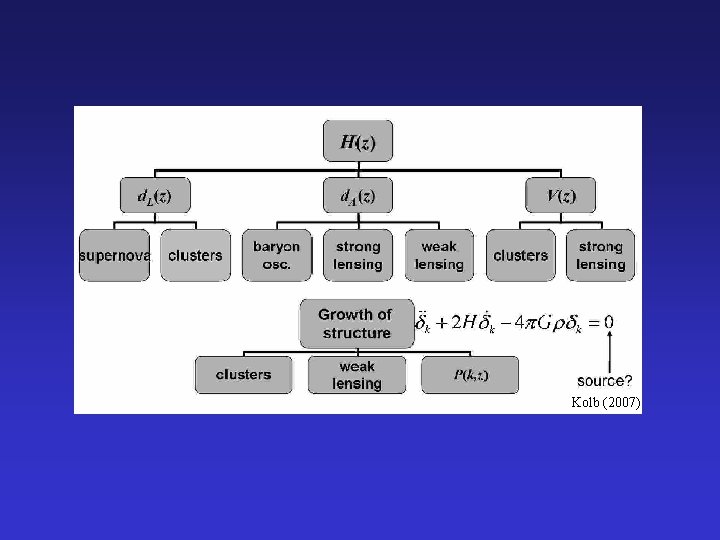
Kolb (2007)
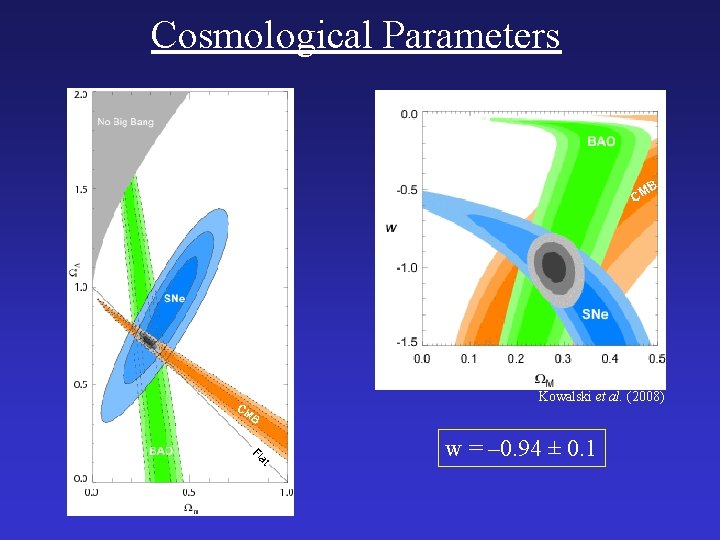
Cosmological Parameters Kowalski et al. (2008) w = – 0. 94 ± 0. 1
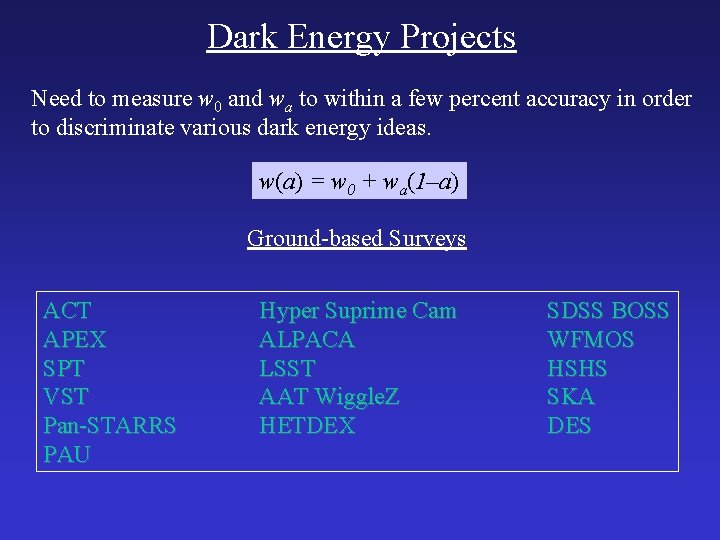
Dark Energy Projects Need to measure w 0 and wa to within a few percent accuracy in order to discriminate various dark energy ideas. w(a) = w 0 + wa(1–a) Ground-based Surveys ACT APEX SPT VST Pan-STARRS PAU Hyper Suprime Cam ALPACA LSST AAT Wiggle. Z HETDEX SDSS BOSS WFMOS HSHS SKA DES
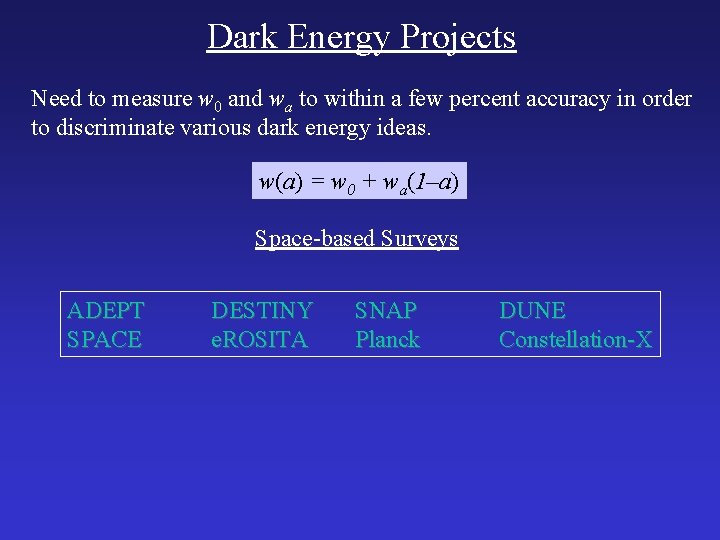
Dark Energy Projects Need to measure w 0 and wa to within a few percent accuracy in order to discriminate various dark energy ideas. w(a) = w 0 + wa(1–a) Space-based Surveys ADEPT SPACE DESTINY e. ROSITA SNAP Planck DUNE Constellation-X
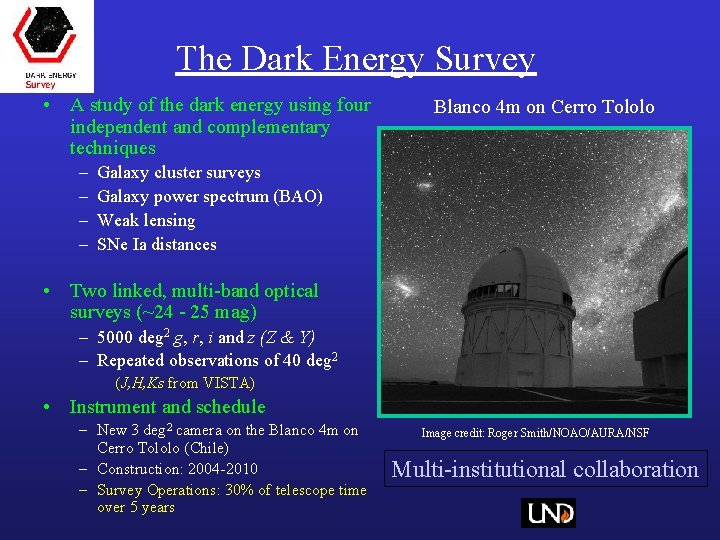
The Dark Energy Survey • A study of the dark energy using four independent and complementary techniques – – Blanco 4 m on Cerro Tololo Galaxy cluster surveys Galaxy power spectrum (BAO) Weak lensing SNe Ia distances • Two linked, multi-band optical surveys (~24 - 25 mag) – 5000 deg 2 g, r, i and z (Z & Y) – Repeated observations of 40 deg 2 (J, H, Ks from VISTA) • Instrument and schedule – New 3 deg 2 camera on the Blanco 4 m on Cerro Tololo (Chile) – Construction: 2004 -2010 – Survey Operations: 30% of telescope time over 5 years Image credit: Roger Smith/NOAO/AURA/NSF Multi-institutional collaboration
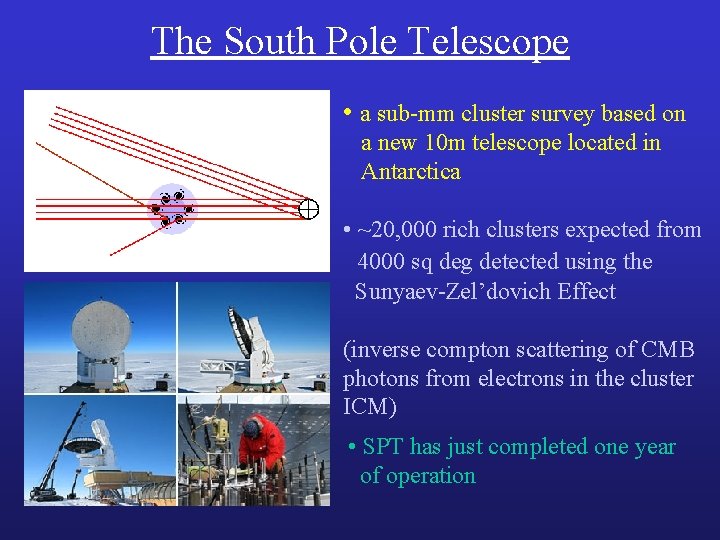
The South Pole Telescope • a sub-mm cluster survey based on a new 10 m telescope located in Antarctica • ~20, 000 rich clusters expected from 4000 sq deg detected using the Sunyaev-Zel’dovich Effect (inverse compton scattering of CMB photons from electrons in the cluster ICM) • SPT has just completed one year of operation
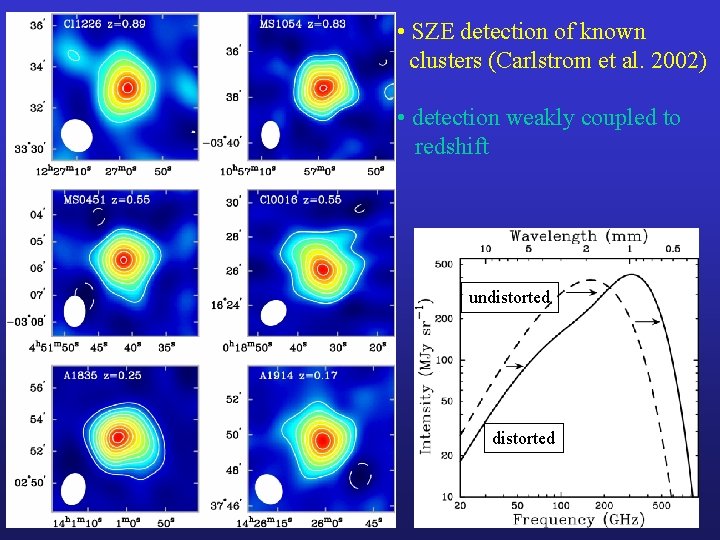
• SZE detection of known clusters (Carlstrom et al. 2002) • detection weakly coupled to redshift undistorted
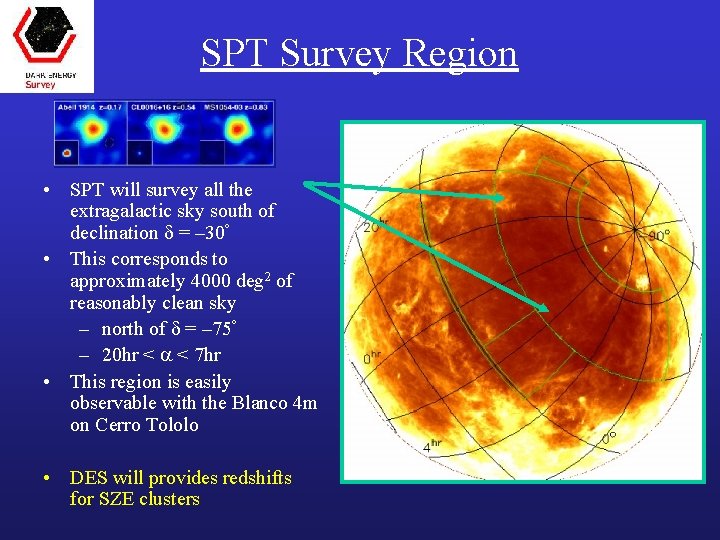
SPT Survey Region • SPT will survey all the extragalactic sky south of declination d = – 30° • This corresponds to approximately 4000 deg 2 of reasonably clean sky – north of d = – 75° – 20 hr < a < 7 hr • This region is easily observable with the Blanco 4 m on Cerro Tololo • DES will provides redshifts for SZE clusters
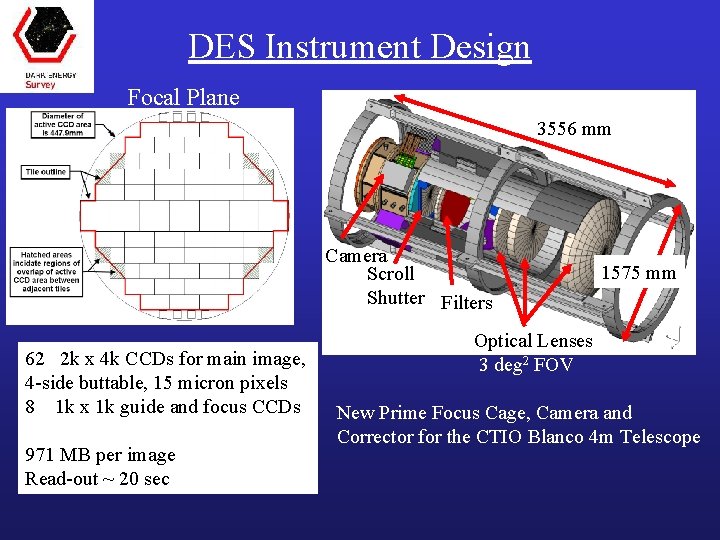
DES Instrument Design Focal Plane 3556 mm Camera Scroll Shutter Filters 62 2 k x 4 k CCDs for main image, 4 -side buttable, 15 micron pixels 8 1 k x 1 k guide and focus CCDs 971 MB per image Read-out ~ 20 sec 1575 mm Optical Lenses 3 deg 2 FOV New Prime Focus Cage, Camera and Corrector for the CTIO Blanco 4 m Telescope
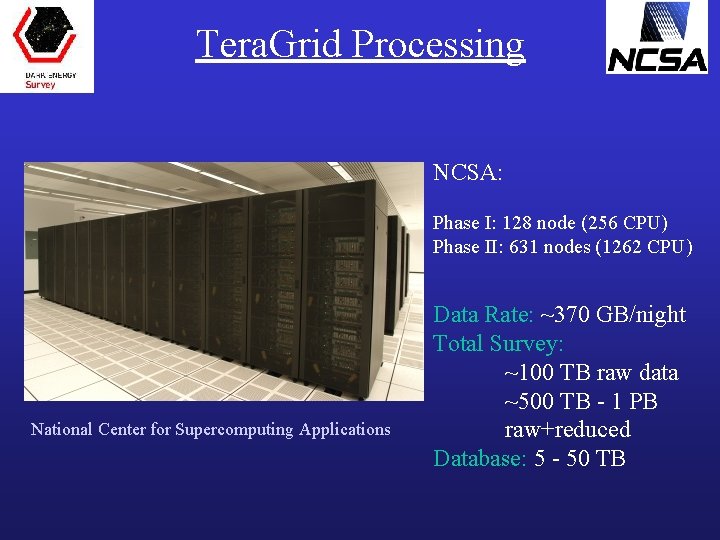
Tera. Grid Processing NCSA: Phase I: 128 node (256 CPU) Phase II: 631 nodes (1262 CPU) National Center for Supercomputing Applications Data Rate: ~370 GB/night Total Survey: ~100 TB raw data ~500 TB - 1 PB raw+reduced Database: 5 - 50 TB

Finding Galaxy Clusters Voronoi Tessellation and Percolation Technique CXOMP J 160948. 4+660057 Previously unknown cluster (z~ 0. 475) VTP/X-ray detected Ramella et al. 2001 • Galaxy plane divided into cells containing a unique galaxy • clusters selected as over-densities in cell numbers grouped using percolation technique • detection significance derived from comparison to random field • Independent of cluster shape Barkhouse et al. 2006 (irregular + symmetric clusters)
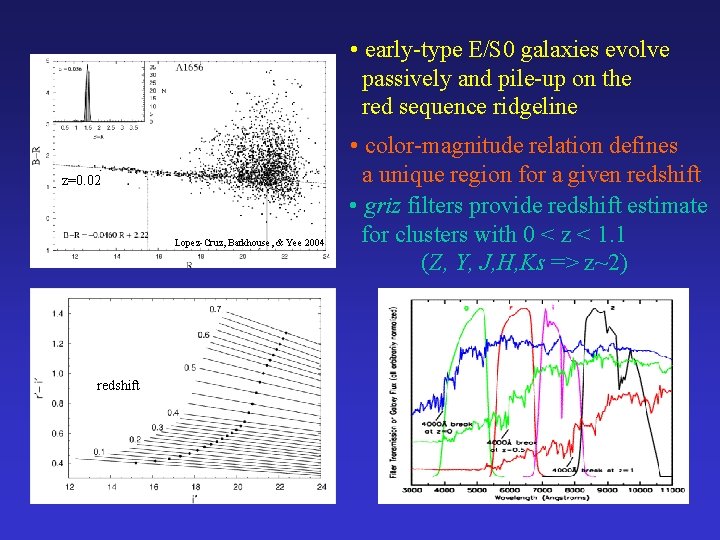
• early-type E/S 0 galaxies evolve passively and pile-up on the red sequence ridgeline z=0. 02 Lopez-Cruz, Barkhouse, & Yee 2004 redshift • color-magnitude relation defines a unique region for a given redshift • griz filters provide redshift estimate for clusters with 0 < z < 1. 1 (Z, Y, J, H, Ks => z~2)
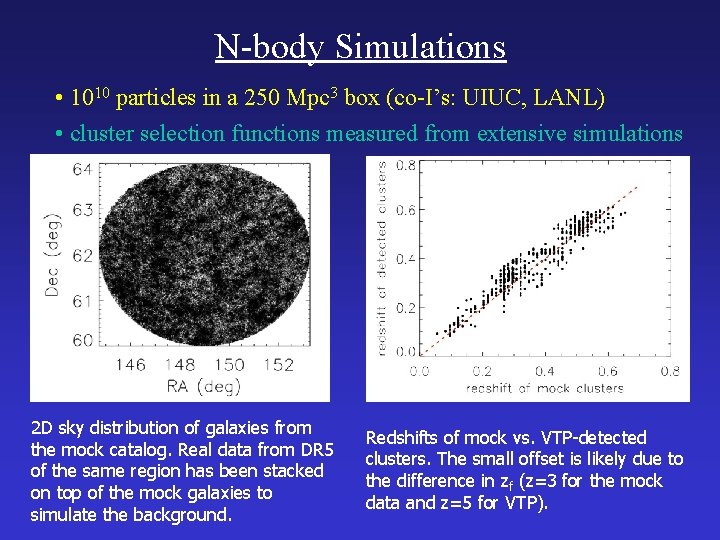
N-body Simulations • 1010 particles in a 250 Mpc 3 box (co-I’s: UIUC, LANL) • cluster selection functions measured from extensive simulations 2 D sky distribution of galaxies from the mock catalog. Real data from DR 5 of the same region has been stacked on top of the mock galaxies to simulate the background. Redshifts of mock vs. VTP-detected clusters. The small offset is likely due to the difference in zf (z=3 for the mock data and z=5 for VTP).
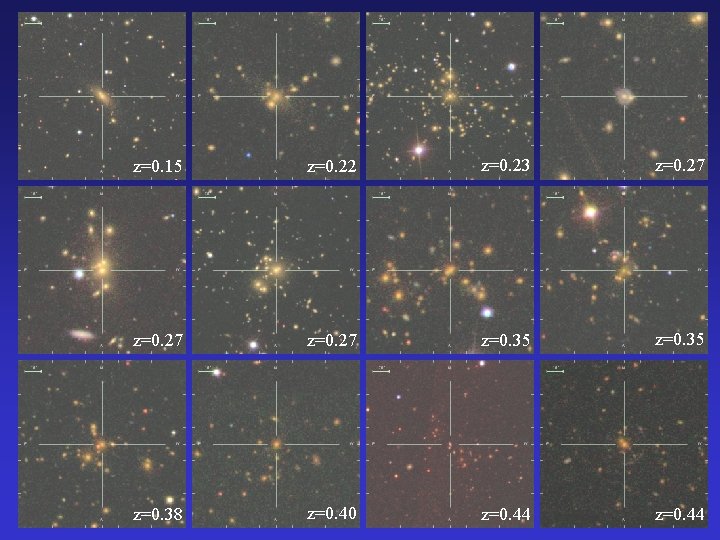
z=0. 15 z=0. 22 z=0. 23 z=0. 27 z=0. 35 z=0. 38 z=0. 40 z=0. 44
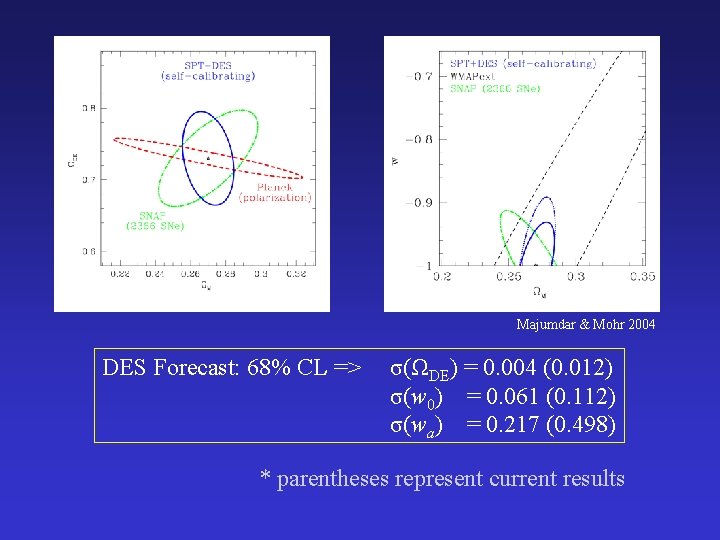
Majumdar & Mohr 2004 DES Forecast: 68% CL => σ(ΩDE) = 0. 004 (0. 012) σ(w 0) = 0. 061 (0. 112) σ(wa) = 0. 217 (0. 498) * parentheses represent current results
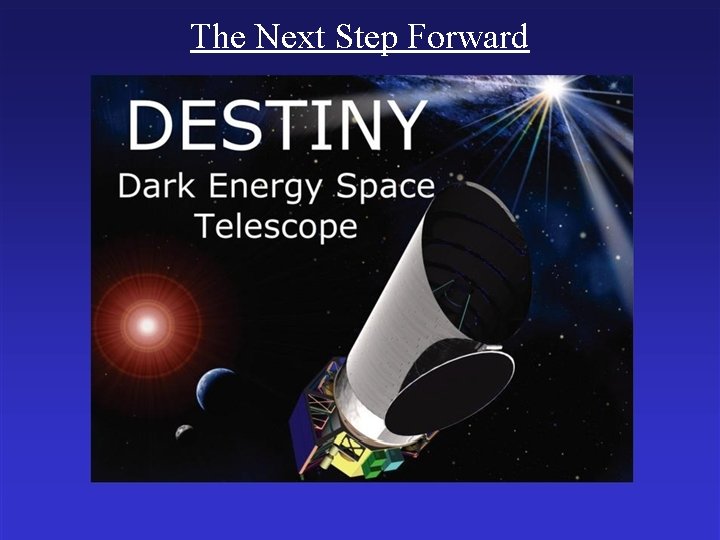
The Next Step Forward
Summary • Strong evidence for accelerated expansion • Dark Energy as the cause of cosmic acceleration • Independent evidence for Dark Energy • Vacuum energy as Dark Energy • Current observational status: w ~ -1 ± 0. 1 (stat) ± 0. 1 (sys) • The Dark Energy Survey and other ground- and space-based surveys will provide tight constraints on dark energy
“At the last dim horizon, we search for ghostly errors of observations for landmarks that are scarcely more substantial. ” Edwin Hubble, The Realm of the Nebulae (1936)
- Slides: 45