
Shearwave Splitting Tomography in the Central American Mantle

- Slides: 14
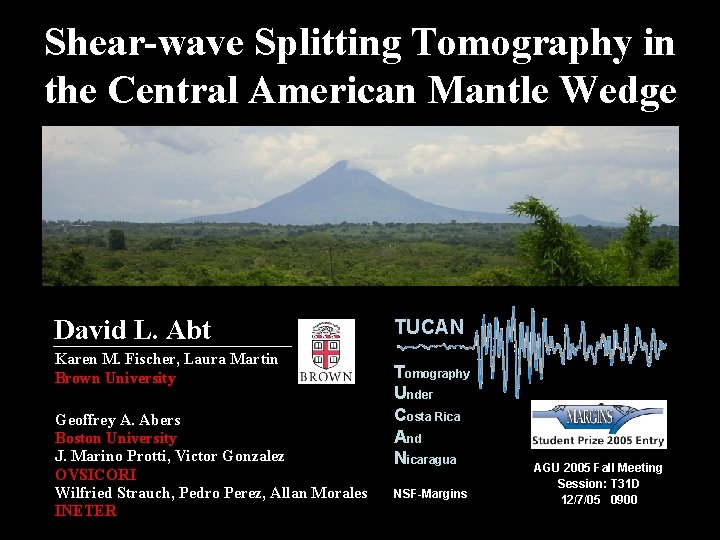
Shear-wave Splitting Tomography in the Central American Mantle Wedge David L. Abt Karen M. Fischer, Laura Martin Brown University Geoffrey A. Abers Boston University J. Marino Protti, Victor Gonzalez OVSICORI Wilfried Strauch, Pedro Perez, Allan Morales INETER TUCAN Tomography Under Costa Rica And Nicaragua NSF-Margins AGU 2005 Fall Meeting Session: T 31 D 12/7/05 0900
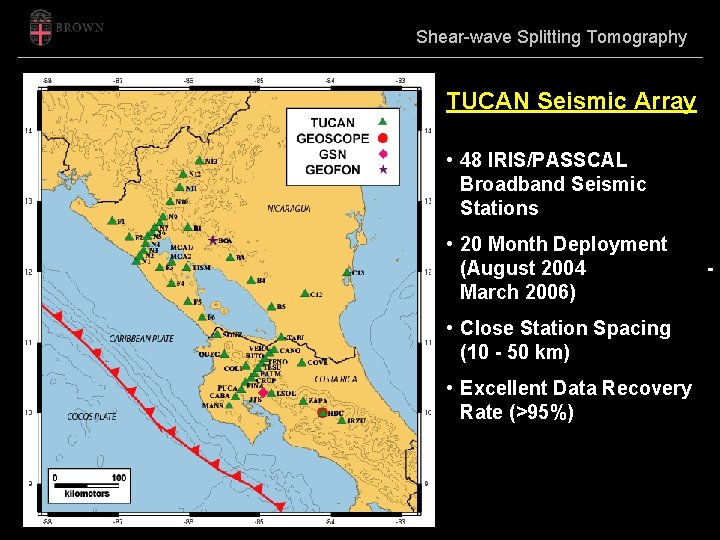
Shear-wave Splitting Tomography TUCAN Seismic Array • 48 IRIS/PASSCAL Broadband Seismic Stations • 20 Month Deployment (August 2004 March 2006) • Close Station Spacing (10 - 50 km) • Excellent Data Recovery Rate (>95%) -
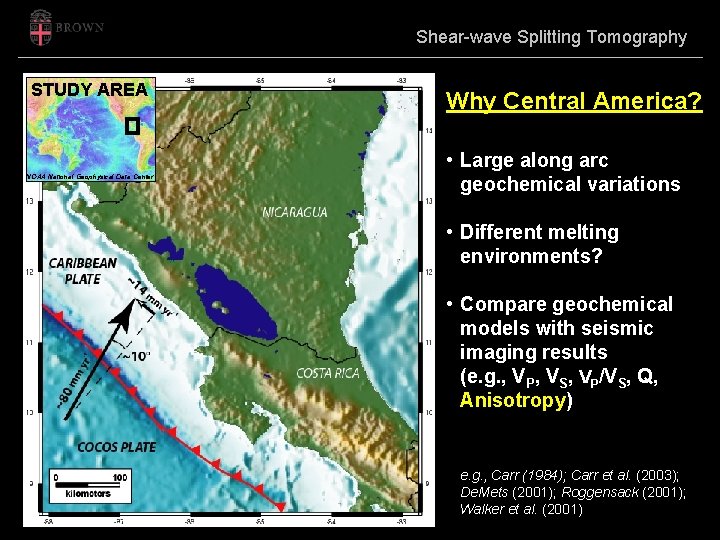
Shear-wave Splitting Tomography STUDY AREA NOAA National Geophysical Data Center Why Central America? • Large along arc geochemical variations • Different melting environments? • Compare geochemical models with seismic imaging results (e. g. , VP, VS, VP/VS, Q, Anisotropy) e. g. , Carr (1984); Carr et al. (2003); De. Mets (2001); Roggensack (2001); Walker et al. (2001)
Shear-wave Splitting Tomography SHEAR-WAVE SPLITTING TOMOGRAPHY Objective: Help constrain flow, melt and volatile distribution by modeling anisotropic structure in the wedge Method: • Shear-wave splitting analysis • Forward model: synthetic waveforms • Linearized inversion Preliminary Results & Implications…
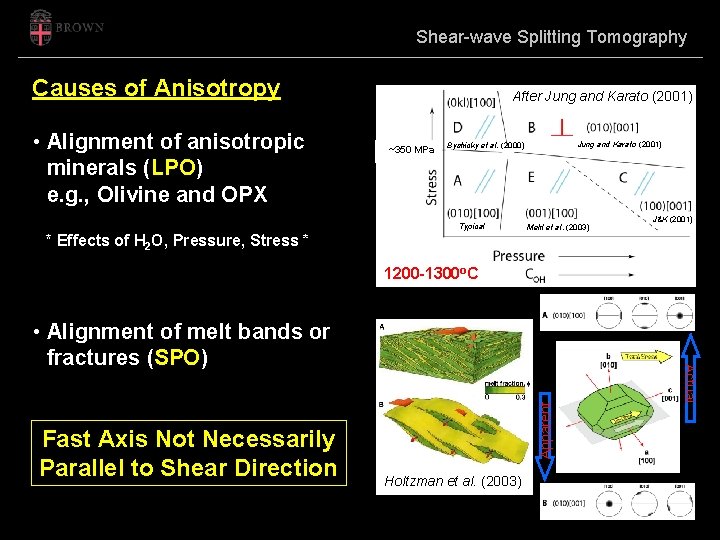
Shear-wave Splitting Tomography Causes of Anisotropy • Alignment of anisotropic minerals (LPO) e. g. , Olivine and OPX After Jung and Karato (2001) ~350 MPa Jung and Karato (2001) Bystricky et al. (2000) Typical Mehl et al. (2003) J&K (2001) * Effects of H 2 O, Pressure, Stress * 1200 -1300 o. C Apparent Fast Axis Not Necessarily Parallel to Shear Direction Holtzman et al. (2003) Actual • Alignment of melt bands or fractures (SPO)
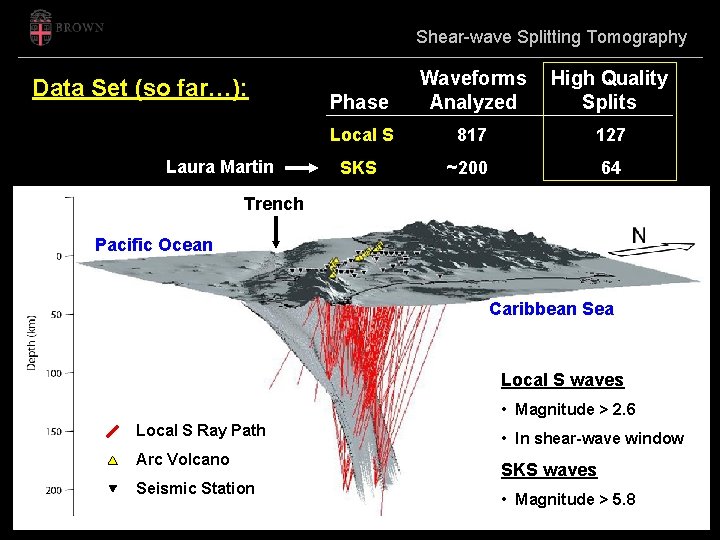
Shear-wave Splitting Tomography Data Set (so far…): Laura Martin Phase Waveforms Analyzed High Quality Splits Local S 817 127 SKS ~200 64 Trench Pacific Ocean Caribbean Sea Local S waves • Magnitude > 2. 6 Local S Ray Path Arc Volcano Seismic Station • In shear-wave window SKS waves • Magnitude > 5. 8
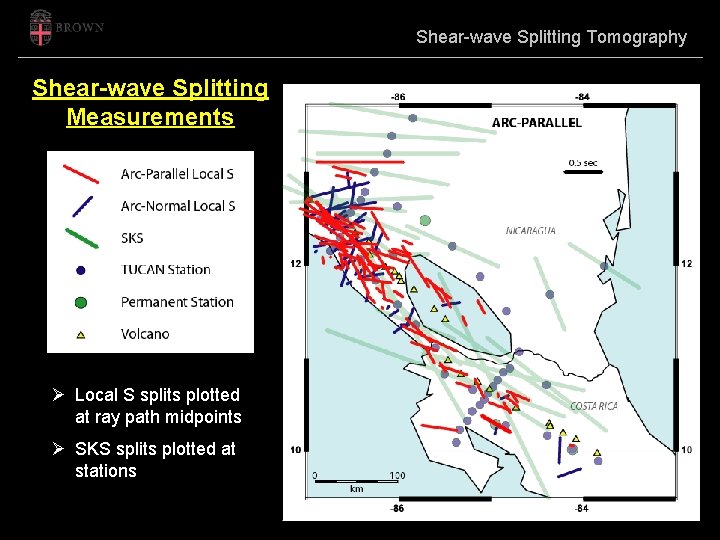
Shear-wave Splitting Tomography Shear-wave Splitting Measurements Caribbean Sea Ø Local S splits plotted at ray path midpoints Ø SKS splits plotted at stations Pacific Ocean
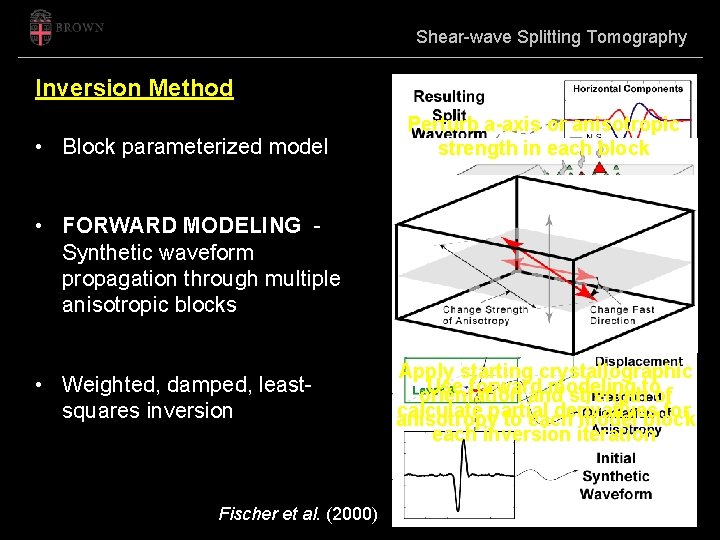
Shear-wave Splitting Tomography Inversion Method • Block parameterized model Perturb a-axis or anisotropic strength in each block • FORWARD MODELING Synthetic waveform propagation through multiple anisotropic blocks • Weighted, damped, leastsquares inversion Fischer et al. (2000) Apply starting crystallographic Use forward modeling orientation and strengthtoof calculate partial derivatives for anisotropy to each model block each inversion iteration
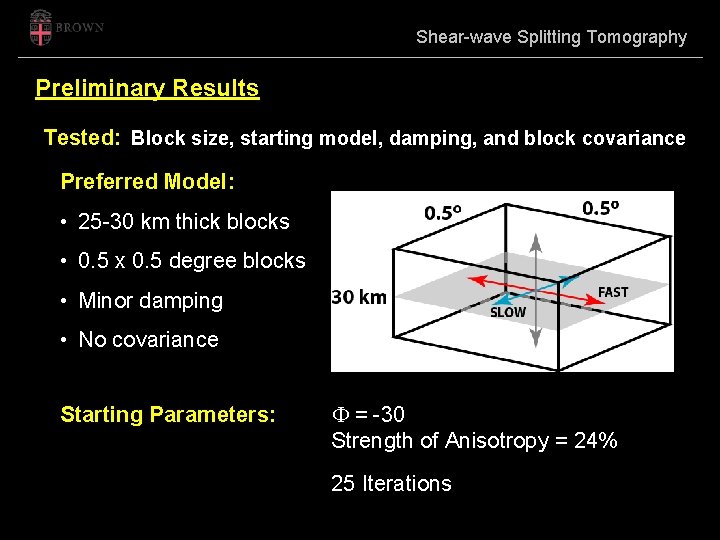
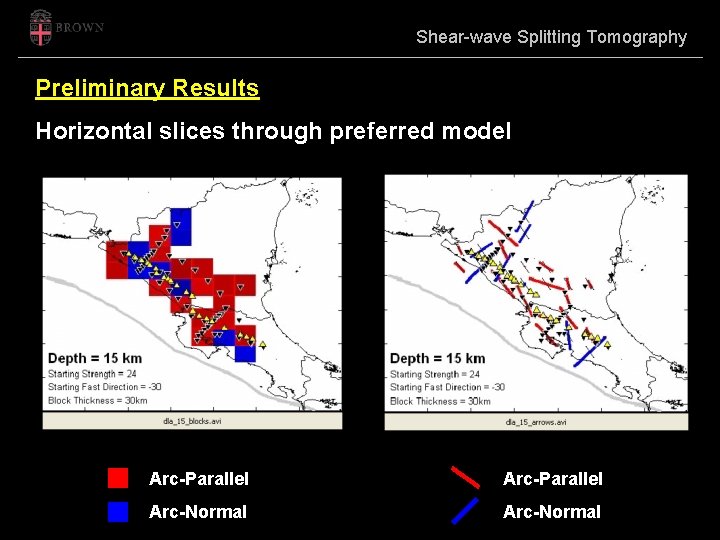
Shear-wave Splitting Tomography Preliminary Results Tested: Block size, starting model, damping, and block covariance Preferred Model: • 25 -30 km thick blocks • 0. 5 x 0. 5 degree blocks • Minor damping • No covariance Starting Parameters: F = -30 Strength of Anisotropy = 24% 25 Iterations
Shear-wave Splitting Tomography Preliminary Results Horizontal slices through preferred model Arc-Parallel Arc-Normal
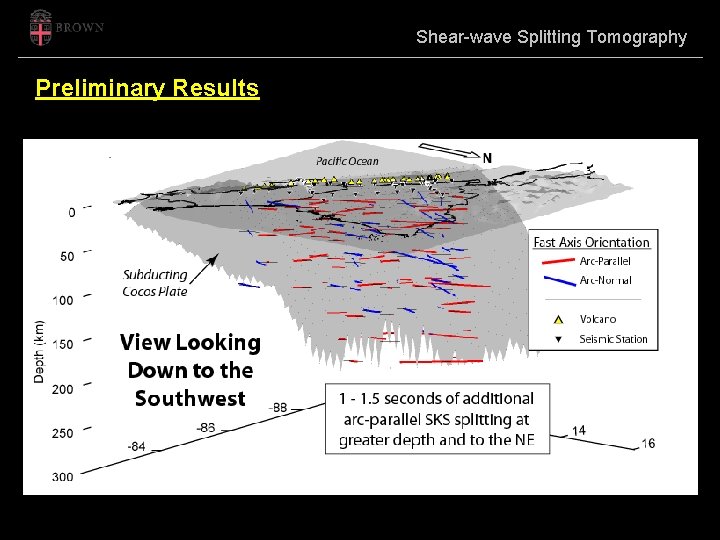
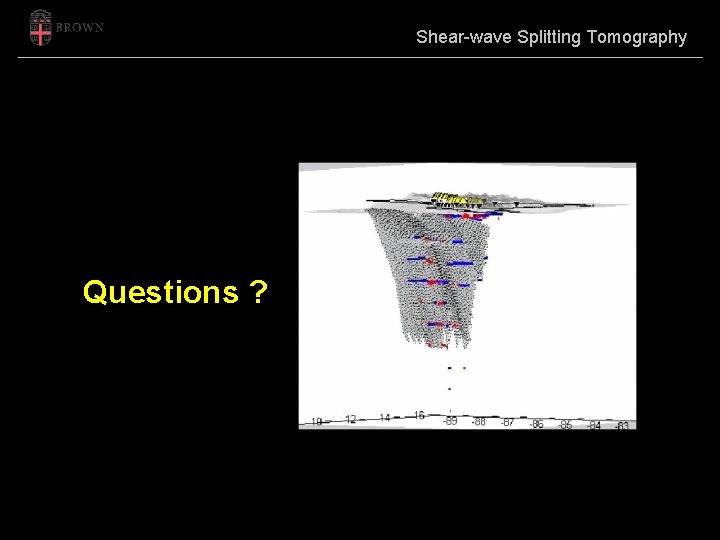
Shear-wave Splitting Tomography Depth (km) Preliminary Results View looking SW
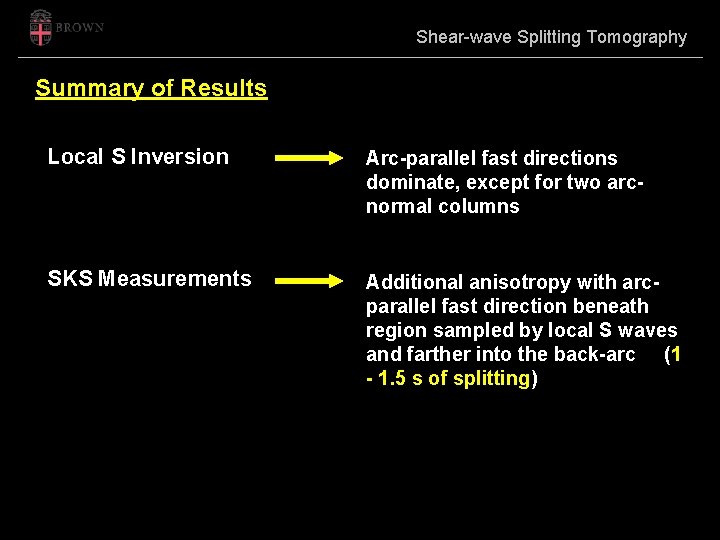
Shear-wave Splitting Tomography Summary of Results Local S Inversion Arc-parallel fast directions dominate, except for two arcnormal columns SKS Measurements Additional anisotropy with arcparallel fast direction beneath region sampled by local S waves and farther into the back-arc (1 - 1. 5 s of splitting)
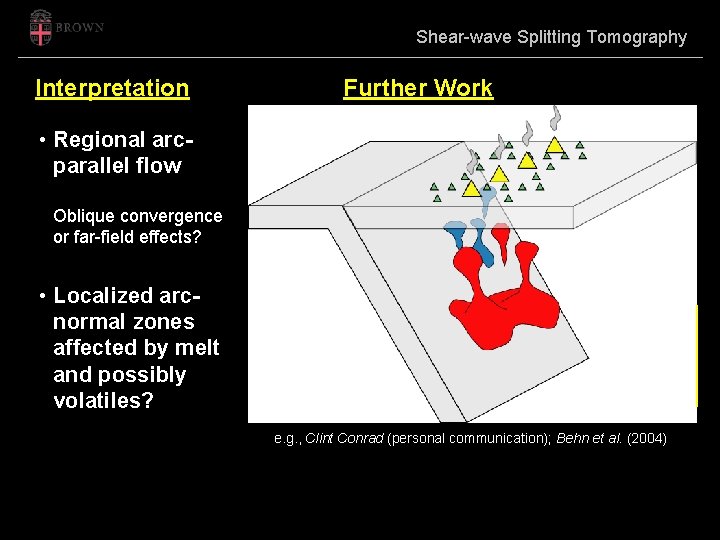
Shear-wave Splitting Tomography Interpretation Further Work • Regional arcparallel flow • Full data set Oblique convergence or far-field effects? • Localized arcnormal zones affected by melt and possibly volatiles? • 3 -D rotations of fast direction • Optimize model uniqueness and resolution ~5 months ~20 months 127 Local Splits ~500 Splits? e. g. , Clint Conrad (personal communication); Behn et al. (2004)
Shear-wave Splitting Tomography Questions ?