
Sharing the Road Purpose Study issues related to
- Slides: 47
Sharing the Road Purpose: Study issues related to sharing the roadway with motorcycles, slow moving vehicles, emergency vehicles, trolleys and carpoolers.
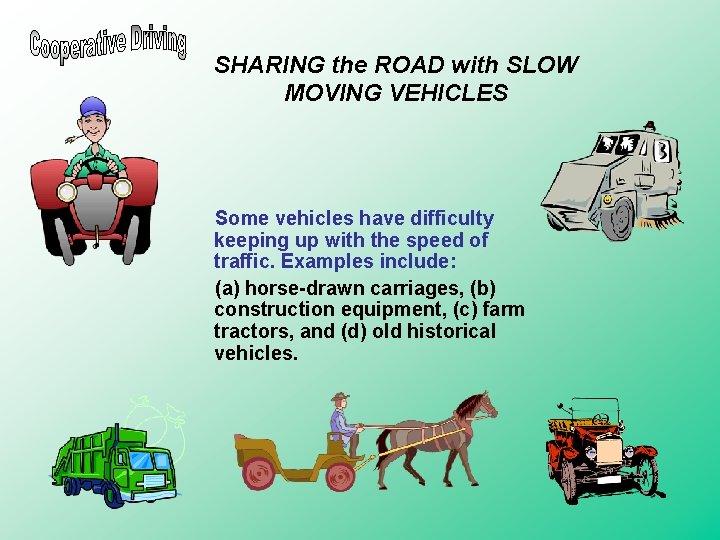
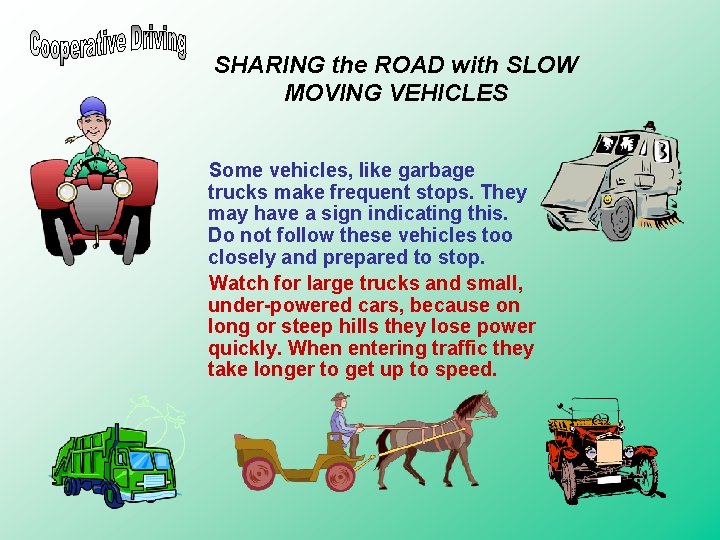
SHARING the ROAD with SLOW MOVING VEHICLES Some vehicles have difficulty keeping up with the speed of traffic. Examples include: (a) horse-drawn carriages, (b) construction equipment, (c) farm tractors, and (d) old historical vehicles.
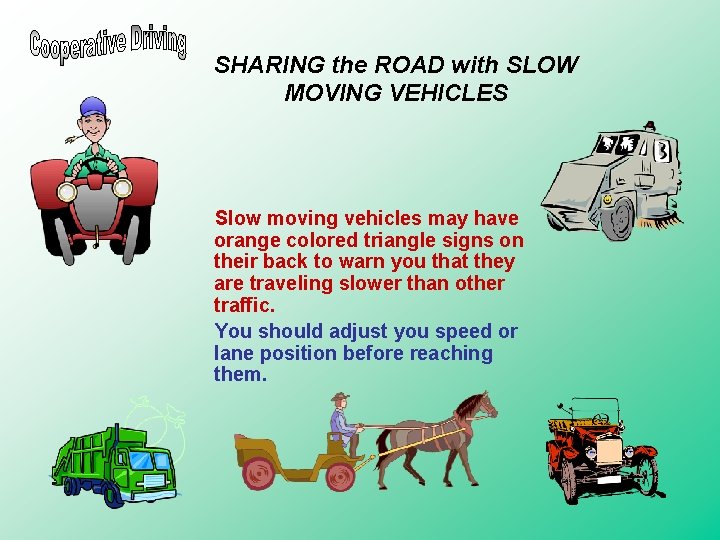
SHARING the ROAD with SLOW MOVING VEHICLES Slow moving vehicles may have orange colored triangle signs on their back to warn you that they are traveling slower than other traffic. You should adjust you speed or lane position before reaching them.
SHARING the ROAD with SLOW MOVING VEHICLES Some vehicles, like garbage trucks make frequent stops. They may have a sign indicating this. Do not follow these vehicles too closely and prepared to stop. Watch for large trucks and small, under-powered cars, because on long or steep hills they lose power quickly. When entering traffic they take longer to get up to speed.
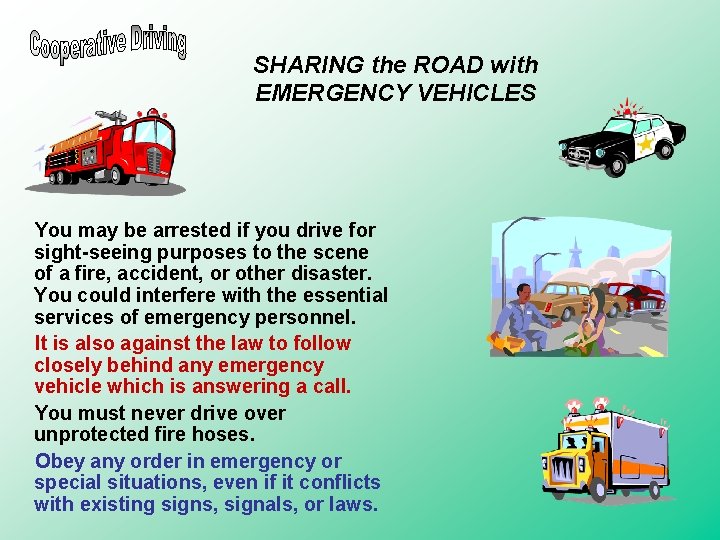
SHARING the ROAD with EMERGENCY VEHICLES Emergency vehicles include: ambulances, law enforcement, fire fighting, forestry, lifeguard, and other rescue and lifesaving vehicles. When you encounter them on the roadway, be courteous. Act like you would want other drivers to act if you were the one who needed help. You must yield the right of way to a police car, fire engine, ambulance or other emergency vehicle using a siren or flashing lights.
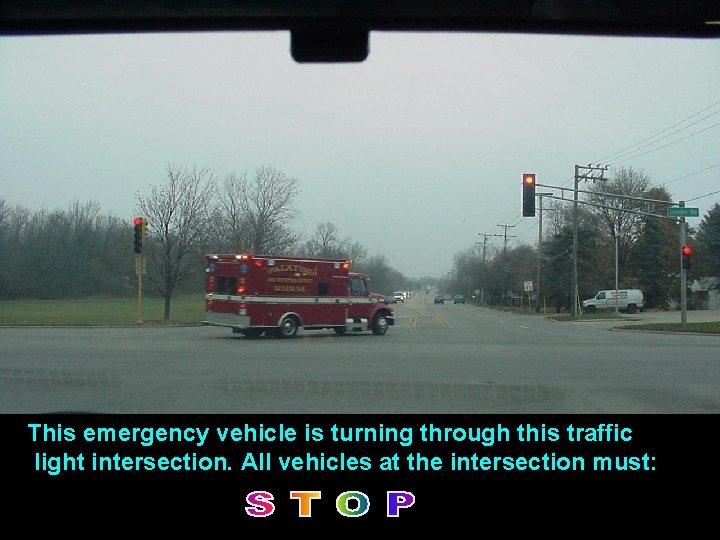
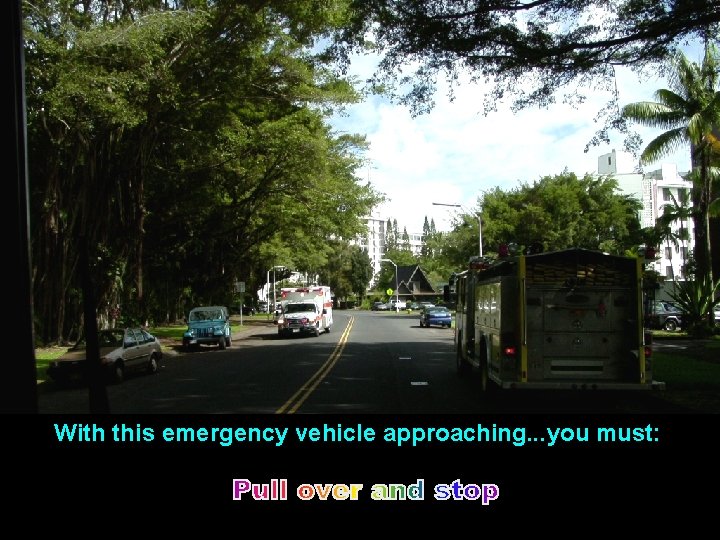
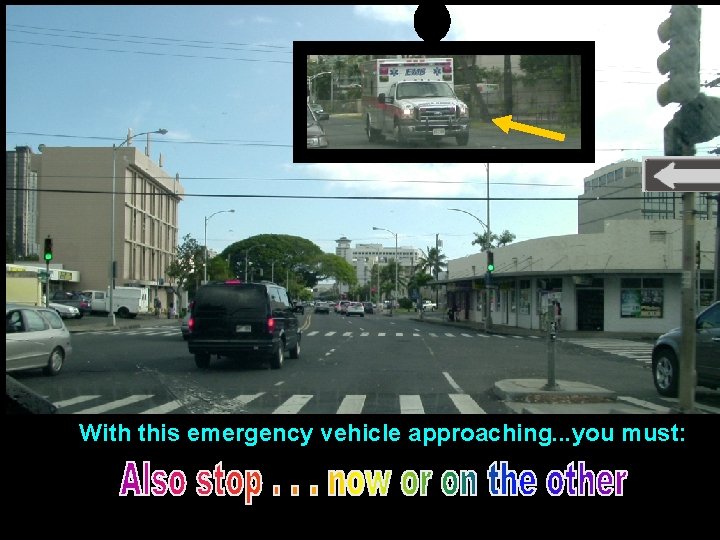
SHARING the ROAD with EMERGENCY VEHICLES When you are driving be alert for the lights and siren of approaching emergency vehicles. Do not play your sound system so loud as to not hear them. If you hear sirens but do not see the emergency vehicle, slow down and be prepared to stop. Do not panic. Scan the roadway and your mirrors. Approach intersections with caution – the emergency vehicle may be approaching quickly from a side street. Your responsibility is to pull over as far to the right as possible and stop until they have passed. It does not matter which side of the road it is approaching from. You should not stop in the middle of an intersection. Continue through and then pull over.
SHARING the ROAD with EMERGENCY VEHICLES When on the freeway and an emergency vehicle approaches from behind, you should yield the right of way. Usually this means moving out of the left most lane, slowing your vehicle, and allow the emergency vehicle to pass. You must also get out of the way of emergency vehicles trying to enter or exit the highway. Do not pull over to the side on a multi-lane freeway and stop – this is very dangerous. If you are a pedestrian you should proceed to the nearest curb or place of safety and remain there until the vehicle has passed. Sometimes emergency vehicles will use the wrong side of the street to continue on their way. Emergency vehicles may use a loud speaker to talk to drivers blocking their path.
SHARING the ROAD with EMERGENCY VEHICLES You may be arrested if you drive for sight-seeing purposes to the scene of a fire, accident, or other disaster. You could interfere with the essential services of emergency personnel. It is also against the law to follow closely behind any emergency vehicle which is answering a call. You must never drive over unprotected fire hoses. Obey any order in emergency or special situations, even if it conflicts with existing signs, signals, or laws.
This emergency vehicle is turning through this traffic light intersection. All vehicles at the intersection must:
With this emergency vehicle approaching. . . you must:
With this emergency vehicle approaching. . . you must:
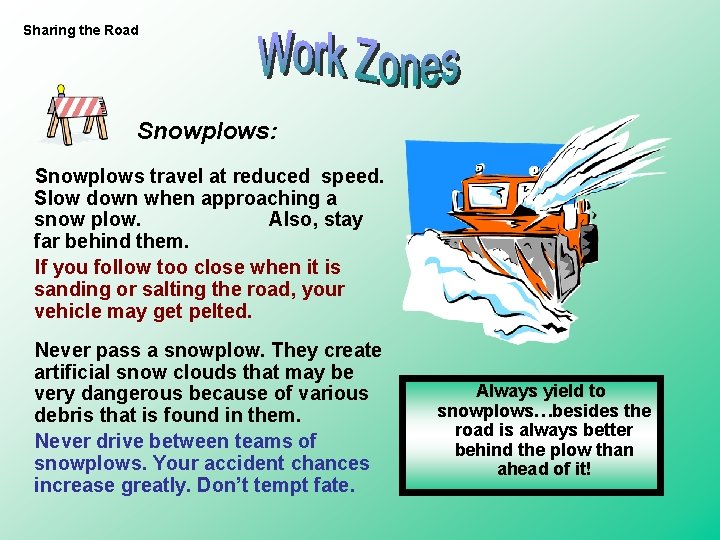
Sharing the Road Snowplows: Snowplows travel at reduced speed. Slow down when approaching a snow plow. Also, stay far behind them. If you follow too close when it is sanding or salting the road, your vehicle may get pelted. Never pass a snowplow. They create artificial snow clouds that may be very dangerous because of various debris that is found in them. Never drive between teams of snowplows. Your accident chances increase greatly. Don’t tempt fate. Always yield to snowplows…besides the road is always better behind the plow than ahead of it!
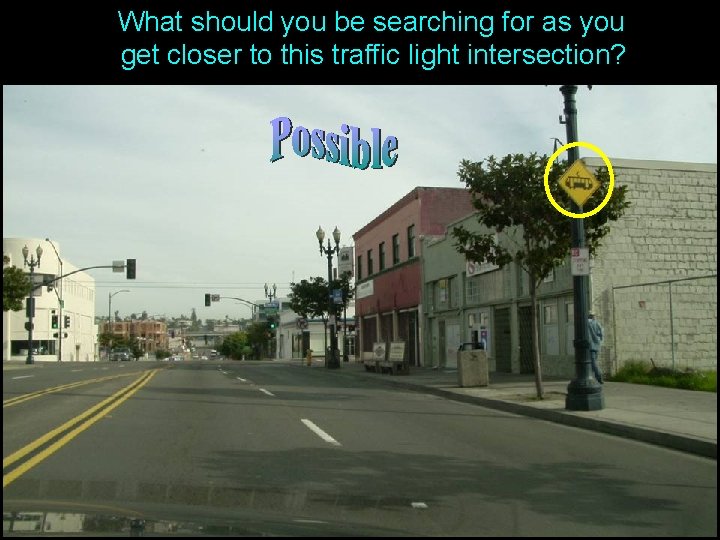
What should you be searching for as you get closer to this traffic light intersection?
Sharing the Road Light rail vehicles, or trolleys, have the same rights and responsibilities on public roadways as other vehicles. Although everyone must follow the same traffic laws, trolleys, because of their size, require exceptional handling ability. Trolleys differ from trains in that they are very quiet and move more quickly than freight trains. Some traffic signals are used to control traffic for trolleys and light rail trains only. The lights on these signals are marked with a letter T. Trolleys can interrupt traffic signals, so do not proceed forward until the signal light indicates you may.
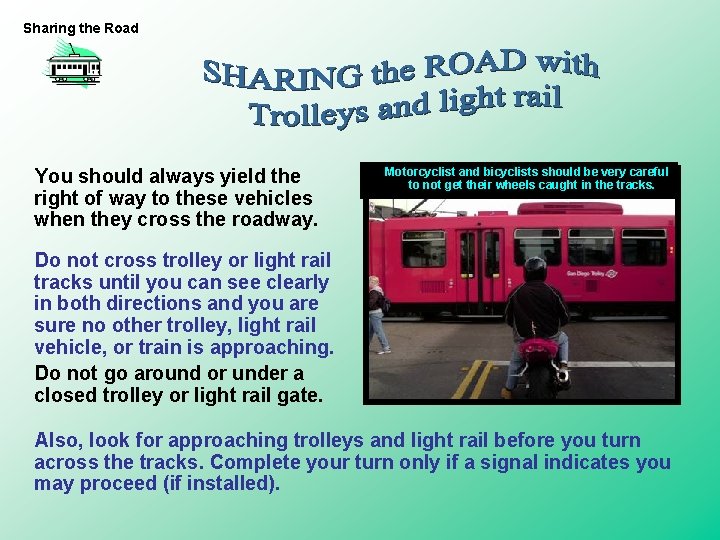
Sharing the Road You should always yield the right of way to these vehicles when they cross the roadway. Motorcyclist and bicyclists should be very careful to not get their wheels caught in the tracks. Do not cross trolley or light rail tracks until you can see clearly in both directions and you are sure no other trolley, light rail vehicle, or train is approaching. Do not go around or under a closed trolley or light rail gate. Also, look for approaching trolleys and light rail before you turn across the tracks. Complete your turn only if a signal indicates you may proceed (if installed).
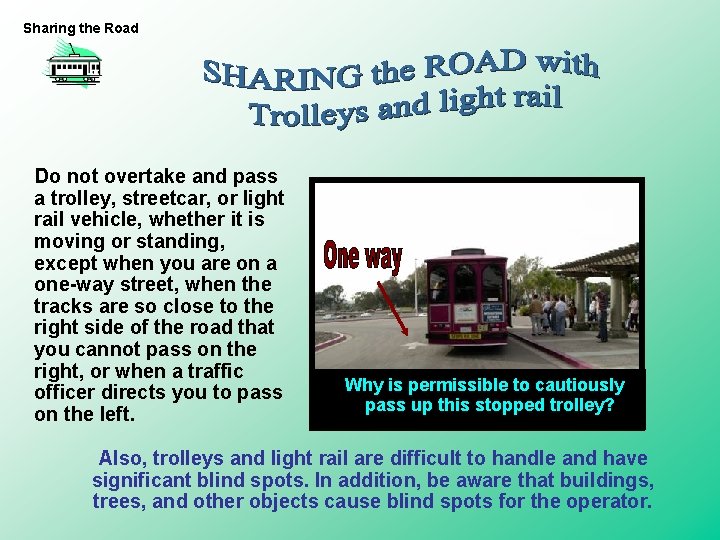
Sharing the Road Do not overtake and pass a trolley, streetcar, or light rail vehicle, whether it is moving or standing, except when you are on a one-way street, when the tracks are so close to the right side of the road that you cannot pass on the right, or when a traffic officer directs you to pass on the left. Why is permissible to cautiously pass up this stopped trolley? Also, trolleys and light rail are difficult to handle and have significant blind spots. In addition, be aware that buildings, trees, and other objects cause blind spots for the operator.
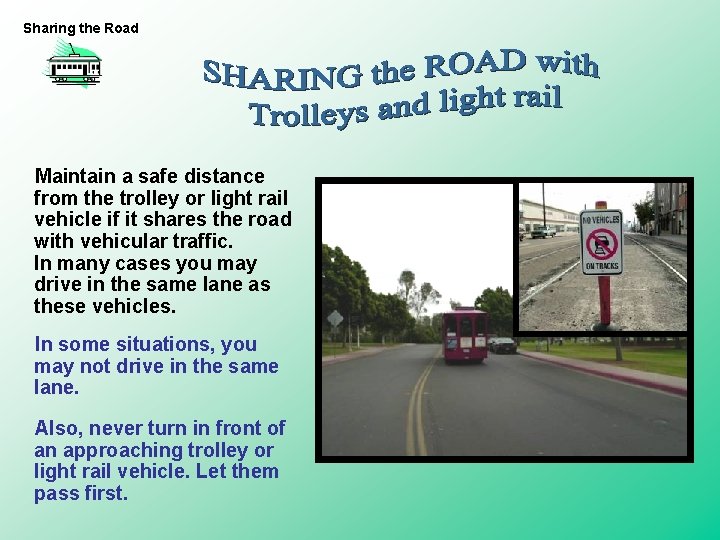
Sharing the Road Maintain a safe distance from the trolley or light rail vehicle if it shares the road with vehicular traffic. In many cases you may drive in the same lane as these vehicles. In some situations, you may not drive in the same lane. Also, never turn in front of an approaching trolley or light rail vehicle. Let them pass first.
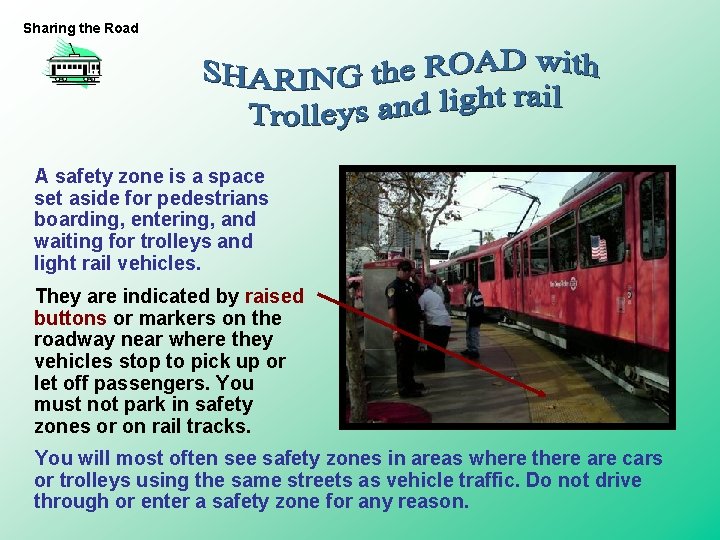
Sharing the Road A safety zone is a space set aside for pedestrians boarding, entering, and waiting for trolleys and light rail vehicles. They are indicated by raised buttons or markers on the roadway near where they vehicles stop to pick up or let off passengers. You must not park in safety zones or on rail tracks. You will most often see safety zones in areas where there are cars or trolleys using the same streets as vehicle traffic. Do not drive through or enter a safety zone for any reason.
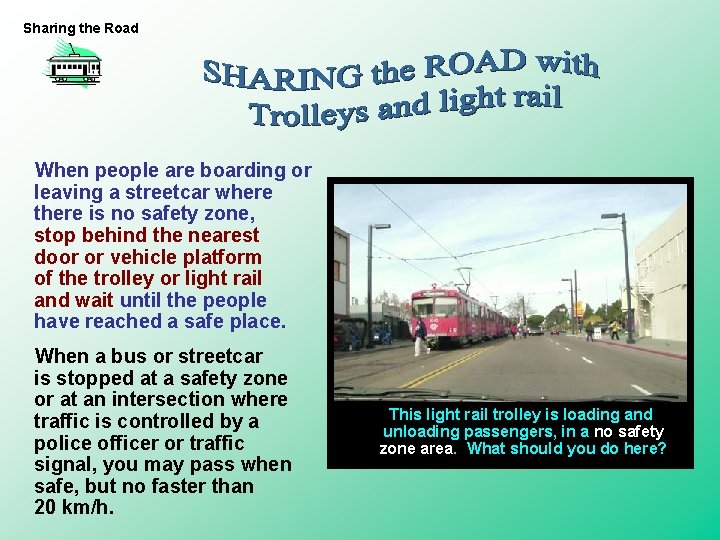
Sharing the Road When people are boarding or leaving a streetcar where there is no safety zone, stop behind the nearest door or vehicle platform of the trolley or light rail and wait until the people have reached a safe place. When a bus or streetcar is stopped at a safety zone or at an intersection where traffic is controlled by a police officer or traffic signal, you may pass when safe, but no faster than 20 km/h. This light rail trolley is loading and unloading passengers, in a no safety zone area. What should you do here?
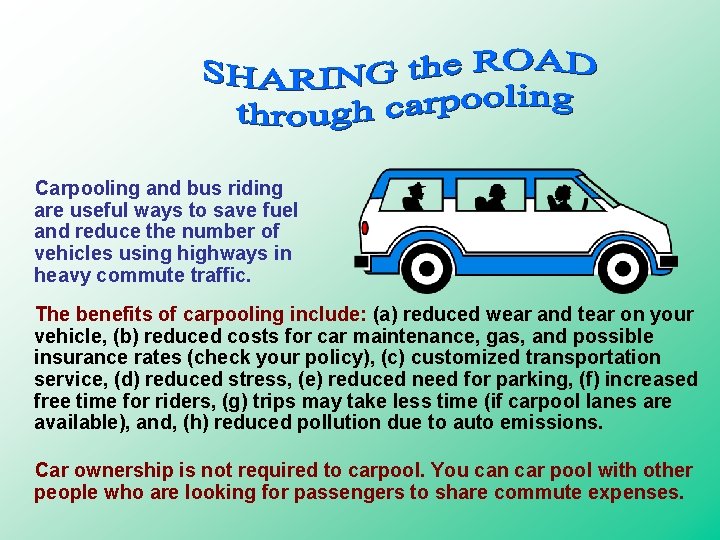
Carpooling and bus riding are useful ways to save fuel and reduce the number of vehicles using highways in heavy commute traffic. The benefits of carpooling include: (a) reduced wear and tear on your vehicle, (b) reduced costs for car maintenance, gas, and possible insurance rates (check your policy), (c) customized transportation service, (d) reduced stress, (e) reduced need for parking, (f) increased free time for riders, (g) trips may take less time (if carpool lanes are available), and, (h) reduced pollution due to auto emissions. Car ownership is not required to carpool. You can car pool with other people who are looking for passengers to share commute expenses.
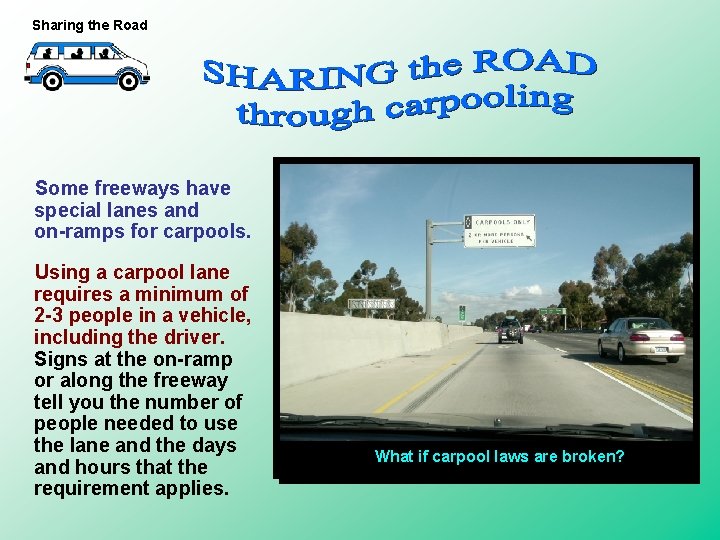
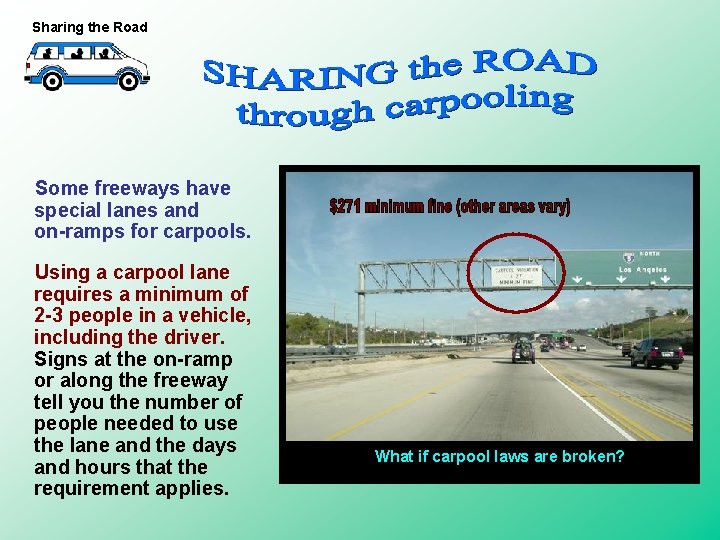
Sharing the Road Some freeways have special lanes and on-ramps for carpools. Using a carpool lane requires a minimum of 2 -3 people in a vehicle, including the driver. Signs at the on-ramp or along the freeway tell you the number of people needed to use the lane and the days and hours that the requirement applies. What if carpool laws are broken?
Sharing the Road Some freeways have special lanes and on-ramps for carpools. Using a carpool lane requires a minimum of 2 -3 people in a vehicle, including the driver. Signs at the on-ramp or along the freeway tell you the number of people needed to use the lane and the days and hours that the requirement applies. What if carpool laws are broken?
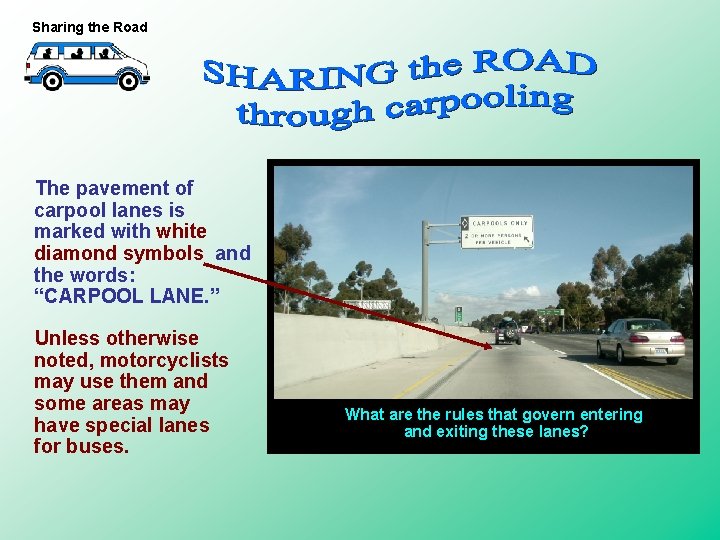
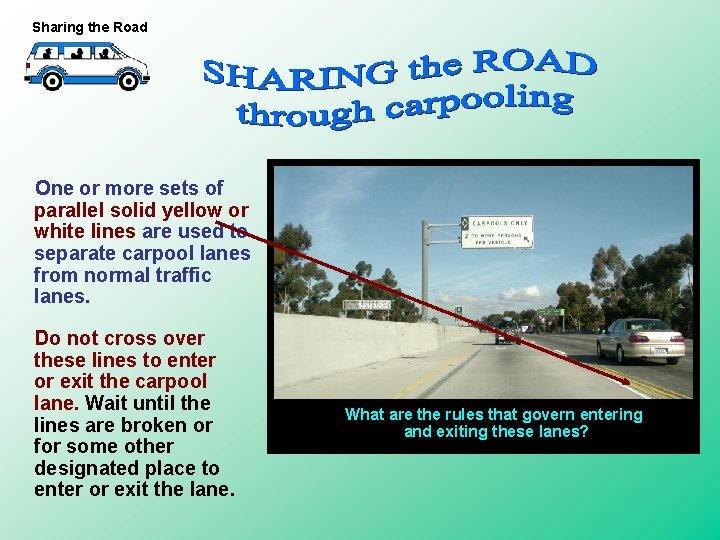
Sharing the Road The pavement of carpool lanes is marked with white diamond symbols and the words: “CARPOOL LANE. ” Unless otherwise noted, motorcyclists may use them and some areas may have special lanes for buses. What are the rules that govern entering and exiting these lanes?
Sharing the Road One or more sets of parallel solid yellow or white lines are used to separate carpool lanes from normal traffic lanes. Do not cross over these lines to enter or exit the carpool lane. Wait until the lines are broken or for some other designated place to enter or exit the lane. What are the rules that govern entering and exiting these lanes?
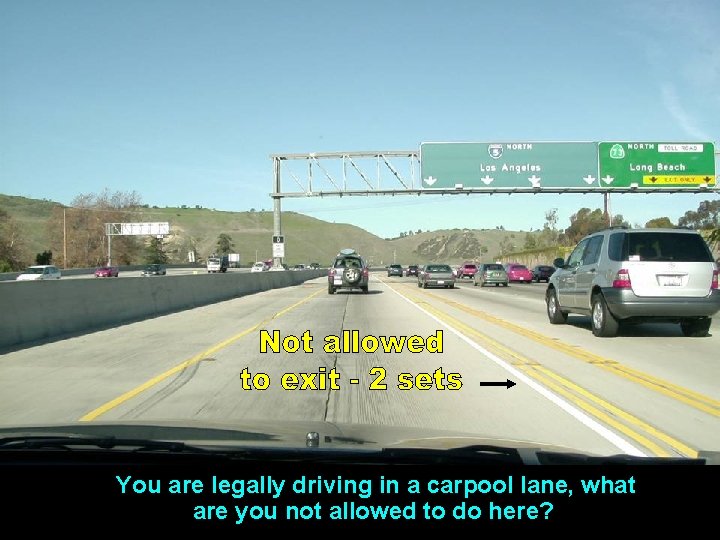
You are legally driving in a carpool lane, what are you not allowed to do here?
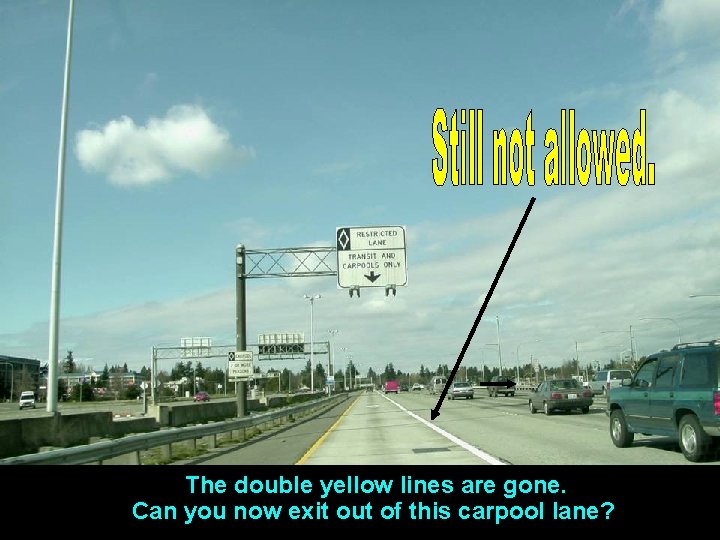
The double yellow lines are gone. Can you now exit out of this carpool lane?
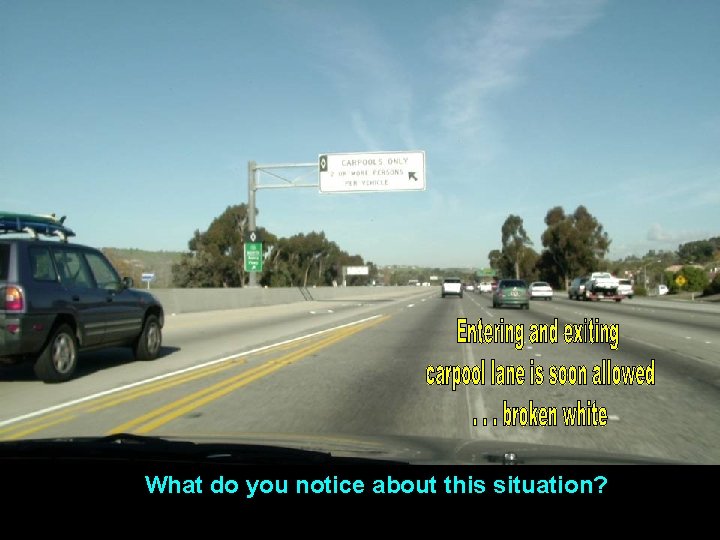
What do you notice about this situation?
Sharing the Road Successful Carpooling Tips For successful carpooling you should: (a) decide who will drive and when, (b) give everyone a list with each carpooler’s phone number, (c) choose a convenient pick up location, (d) set up a schedule and stick to it – make sure everyone knows the schedule and is notified of changes and how long you will wait for tardy riders, (e) establish a fare – if you share the driving equally you will not need to exchange money, but if one person drives, agree on a mutually acceptable fare, and, (f) establish guidelines on smoking, eating, drinking, playing the radio or audio system, and seating arrangement.
While everyone must follow the same traffic laws, motorcyclists face unusual dangers because they are hard to see and the motorcycle requires exceptional handling ability. An accident involving a motorcycle frequently results in serious injury. In most accidents between a car and a motorcycle, the driver of the car is at fault. In order to avoid collisions, operators of both types of vehicles need to understand the rights, responsibilities and limitations of the other. The death rate per registered motorcycle is more than three times that of registered passenger vehicles. In addition, the likelihood of injury is extremely high in motorcycle accidents. 98% of multiple vehicle collisions and 98% of single vehicle accidents resulted in injury to the rider. 45% were serious injuries.
Sharing the Road Over the last five years, motorcycle victims killed have decreased over 31%. This is likely due to the combined effects of the training classes that are now required of younger riders and helmet laws. The fatality rate for unlicensed riders is three times that of licensed riders, and for the past ten years, an average of 65% of all fatalities operated a motorcycle without a valid motorcycle endorsement. More than 50% of motorcycle accident-involved riders had less than 5 months of riding experience. What do the three above paragraphs clearly show?
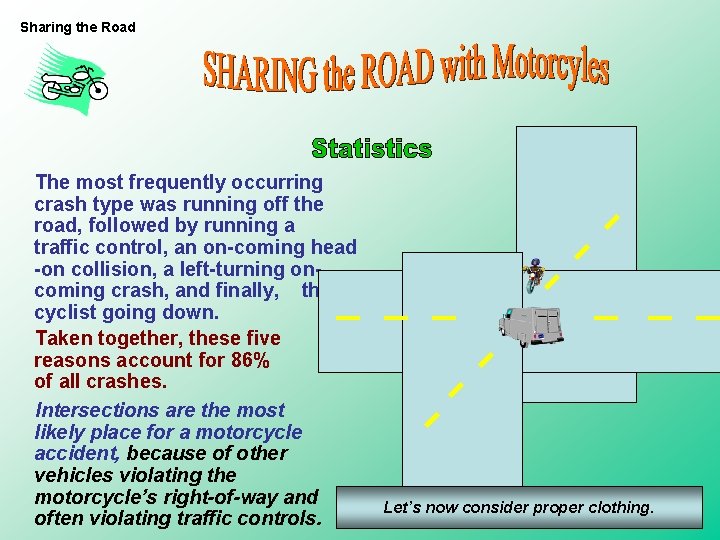
Sharing the Road The most frequently occurring crash type was running off the road, followed by running a traffic control, an on-coming head -on collision, a left-turning oncoming crash, and finally, the cyclist going down. Taken together, these five reasons account for 86% of all crashes. Intersections are the most likely place for a motorcycle accident, because of other vehicles violating the motorcycle’s right-of-way and often violating traffic controls. Let’s now consider proper clothing.
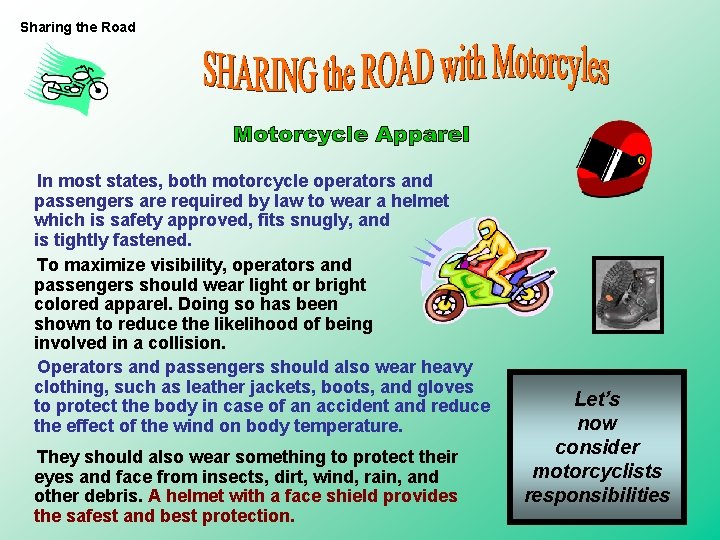
Sharing the Road In most states, both motorcycle operators and passengers are required by law to wear a helmet which is safety approved, fits snugly, and is tightly fastened. To maximize visibility, operators and passengers should wear light or bright colored apparel. Doing so has been shown to reduce the likelihood of being involved in a collision. Operators and passengers should also wear heavy clothing, such as leather jackets, boots, and gloves to protect the body in case of an accident and reduce the effect of the wind on body temperature. They should also wear something to protect their eyes and face from insects, dirt, wind, rain, and other debris. A helmet with a face shield provides the safest and best protection. Let’s now consider motorcyclists responsibilities
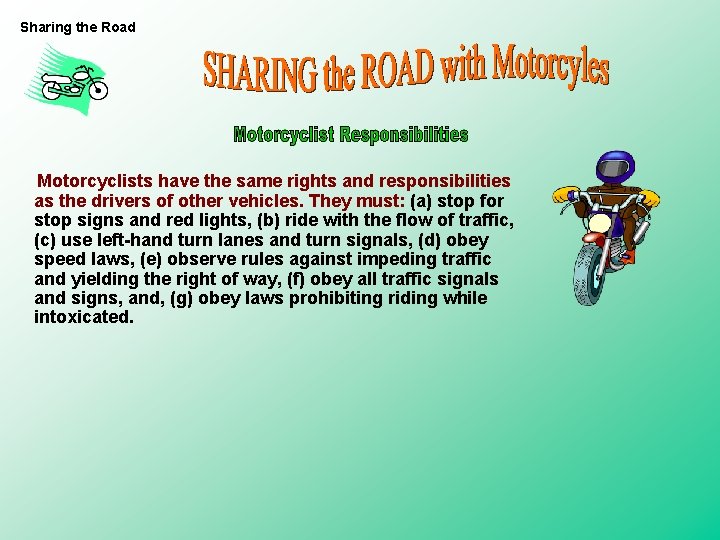
Sharing the Road Motorcyclists have the same rights and responsibilities as the drivers of other vehicles. They must: (a) stop for stop signs and red lights, (b) ride with the flow of traffic, (c) use left-hand turn lanes and turn signals, (d) obey speed laws, (e) observe rules against impeding traffic and yielding the right of way, (f) obey all traffic signals and signs, and, (g) obey laws prohibiting riding while intoxicated.
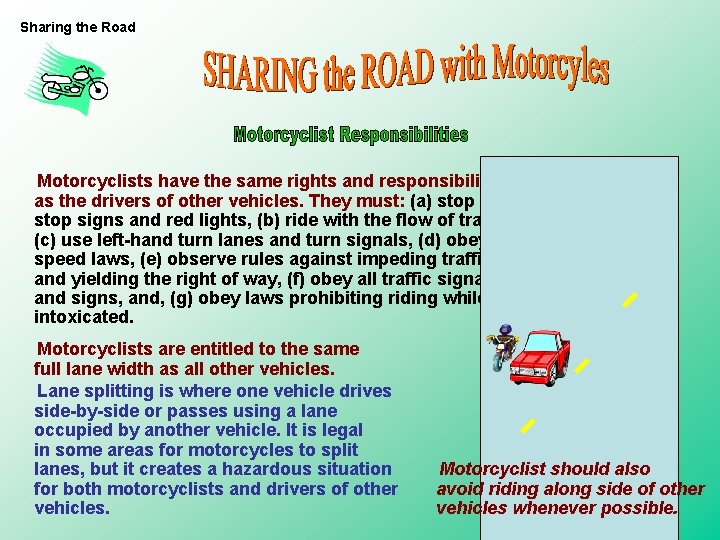
Sharing the Road Motorcyclists have the same rights and responsibilities as the drivers of other vehicles. They must: (a) stop for stop signs and red lights, (b) ride with the flow of traffic, (c) use left-hand turn lanes and turn signals, (d) obey speed laws, (e) observe rules against impeding traffic and yielding the right of way, (f) obey all traffic signals and signs, and, (g) obey laws prohibiting riding while intoxicated. Motorcyclists are entitled to the same full lane width as all other vehicles. Lane splitting is where one vehicle drives side-by-side or passes using a lane occupied by another vehicle. It is legal in some areas for motorcycles to split lanes, but it creates a hazardous situation for both motorcyclists and drivers of other vehicles. Motorcyclist should also avoid riding along side of other vehicles whenever possible.
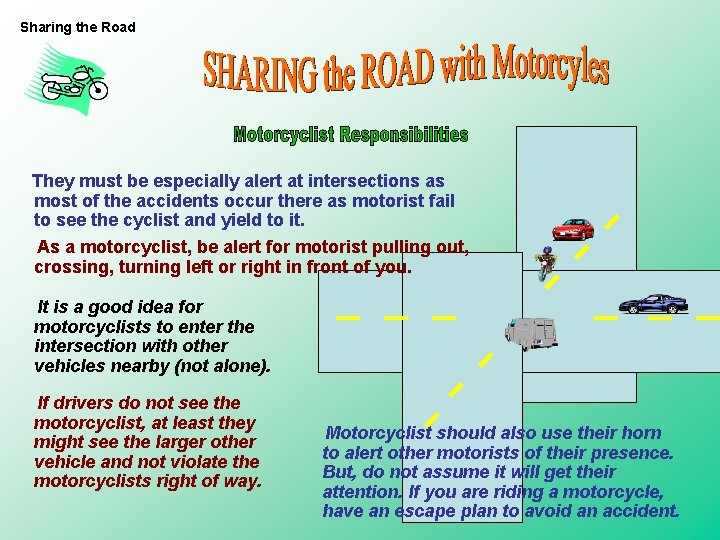
Sharing the Road They must be especially alert at intersections as most of the accidents occur there as motorist fail to see the cyclist and yield to it. As a motorcyclist, be alert for motorist pulling out, crossing, turning left or right in front of you. It is a good idea for motorcyclists to enter the intersection with other vehicles nearby (not alone). If drivers do not see the motorcyclist, at least they might see the larger other vehicle and not violate the motorcyclists right of way. Motorcyclist should also use their horn to alert other motorists of their presence. But, do not assume it will get their attention. If you are riding a motorcycle, have an escape plan to avoid an accident.
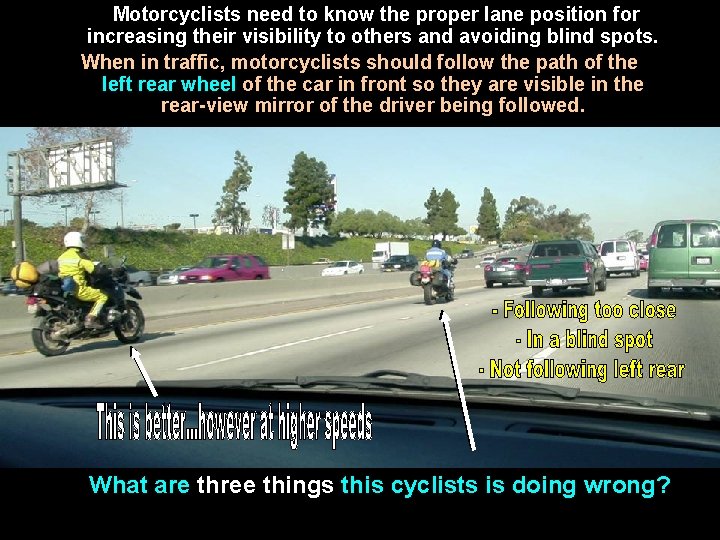
Motorcyclists need to know the proper lane position for increasing their visibility to others and avoiding blind spots. When in traffic, motorcyclists should follow the path of the left rear wheel of the car in front so they are visible in the rear-view mirror of the driver being followed. What are three things this cyclists is doing wrong?
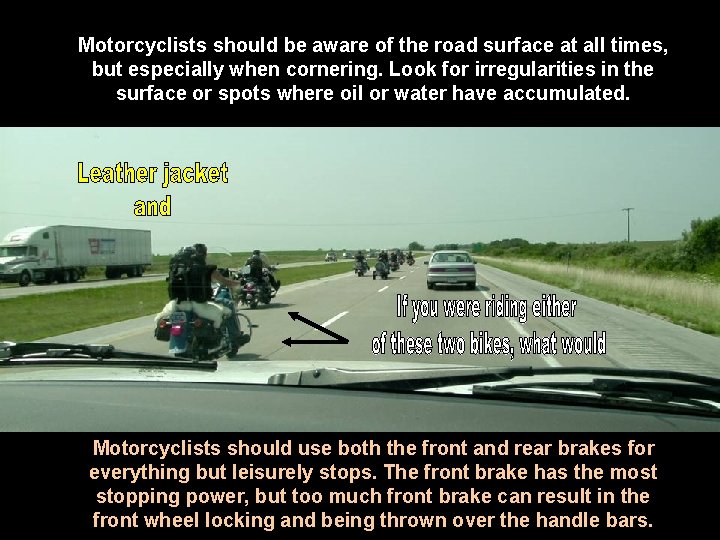
Motorcyclists should be aware of the road surface at all times, but especially when cornering. Look for irregularities in the surface or spots where oil or water have accumulated. Motorcyclists should use both the front and rear brakes for everything but leisurely stops. The front brake has the most stopping power, but too much front brake can result in the front wheel locking and being thrown over the handle bars.
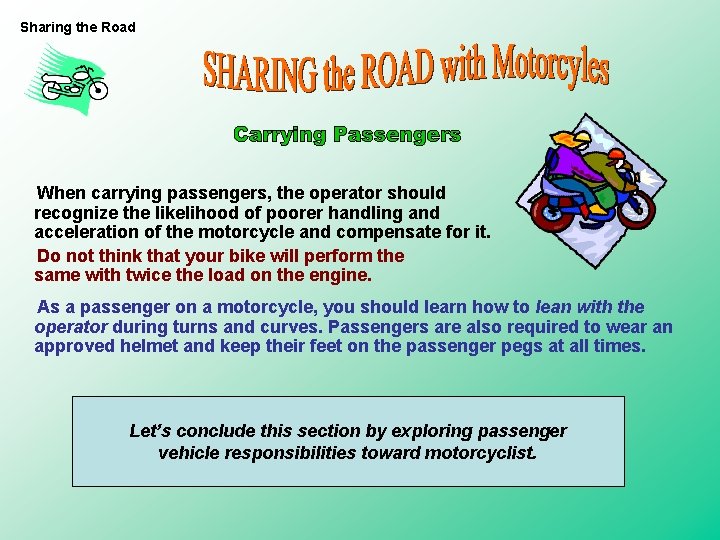
Sharing the Road When carrying passengers, the operator should recognize the likelihood of poorer handling and acceleration of the motorcycle and compensate for it. Do not think that your bike will perform the same with twice the load on the engine. As a passenger on a motorcycle, you should learn how to lean with the operator during turns and curves. Passengers are also required to wear an approved helmet and keep their feet on the passenger pegs at all times. Let’s conclude this section by exploring passenger vehicle responsibilities toward motorcyclist.
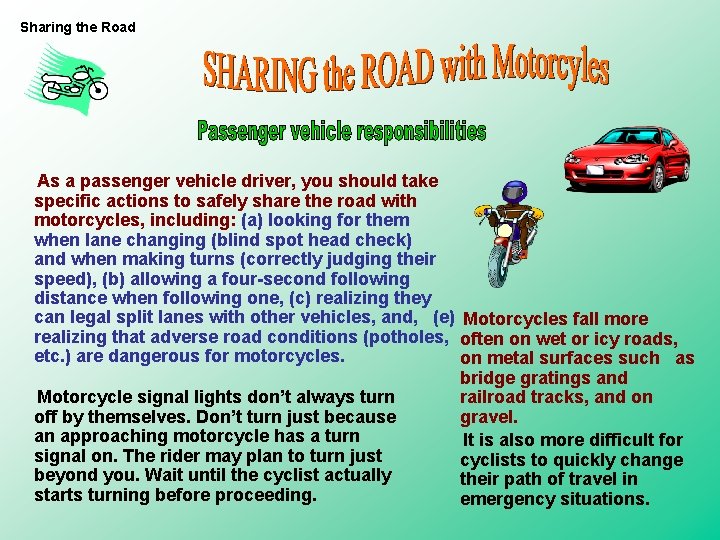
Sharing the Road As a passenger vehicle driver, you should take specific actions to safely share the road with motorcycles, including: (a) looking for them when lane changing (blind spot head check) and when making turns (correctly judging their speed), (b) allowing a four-second following distance when following one, (c) realizing they can legal split lanes with other vehicles, and, (e) Motorcycles fall more realizing that adverse road conditions (potholes, often on wet or icy roads, etc. ) are dangerous for motorcycles. on metal surfaces such as bridge gratings and railroad tracks, and on Motorcycle signal lights don’t always turn gravel. off by themselves. Don’t turn just because an approaching motorcycle has a turn It is also more difficult for signal on. The rider may plan to turn just cyclists to quickly change beyond you. Wait until the cyclist actually their path of travel in starts turning before proceeding. emergency situations.
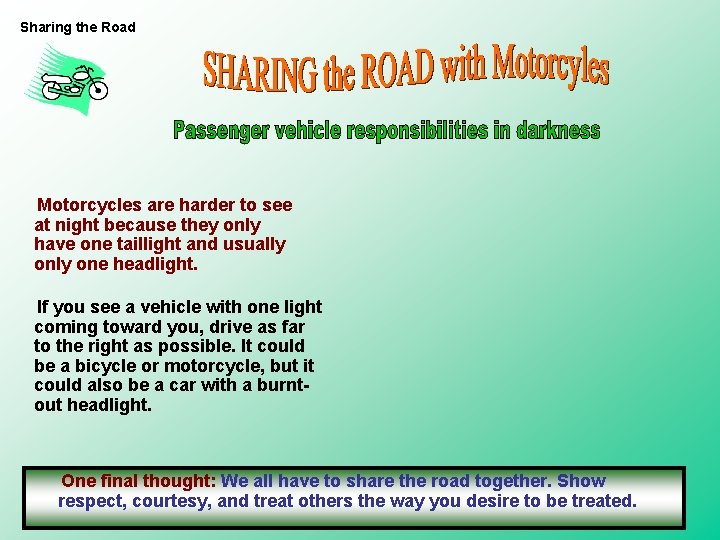
Sharing the Road Motorcycles are harder to see at night because they only have one taillight and usually one headlight. If you see a vehicle with one light coming toward you, drive as far to the right as possible. It could be a bicycle or motorcycle, but it could also be a car with a burntout headlight. One final thought: We all have to share the road together. Show respect, courtesy, and treat others the way you desire to be treated.
Sharing the Road Review time…how much do you remember?
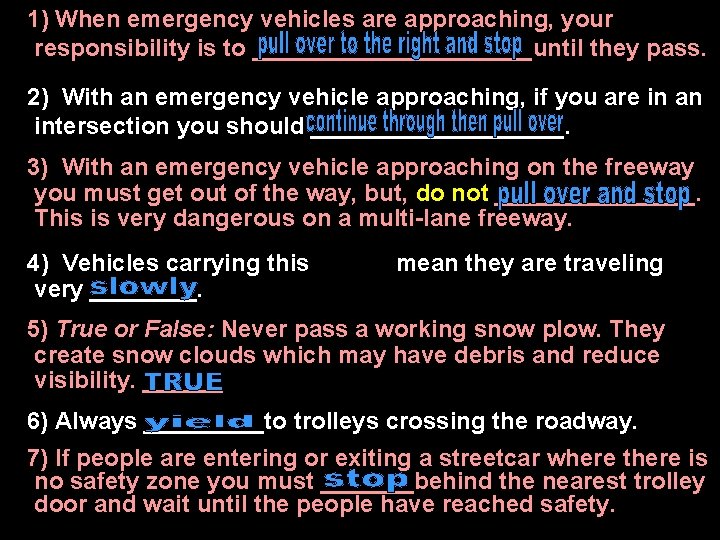
1) When emergency vehicles are approaching, your responsibility is to ___________until they pass. 2) With an emergency vehicle approaching, if you are in an intersection you should __________. 3) With an emergency vehicle approaching on the freeway you must get out of the way, but, do not ________. This is very dangerous on a multi-lane freeway. 4) Vehicles carrying this very ____. mean they are traveling 5) True or False: Never pass a working snow plow. They create snow clouds which may have debris and reduce visibility. ______ 6) Always _____to trolleys crossing the roadway. 7) If people are entering or exiting a streetcar where there is no safety zone you must _______behind the nearest trolley door and wait until the people have reached safety.
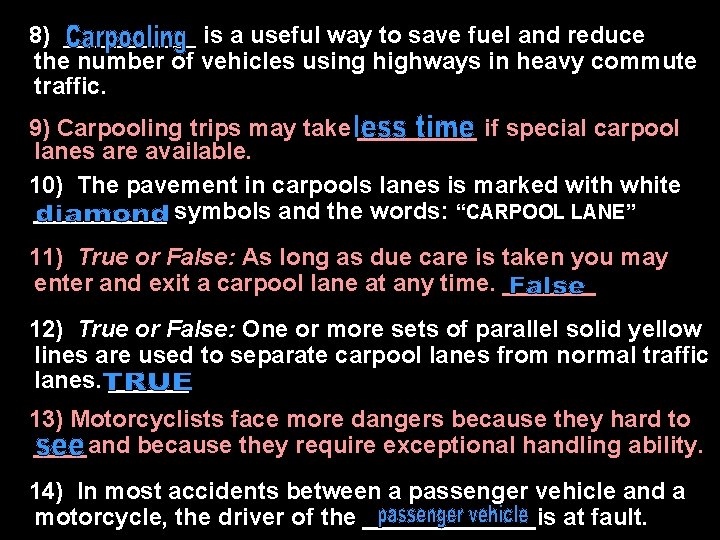
1)8) _____ is a useful way to save fuel and reduce the number of vehicles using highways in heavy commute traffic. 1)9) Carpooling trips may take _____ if special carpool lanes are available. 1)10) The pavement in carpools lanes is marked with white _____ symbols and the words: “CARPOOL LANE” 1)11) True or False: As long as due care is taken you may enter and exit a carpool lane at any time. _______ 1)12) True or False: One or more sets of parallel solid yellow lines are used to separate carpool lanes from normal traffic lanes. ______ 1)13) Motorcyclists face more dangers because they hard to ____and because they require exceptional handling ability. 1)14) In most accidents between a passenger vehicle and a motorcycle, the driver of the _______is at fault.
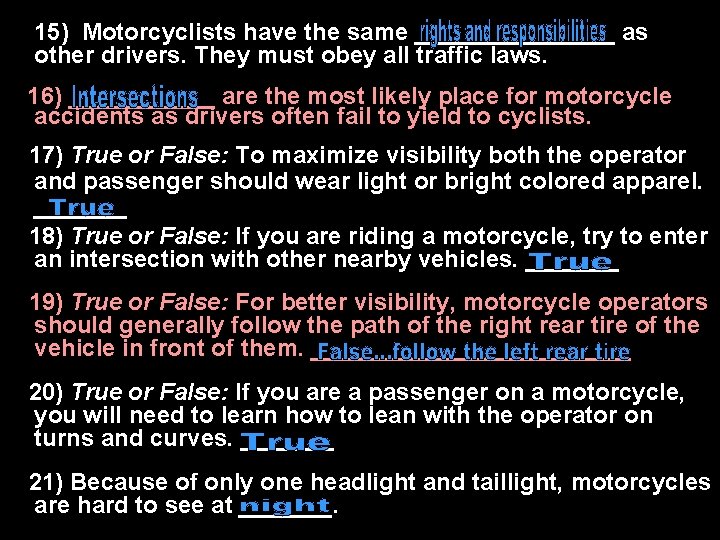
15) Motorcyclists have the same ________ as other drivers. They must obey all traffic laws. 16) ______ are the most likely place for motorcycle accidents as drivers often fail to yield to cyclists. 1)17) True or False: To maximize visibility both the operator and passenger should wear light or bright colored apparel. _______ 1)18) True or False: If you are riding a motorcycle, try to enter an intersection with other nearby vehicles. _______ 1)19) True or False: For better visibility, motorcycle operators should generally follow the path of the right rear tire of the vehicle in front of them. ____________ 1)20) True or False: If you are a passenger on a motorcycle, you will need to learn how to lean with the operator on turns and curves. _______ 1)21) Because of only one headlight and taillight, motorcycles are hard to see at _______.
Sharing the Road
Drivers Edge: Interactive slides and videos® Copyrighted Driver Education School Literature These electronic slide shows are produced by Inter. Active Enterprises. Microsoft Power. Point ® was used to create the presentations. Each segment includes discussion questions and may include illustrations, photographs, videos, animations, etc. Contact us at for more information at: 2183 Doctor Robertson Rd. Spring Hill, TN 37174 Email with suggestions, comments, questions or for more information. This slide show is a type of educational media and is copyrighted in regards to slide layout, text and arrangement. You may modify, delete, or add to for your own use but you may not redistribute. One set of slides per school or user may be copied to the computer’s hard drive. Networking in a computer lab is also allowed. See other restrictions in regards to graphics as required by agreements with graphic providers. RESTRICTIONS: “This product/publication includes images from Microsoft Design Gallery, Animation Factory, Corel Mega. Gallery and Corel Gallery 1, 000 and Click Art which are protected by the copyright laws of the U. S. , Canada and elsewhere. Used under license. These images are for viewing purposes only in this series and may not be saved or downloaded for other uses. Other images used by permission are from: In-Motion magazine, General Motors; selected videos from the U. S. Dept. of Transportation (Moving Safely Across America) Many other images are from the public domain. A limited warranty or guarantee is in effect upon initial receipt of this product. Any defective product will be replaced upon notification within 90 days of receipt of product. Copyright © 2009 Inter. Active Enterprises iae@charter. net