
Sharing Learn Ing from Practice to improve Patient




- Slides: 26
Sharing Learn. Ing from Practice to improve Patient Safety (SLIPPS) https: //www. slipps. eu
Sharing Learn. Ing from Practice to improve Patient Safety (SLIPPS) Project overview Assoc. Prof Alison Steven (SLIPPS Lead)
Context: Harm and burden q Around 1 in 10 patients in high income countries suffer harm - nearly 50% are avoidable (WHO) q There is a 1 in 300 chance of a patient being harmed during health care (WHO) q Hospital infections affect 14 of every 100 patients admitted to hospital q Administration errors - Account for up to half of all medical errors in primary care q Patient Harm - 14 th leading cause of global disease burden comparable with diseases like tuberculosis and malaria
Context: Global cost q Globally - 15% of heath spending is wasted on dealing with adverse events q Research suggests additional hospitalization, litigation costs, infections, disability, lost productivity and medical expenses cost some countries ~ US$ 19 billion a year q Globally - cost of dealing with medication errors is estimated at US$ 42 million a year
Context: Investment and development q Investments to reduce patient safety incidents - USA safety improvement led to estimated US$28 billion saving between 2010 -2015 q Education, research and collaboration - crucial to developing health and social care practice and improving patient safety q WHO Multi-professional Patient Safety Curriculum Guide (2011)
Context: Human cost q Patients q Family members, relatives and loved ones q Staff q Organisations and q Students
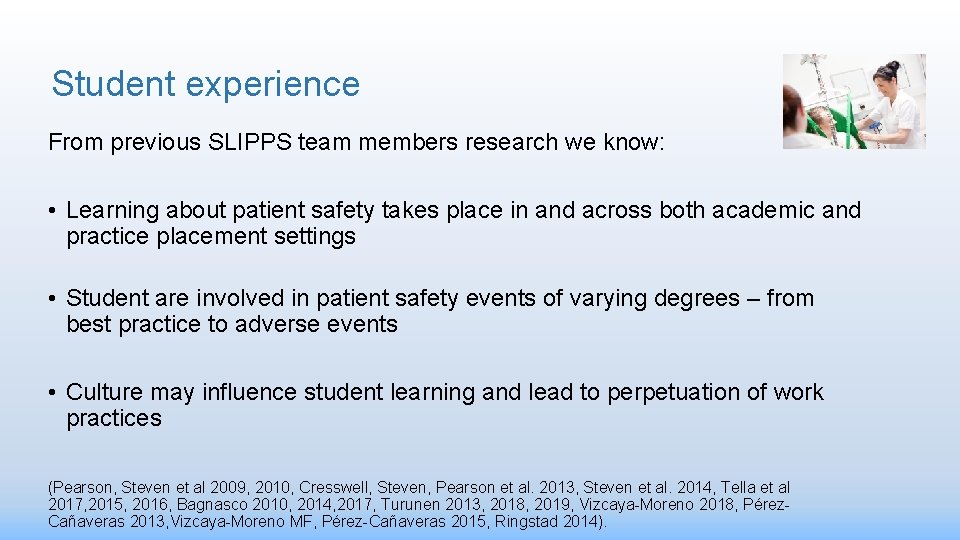
Student experience From previous SLIPPS team members research we know: • Learning about patient safety takes place in and across both academic and practice placement settings • Student are involved in patient safety events of varying degrees – from best practice to adverse events • Culture may influence student learning and lead to perpetuation of work practices (Pearson, Steven et al 2009, 2010, Cresswell, Steven, Pearson et al. 2013, Steven et al. 2014, Tella et al 2017, 2015, 2016, Bagnasco 2010, 2014, 2017, Turunen 2013, 2018, 2019, Vizcaya-Moreno 2018, Pérez. Cañaveras 2013, Vizcaya-Moreno MF, Pérez-Cañaveras 2015, Ringstad 2014).
Student learning • Students often feel that there is a gap between learning about patient safety in academic and clinical settings (Pearson, Steven et al 2009, Cresswell et a. . 2013, Steven et al. 2014) • Students learn in a variety of care organisations - but their experiences and learning are not systematically utilised (Tella et al. 2015 a, b, 2016) • Tensions exist in learning across academic, organisational and practice contexts, which can impact on students ‘emotional safety for learning’ (Steven et al 2014)
Student learning: reflection in and on action • Reflecting on errors (and best practice) helps to understand complex situations and assists learning from the experience (Mann, Gordon, and Mac. Leod 2009). • Students are in a special situation they: • Observe the ‘daily life’ of health and social care organisations • Learn as part of a team in direct contact with clients and patients. • Experience a range of events and learn from experience –but this experience is often not utilised
Sharing Learn. Ing from Practice to improve Patient Safety (SLIPPS) q 3 year project from September 2016 q Encompassing: Educational research, innovation and collaboration q 5 countries, 7 HEIs and multiple Health/social care organisations https: //www. slipps. eu/
SLIPPS: Overall purpose q To draw on the untapped potential of the real ‘important learning events’ experienced by students while in practice placements. To develop: q Educational tools and resources, and make them freely available q Greater understandings of how witnessing or involvement in incidents influences students (and potentially future practice and culture) q Greater understanding of patient safety learning events diversity across professions, nations and health care systems q High quality research into learning events, safety culture and professional working
SLIPPS: Important learning events Important patient safety leaning events can be described as significant events or experience in a learners’ life: q Something memorable for them, it does not need to be a major event q Something they feel strongly influenced their learning q A positive, satisfactory event q A negative, unsatisfactory event
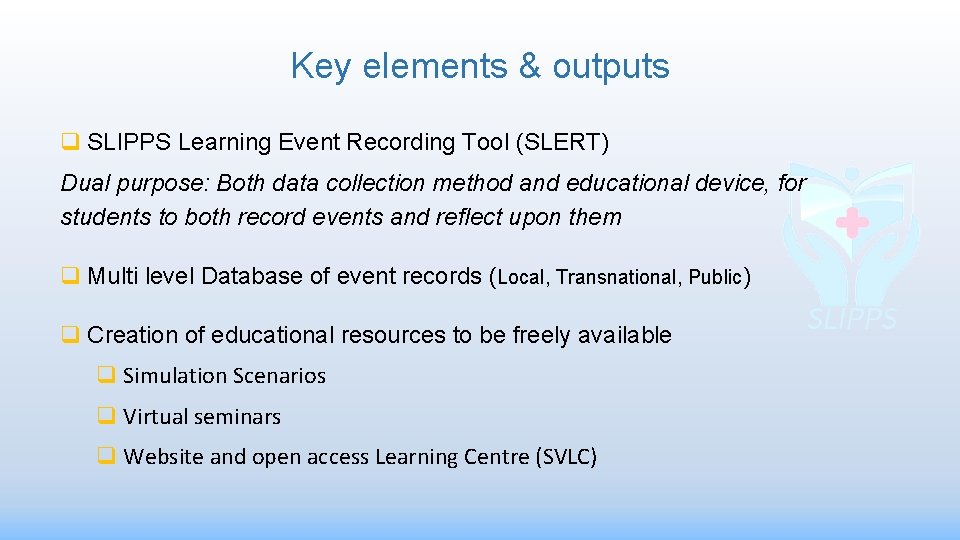
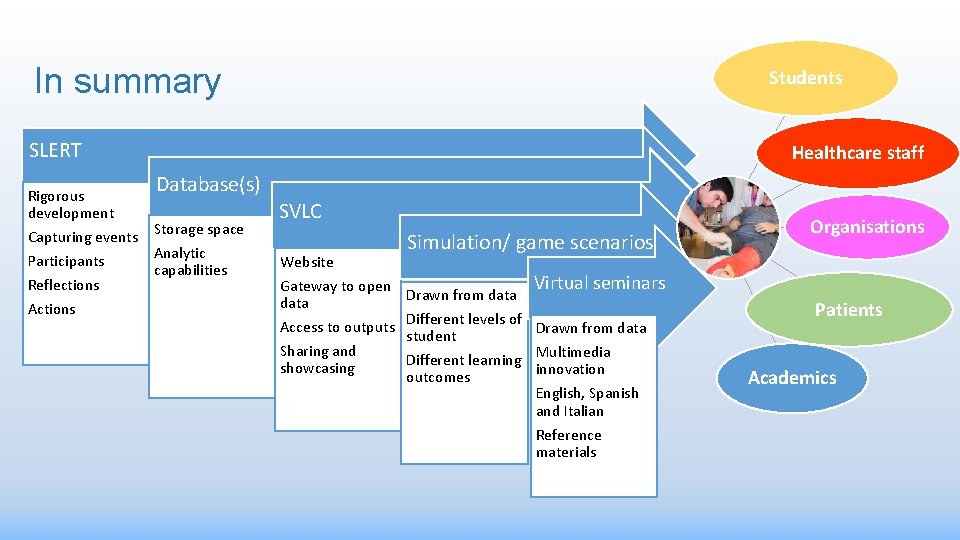
Key elements & outputs q SLIPPS Learning Event Recording Tool (SLERT) Dual purpose: Both data collection method and educational device, for students to both record events and reflect upon them q Multi level Database of event records (Local, Transnational, Public) q Creation of educational resources to be freely available q Simulation Scenarios q Virtual seminars q Website and open access Learning Centre (SVLC)
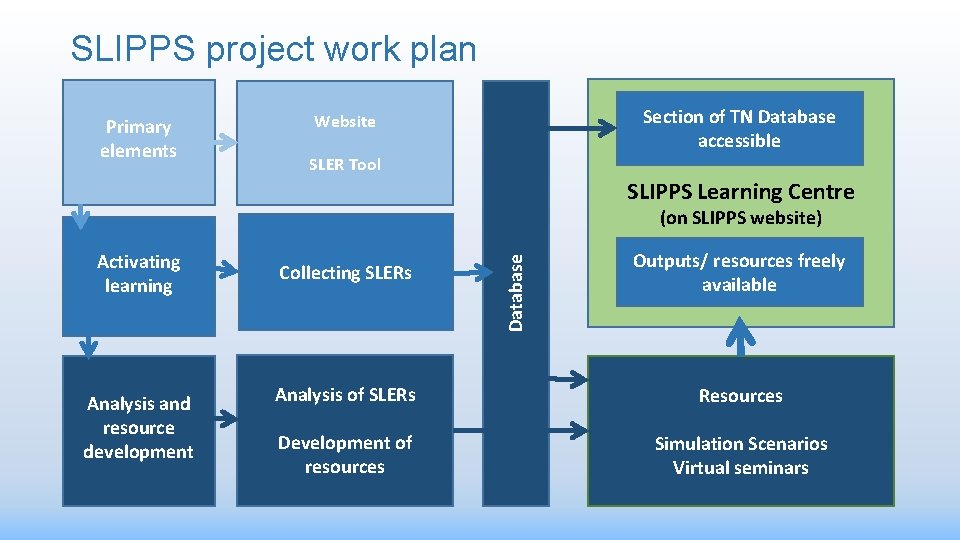
SLIPPS project work plan Primary elements Section of TN Database accessible Website SLER Tool SLIPPS Learning Centre Activating learning Analysis and resource development Collecting SLERs Database (on SLIPPS website) Outputs/ resources freely available Analysis of SLERs Resources Development of resources Simulation Scenarios Virtual seminars
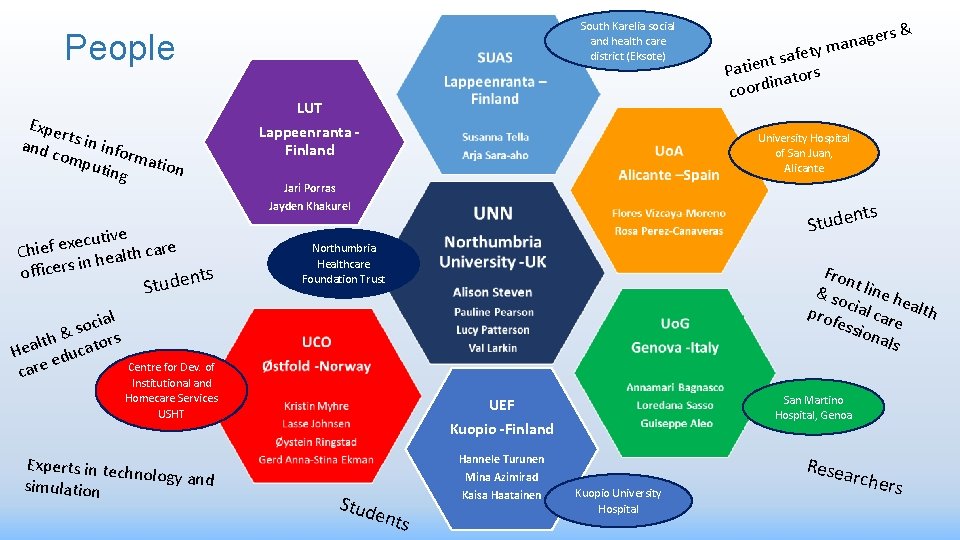
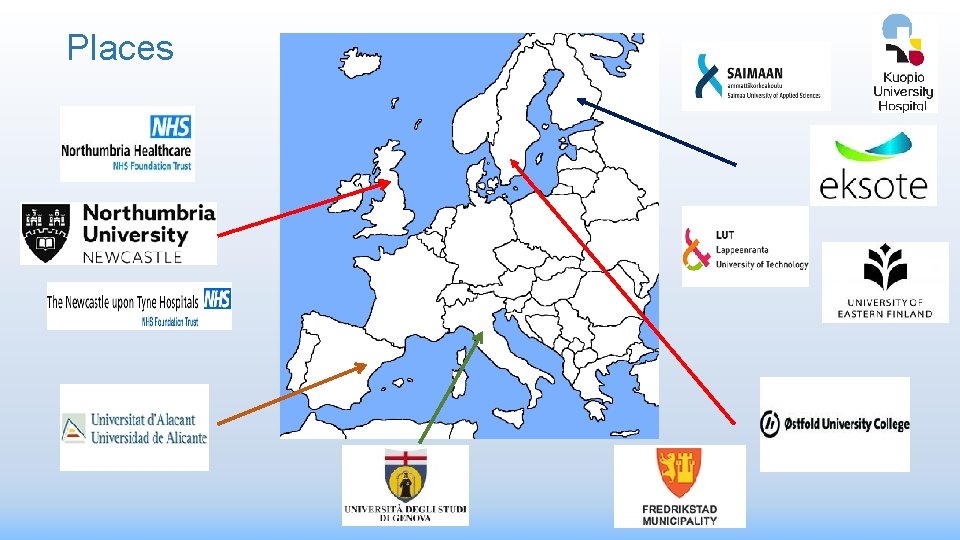
South Karelia social and health care district (Eksote) People LUT Lappeenranta Finland Expe r and ts in info com putin rmation g tive u c e x e re a c Chief h t l a in he officers Jari Porras Jayden Khakurel s cial o s h & tors t l a He educa care nts Stude Northumbria Healthcare Foundation Trust Centre for Dev. of Institutional and Homecare Services USHT Experts in tech nology and simulation afet s t n e i Pat tors a n i d r coo University Hospital of San Juan, Alicante nt Stude gers & a n a y m Fron & so t line h e pro cial car alth fess e iona ls San Martino Hospital, Genoa UEF Kuopio -Finland Stud ents Hannele Turunen Mina Azimirad Kaisa Haatainen Resea Kuopio University Hospital rcher s
Places
SLIPPS: Ethical considerations q Approval granted from all participating Universities q Permissions gained from Health care organisations q Each partner has gained any other appropriate approvals q Data protection issues attended to q Students consent to LER being used in SLIPPS
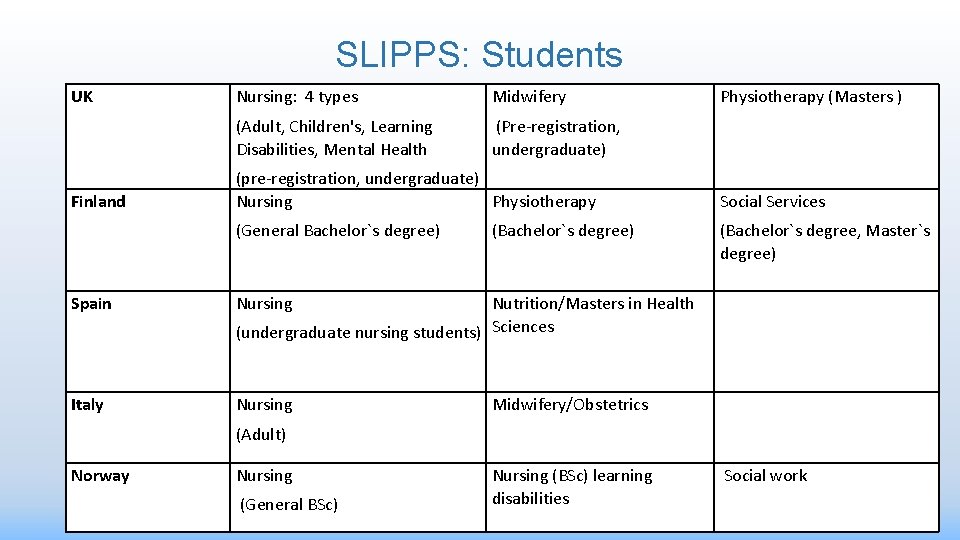
SLIPPS: Students UK Finland Nursing: 4 types Midwifery (Adult, Children's, Learning Disabilities, Mental Health (Pre-registration, undergraduate) (pre-registration, undergraduate) Nursing Physiotherapy (General Bachelor`s degree) Spain Nursing Italy Nursing (Bachelor`s degree) Nutrition/Masters in Health (undergraduate nursing students) Sciences Physiotherapy (Masters ) Social Services (Bachelor`s degree, Master`s degree) Midwifery/Obstetrics (Adult) Norway Nursing (General BSc) Nursing (BSc) learning disabilities Social work
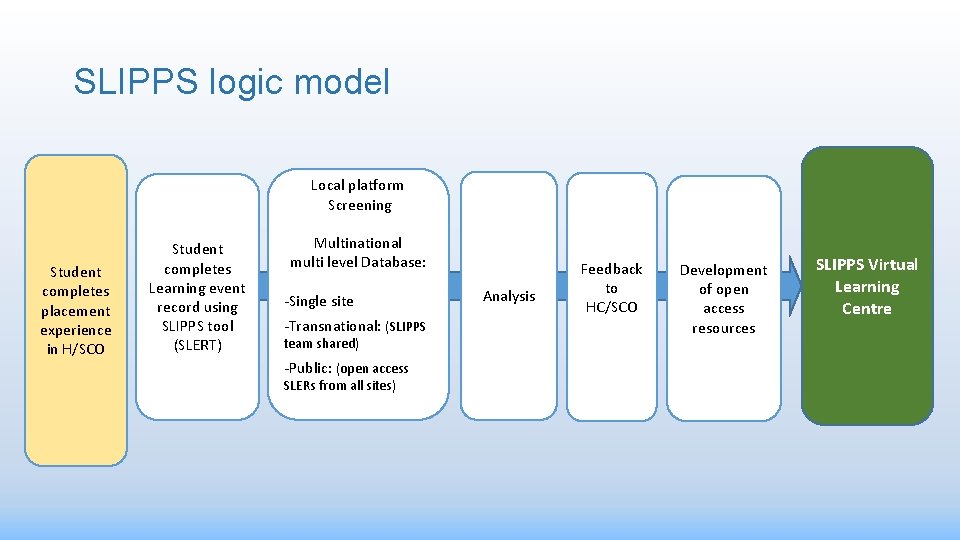
SLIPPS logic model Local platform Screening Student completes placement experience in H/SCO Student completes Learning event record using SLIPPS tool (SLERT) Multinational multi level Database: -Single site -Transnational: (SLIPPS team shared) -Public: (open access SLERs from all sites) Analysis Feedback to HC/SCO Development of open access resources SLIPPS Virtual Learning Centre
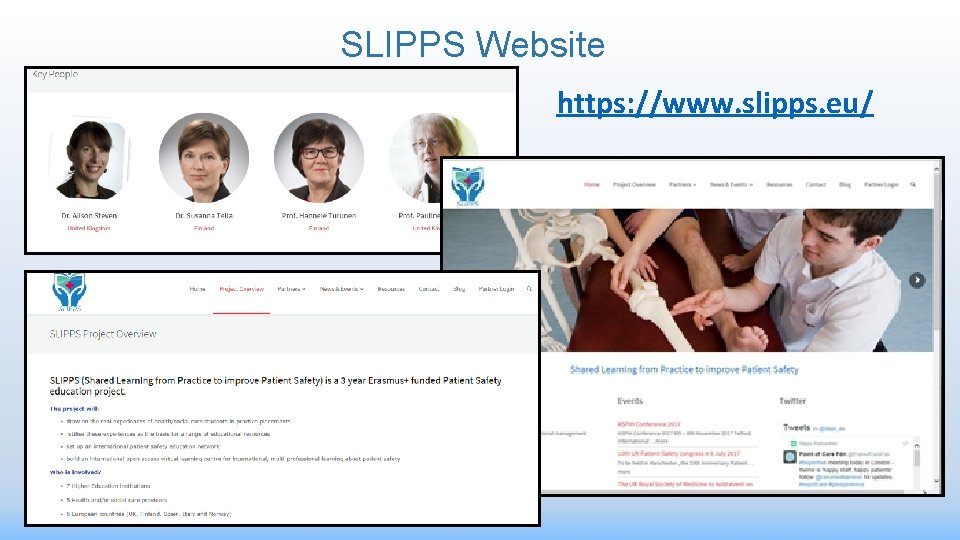
SLIPPS Website https: //www. slipps. eu/ .
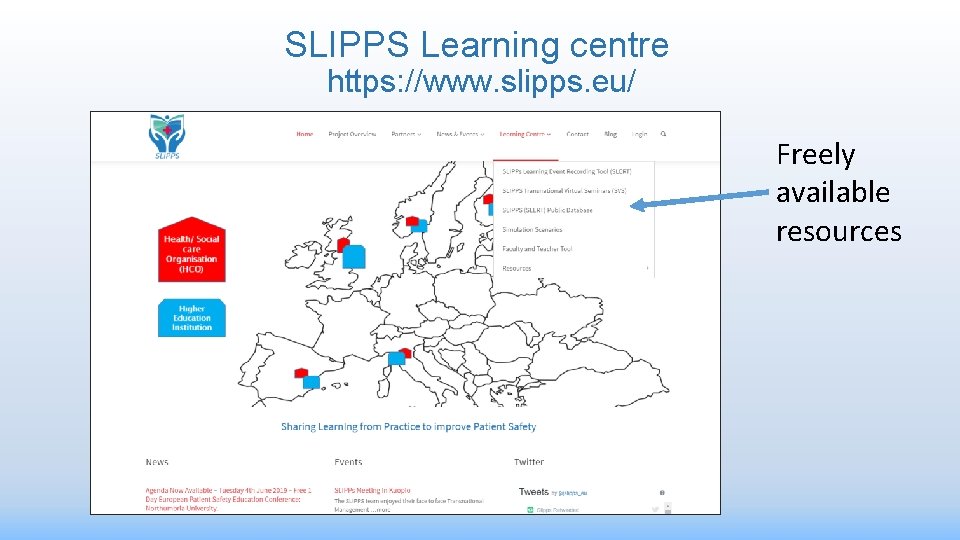
SLIPPS Learning centre https: //www. slipps. eu/ Freely available resources
In summary Students SLERT Rigorous development Capturing events Participants Reflections Actions Healthcare staff Database(s) Storage space Analytic capabilities SVLC Simulation/ game scenarios Website Virtual seminars Gateway to open Drawn from data Different levels of Access to outputs Drawn from data student Sharing and Multimedia Different learning showcasing innovation outcomes English, Spanish and Italian Reference materials Organisations Patients Academics
Thank you Associate Prof Dr Alison Steven Department of Nursing, Midwifery and Health Faculty of Health and Life Sciences Northumbria University Alison. steven@northumbria. ac. uk https: //www. slipps. eu
References § Asensi-Vicente J, Jiménez-Ruiz I, Vizcaya-Moreno MF. Medication Errors Involving Nursing Students: A Systematic Review. Nurse Educator. 2018; 43(5): E 1 -E 5. doi: 10. 1097/NNE. 0000000481. § Bagnasco A, Timmins F, de Vries JMA, Aleo G, Zanini M, Catania G, Sasso L. Understanding and addressing missed care in clinical placements - implications for nursing students and nurse educators. Nurse Education Today, 2017; 56: 1 -5 § Bagnasco A, Pagnucci N, Tolotti A, et al. (2014) The role of simulation in developing communication and gestural skills in medical students. BMC Medical Education 14: 106. § Bagnasco A, Tibaldi L, Chirone P, et al. (2010) Patient safety culture: An Italian experience. Journal of Clinical Nursing 20(7– 8): 1188– 1195. § Bradley F, Steven A, and Ashcroft DM (2011) Learning about patient safety: recognizing the importance of the hidden curriculum in pharmacy education. American Journal of Pharmaceutical Education 2011; 75 (7) 1 -7 § Cresswell, K, Howe, A, Steven, A, Smith, P, Ashcroft, D, Fairhurst, K, Bradley, F, Magnusson, C, Mc. Arthur, M, Pearson P and Sheikh A (2013) Patient safety in healthcare pre-registration educational curricula: multiple case study-based investigations of eight medicine, nursing, pharmacy and physiotherapy university courses, BMJ Quality & Safety, doi: 10. 1136/bmjqs-2013 -001905 § Liukka M, Hupli M and Turunen H (2018) How transformational leadership appears in action with adverse events? A study for Finnish nurse manager. Journal of Nursing Management 26: 639– 646 § Mann, K. , J. Gordon, and A. Mac. Leod. 2009. “Reflection and Reflective Practice in Health Professions Education: A Systematic Review. ” Advances in Health Sciences Education 14 (4): 595– 621. § Marvi Langari MN, Tella S, Smith N-J, Turunen H. Self-Assessment of Patient Safety Competence: A Questionnaire Survey of Final Year British and Finnish Pre-Registration Nursing Students. International Journal of Caring Sciences. 2017; 10(3): 1212 -1223.
References § Pearson, P. , Steven, A. , Howe, A. , Sheikh, A. , Ashcroft, D. , Smith, P. , 2010. Learning about patient safety: organizational context and culture in the education of health care professionals. Journal of Health Services Research & Policy 15, 4– 10. § Pearson P, Steven A, Howe A, Sheikh A, Ashcroft D, Smith P on behalf of the Patient Safety Education Study Group (2010) Learning about patient safety: organisational context and culture in the education of health care professionals, Journal of Health Services Research & Policy, 15(Supplement 1): 4— 10 § Saarikoski, M. , Kaila, P. , Lambrinou, E. , Pérez Cañaveras, R. M. , Tichelaar, E. , Tomietto, M. , & Warne, T. Students’ experiences of cooperation with nurse teacher during their clinical placements: An empirical study in a Western European context. Nurse Education in Practice. 2013; 13(2): 78 -82. § Sahlström M, Partanen P, Azimirad M, Selander T, Turunen H. (2019) Patient participation in patient safety—An exploration of promoting factors. Journal of Nursing Management 27(1): 84– 92 § Steven, A; Magnusson, C; Smith, P; Pearson, P H. (2014) Patient safety in nursing education: Contexts, tensions and feeling safe to learn, Nurse Education Today, 34, 277 -284 http: //dx. doi. org/10. 1016/j. nedt. 2013. 04. 025 § Steven A. , Tella S. , Turunen H. , Vizcaya-Moreno M. F. , Pérez-Cañaveras R. M. , Porras J. , Bagnasco A, Sasso L. , Myhre K, Sara-aho A. , Ringstad Ø. , Pearson P. (2019) Shared Learning from National to International Contexts: A Research and Innovation Collaboration to Enhance Education for Patient Safety. ” Journal of Research in Nursing 24, no. 3– 4 (June 2019): 149– 64. doi: 10. 1177/1744987118824628 § Stewart, J. , 2008. To call or not to call: a judgement of risk by pre-registration house officers. Medical education 42, 938– 944.
References § Tella S; Smith N-J; Partanena P ; Turunen H (2016) Work placements as learning environments for patient safety: Finnish and British preregistration nursing students’ important learning events Journal of Vocational Education and Training, 2016 VOL. 68, NO. 1, 51– 69 § Tella S, Smith N, Partanen P, Jamookeeah D, Lamidi M, Turunen H. Learning to ensure patient safety in clinical settings: comparing Finnish and British nursing students’ perceptions. Journal of Clinical Nursing (John Wiley & Sons, Inc). 2015; 24(19 -20): 2954 -2964. doi: 10. 1111/jocn. 12914 § Tella S, Smith N-J, Partanen P, Turunen H. Learning Patient Safety in Academic Settings: A Comparative Study of Finnish and British Nursing Students’ Perceptions. Worldviews on Evidence-Based Nursing. 2015; 12(3): 154 -164. doi: 10. 1111/wvn. 12088 § Turunen H, Partanen P, Kvist T, Miettinen M, Vehviläinen JK. Patient safety culture in acute care: A web-based survey of nurse managers’ and registered nurses’ views in four Finnish hospitals. International Journal of Nursing Practice 2013; 19(6): 609 -617. doi: 10. 1111/ijn. 12112. § Ringstad Ø. Understanding through experience: information, experience and understanding in clinical rehabilitation practice. Disability & Rehabilitation. 2014; 36(12): 978 -986 § Vizcaya-Moreno MF, Pérez-Cañaveras RM, De Juan J, Saarikoski M. Development and psychometric testing of the clinical learning environment, supervision and nurse teacher evaluation scale (CLES+T): The Spanish version. International Journal of Nursing Studies. 2015; 52(1): 361 -367.