
Sharing iReady Diagnostic Results Purpose 1 How does
- Slides: 15
Sharing i-Ready Diagnostic Results
Purpose 1. How does i-Ready help my child learn? 2. What is the i-Ready Parent Report? 3. What areas of learning in reading & math are covered? 4. What are my child’s areas of strengths / needs? 5. What does the Parent Report tell me?
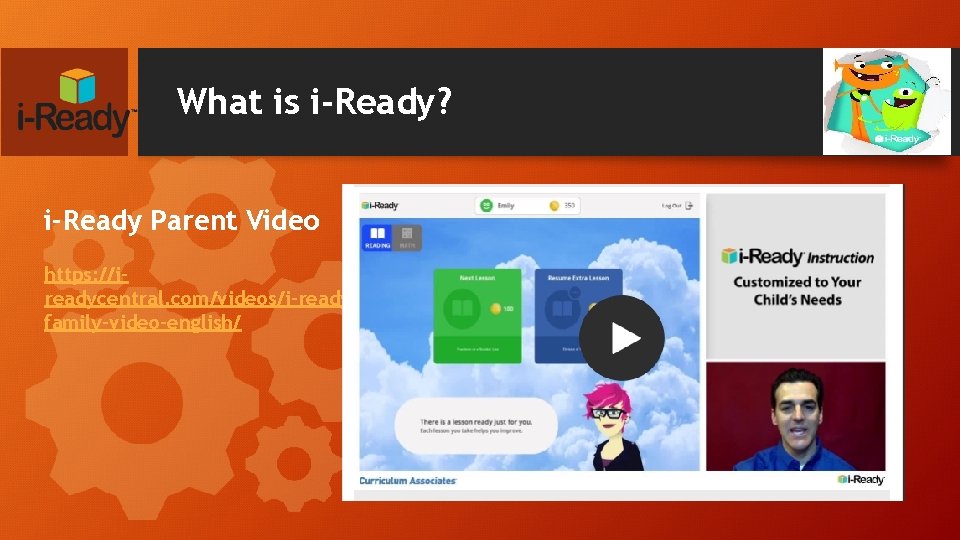
What is i-Ready? i-Ready Parent Video https: //ireadycentral. com/videos/i-readyfamily-video-english/
How will i-Ready help my child learn? • i-Ready gives teachers feedback on your child's strengths and areas for growth. • The results of the diagnostic will help your child’s teachers identify exactly where your child needs to develop, as well as where his or her strengths are. • Teachers can use this information to design instruction that meets the unique needs of your child. And because the diagnostic is taken a few times throughout the school year, your child’s teacher will be able to measure progress and growth over the course of the year.
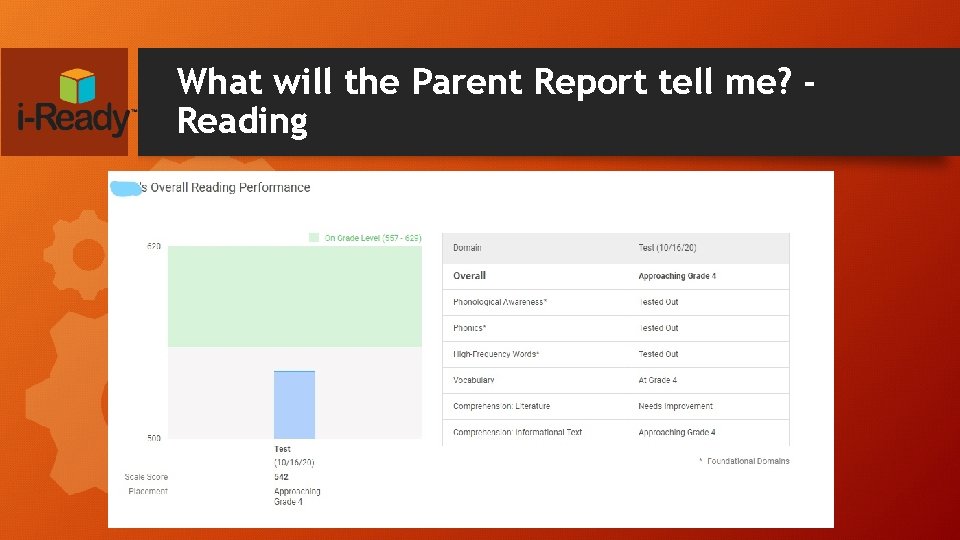
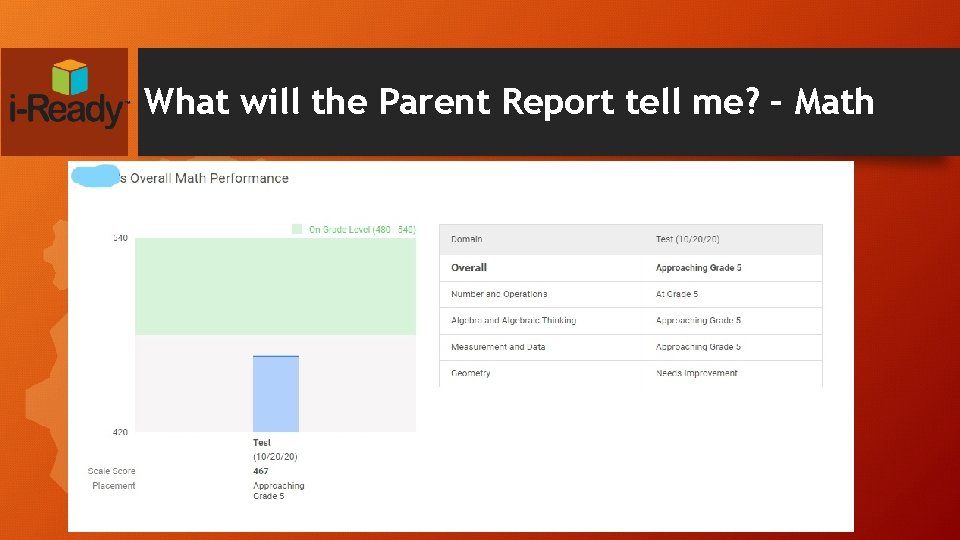
What is the i-Ready Parent Report? • This report tells you the score your child received on the diagnostic. It also tells you if the score is approaching grade level, on grade level, or above grade level. • It also describes each “domain, ” or area of learning, that the student was assessed in, along with the placement level in each domain. After each diagnostic, the Parent Report is updated, allowing you to compare progress throughout the year. • If you have any questions about the Parent Report, please contact your child’s teacher.
The Diagnostic Covers these Mathematics Domains: https: //i-readycentral. com/download/? res=16754&view_pdf=1 Numbers and Operations Numbers and operations in Grades K-8 refers to the mathematics skills often thought as arithmetic, from reading and writing numbers to adding, subtracting, and dividing different types of numbers. This includes whole numbers, decimals, fractions, integers, and irrational numbers. Algebra & Algebraic Thinking Algebra and Algebraic Thinking in Grades K-8 refers to mathematical skills related to seeing number patterns, understanding the meaning of addition, subtraction, multiplication, and division, and using symbols to write and solve equations including those used to solve word problems.
The Diagnostic Covers these Mathematics Domains: https: //i-readycentral. com/download/? res=16754&view_pdf=1 Measurement & Data is a wide range of math skills related to collecting, organizing, and interpreting numerical information, from telling time or using a ruler to measure length of an object, to using formulas to find volume or surface area. It also includes understanding tables and graphs, and in later grades, statistics and probability. Geometry refers to a variety of skills related to analyzing two-and three-dimensional shapes. These include naming and classifying shapes, using characteristics such as symmetry, number of sides, and angle measures, and in later grades, using congruence and similarity.
The Diagnostic Covers these Reading Domains: https: //i-readycentral. com/download/? res=16754&view_pdf=1 Phonological Awareness is the understanding that a spoken word is made up of different parts and that each of these parts makes a sound. For example, the word ‘bat’ includes the sounds /b/, /a/, and/t/ and the word ‘batter’ can be broken into two syllables that make the sounds /bat/ and /term/. Phonological Awareness is an important building block for Phonics. Readers need to be able to distinguish, or make out, the individual sounds in spoken words before they can fully master matching sounds to letter. High Frequency Words High-Frequency words are the words that appear most often in what children read. Words such as the, and it are high frequency words. Because these words appear so often, readers must learn to recognize them automatically. Also, these words are often spelled in ways that can be confusing. Words such as could and there do not follow the rules that connect sounds to letters in most words. Learning to recognize these words automatically helps students read more quickly and easily, which gives them a better opportunity to understand what they are reading.
The Diagnostic Covers these Reading Domains: https: //i-readycentral. com/download/? res=16754&view_pdf=1 Comprehensive: Literature describes a student’s ability to understand types of writing that are usually made up, or fictional. Stories are the literal texts that students read most often. Plays and poems are also examples of literary texts. A student who understands literature might identify the sequence of events in a story, discuss the meaning of a poem, or explain the lines a character speaks in a play. As a student develops as a reader, the student can understand stories, plays and poems that are increasingly complicated. Comprehension: Informational Text describes a student’s ability to understand types of writing that are usually true. Books about science or history are examples of informational text, as are newspaper or magazine articles. This kind of writing is often structured differently than literary texts. Informational text often does not tell a story, and it is usually organized into sections with headings. Additionally, it might contain charts, diagrams, and graphs that are important to understand. A student who understands informational text might identify the main idea and supporting details, describe the way the writing is organized, or draw information out of a photograph or diagram.
The Diagnostic Covers these Reading Domains: https: //i-readycentral. com/download/? res=16754&view_pdf=1 Phonics instruction teaches children how to connect the sounds they hear in spoken words to the letters they see in written words. For example, a student who can connect sounds to letters knows to read “th” in ‘then’ as a single sound /th/, rather than the sound /t/ and the sound /h/. Students must learn many different connections between sounds and spelling patterns. In fact, there are so many connections that learning Phonics can feel like learning the rules to understand a hidden code. This skill is mastered by taking one step at a time, learning one rule and then another, and so on. Once students can make these connections quickly and easily, they can really start to read for meaning.
The Diagnostic Covers these Reading Domains: https: //i-readycentral. com/download/? res=16754&view_pdf=1 Vocabulary is the name for the words a student knows. The more words a student knows, the easier it is to understand what the student needs. Good readers know the meanings of many words. Students grow their vocabularies by hearing and reading new words, talking, and being taught specific reading.
What will the Parent Report tell me? Reading
What will the Parent Report tell me? – Math
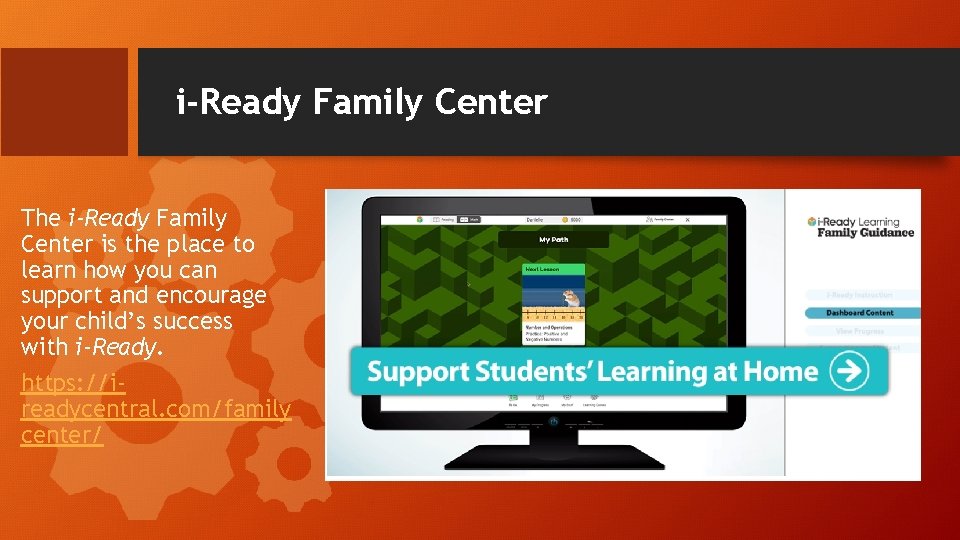
i-Ready Family Center The i-Ready Family Center is the place to learn how you can support and encourage your child’s success with i-Ready. https: //ireadycentral. com/family center/
Thank You!