
Shariah Review of Profit rate Swap Strategies in
- Slides: 15
Shariah Review of Profit rate Swap Strategies in Islamic financial institutions: The case of Malaysia
ABSTRACT As a growing financial industry, Islamic finance needs hedging tools. Islamic Profit Rate Swap (IPRS) is a contract designed as a hedging mechanism to minimize the risk of rate of return. According to Sami Al-Suwailem 97. 30% of derivatives products are being used for speculation. This research, aims to review from Shariah perspective , the legality of Islamic profit rate Swap as currently offered by many Islamic financial institutions in Malaysia.
OUTLINE Introduction Research Methodology Swap as a Risk Management tool Islamic profit rate swap Strategy Findings
RESEARCH METHODOLOGY Series of internal discussions with Shariah experts and operating officers from Malaysian Islamic financial institutions. Qualitative method of research: Inductive approach is adopted to abstract what has been written about IPRS theoretically and practically. It also adopts a deductive approach to derive legal provisions applied in derivative contracts from Quran and Sunnah.
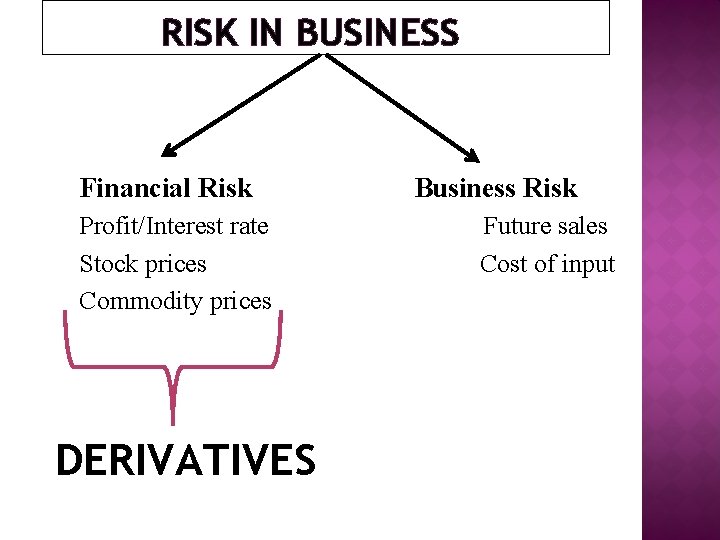
RISK IN BUSINESS Financial Risk Profit/Interest rate Stock prices Commodity prices DERIVATIVES Business Risk Future sales Cost of input
SWAP AS A RISK MANAGEMENT TOOL Swap is by nature a derivative product generally used for the purpose of hedging or mitigating risk faced by financial institutions. An Interest Rate Swap is an agreement to exchange interest rate cash flows, calculated on a notional principal amount, at specified intervals (payment dates) during the life of the agreement. Each party’s payment obligation is computed using a different interest rate. In an interest rate swap, the notional principal is never exchanged. Swap typically refers to a generic interest rate swap in which one party pays a fixed rate and another pays a floating rate.
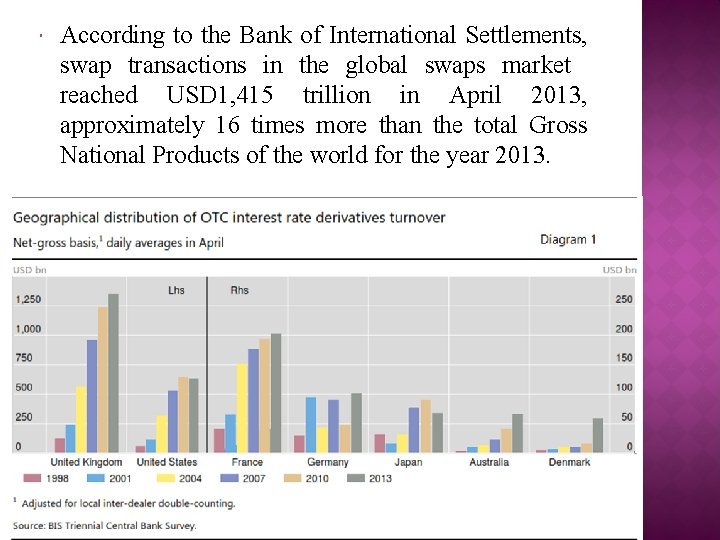
According to the Bank of International Settlements, swap transactions in the global swaps market reached USD 1, 415 trillion in April 2013, approximately 16 times more than the total Gross National Products of the world for the year 2013.
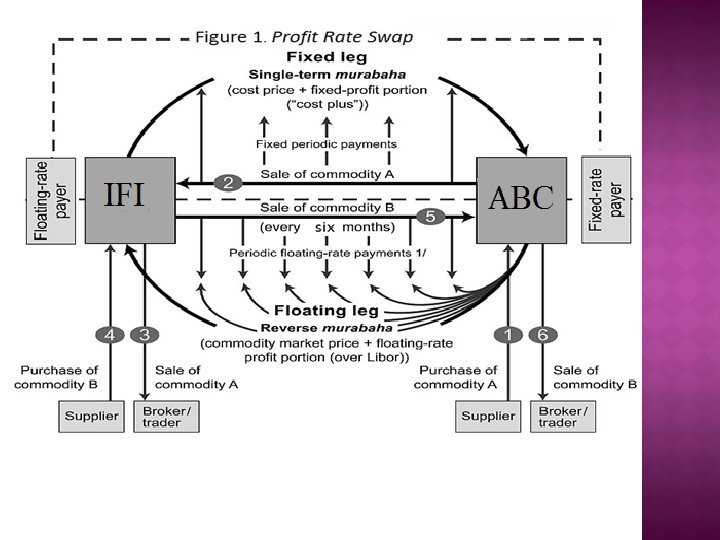
ISLAMIC PROFIT RATE SWAP An Islamic Profit Rate Swap is an agreement to exchange profit rates between a Fixed Rate Party and a Floating Rate Party or vice versa implemented through the execution of a series of Murabaha(sale of an asset with cost plus profit) contract. The notional principal is never exchanged as it is netted off. Swap typically refers to the difference in the price over and above the notional principal in which one party pays a fixed rate and another pays a floating rate.
OBJECTIVES OF IPRS To match funding rates with return rates (from investment); To achieve lower cost of funding; To restructure existing debt profile without raising new finance, or altering the structure of the balance sheet; To manage exposure to interest rate movement as Islamic financial institutions still compete with conventional banks for market space.
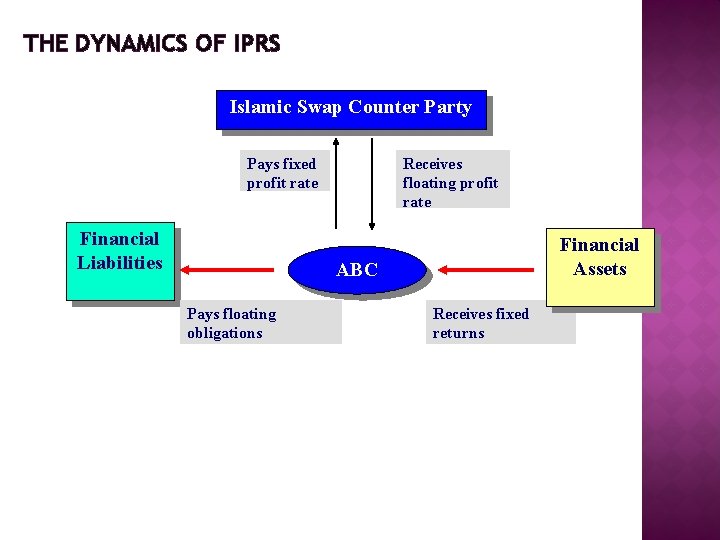
THE DYNAMICS OF IPRS Islamic Swap Counter Party Pays fixed profit rate Financial Liabilities Receives floating profit rate Financial Assets ABC Pays floating obligations Receives fixed returns Page 10
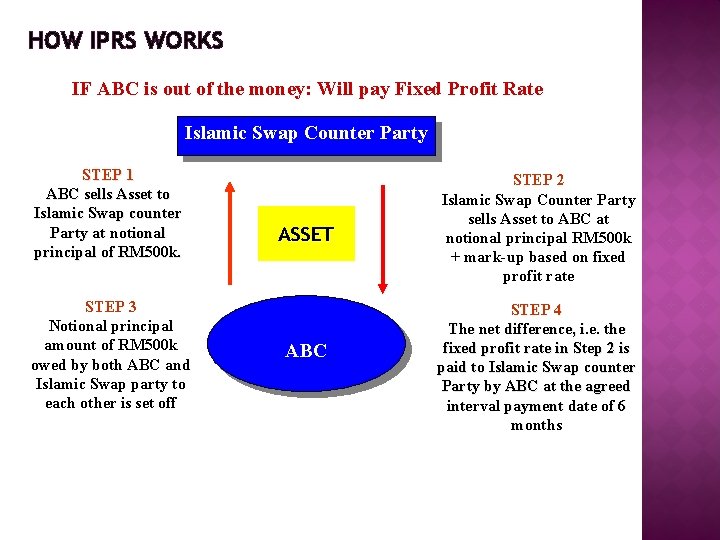
HOW IPRS WORKS IF ABC is out of the money: Will pay Fixed Profit Rate Islamic Swap Counter Party STEP 1 ABC sells Asset to Islamic Swap counter Party at notional principal of RM 500 k. STEP 3 Notional principal amount of RM 500 k owed by both ABC and Islamic Swap party to each other is set off ASSET ABC STEP 2 Islamic Swap Counter Party sells Asset to ABC at notional principal RM 500 k + mark-up based on fixed profit rate STEP 4 The net difference, i. e. the fixed profit rate in Step 2 is paid to Islamic Swap counter Party by ABC at the agreed interval payment date of 6 months Page 11
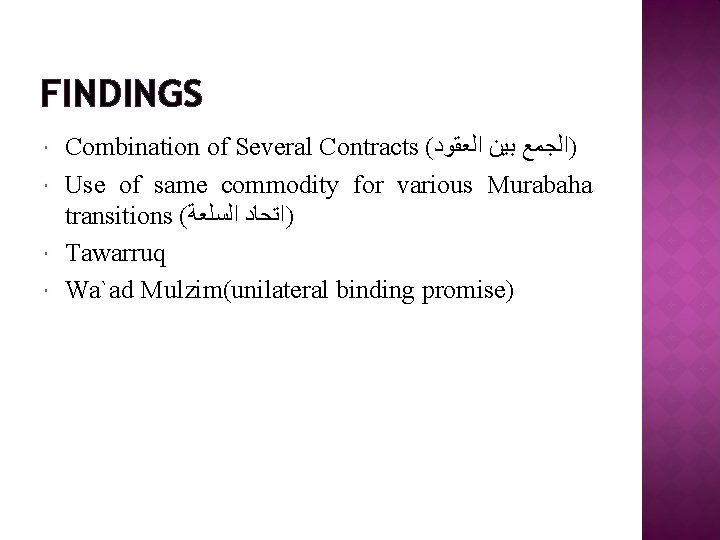
FINDINGS Combination of Several Contracts ( )ﺍﻟﺠﻤﻊ ﺑﻴﻦ ﺍﻟﻌﻘﻮﺩ Use of same commodity for various Murabaha transitions ( )ﺍﺗﺤﺎﺩ ﺍﻟﺴﻠﻌﺔ Tawarruq Wa`ad Mulzim(unilateral binding promise)
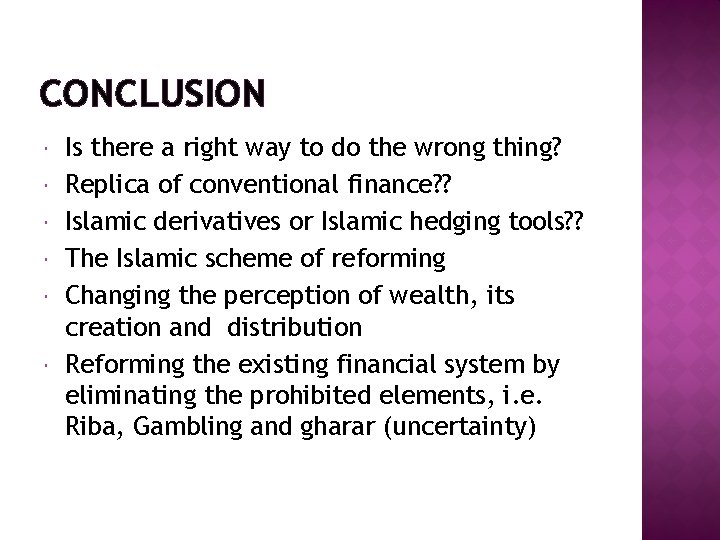
CONCLUSION Is there a right way to do the wrong thing? Replica of conventional finance? ? Islamic derivatives or Islamic hedging tools? ? The Islamic scheme of reforming Changing the perception of wealth, its creation and distribution Reforming the existing financial system by eliminating the prohibited elements, i. e. Riba, Gambling and gharar (uncertainty)