
Shared Path to Success Team KickOff Meeting Network
- Slides: 29
Shared Path to Success Team Kick-Off Meeting Network 603 The Special Education Kaleidoscope Team October 16, 2014 Deana Blake Safety Administrator Sirmati Persaud Administrator of Special Education Christa Tilson Administrator of Special Education Janet Vasquez Special Education Achievement Coach
Norms • Be present • Honor time • Establish a community of professionals • Employ a learning stance: • Active listening • Acceptance • Be respectful
The Major Points of the Reform Special education is a SERVICE not a place! • Keeping students in their neighborhood, zoned schools • Keeping students in Least Restrictive Environment • Offering the full Continuum of Services
The Continuum ------Non-SPECIAL EDUCATION – – – Strategies to maintain students in general education and to support achievement of standards Educationally Related Support Services, Reading Intervention/Remedial Instruction and Behavioral Support/Social Skills Program Declassification Support Services ----Referral for Special Education – – – General Education with Related Services General Education with Special Education Teacher Support Services Collaborative Team Teaching -----Special Class Services – – – General Education part time & Special class support part time in a community school Special class full time in Community school Special class full time in specialized schools State supported/operated schools and SED approved non public schools Home/ hospital/Instruction (temporary) Kaleidoscope
Seeks to align the work of the special education reform initiatives to the Citywide Instructional Expectations, with the goal of ensuring that all students graduate and are college and career ready by focusing of four key strands: 1. ACCESS -access to community schools, LRE, common core -aligned curriculum effective instruction 2. QUALITY IEPs- getting to know students well, strengthening school based IEP process, developing common core-aligned IEPs, appropriate services, 3. POSITIVE BEHAVIORAL SUPPORTS -implementing systems of support that foster positive school culture 4. TRANSITION PLANNING – ensuring students are on track to receive the highest diploma option possible, coordinated set of activities that will promote successful movement from school to post secondary life
What’s Up With All These Teams? • • Child Study Team I. E. P. Team Content Level Team Inquiry Team Transition Team RTI Team Behavior Team Grade Level Team
School Implementation Team School-based team with a sole focus on the implementation of the Special Education Reform initiatives focusing on the improvement of school-wide structures (instructional and operational) to support instruction for all students, ensure appropriate placement and related service mandates to promote achievement among students with disabilities (SWDs).
SIT Mission Statement • The SIT is the structure to facilitate the strategic planning and guidance necessary to ensure that your school community appropriately and adequately serves all students. • The SIT will align services and needs for each individual student with a disability.
SIT Vision • To continue to implement the Shared Path to Success • Ensure access to appropriate rigorous curriculum to prepare students with disabilities for College & Career Readiness, and independent living • Transition planning will be authentically implemented for all students with disabilities in planning for post-secondary life
Goals for 2014 -2015 • Ensure knowledge of the academic and personal behavior readiness of each student with a disability and use this knowledge to drive the creation of a high quality IEP that reflects rigorous expectations for SWDs in a Common Core aligned curriculum. • Review the Recommended Programs and Services of students within the school to ensure appropriate access to the individual student’s LRE, to the maximum extent possible (inclusive of flexible and part time programming). To this end, SITs will focus on the expansion of the continuum of services as necessary. • Continue the development of school-based structures to ensure that teachers and providers are professionally developed and adequately supported to ensure academic and social success for each student with a disability. • Engage families and, as appropriate, students as stakeholders in their education.
Getting Started SIT Meetings First Meeting • Establish norms, roles, and goals • Consider alignment to other initiatives/teams • Logistics- location and dates of meetings, agendas • Consider the use of protocols
Getting Started SIT Meetings Expectations • Meet twice a month • Developing and carrying out an appropriate and effective reform implementation plan specific to your school community. • Reviewing the IEPs of students to determine an alignment between the needs of student s and recommendations of services. • Expanding the current continuum of services the school offers in order to create alignment between the needs of students and the services specific to the school community. • Studying the special education population of the school throughout the year. This will include who the students are, progress monitoring for each student. • Create and implement a professional development plan for both GE and SPED teachers • Select a goal and work towards it » Action plan: Developing a Quality IEP
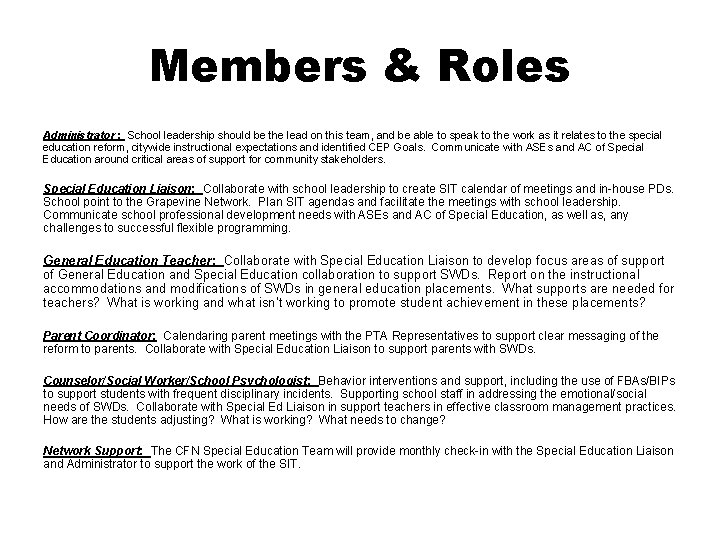
Members & Roles Administrator : School leadership should be the lead on this team, and be able to speak to the work as it relates to the special education reform, citywide instructional expectations and identified CEP Goals. Communicate with ASEs and AC of Special Education around critical areas of support for community stakeholders. Special Education Liaison: Collaborate with school leadership to create SIT calendar of meetings and in-house PDs. School point to the Grapevine Network. Plan SIT agendas and facilitate the meetings with school leadership. Communicate school professional development needs with ASEs and AC of Special Education, as well as, any challenges to successful flexible programming. General Education Teacher: Collaborate with Special Education Liaison to develop focus areas of support of General Education and Special Education collaboration to support SWDs. Report on the instructional accommodations and modifications of SWDs in general education placements. What supports are needed for teachers? What is working and what isn’t working to promote student achievement in these placements? Parent Coordinator: Calendaring parent meetings with the PTA Representatives to support clear messaging of the reform to parents. Collaborate with Special Education Liaison to support parents with SWDs. Counselor/Social Worker/School Psychologist: Behavior interventions and support, including the use of FBAs/BIPs to support students with frequent disciplinary incidents. Supporting school staff in addressing the emotional/social needs of SWDs. Collaborate with Special Ed Liaison in support teachers in effective classroom management practices. How are the students adjusting? What is working? What needs to change? Network Support: The CFN Special Education Team will provide monthly check-in with the Special Education Liaison and Administrator to support the work of the SIT.
IEP Development Present Levels of Performance The FOUNDATION of the IEP Provides the informational basis for generating goals, supports, and services that are specifically designed to meet the student’s individual needs and prepare him or her to meet post-secondary goals.
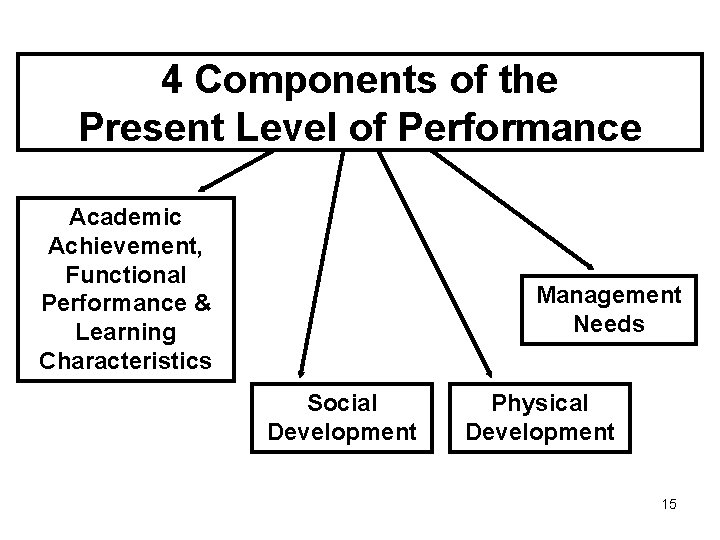
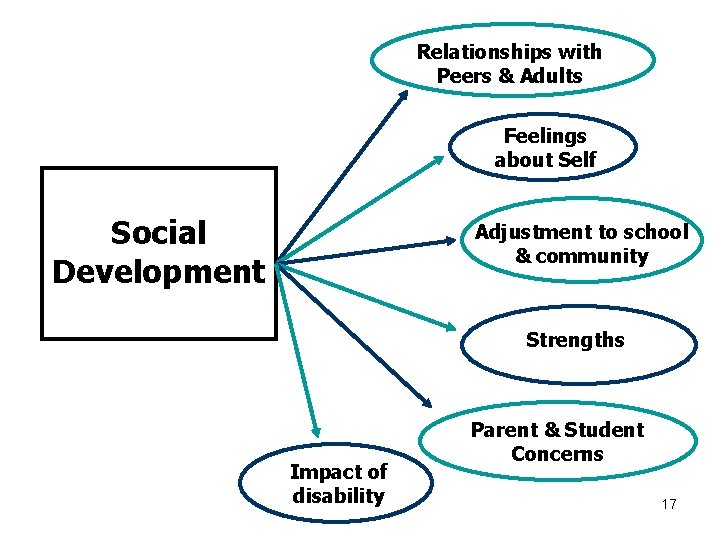
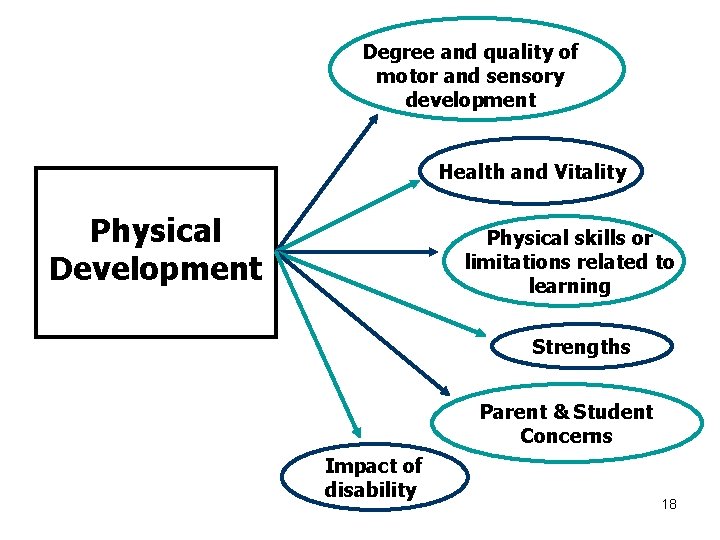
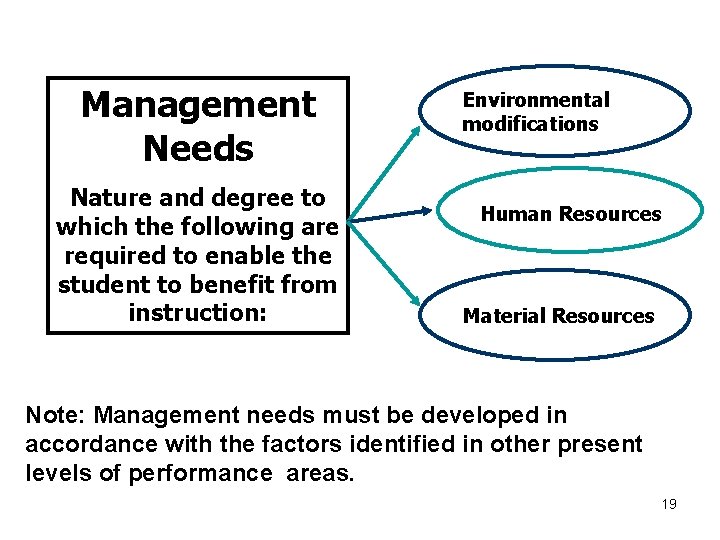
4 Components of the Present Level of Performance Academic Achievement, Functional Performance & Learning Characteristics Management Needs Social Development Physical Development 15
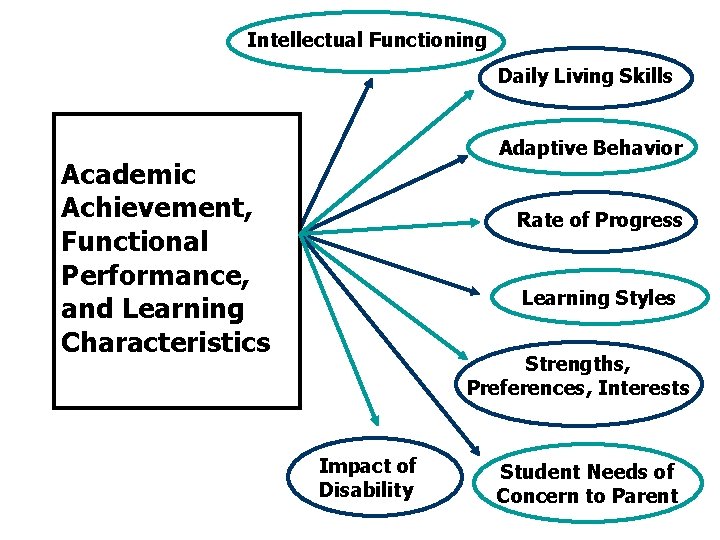
Intellectual Functioning Daily Living Skills Adaptive Behavior Academic Achievement, Functional Performance, and Learning Characteristics Rate of Progress Learning Styles Strengths, Preferences, Interests Impact of Disability Student Needs of Concern to Parent 16
Relationships with Peers & Adults Feelings about Self Social Development Adjustment to school & community Strengths Impact of disability Parent & Student Concerns 17
Degree and quality of motor and sensory development Health and Vitality Physical Development Physical skills or limitations related to learning Strengths Parent & Student Concerns Impact of disability 18
Management Needs Nature and degree to which the following are required to enable the student to benefit from instruction: Environmental modifications Human Resources Material Resources Note: Management needs must be developed in accordance with the factors identified in other present levels of performance areas. 19
Transition Services for School-Aged Students
Transition Services Defined as: A coordinated set of activities designed to be within a results-oriented process, that is focused on improving the academic and functional achievement of the child with a disability to facilitate the child’s movement from school to post-school activities… 21
The IEP Shall Include… • A statement of the transition service needs of the student that focuses on the student’s courses of study • Needed activities to facilitate the student’s movement from school to post-school activities… • A statement of the responsibilities of the school district, and, when applicable, participating agencies for the provision of such services and activities 22
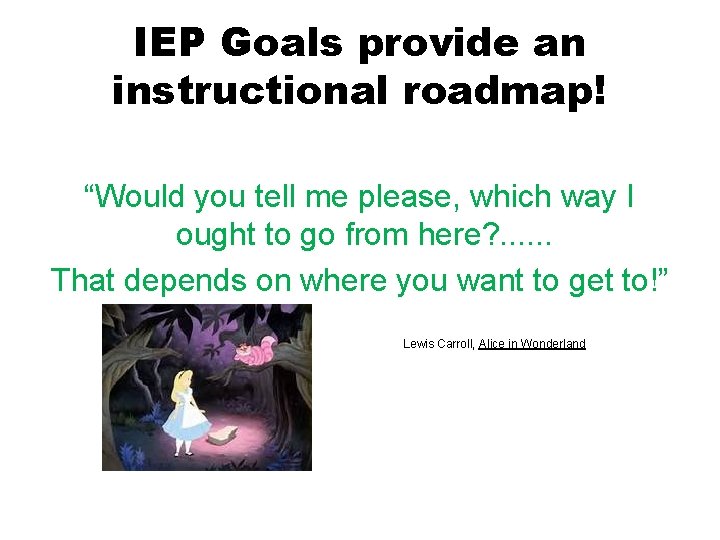
IEP Goals provide an instructional roadmap! “Would you tell me please, which way I ought to go from here? . . . That depends on where you want to get to!” Lewis Carroll, Alice in Wonderland
Annual Goal A statement that identifies what knowledge, skills or behaviors a student is expected to be able to demonstrate by the end of the year – Focus on knowledge, skills, behaviors and strategies to address the student’s needs as identified in the present level of performance 24
Measurable Post-Secondary Goals • Based on the student’s expressed interests and age-appropriate transition and vocational assessments • MPSGs are considered, along with the needs identified in the PLOP, when determining annual goals, services, and coordinated transition activities • Annual goals incrementally prepare the student to achieve his/her post-secondary goals 25
QUESTIONS AND ANSWERS Is it clear? ? 26
What’s Going on Your “To Do” List? • “I” time – reflect on the IEP development process and procedures reviewed • Note any specific “to do’s” 27
Action Plan All schools are being charged with submitting an action plan that will address their school’s efforts in strengthening the development of a Quality IEP. DUE: October 31 st
Action Plan Dependent upon the school’s needs, consider the following as areas of focus; please identify 2 -3 goals: • Provide training to all staff on quality IEP development, including, but not limited to Least Restrictive Environment, alignment of Present Levels, Goals and Recommendations • Development of school CSE (IEP Team) on procedural safeguards and school-based IEP systems and procedures • Establish a school based process for reviewing IEPs • Coach teachers on integration of CCLS in IEP goals, ensuring aligned lesson plans and progress monitoring systems • Support general education teachers on supporting SWDs in their appropriate Least Restrictive Environment • Create meaningful opportunities for parent engagement in the IEP process.