
Shared Memory UMA and NUMA Uniform memory access
- Slides: 13
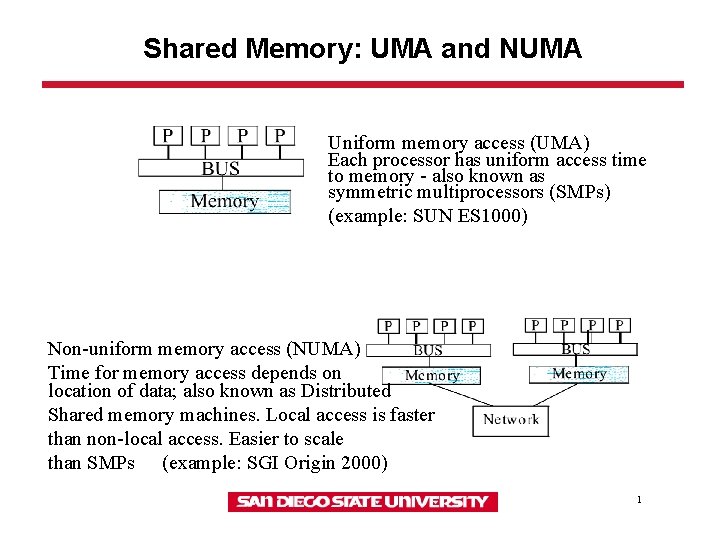
Shared Memory: UMA and NUMA Uniform memory access (UMA) Each processor has uniform access time to memory - also known as symmetric multiprocessors (SMPs) (example: SUN ES 1000) Non-uniform memory access (NUMA) Time for memory access depends on location of data; also known as Distributed Shared memory machines. Local access is faster than non-local access. Easier to scale than SMPs (example: SGI Origin 2000) 1
SMPs: Memory Access Problems • Conventional wisdom is that systems do not scale well – Bus based systems can become saturated – Fast large crossbars are expensive 2
SMPs: Memory Access Problems • Cache Coherence : When a processor modifies a shared variable in local cache, different processors have different value of the variable. Several mechanism have been developed for handling the cache coherence problem • Cache coherence problem – – Copies of a variable can be present in multiple caches A write by one processor may not become visible to others They'll keep accessing stale value in their caches Need to take actions to ensure visibility or cache coherence 3
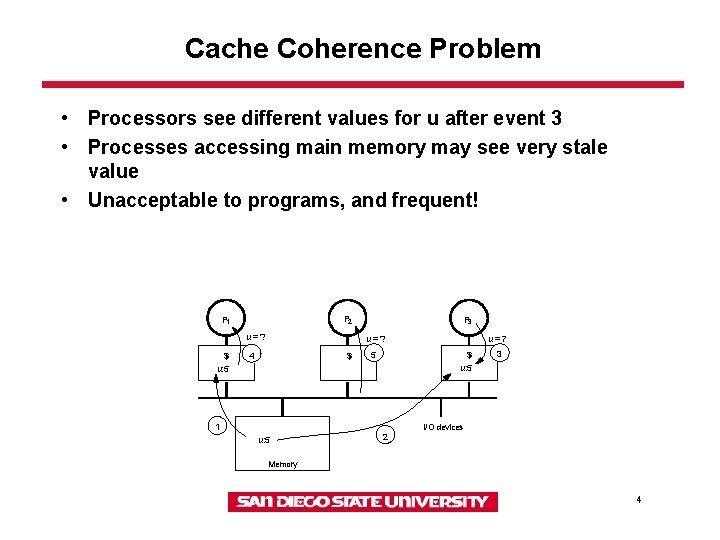
Cache Coherence Problem • Processors see different values for u after event 3 • Processes accessing main memory may see very stale value • Unacceptable to programs, and frequent! P 2 P 1 u=? $ u: 5 P 3 u=? 4 $ 1 u: 5 5 u=7 $ u: 5 2 3 I/O devices Memory 4
Snooping-Based Coherence • Basic idea: – Transactions on memory are visible to all processors – Processor or their representatives can snoop (monitor) bus and take action on relevant events • Implementation – When a processor writes a value a signal is sent over the bus – Signal is either • Write invalidate - tell others cached value is invalid and then update • Write broadcast/update - tell others the new value continuously as it is updated 5
SMP Machines • Various Suns such as the E 10000/HPC 10000 • Various Intel and Alpha servers • Crays: T 90, J 90, SV 1 6
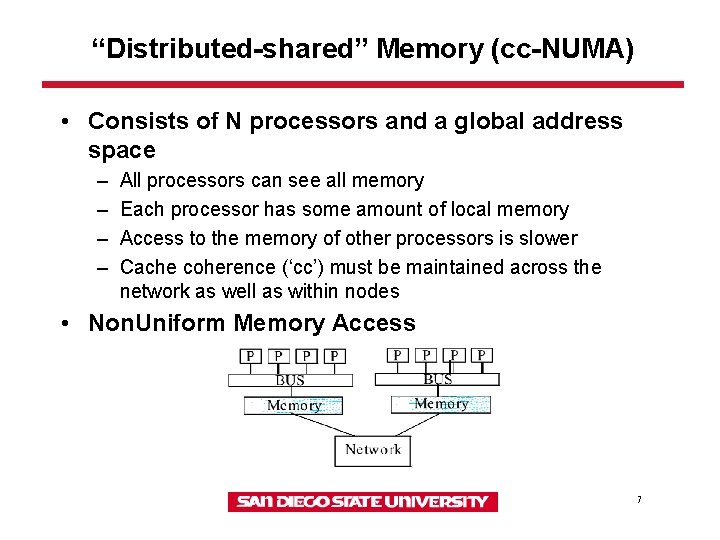
“Distributed-shared” Memory (cc-NUMA) • Consists of N processors and a global address space – – All processors can see all memory Each processor has some amount of local memory Access to the memory of other processors is slower Cache coherence (‘cc’) must be maintained across the network as well as within nodes • Non. Uniform Memory Access 7
cc-NUMA Memory Issues • Easier to build with same number of processors because of slower access to remote memory (crossbars/buses can be less expensive than if all processors are in an SMP box) • Possible to created much larger shared memory system than in SMP • Similar cache problems as SMPs, but coherence must be also enforced across network now! • Code writers should be aware of data distribution – Load balance – Minimize access of "far" memory 8
cc-NUMA Machines • SGI Origin 2000 • HP X 2000, V 2500 9
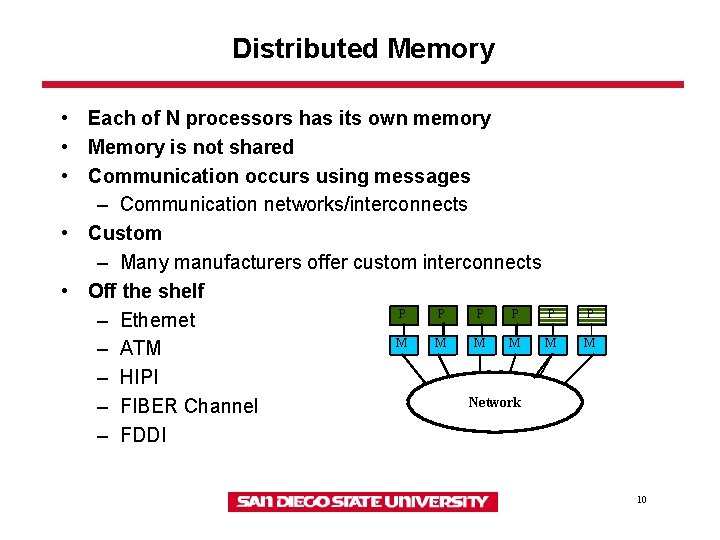
Distributed Memory • Each of N processors has its own memory • Memory is not shared • Communication occurs using messages – Communication networks/interconnects • Custom – Many manufacturers offer custom interconnects • Off the shelf P P P – Ethernet M M M – ATM – HIPI Network – FIBER Channel – FDDI P M 10
Types of Distributed Memory Machine Interconnects • Fully connected • Array and torus – Paragon – T 3 E • Crossbar – IBM SP – Sun HPC 10000 • Hypercube – Ncube • Fat Trees – Meiko CS-2 11
Multi-tiered/Hybrid Machines • Clustered SMP nodes (‘CLUMPS’): SMPs or even cc-NUMAs connected by an interconnect network • Examples systems – All new IBM SP – Sun HPC 10000 s using multiple nodes – SGI Origin 2000 s when linked together – HP Exemplar using multiple nodes – SGI SV 1 using multiple nodes 12
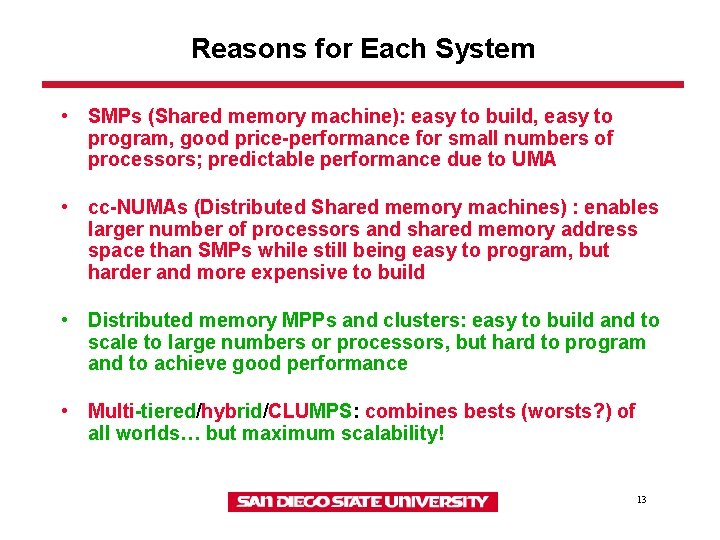
Reasons for Each System • SMPs (Shared memory machine): easy to build, easy to program, good price-performance for small numbers of processors; predictable performance due to UMA • cc-NUMAs (Distributed Shared memory machines) : enables larger number of processors and shared memory address space than SMPs while still being easy to program, but harder and more expensive to build • Distributed memory MPPs and clusters: easy to build and to scale to large numbers or processors, but hard to program and to achieve good performance • Multi-tiered/hybrid/CLUMPS: combines bests (worsts? ) of all worlds… but maximum scalability! 13